
Reporting a toxic boss to HR can feel like the moment when something finally changes.
You have spent weeks or months dealing with confusing instructions, unfair criticism, exclusion, credit problems, inappropriate behavior, or repeated conflict.
Eventually, you decide to report it.
Then another question appears:
What happens now?
Usually, HR will first acknowledge or assess the complaint and determine what workplace process applies. Depending on the situation, HR may gather documents, speak with you, interview your manager or coworkers, review workplace policies, assess the professional impact, and decide whether the issue should be resolved informally or through a formal process. The exact process varies by employer, workplace policy, jurisdiction, and the nature of the complaint.
That uncertainty can be difficult.
You may wonder whether your boss will find out immediately.
You may worry that coworkers will be interviewed.
You may wonder how long the investigation will take.
You may be afraid that your manager will suddenly start criticizing your performance.
You may also expect HR to tell you exactly what happened to the manager, only to discover that organizations may limit what they can share about another employee’s personnel matters.
Understanding the process can help you separate what you know from what you fear.
This article explains what can happen after you report a toxic boss to HR, what HR may investigate, what you should do during the process, what outcomes are possible, how to document what happens afterward, and what to do if the process does not produce the result you expected.
If you have not reported the problem yet, start with our guide on how to report workplace gaslighting to HR using facts, not labels.
Key Takeaways
- Reporting a toxic boss to HR does not always mean a formal investigation will immediately begin.
- HR may first assess what happened, which policy or process applies, and whether informal or formal action is appropriate.
- An investigation may involve documents, emails, meetings, interviews, witnesses, policies, performance records, and other relevant information.
- You may not be told every detail of what HR does with another employee because personnel information can be confidential.
- The strongest approach is to remain factual, responsive, professional, and consistent while the process is underway.
- Continue documenting significant events after the complaint, especially material changes to assignments, access, performance criticism, discipline, or treatment.
- Do not automatically label every negative event after a complaint as retaliation. Timing can matter, but the facts and applicable law determine whether legal protection applies.
- If HR does not resolve the problem, you may still have options such as clarification, review, appeal, another internal process, outside advice, transfer, or a carefully planned exit.
Important Legal and Process Note
This article provides general workplace information, not legal advice.
The process for reporting a manager can differ substantially between organizations and countries. A formal grievance procedure may have specific steps, deadlines, meeting rights, investigation standards, or appeal procedures.
For example, ACAS guidance explains that workplace investigations are intended to gather relevant information from all sides, establish what happened, and help determine what should happen next. Its guidance also notes that some investigations can be relatively simple while others may take several weeks depending on their complexity.
You can review the ACAS guidance on workplace investigations for more detail.
In the United States, additional legal protections may apply when a complaint involves discrimination or other legally protected activity. The U.S. Equal Employment Opportunity Commission explains that certain actions taken in response to protected activity can constitute unlawful retaliation.
You can review the EEOC guidance on retaliation for general information.
If your situation involves discrimination, harassment, retaliation, dismissal, whistleblowing, contractual rights, safety issues, or another serious employment matter, seek advice relevant to your jurisdiction.
What Usually Happens After You Report a Toxic Boss to HR?
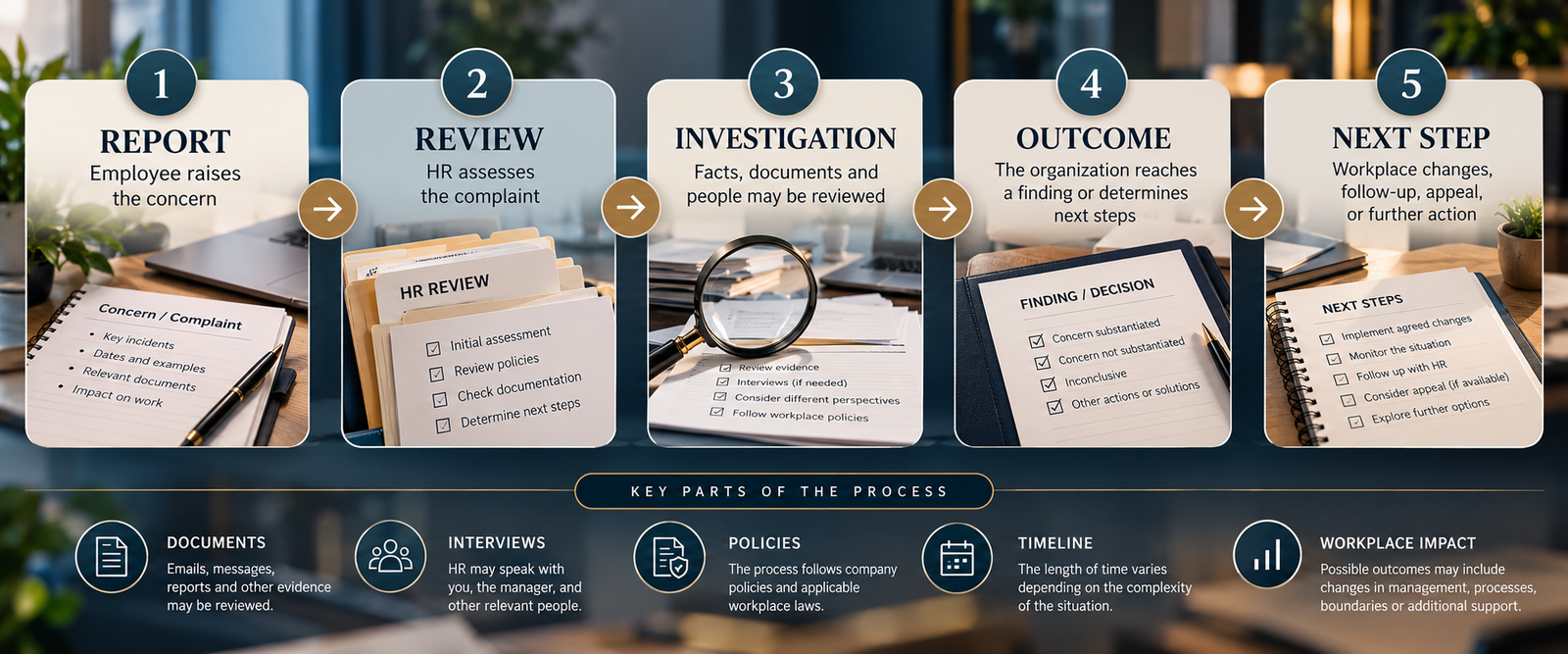
There is no single universal HR process.
But many workplace complaints follow a general sequence:
- HR receives the complaint.
- The concern is assessed.
- HR decides what process applies.
- Information and evidence may be gathered.
- Relevant people may be interviewed.
- The organization evaluates what happened.
- A decision or next step is determined.
- The workplace may implement corrective or preventive measures.
- You may need to continue monitoring what happens afterward.
These stages do not necessarily happen in exactly this order.
Some complaints may be handled informally.
Some may require a formal grievance or investigation.
Some may be referred to another department.
Some may involve immediate workplace measures while the facts are being reviewed.
The important point is that reporting is usually the beginning of a process, not the end of the problem.
1. HR May Acknowledge Your Complaint
The first thing that happens may be surprisingly simple.
HR may confirm that your complaint has been received.
You might receive:
- an email acknowledging the report
- a request for a meeting
- a request for additional information
- an explanation of the next step
- a request to submit the concern formally
- information about the relevant workplace policy
Do not interpret a short acknowledgment as evidence that HR does not care.
At this stage, you may not yet know who will handle the complaint or what process will apply.
Likewise, do not assume that a long response means the organization has already decided that your complaint is valid.
The initial stage is often about understanding what has been reported and deciding how it should be handled.
2. HR May Ask You to Explain What Happened
You may be invited to a meeting.
HR may ask questions such as:
- What happened?
- When did it happen?
- Who was involved?
- How often has this occurred?
- What was said or done?
- Do you have written records?
- Were there witnesses?
- What did you do when the problem occurred?
- Did you raise the concern previously?
- How has the situation affected your work?
- What outcome are you seeking?
This is where a calm chronology becomes extremely useful.
If you need to build one, see how to document workplace abuse calmly and clearly.
Do Not Feel You Have to Tell Your Entire Career Story
If you have experienced months of difficult interactions, you may feel that every incident is connected.
But HR may understand the problem more easily if you begin with the strongest examples.
For each important incident, explain:
- what happened
- when it happened
- what evidence exists
- who witnessed it
- what happened afterward
- how it affected your work
Three strong, organized examples can sometimes communicate a pattern more clearly than dozens of loosely connected complaints.
3. HR May Decide Whether the Complaint Is Informal or Formal
Not every workplace complaint becomes a formal investigation.
Some organizations have several ways to handle workplace concerns.
A problem may be:
- addressed through an informal conversation
- handled by a manager or senior manager
- referred to HR or employee relations
- handled under a grievance procedure
- investigated formally
- referred to another internal function such as compliance or ethics
The seriousness of the issue, workplace policy, the nature of the conduct, and the facts available can all affect the process.
ACAS similarly distinguishes informal problem-solving from formal grievance procedures and explains that formal grievances involve a defined process.
You can review the ACAS formal grievance procedure guidance as a general reference. Your own employer’s policy should take priority for your workplace process.
4. HR May Ask for Documents and Other Evidence

If HR investigates the concern, you may be asked for supporting information.
This could include:
- emails
- workplace messages
- calendar entries
- project records
- written instructions
- performance feedback
- meeting notes
- previous complaints or reports
- names of relevant witnesses
- your factual incident log
The purpose is not necessarily to collect everything you have ever saved.
HR usually needs information that helps establish what happened.
Build an Evidence Index
Instead of giving HR a huge unsorted collection of screenshots, create a simple index.
| Incident | Date | Record | What It Shows |
|---|---|---|---|
| Deadline changed | September 4 | Project email | Original deadline |
| Deadline disputed | September 8 | Meeting notes | Later statement about deadline |
| Clarification requested | September 8 | Follow-up email | Employee requested confirmation |
| Performance criticism | September 15 | Written feedback | Deadline later used in criticism |
This approach gives HR a map.
For a deeper explanation, see how to preserve workplace evidence without violating policy or privacy.
Do Not Assume You Can Copy Everything to a Personal Account
This is important.
Evidence may contain:
- confidential company information
- client information
- personal information about coworkers
- trade secrets
- financial information
- internal communications
Your ability to access a document at work does not automatically mean you are permitted to copy it to a personal account.
Do not respond to a workplace problem by downloading the entire company archive.
Preserve relevant information in a way that follows workplace policy and applicable law.
Our guide to preserving workplace evidence goes deeper into this distinction.
5. HR May Interview Your Manager
If your complaint concerns your boss, it is reasonable to expect that the manager may eventually be asked about the allegations.
That does not necessarily mean your manager will receive every detail exactly as you presented it.
The organization may need to give the person an opportunity to respond to relevant allegations.
Depending on the process, HR may ask the manager:
- what happened
- what instructions were given
- what decisions were made
- what performance concerns exist
- who else was involved
- what records support their account
- what they believe should happen next
This can feel frightening.
You may think:
“Now my boss knows I reported them. What are they going to do?”
That is exactly why professional discipline during the process matters.
Do not begin a campaign to convince coworkers that your version is correct.
Do not confront your manager about what you assume HR told them.
Continue communicating about legitimate work.
Keep important instructions clear.
Document significant developments.
6. HR May Interview Coworkers or Other Witnesses
If other people directly witnessed relevant events, HR may speak with them.
For example, if you report:
“My manager publicly told the team that I had missed a deadline even though the written project schedule showed a different deadline,”
HR may want to understand:
- who attended the meeting
- what was said
- whether the deadline was discussed previously
- whether other employees received the same instruction
- whether the meeting produced any records
Do Not Coach Witnesses
If coworkers witnessed relevant events, provide their names when appropriate.
But do not tell them:
- what they should say
- what they should remember
- what conclusion they should reach
- that they need to support your side
Independent information is more useful than coordinated stories.
Your goal is not to build a team against your manager.
Your goal is to make the facts reviewable.
7. HR May Review Workplace Policies
One of the biggest misunderstandings about HR complaints is the assumption that HR is simply deciding:
“Who is the good person and who is the bad person?”
That is usually not a useful way to think about the process.
HR may need to determine whether the reported conduct falls under a particular workplace policy.
For example:
| Reported Problem | Possible Policy or Process Area |
|---|---|
| Harassment | Anti-harassment policy |
| Discrimination | Equal opportunity / anti-discrimination process |
| Threatening conduct | Workplace conduct or safety policy |
| Repeated bullying | Respectful workplace or bullying policy |
| Retaliation concern | Retaliation or protected activity process |
| Changing responsibilities | Management / performance / role process |
| Credit disputes | Management, performance, or workplace conduct issue |
| General conflict | Conflict-resolution or management process |
This is one reason labels such as “narcissist,” “gaslighter,” or “toxic person” may not be enough.
HR needs to understand the conduct itself.
If your concern involves gaslighting specifically, see How to Report Workplace Gaslighting to HR Using Facts, Not Labels.
8. HR May Ask What You Want to Happen
You may be asked what outcome you are seeking.
You do not necessarily need to demand that your boss be fired.
Your requested outcome might be:
- clarification of responsibilities
- a different reporting arrangement
- clear written expectations
- an end to specific conduct
- appropriate meeting access
- correction of an inaccurate performance record
- protection from further inappropriate conduct
- mediation where appropriate
- information about the formal grievance process
Think carefully about what would actually improve the working situation.
For example:
“I would like the project approval process and reporting responsibilities clarified in writing so that future deadlines and accountability are clear.”
That may be more useful than:
“I want HR to prove that my boss is a narcissist.”
9. You May Be Asked to Participate in More Than One Meeting
Do not assume that your first meeting with HR will be the last.
You may have:
- an initial intake meeting
- a formal grievance meeting
- a follow-up fact-finding meeting
- a meeting to clarify evidence
- a meeting about workplace arrangements
- a meeting to discuss the outcome
If important information is discussed verbally, you can use a concise follow-up email after a difficult verbal conversation to confirm your understanding.
For example:
“Thank you for meeting with me today. My understanding is that HR will review the incidents I submitted, speak with the relevant individuals where appropriate, and update me regarding the next step. Please let me know if I have misunderstood the process.”
This does not mean HR has agreed with your account.
It simply creates a clearer record of what you understood.
10. The Investigation May Take Time
This is one of the hardest parts for employees.
You reported the problem.
You want an answer.
But a fair investigation may require time.
HR may need to:
- review multiple documents
- interview several people
- compare conflicting accounts
- review workplace policies
- check performance records
- verify project timelines
- investigate related incidents
- determine what information can be shared
ACAS notes that some workplace investigations can be simple while more complicated investigations may take several weeks.
The important point is that there is no universal number of days that applies to every HR complaint.
Your organization’s policy may provide its own expectations.
What If HR Does Not Give You Updates?
You can ask professionally.
“I wanted to follow up regarding the workplace concern I raised on September 10. Could you please let me know whether there is an update on the process or whether you need any additional information from me?”
You do not need to write:
“Why is HR ignoring me?”
Keep the follow-up factual.
11. HR May Take Temporary Workplace Measures
In some situations, the organization may make temporary changes while a concern is being reviewed.
Depending on the circumstances, this could involve:
- changing reporting arrangements
- adjusting schedules
- changing meeting arrangements
- limiting direct contact temporarily
- assigning another manager to certain decisions
- making other temporary workplace adjustments
A temporary measure does not necessarily mean HR has decided who is right or wrong.
It may simply be intended to keep the workplace functioning while information is gathered.
Similarly, the absence of temporary measures does not automatically mean HR has rejected your complaint.
Different situations require different responses.
12. Your Boss May Change Their Behavior After the Complaint
This is one of the most important things to understand.
After your boss learns about the complaint, their behavior may change.
They may become:
- more formal
- more careful
- more distant
- more communicative
- more critical
- more focused on documentation
Any of these changes can have different explanations.
Do not automatically interpret every change as retaliation.
Instead, watch for material developments.
For example:
| Less Useful Interpretation | More Useful Record |
|---|---|
| “My boss hates me now.” | “My manager removed me from the weekly client meeting on October 3.” |
| “They are definitely retaliating.” | “My responsibilities changed on October 7, three weeks after my complaint.” |
| “They are trying to destroy my career.” | “A new performance concern appeared in writing that had not appeared in the previous review.” |
The second column gives you something that can actually be reviewed.
13. What Counts as Retaliation?
The word retaliation is often used broadly in everyday workplace conversations.
Legally, however, retaliation depends on the type of complaint, the protected activity involved, and the law that applies.
For example, in the United States, the EEOC explains that certain employment actions taken because someone engaged in protected activity involving employment discrimination can be unlawful retaliation.
Those protections can include situations involving reporting discrimination, participating in an investigation, or opposing unlawful discrimination.
But a general complaint that a manager is difficult, unfair, rude, or toxic does not automatically create the same legal protection.
That distinction matters.
Regardless of the legal terminology, document significant post-complaint changes.
Watch for Material Changes
- assignments removed
- responsibilities substantially changed
- access withdrawn
- new disciplinary action
- significant performance criticism
- hours or schedule changed
- important meetings removed
- promotion opportunities withdrawn
- new threats concerning employment
- negative claims about you appearing in formal records
Do not turn every uncomfortable interaction into evidence.
A manager looking annoyed is not the same as a documented change in your job responsibilities.
Chronology matters.
For more detail about the post-complaint period, see What to Do When HR Sides With Your Manager.
14. HR May Keep Some Information Confidential
This is another common source of frustration.
You may expect HR to tell you:
“We interviewed your manager, and here is exactly what they said.”
You may not receive that level of detail.
Workplace investigations can involve private information about employees, witnesses, performance records, and personnel decisions.
Confidentiality also has practical limits.
An organization may need to share enough information with relevant people to investigate the complaint fairly.
That means:
Confidential does not always mean completely secret.
Do not assume that because you are not given every investigative detail, nothing happened.
Instead, ask what information HR can reasonably provide about:
- the status of the complaint
- the process being followed
- your responsibilities
- any changes you need to follow
- how future concerns should be reported
15. HR May Find That the Conduct Happened but Does Not Violate a Policy
This can be confusing.
Suppose you report:
“My manager repeatedly speaks to me in a dismissive way and excludes me from conversations.”
HR may conclude that some of the behavior occurred but does not meet the organization’s definition of prohibited conduct.
That does not necessarily mean:
“Nothing happened.”
It may mean:
“The organization did not find that the conduct violated the specific policy being considered.”
Those are different conclusions.
This distinction is particularly important when your concern is described using psychological language such as “narcissistic abuse,” “gaslighting,” or “manipulation.”
HR may not use those terms.
The practical question is whether the underlying workplace behavior was reviewed and whether anything needs to change.
16. HR May Call It a Communication Problem
This can be frustrating.
You may believe you have identified a much larger pattern.
HR may describe it as:
- communication difficulties
- personality conflict
- management style differences
- misunderstanding
- unclear expectations
Before concluding that HR ignored you, ask what practical changes follow from that finding.
For example:
“If the issue is being treated as a communication problem, can we establish a process where important deadlines, responsibilities and changes in instructions are confirmed in writing?”
Or:
“Can future performance concerns be accompanied by specific examples and the expected standard?”
You may not receive the label you expected.
You may still receive a safeguard that makes the workplace more workable.
This approach is consistent with the existing Reclaim Your Power guidance on boundaries: focus on the operational issue rather than trying to win an argument about another person’s personality.
For more practical scripts, see how to set boundaries with a manipulative boss professionally.
17. What If HR Starts Asking About Your Performance?
This can be alarming.
You report your manager.
Then suddenly someone asks about your performance.
It is tempting to conclude:
“They are building a case against me.”
Maybe.
But it is also possible that the organization has legitimate performance concerns that are separate from your complaint.
Two things can be true at the same time:
- you may have a legitimate workplace concern
- your employer may have legitimate concerns about some part of your performance
Do not automatically combine them.
Keep Two Tracks
Track A — Your complaint:
- What did you report?
- What evidence supports it?
- What did HR do?
- What outcome was reached?
Track B — Performance:
- What specific concern is being raised?
- When did it first appear?
- What examples support it?
- What standard applies?
- What improvement is expected?
This separation makes your record much stronger.
If responsibility is being repeatedly rewritten after problems occur, see blame-shifting at work.
18. What If Your Boss Suddenly Becomes Very Formal?
Sometimes an employee expects the manager to become openly hostile.
Instead, the manager becomes extremely formal.
Every message is now written.
Every meeting has notes.
Every instruction is carefully documented.
This can feel suspicious.
But formal communication is not automatically a bad sign.
In fact, structured communication may make your work easier to manage.
Do not resist legitimate professional documentation simply because the relationship has changed.
Use the same approach yourself:
- be brief
- be factual
- answer legitimate questions
- confirm important decisions
- avoid unnecessary emotional arguments
- keep the work moving
This is similar to the principle discussed in our gray rock method at work guide: workplace neutrality should not mean becoming unresponsive. The safer goal is usually calm, factual, complete communication.
19. What If Your Boss Tries to Pull You Into an Argument?
After a complaint, you may encounter statements such as:
“So now you are reporting everything I do?”
Or:
“You are trying to make me look bad.”
Or:
“You clearly do not trust me anymore.”
You do not need to defend your entire personality.
You can redirect the conversation:
“I want to keep our communication focused on the work. If there is a specific issue with my performance or responsibilities, please let me know.”
Or:
“I am happy to discuss the project requirements. Please let me know what needs to change.”
If the interaction becomes a repeated denial, attack, and reversal of the original issue, see our guide to DARVO at work.
20. What If Your Boss Starts Blaming You After You Report?
Watch the chronology.
Suppose you report that your manager repeatedly changed deadlines.
Shortly afterward, the manager says:
“The real problem is that you are incompetent.”
That statement may or may not be related to the complaint.
Do not automatically label it retaliation.
Record:
- what you originally reported
- when you reported it
- what evidence you provided
- what happened afterward
- what new criticism appeared
- what specific examples were provided
- what standard you were told to meet
If the focus repeatedly shifts away from the original issue and toward attacking your credibility or character, compare the sequence with DARVO at work and blame-shifting at work.
21. Continue Doing Your Job Carefully
This may be the least dramatic advice in the article.
It is also one of the most important.
While an HR complaint is being reviewed, continue to:
- perform your legitimate responsibilities
- meet reasonable deadlines
- ask for clarification when necessary
- follow workplace policies
- respond to legitimate work communication
- confirm important changes in writing
- keep professional communication calm
Do not deliberately become difficult because you believe the complaint protects you from normal accountability.
It does not.
Likewise, do not deliberately overwork yourself because you are afraid that one mistake will destroy your case.
A healthy goal is simply to keep your professional record accurate.
22. Continue Documenting After You Report
Your documentation should not necessarily stop once HR receives your complaint.
The post-report period can become an important part of the chronology.
Record significant events such as:
- HR meetings
- manager meetings
- changes in responsibilities
- new instructions
- new performance criticism
- disciplinary action
- meeting exclusions
- changes in access
- new opportunities or opportunities withdrawn
- changes to reporting arrangements
Use your workplace incident log to keep material events organized.
Do not record every ordinary interaction as evidence.
Your record should help you identify meaningful changes rather than turn the entire workplace into a surveillance project.
23. What Happens After the Investigation?
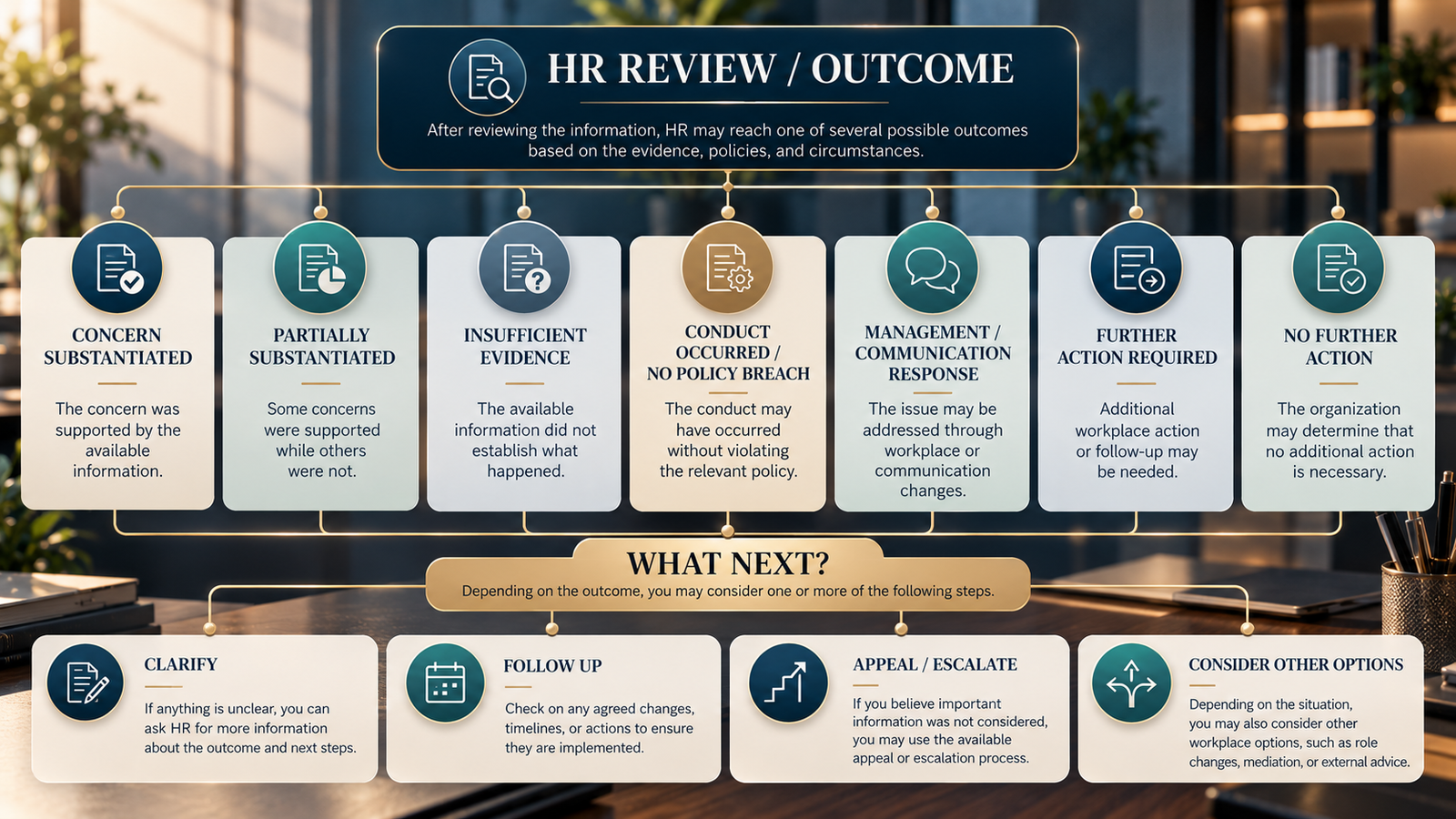
The possible outcomes vary.
HR or the organization may conclude that:
- the concern is substantiated
- some parts are substantiated and others are not
- there is insufficient evidence to establish what happened
- the conduct occurred but did not breach the relevant policy
- the issue is better handled through management or communication changes
- further action is required
- no further action is necessary
These outcomes are not interchangeable.
For example:
“We could not establish what happened.”
is different from:
“We established that the conduct occurred but found that it did not violate this policy.”
And both are different from:
“The investigation found that the manager’s account was supported by the available records.”
If HR gives you an unfavorable outcome, do not immediately assume the entire process was worthless.
First understand exactly what was decided.
Our dedicated guide explains what to do when HR sides with your manager.
24. What If HR Says There Is Not Enough Evidence?
This is one of the hardest outcomes to hear.
But ask what “not enough evidence” actually means.
You can ask:
- Which part of the complaint could not be established?
- What evidence was reviewed?
- Were the relevant witnesses considered?
- Were the written records reviewed?
- Was there conflicting evidence?
- Can additional information be submitted?
- Does the organization have a review or appeal process?
Do not automatically interpret “insufficient evidence” as:
“HR thinks I am lying.”
It may simply mean that the available information did not allow the organization to reach the conclusion you wanted.
If HR’s decision appears to have overlooked important evidence or the applicable process was not followed, the next step may be review or appeal, depending on your workplace policy.
For a detailed discussion, see What to Do When HR Sides With Your Manager.
25. What If HR Says Your Complaint Is Just a Communication Problem?
You can ask what practical change will follow from that conclusion.
For example:
“If the issue is considered a communication problem, can we agree that future deadlines and material changes to my responsibilities will be confirmed through the project system?”
Or:
“Can future performance concerns be provided with specific examples and the expected standard?”
This approach converts a vague conclusion into an operational improvement.
You may not get the label you wanted.
You may still get something useful.
26. What If HR Sides With Your Manager?
This deserves its own separate article because the next steps can become complicated.
If HR rejects your complaint, says there is insufficient evidence, or reaches a conclusion you believe is wrong, start by obtaining the outcome and reasons in writing where possible.
Then ask:
- What exactly did HR decide?
- Which incidents were addressed?
- What evidence was considered?
- Was relevant evidence overlooked?
- Was the correct workplace policy applied?
- Is there an appeal or review process?
- Has the underlying behavior actually stopped?
Do not immediately send an angry message accusing HR of protecting your boss.
Review the process first.
Then decide whether clarification, appeal, another internal route, outside advice, transfer, or an exit plan makes sense.
For the complete step-by-step response, read What to Do When HR Sides With Your Manager.
27. What If HR Does Nothing?
“HR did nothing” can describe several different situations.
Perhaps the complaint was not formally recorded.
Perhaps HR reviewed it but decided no policy violation occurred.
Perhaps the organization is still investigating.
Perhaps the organization addressed the problem informally.
Perhaps the process was poorly handled.
Before deciding that nothing happened, identify:
- what you reported
- when you reported it
- who received it
- what process was explained
- what action was promised
- what actually happened
If you still need an update, ask directly:
“Could you please confirm the current status of the concern I raised on September 12 and whether there are any next steps required from me?”
If internal processes are exhausted and the problem continues, the question may eventually become less about getting HR to agree with you and more about whether the workplace remains workable.
28. What If the Story Turns Against You After Reporting?
Sometimes the original complaint can gradually disappear from the conversation.
You report:
“My manager changed the deadline and then blamed me for missing it.”
Later, the conversation becomes:
“The real issue is that you are difficult and defensive.”
Those are separate issues.
Your communication style can legitimately be discussed.
But that does not automatically erase the original concern.
Keep two records:
Track A — The Original Complaint
- What happened?
- What evidence exists?
- What did HR decide?
Track B — New Performance or Conduct Concerns
- What new concern was raised?
- When?
- What examples were provided?
- What standard applies?
- What improvement is expected?
This prevents the original issue and the new issue from being blended into one confusing story.
If the pattern involves denial, attack, and reversal, see DARVO at work.
29. Protect Your Reputation While the Process Is Happening
An HR complaint can become a difficult social situation.
You may wonder whether coworkers know.
You may hear rumors.
You may notice people behaving differently.
Resist the temptation to explain everything to everyone.
Instead:
- continue doing your work
- communicate directly
- avoid gossip
- do not recruit coworkers into sides
- correct important factual inaccuracies when necessary
- keep your professional achievements visible
If the situation develops into repeated reputation attacks or false stories being spread about you, see Workplace Smear Campaigns: Signs, Risks, and Calm Damage Control.
30. Do Not Turn the HR Process Into a Second Workplace Conflict
Once you report a problem, it can be tempting to monitor every interaction.
Every email feels important.
Every facial expression feels meaningful.
Every conversation sounds like it might be connected to the complaint.
That can make an already difficult situation harder to manage.
Use a simple rule:
Document material events, not every uncomfortable moment.
If something changes your work, responsibilities, access, performance record, reputation, or employment position, document it.
If someone simply seems less friendly one afternoon, you may not need an incident report.
This distinction also appears throughout our documentation guidance: the purpose of a record is to create clarity, not to turn your workplace into a secret investigation.
31. What You Should Do During an HR Investigation
A practical checklist is:
- Keep your communication professional.
- Answer legitimate HR questions honestly.
- Provide relevant evidence in an organized way.
- Do not exaggerate uncertain details.
- Distinguish firsthand knowledge from things you heard from others.
- Do not coach witnesses.
- Continue performing legitimate work responsibilities.
- Confirm important instructions in writing.
- Document significant developments.
- Follow applicable workplace policies.
- Keep the complaint and your ordinary work responsibilities as separate as possible.
32. What You Should Not Do After Reporting Your Boss
A complaint does not make every reaction safe or useful.
Avoid:
- sending angry messages to your manager
- publicly accusing your boss of being a narcissist
- telling coworkers that HR is investigating them
- asking coworkers to “back up your story”
- creating a counter-rumor campaign
- withholding information from your manager or coworkers unnecessarily
- ignoring legitimate work instructions
- secretly copying confidential company information
- editing original evidence
- making accusations about motives you cannot establish
- assuming every negative event proves retaliation
- threatening HR or your manager with publicity
- resigning impulsively solely because the process feels uncomfortable
Self-protection should reduce professional risk, not create new problems.
33. Use Calm, Low-Reactivity Communication
You do not need to become emotionally invisible.
You do need to remain professional.
If your manager tries to provoke an argument, you can redirect:
“I am happy to discuss the specific work issue. What decision do you need from me?”
If they make a broad accusation:
“Can you give me the specific example you are referring to?”
If they challenge your professionalism:
“I want to make sure my communication is appropriate. Please tell me the specific behavior you want me to change.”
If you need a broader communication framework, see The Gray Rock Method at Work: Uses, Risks, and Safer Alternatives.
Remember that workplace gray rock should not mean ignoring legitimate work communication.
34. When Should You Ask for a Written Outcome?
If the HR process concludes with a verbal discussion, you may want to understand whether a written outcome is available.
You can ask:
“Thank you for meeting with me today. Could you please provide the outcome and any next steps in writing so I can make sure I understand the decision accurately?”
If a detailed report cannot be provided, you can still confirm your understanding:
“My understanding from today’s discussion is that the concern was not substantiated because the available information was insufficient to establish the disputed events. Please let me know if I have misunderstood the outcome.”
Do not write:
“I am putting this in writing because HR is protecting my boss.”
The first approach preserves clarity.
The second creates a new accusation.
For more guidance on unfavorable HR outcomes, read What to Do When HR Sides With Your Manager.
35. When an HR Complaint Leads to Better Boundaries
Not every successful workplace complaint ends with someone being disciplined.
Sometimes the most useful outcome is a change in how the work is managed.
For example:
- deadlines are now documented
- responsibilities are clarified
- approval authority is defined
- meetings include the appropriate people
- performance expectations become specific
- communication is routed through a formal system
- future concerns have a clearer reporting path
This can be a meaningful improvement even if the organization never uses the word “toxic.”
The goal is not necessarily to win a psychological argument.
The goal is a workable professional environment.
36. When the Complaint Changes Nothing
Sometimes you report a problem and the underlying behavior continues.
At that point, ask a different set of questions.
- Can I still perform my job effectively?
- Has my professional reputation remained intact?
- Are my responsibilities clear?
- Are reasonable boundaries respected?
- Is there another internal reporting route?
- Is an appeal available?
- Would a transfer help?
- Do I need independent advice?
- Should I begin preparing a career exit?
This is where protection becomes bigger than the HR complaint itself.
Your career should not depend entirely on whether one internal process gives you the outcome you hoped for.
37. When Should You Consider Going Above HR?
Do not automatically email every senior executive in the company.
First identify whether your organization has another designated process.
Depending on the workplace, this could include:
- formal grievance appeal
- senior HR leadership
- employee relations
- ethics or compliance channel
- whistleblowing channel where applicable
- higher-level management
- union representative
- ombuds function
If you escalate, explain:
- what you originally reported
- what process occurred
- what outcome was reached
- why you believe further review is justified
- what evidence supports that request
- what outcome you are seeking
Structured escalation is usually more credible than simply increasing the emotional intensity of the complaint.
38. When External Advice May Be Worth Considering
HR is an internal workplace function.
It is not necessarily your personal legal representative.
Independent advice may become particularly important if you are dealing with:
- possible discrimination
- legally protected retaliation
- termination or threatened termination
- formal disciplinary action
- significant contractual disputes
- protected whistleblowing
- serious safety concerns
- substantial financial consequences
- questions about preserving sensitive evidence
The appropriate adviser depends on your location and circumstances.
Do not assume that an internet article can determine whether you have a legal claim.
39. Should You Stay or Leave After Reporting a Toxic Boss?
Reporting a boss does not automatically mean you should resign.
It also does not mean you have to stay indefinitely.
Watch what happens next.
Staying May Still Be Reasonable If:
- the behavior improves
- communication becomes clearer
- your responsibilities become more stable
- reasonable boundaries are respected
- your professional opportunities remain intact
- the organization responds constructively
A Careful Exit May Become More Rational If:
- the underlying behavior continues
- your professional credibility continues to deteriorate
- reasonable safeguards repeatedly fail
- internal options are exhausted
- your role becomes structurally unworkable
- your career opportunities are disappearing
- there is no realistic path toward a workable relationship
Leaving should not automatically be framed as losing.
But leaving should also not be the automatic answer to every difficult manager.
Build options before you need them.
40. A Simple Post-HR Complaint Tracking Sheet
You can keep a simple record like this:
| Date | Event | What Changed? | Evidence | Next Step |
|---|---|---|---|---|
| Sept. 10 | Complaint submitted | Concern formally reported | HR email | Await process update |
| Sept. 14 | HR meeting | Additional examples requested | Meeting notes | Provide chronology |
| Sept. 18 | Evidence submitted | Three representative incidents provided | Evidence index | Await investigation |
| Sept. 25 | Manager meeting | New communication expectations established | Follow-up email | Follow new process |
| Oct. 2 | Performance concern raised | New written criticism | Performance record | Request specific examples |
This type of chronology can help you distinguish between what happened before the complaint and what happened afterward.
It also makes future conversations much easier.
41. The Most Important Question After Reporting
It is easy to become focused on:
“Did HR believe me?”
That question matters.
But another question may be more useful:
“What changed after I reported the problem?”
Did expectations become clearer?
Did the behavior stop?
Did communication improve?
Was your performance record corrected?
Were responsibilities clarified?
Did the problem continue?
Did your treatment materially change?
Are you now safer professionally?
Can you continue doing your job effectively?
The answer to those questions may tell you more about the usefulness of the process than a single sentence in an outcome letter.
42. What If You Regret Reporting Your Boss?
You may have moments where you think:
“I should never have reported this.”
That feeling does not automatically mean reporting was a mistake.
The process can be uncomfortable.
Your manager may know.
People may behave differently.
You may feel exposed.
Instead of judging the decision only by how uncomfortable the process feels, evaluate what information you now have.
You may now know:
- which process applies
- what your organization considers acceptable
- what evidence exists
- what your manager’s response is
- what HR is willing to address
- whether communication can improve
- whether internal safeguards are available
- whether you need to consider another option
Information can be useful even when the outcome is not what you hoped for.
43. What If You Did Not Have Much Evidence?
You can still report what you personally experienced.
Not every workplace incident happens in front of witnesses.
Not every conversation produces an email.
Do not invent evidence because you believe HR will not listen without it.
Instead, clearly distinguish:
- what you directly experienced
- what you remember
- what you can document
- what someone else told you
- what you are uncertain about
For example:
“I do not have a written record of the conversation. It occurred during a one-to-one meeting on September 8. My recollection is that the manager said the deadline had always been Wednesday. I have included the project email from September 4, which lists Friday as the deadline.”
This is more credible than pretending you have proof you do not have.
44. What If You Made a Mistake Too?
You can acknowledge your own mistakes without abandoning your complaint.
Suppose you missed part of a deadline.
You can say:
“I accept that I should have flagged the delay earlier. My concern is separate: the approval required for the final submission was not provided until after the client deadline.”
This demonstrates something important.
You are not claiming perfection.
You are asking for an accurate account of responsibility.
That can make your documentation more credible.
45. What If Your Manager Accuses You of Being Disloyal?
A complaint can sometimes be framed as:
“You are not a team player.”
Or:
“You are trying to undermine management.”
You do not need to defend your loyalty in an emotional argument.
Return to the work:
“My goal is to resolve the work issue and make the expectations clear. I am continuing to follow my responsibilities and the applicable process.”
This keeps the conversation away from an undefined character judgment.
For more examples of keeping boundaries operational, see How to Set Boundaries With a Manipulative Boss Professionally.
46. What If the Complaint Involves Credit for Your Work?
If your complaint concerns a manager taking credit for your work, keep the focus on attribution and evidence.
Document:
- what you created
- when you created it
- who was involved
- how the contribution was communicated
- where the work was recorded
- what recognition or attribution changed
Do not make the complaint simply:
“My boss steals everything I do.”
Instead:
“I developed the initial analysis and documented the methodology in the project file on August 12. During the September 5 presentation, the work was presented without attribution. I am requesting clarification about how individual project contributions are recorded.”
For a deeper guide, read Credit Stealing at Work: How to Protect Your Ideas and Reputation.
47. What If the Complaint Involves a Smear Campaign?
If you believe negative claims about you are spreading after your complaint, avoid trying to identify and confront every person who may have heard them.
Instead, document specific, verifiable examples.
For example:
“On October 4, a project stakeholder told me that they had been informed that I failed to complete the client handoff. The project record shows that I completed the handoff document on September 30 and sent it for approval the same day.”
That is more useful than:
“Everyone is talking about me.”
If the pattern becomes broader and materially affects your professional reputation, see Workplace Smear Campaigns.
48. What Happens If the Complaint Is Resolved Informally?
An informal resolution can still be meaningful.
For example, HR may help establish:
- new communication expectations
- clear reporting lines
- documented deadlines
- different meeting arrangements
- management coaching
- mediation
- clearer performance standards
If the practical problem improves, you may not need to keep fighting over the label.
Ask whether the workplace is now functioning better.
Are the original problems stopping?
Are expectations clearer?
Can you perform your role effectively?
That is the practical test.
49. The HR Process Is Not the Same as Justice
This may be one of the most important ideas in the entire article.
HR is part of an organization’s internal structure.
Its processes, policies, responsibilities, and authority are defined by that organization and the applicable law.
An HR complaint can give you:
- a formal record
- an opportunity to raise the concern
- an investigation or review
- clarification
- workplace safeguards
- corrective action
- an appeal route
- information for deciding what to do next
But it cannot guarantee that the result will match your preferred outcome.
That is why your own protection system matters too.
50. Your Protection Plan After Reporting to HR
Think of the process as four parallel tracks.
Track Your Focus HR process Understand the process, meetings, findings and next steps. Evidence Preserve relevant records and maintain a factual chronology. Professional position Keep doing your work, protect your reputation and communicate clearly. Future options Evaluate whether staying, transferring, appealing or leaving makes sense. Do not let the HR process consume all four tracks.
You still have a career to protect.
Chapter 4: Protect Yourself While the Process Is Happening
This article connects directly with Chapter 4 of Reclaim Your Power.
Reporting a toxic boss is not the same as surrendering control of what happens next.
You can still:
- document significant incidents
- protect your work
- protect your professional reputation
- set reasonable boundaries
- preserve evidence appropriately
- communicate professionally
- monitor meaningful changes
That is why the protection system matters even after the complaint has been submitted.
Chapter 5: Protect Your Future if the Workplace Does Not Improve
Chapter 5 moves the question forward.
What happens if the internal process does not solve the problem?
You may need to evaluate:
- appeal
- another internal reporting route
- transfer
- independent advice
- career planning
- careful exit preparation
An HR complaint should not become a point where your entire future depends on whether one person inside the organization agrees with you.
Build options.
Keep your achievements visible.
Maintain appropriate professional relationships.
Keep your resume current.
Know what you have contributed.
Protect your references where appropriate.
And if leaving eventually becomes necessary, try to make it a planned career decision rather than a reaction made at the peak of frustration.
Frequently Asked Questions
What happens after you report a toxic boss to HR?
HR may acknowledge the complaint, assess which workplace process applies, gather information, review evidence, interview relevant people, and determine whether the issue should be handled informally or through a formal process. The exact steps vary by organization, policy, jurisdiction, and the nature of the complaint.
Will HR investigate my toxic boss?
Possibly, but there is no single process for every complaint. HR may conduct a formal investigation, handle the issue through management or another internal process, request additional information, or determine that the reported conduct does not fall under a particular policy.
Will my boss know that I reported them to HR?
It depends on the complaint and process. An organization may need to share relevant information with the person being accused so they can respond fairly. Confidentiality can have limits because an effective investigation may require speaking with the manager or witnesses.
How long does an HR investigation take?
There is no universal timeline. A simple issue may require relatively little fact-finding, while a complicated complaint involving several people and large amounts of evidence can take considerably longer. Your workplace policy may provide specific process expectations.
What evidence should I give HR about my boss?
Provide relevant records that support the specific incidents you are reporting, such as emails, messages, project records, calendar entries, written instructions, performance records, meeting notes, and factual incident notes. Organize the material rather than sending everything you have.
Should I send HR every screenshot I have?
Usually, focus on relevant evidence. A large unsorted collection can make the central issue harder to understand. Also be careful with confidential company, client, or employee information and do not copy records in ways that violate workplace policy or applicable law.
What if I have no witnesses?
You can still report what you personally experienced. Clearly distinguish your firsthand account from information you heard from others, and identify any contemporaneous records that exist. Do not invent witnesses or corroboration.
What if HR says there is not enough evidence?
Ask what specifically could not be established, what evidence was reviewed, whether relevant witnesses were considered, and whether additional information can be submitted. “Insufficient evidence” is not necessarily the same as a finding that the event did not happen.
What if HR says it is only a communication problem?
Ask what practical changes will follow. For example, you might request written confirmation of deadlines, clearer responsibilities, or specific performance expectations. You do not necessarily need HR to use the same label you use to obtain useful workplace safeguards.
What if my boss starts treating me differently after I report them?
Document material changes without automatically assuming they are retaliation. Record changes in assignments, access, discipline, performance ratings, meetings, responsibilities, opportunities, or other significant employment conditions. Whether conduct legally qualifies as retaliation depends on the circumstances and applicable law.
Is retaliation after reporting a toxic boss illegal?
Not every negative event following a complaint is legally retaliation. Legal protections depend on the type of complaint, whether the activity is protected, and the jurisdiction. In the United States, certain complaints and participation involving employment discrimination receive federal retaliation protection.
What if my boss blames me after I report them?
Separate legitimate performance concerns from the original complaint. Ask for specific examples, dates, standards, and expected improvements. Continue documenting the original complaint and any new performance concerns as separate tracks.
What if HR sides with my manager?
First obtain or confirm the outcome and understand what HR actually decided. Then compare the decision with your evidence and workplace policy, identify any appeal or review process, and continue documenting significant events. See What to Do When HR Sides With Your Manager for the detailed next steps.
Should I copy my boss on my HR complaint?
Do not assume you should. Follow your organization’s complaint procedure and use the designated reporting channel. If the complaint concerns your manager, there may be another person or department responsible for receiving it.
Should I tell coworkers that I reported my boss?
Usually, there is little professional benefit to sharing the details widely. Maintain normal professional relationships and avoid turning coworkers into sides of the dispute. If someone is a relevant witness, provide their name through the appropriate process rather than trying to coordinate their account.
Can I continue working normally while HR investigates?
Where reasonably possible, yes. Continue performing legitimate responsibilities, follow workplace policies, communicate professionally, ask for clarification, and document material changes. A complaint does not normally remove ordinary workplace responsibilities.
What if the HR complaint does not change anything?
Assess what process occurred, what outcome was reached, whether an appeal or another internal route exists, and whether the underlying behavior continues. If internal safeguards fail, you may need to consider transfer, independent advice, or a carefully planned exit depending on your circumstances.
Should I resign after reporting my boss to HR?
Not automatically. Consider whether the workplace can become workable, whether the conduct improves, whether an appeal or transfer exists, your financial and professional circumstances, and whether leaving would be better planned rather than immediate. If the situation involves serious legal or safety concerns, seek appropriate professional advice.
How do I protect myself after reporting my boss to HR?
Continue doing your job professionally, document significant events, preserve relevant evidence appropriately, confirm important instructions in writing, protect your reputation, maintain professional relationships, and monitor material changes to your role or treatment.
Final Thoughts: Reporting Is a Step, Not the Finish Line
Reporting a toxic boss to HR can feel like handing your problem to someone else.
But you may still have many decisions to make afterward.
You may need to provide information.
You may need to answer questions.
You may need to wait.
You may need to clarify the outcome.
You may need to document what happens afterward.
You may need to appeal.
You may need to decide whether the workplace can become workable.
And sometimes, you may eventually need to decide whether your career is better served somewhere else.
That uncertainty does not mean you made the wrong decision by reporting.
It means an HR complaint is one part of a much larger protection process.
Do not measure everything by whether HR uses the exact words you used.
Look at what can be established.
Look at what changes.
Look at whether the behavior continues.
Look at whether your work becomes clearer.
Look at whether your professional record remains accurate.
And look at whether you still have meaningful options.
You cannot control every decision an organization makes.
You can control how carefully you document what happens, how professionally you communicate, how deliberately you respond, and how well you protect your future.
If you are preparing to report a specific pattern, read How to Report Workplace Gaslighting to HR Using Facts, Not Labels.
If you need to organize your evidence, read How to Document Workplace Abuse Calmly and Clearly and use the Workplace Incident Log.
If you need to preserve records safely, see How to Preserve Workplace Evidence Without Violating Policy or Privacy.
If you need to put an important conversation in writing, see How to Write a Follow-Up Email After a Difficult Verbal Conversation.
If the outcome is unfavorable, continue with What to Do When HR Sides With Your Manager.
Build a Complete Protection Strategy
An HR complaint is only one piece of the larger process.
You may also need to recognize manipulation patterns, document what is happening, establish boundaries, protect your work and reputation, evaluate your options, and prepare for what comes next.
That is the wider purpose of Reclaim Your Power.
The seven-chapter guide brings together recognition, documentation, boundaries, immediate workplace protection, career decision-making, recovery, and rebuilding professional confidence.
If you are navigating a difficult workplace situation and want a structured way to move from confusion toward clearer decisions, explore Reclaim Your Power and the complete workplace recovery workbook.
Educational disclaimer: This article provides general workplace information and is not legal advice. Employment law, grievance procedures, retaliation protections, confidentiality rules, and reporting requirements vary by jurisdiction and circumstance. The use of terms such as “toxic boss,” “narcissistic abuse,” “gaslighting,” or “retaliation” in this article does not establish a diagnosis or legal finding. Seek qualified professional advice when your situation involves significant employment, legal, safety, discrimination, harassment, or retaliation concerns.
Ready to Reclaim Your Power?
Get the 376-page digital edition with 7 chapters, 22 practical tools, reusable forms, an optional 30-entry journal, and references.
Buy Now — $4.99
Leave a Reply