
The gray rock method at work means reducing unnecessary emotional engagement with someone who repeatedly provokes, manipulates, criticizes or tries to pull you into conflict. You may respond briefly, calmly and without giving the interaction more emotional energy than it requires.
For many workplace situations, the safer approach is not to become a “gray rock.” It is to become brief, factual, courteous and difficult to pull off topic.
What Is the Gray Rock Method?
The gray rock method—also spelled grey rock method—is an informal strategy for interacting with someone who appears to seek emotional reactions, conflict, drama or personal information.
The idea is to become as emotionally uninteresting as a plain gray rock.
Instead of arguing, defending yourself at length or reacting visibly to provocation, you reduce the emotional material available to the interaction.
That might involve:
- shorter responses;
- less personal information;
- a neutral tone;
- not responding to obvious bait;
- returning the conversation to practical matters;
- ending unnecessary conversations sooner.
Cleveland Clinic describes grey rocking as deliberately disengaging from emotionally toxic interactions by becoming less responsive and less emotionally interesting. It also cautions that the method does not work in every situation and can take a psychological toll when used frequently. Read Cleveland Clinic’s overview of the grey rock method.
Another important limitation is often missing from online advice: gray rock has become extremely popular without a strong direct research base.
An academic overview published through The Conversation notes that there is currently no direct scientific research evaluating whether the gray rock method itself is effective. Read the academic overview of gray rock and the current evidence limitations.
That does not mean the underlying idea of staying calm or reducing unnecessary engagement has no value.
It means we should avoid promises such as:
“Gray rock always makes narcissists leave you alone.”
No communication technique can guarantee another person’s behavior.
Gray Rock at Work Is Different From Gray Rock in Personal Relationships
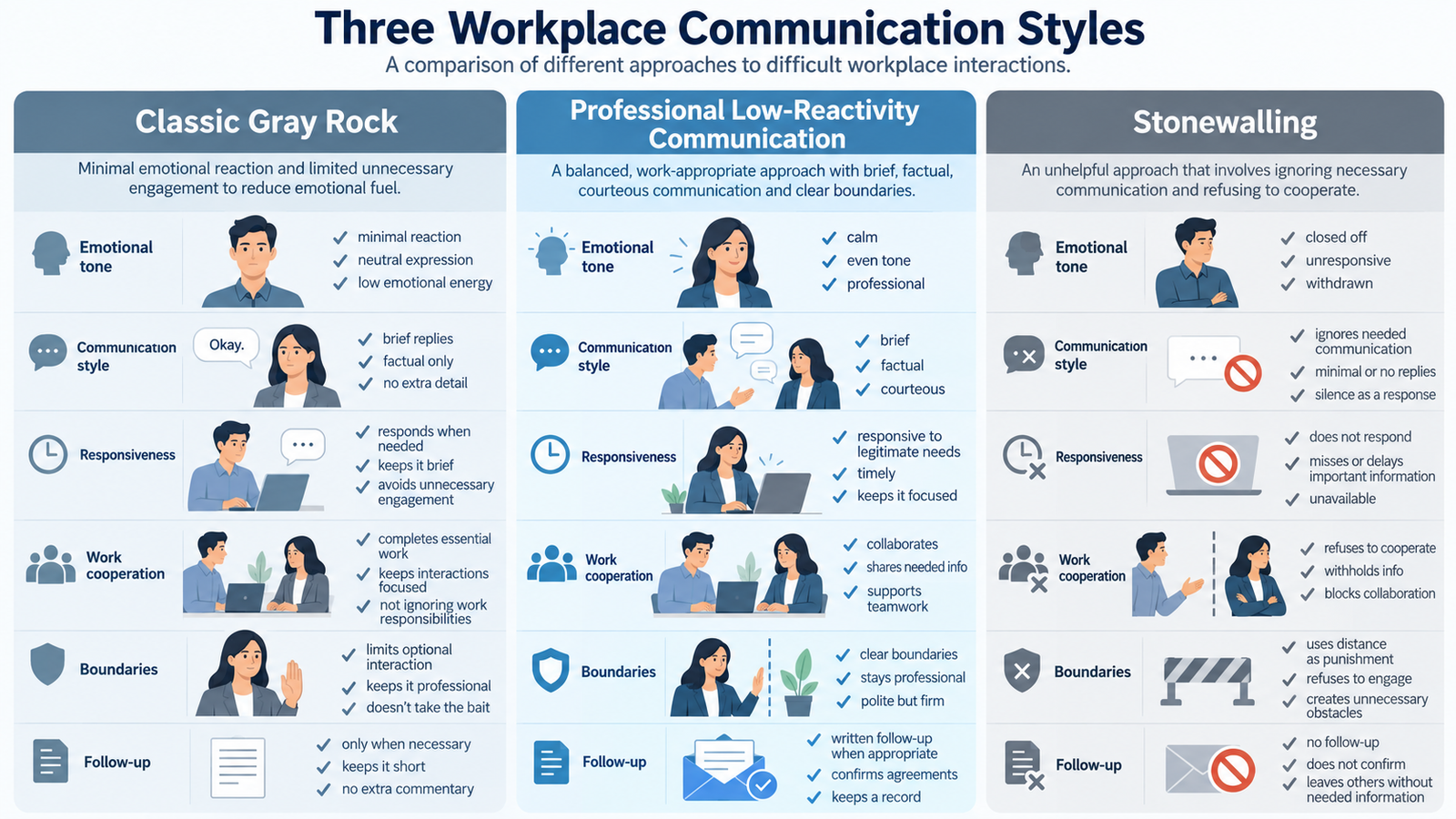
This difference is crucial.
In a personal relationship, advice about gray rock may recommend:
- one-word answers;
- minimal eye contact;
- avoiding conversation;
- showing no emotional reaction;
- sharing almost nothing about yourself.
Some of those behaviors become complicated in a workplace.
If your manager asks:
“Will the client proposal be ready by 3 p.m.?”
replying:
“Maybe.”
is not strategic emotional disengagement.
It is poor work communication.
If a coworker needs information to complete a shared project, ignoring them because you are “gray rocking” could affect the project and your professional reputation.
If your manager gives legitimate performance feedback, responding only:
“Okay.”
while refusing to engage with the substance may look like unwillingness to participate in performance management.
This is why workplace gray rock requires a middle ground.
| Classic Gray Rock | Professional Low-Reactivity Communication | Workplace Stonewalling |
|---|---|---|
| Minimal emotional reaction | Calm emotional control | Silence used to shut down communication |
| Very limited engagement | Engage enough to complete the work | Avoid necessary engagement |
| Little personal information | Share only work-relevant or necessary information | Withhold information others need |
| Short responses | Brief but complete responses | One-word answers where clarity is required |
| Avoid emotional argument | Address facts without emotional escalation | Refuse to address legitimate concerns |
| Reduce unnecessary contact | Structure necessary contact | Avoid required meetings or collaboration |
Cleveland Clinic also distinguishes gray rocking from stonewalling partly through intent: gray rock is used defensively to disengage from unhealthy interaction, while stonewalling can involve shutting another person out or using silence manipulatively.
In the workplace, your behavior also has to remain compatible with your professional responsibilities.
When Might Gray Rock Be Useful at Work?
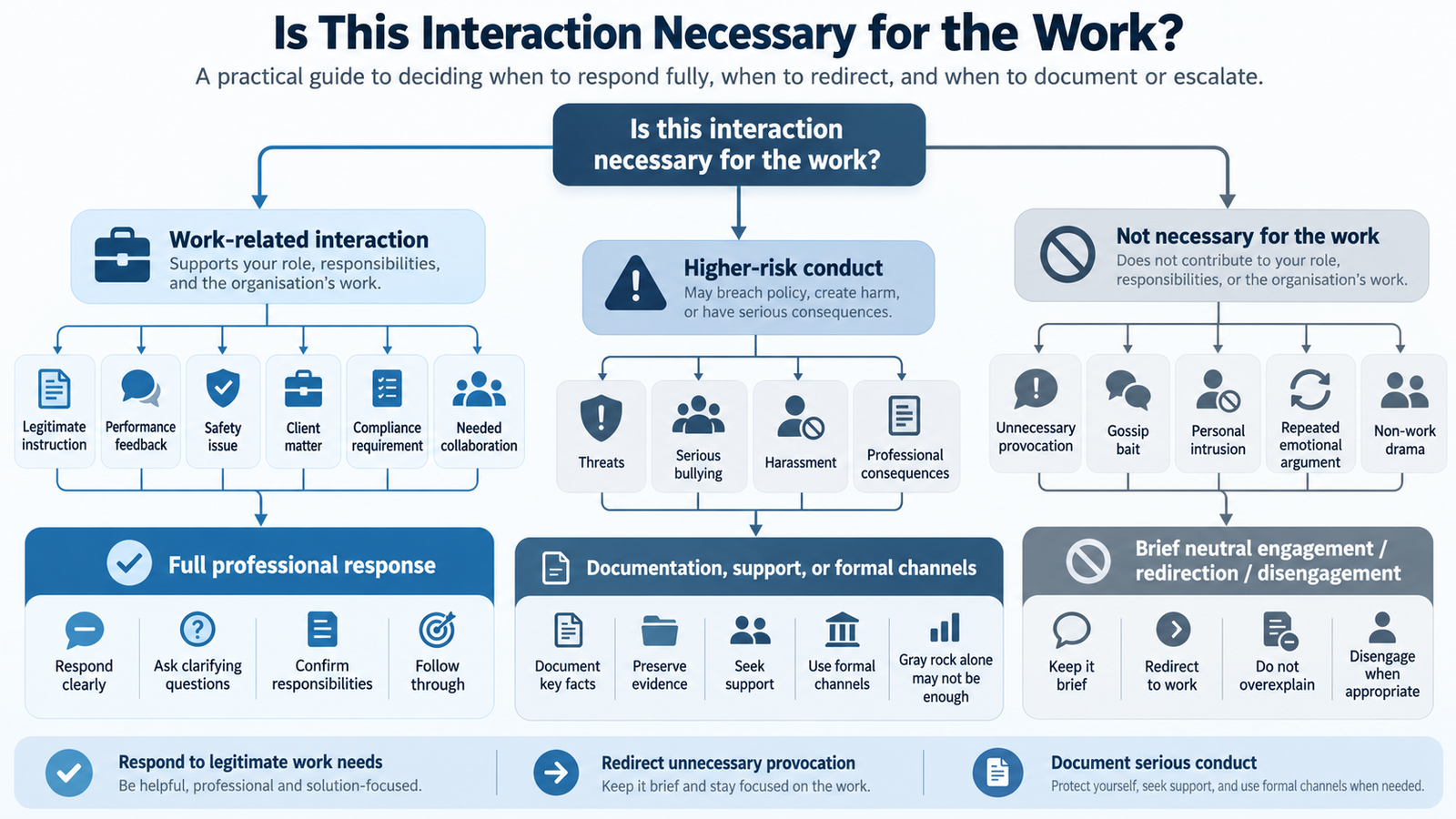
The best candidates are usually interactions where emotional engagement adds little or nothing to the work.
1. A Coworker Keeps Trying to Start Gossip
Coworker:
“Did you hear what Sarah did? Everyone thinks she’s getting fired.”
You:
“I haven’t heard anything about that.”
Then return to your task.
You do not need to:
- defend Sarah;
- attack Sarah;
- ask for details;
- provide your theory;
- repeat the story elsewhere.
2. Someone Keeps Asking Intrusive Personal Questions
“Why did you really take Friday off?”
You might say:
“Just some personal matters. Everything is sorted.”
Then redirect:
“Did you need anything from me on the client file?”
3. A Coworker Repeatedly Makes Provocative Comments
They say:
“You’re awfully quiet today. Something wrong with your performance review?”
You can respond:
“No update from me.”
Then move on.
4. Someone Tries to Pull You Into Repeated Emotional Debate
You have already explained your position.
They keep returning to:
“But don’t you admit you were wrong?”
You can say:
“I’ve explained my understanding. Is there a work decision we still need to make?”
5. A Manipulative Coworker Uses Praise or Criticism to Fish for Personal Information
Instead of explaining your ambitions, frustrations, relationships or insecurities, keep the interaction work-focused.
“I’m focused on finishing this quarter’s project.”
The principle is simple:
Do not provide unnecessary emotional material when the conversation does not require it.
When You Should Not Gray Rock at Work
Gray rock should not become a reason to avoid legitimate professional communication.
Do Not Gray Rock a Genuine Work Instruction
Your manager says:
“The client changed the deadline to Thursday. Can you confirm whether you can meet it?”
This requires an actual answer.
Respond:
“I can complete it Thursday if the pricing section is approved by noon Wednesday. Otherwise I would need Friday morning.”
Do Not Gray Rock Performance Feedback
If feedback is legitimate, engage with it.
You can still ask:
“Can you give me a specific example and the expected standard?”
Neutrality is appropriate.
Disengagement from accountability is not.
Do Not Gray Rock Safety or Compliance Issues
If someone raises:
- a safety concern;
- a legal requirement;
- a financial control;
- security issue;
- client risk;
- compliance problem;
respond with appropriate professional detail.
Do Not Gray Rock HR During a Formal Process
If HR asks:
“Please provide the incidents you reported and the supporting evidence.”
this is not the moment for:
“I’ve already said enough.”
Be factual and responsive.
Do Not Gray Rock Important Collaboration
A coworker you dislike may still need information from you.
Give them the information required for the work without adding unnecessary emotional engagement.
Do Not Rely on Gray Rock When the Situation Is Serious
If the issue involves significant bullying, threats, harassment, discrimination, professional retaliation or safety concerns, becoming less interesting to the other person may not address the risk.
You may need documentation, workplace support or a formal process instead.
Gray Rock With a Boss Is Riskier Than Gray Rock With a Coworker
Power matters.
A coworker who constantly provokes you may have limited authority over your work.
Your manager may control:
- assignments;
- performance ratings;
- schedule;
- approval;
- visibility;
- promotion opportunities;
- access to leadership;
- disciplinary recommendations.
If you begin responding to a manager with:
“Yep.”
“Nope.”
“Whatever.”
you may create a new performance or communication problem.
A safer approach with a difficult boss is usually:
emotionally neutral, professionally complete.
For example:
Boss:
“Why are you always making these deadlines into such a big issue?”
Instead of defending your personality:
“The current issue is that the client report and audit response are both due Friday. I can complete one Friday and one Monday. Which should take priority?”
You are giving little emotional fuel.
But you are still doing your job.
For a fuller framework, see how to set boundaries with a manipulative boss professionally.
The Biggest Risks of Using Gray Rock at Work
Risk 1: You May Appear Uncooperative
Your intention may be:
“I am protecting myself from provocation.”
Others may see:
“They refuse to communicate.”
This is especially risky when the other person has authority over your performance record.
Risk 2: Necessary Information Can Get Lost
Overly minimal communication can create ambiguity.
If a manager asks about project risk and you respond:
“It’s fine.”
when there are actually unresolved problems, you may later be accountable for not communicating them.
Risk 3: The Other Person May Escalate
There is no guarantee that becoming less emotionally responsive will make another person lose interest.
Some people may increase:
- questions;
- criticism;
- pressure;
- attempts to provoke;
- monitoring.
This is one reason gray rock should not be treated as a guaranteed behavior-control technique.
Risk 4: Emotional Suppression Can Become Exhausting
Looking calm does not mean you feel calm.
Cleveland Clinic cautions that maintaining gray rock over long periods may take a psychological toll because the feelings you do not express during the interaction still exist.
A short-term communication tactic should not become your entire emotional coping system.
Risk 5: The Underlying Problem Remains
Gray rock may help you avoid one pointless argument.
It does not correct:
- a false performance record;
- an impossible workload;
- credit stealing;
- unsafe instructions;
- repeated bullying;
- discrimination;
- a broken reporting system.
Some problems require action, not only disengagement.
Risk 6: Your Silence Can Be Reinterpreted
In a manipulative dynamic, neutral behavior may itself become part of a new story.
You may hear:
“You’re hostile.”
“You’re shutting everyone out.”
“You have an attitude.”
“You refuse to engage with feedback.”
This does not mean you should return to emotional arguing.
It means your professional communication should remain clear enough that your actual participation is visible.
Gray Rock Is Not the Same as the Silent Treatment
This distinction matters especially at work.
Gray rock is intended to reduce emotional engagement.
The silent treatment may involve deliberately withholding communication to punish, control or distress another person.
Suppose a coworker sends an unnecessary provocative message:
“I guess some people get special treatment around here.”
You may choose not to engage.
But if the same coworker then asks:
“Can you send the final numbers for the presentation?”
ignoring that work request because you are gray rocking them may cross into a professional communication failure.
You can send:
“Final numbers attached. The revised total is $48,200.”
Nothing more is needed.
That is professional detachment without work avoidance.
Five Safer Alternatives to Full Gray Rock at Work
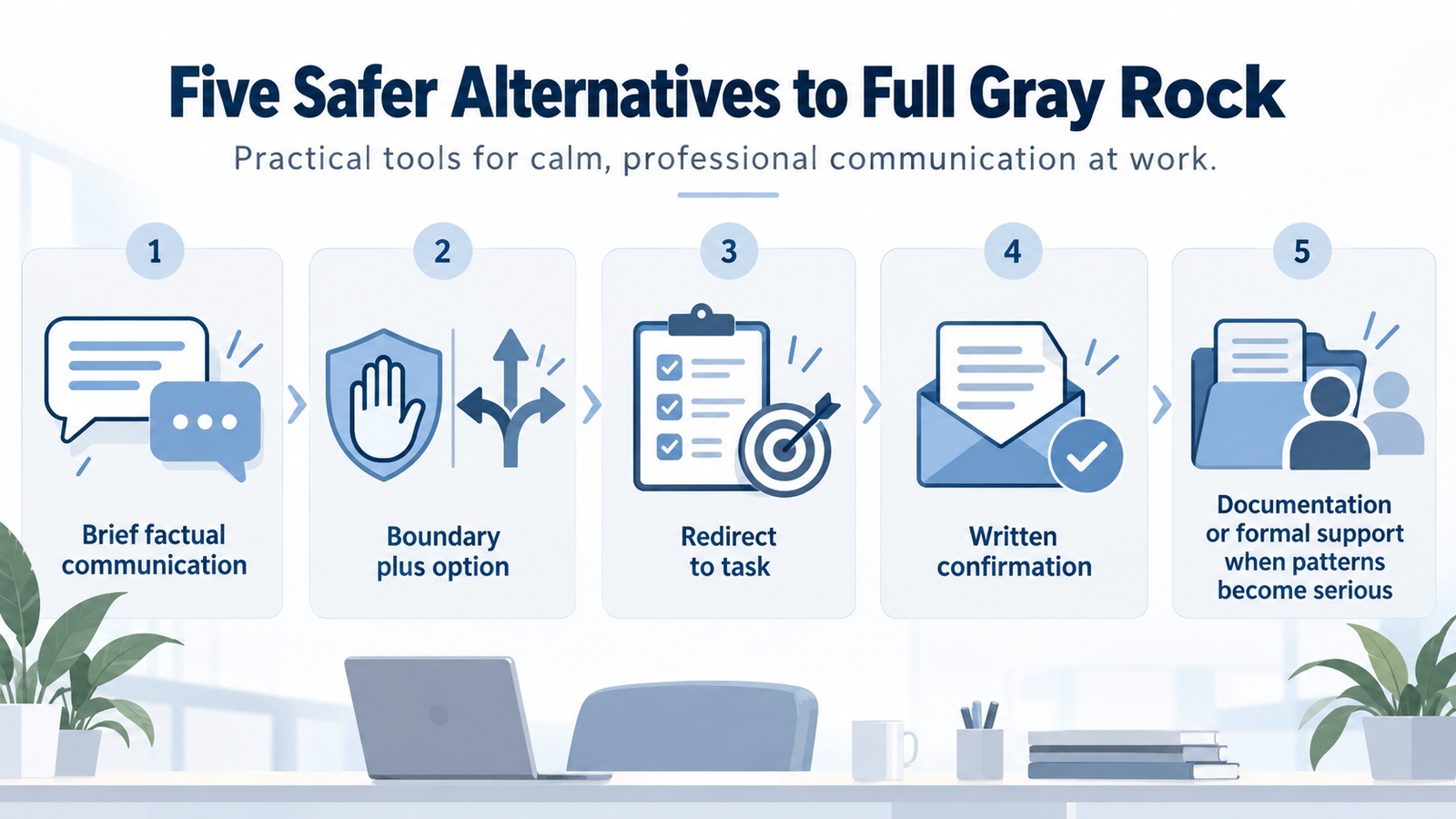
1. Brief, Factual Communication
This is often the best workplace adaptation.
Remove:
- defensiveness;
- personal attacks;
- unnecessary emotional detail;
- long explanations.
Keep:
- facts;
- work information;
- deadlines;
- responsibilities;
- questions requiring decisions.
Example:
“The draft was submitted Tuesday at 2:15 p.m. and is waiting for finance approval. I will send it to the client once approval is received.”
That is much stronger professionally than:
“Whatever. I’ve already done my part.”
2. Boundary + Option
If the problem is pressure rather than provocation, a boundary is more useful than gray rock.
Try:
“I can complete the report today or the client deck today, but not both accurately. Which should take priority?”
You are not disengaging.
You are making the limit operational.
3. Redirect to the Task
When the conversation becomes personal:
Boss:
“You always seem to have an excuse.”
You:
“I’m happy to discuss the specific concern. Which deadline do you believe I missed?”
Coworker:
“Everyone thinks you’re difficult.”
You:
“If there’s a work issue we need to resolve, I’m happy to discuss that.”
Redirecting prevents you from trying to defend yourself against an undefined character judgment.
4. Confirm Important Decisions in Writing
If the interaction affects:
- deadlines;
- responsibility;
- approval;
- performance;
- scope;
- client communication;
do not rely only on emotional neutrality.
Create clarity.
For example:
“Confirming today’s discussion: I will prioritize the client revision and move the audit draft to Monday.”
For templates, see our guide to writing a follow-up email after a difficult verbal conversation.
5. Document or Escalate When the Pattern Becomes Material
If repeated interactions begin affecting:
- performance records;
- assignments;
- professional reputation;
- access;
- pay;
- discipline;
- safety;
- your ability to perform the job;
the problem may have moved beyond what a communication tactic can solve.
At that point, maintain a factual workplace incident log and preserve relevant records appropriately.
ACAS recommends keeping a record of workplace bullying concerns, including what happened, dates and times, available evidence and witnesses, and explains that workers can raise concerns informally or formally depending on the circumstances. See ACAS guidance on workplace bullying.
Professional Gray Rock Scripts for Common Workplace Situations
When Someone Tries to Start Gossip
“I don’t really have anything to add.”
Then return to the work.
When Someone Asks for Personal Information
“I keep that private, but thanks for asking.”
Or:
“Nothing interesting to report. How is the project timeline looking?”
When Someone Makes a Provocative Comment
“Okay.”
Then continue with the actual task.
When a Coworker Keeps Trying to Restart an Argument
“I’ve shared my position. Is there a work decision we still need to make?”
When a Manager Makes a Personal Judgment
“I’m happy to address the specific performance concern. Can you give me the example you want corrected?”
When Someone Tries to Pull You Into Triangulation
“You should probably discuss that directly with them.”
When a Boss Uses Guilt
“I understand the project is important. I still need to know which deadline should take priority.”
When You Receive a Long Accusatory Email
You do not necessarily need to answer every accusation.
Respond to the actionable parts:
“I have received your message. Regarding the project items: the revised draft will be ready Thursday, and I need confirmation of the approval process before client submission.”
Do not assume every emotional statement requires a defense.
What If Gray Rock Makes the Person Push Harder?
This is one of the biggest reasons to avoid treating gray rock like a guaranteed formula.
You reduce emotional engagement.
The person may respond by increasing:
- questions;
- personal comments;
- guilt;
- criticism;
- pressure;
- accusations that you are cold or disrespectful.
Do not immediately conclude:
“Gray rock is working because they’re getting worse.”
You cannot reliably know why another person is escalating.
Instead ask:
Is my current communication still safe, professionally appropriate and effective?
If the answer is no, switch strategies.
You may need:
- a direct boundary;
- structured communication;
- written confirmation;
- a manager or HR conversation;
- documentation;
- professional or legal advice depending on the circumstances.
What If They Accuse You of Being Rude or Hostile?
Check yourself first.
Have you actually become dismissive?
Are you withholding information?
Are you responding sarcastically?
Are you using silence to punish them?
If yes, adjust.
If your communication remains professional, ask for specificity.
“I want to make sure my communication is appropriate. Can you give me the specific example you considered hostile?”
Or:
“My intention is to keep our conversations focused on the work. If there is a specific communication issue you need me to change, please let me know.”
If your calm boundaries or factual documentation are repeatedly reframed as attacks, compare the sequence with our guide to DARVO at work.
The goal is not to declare that DARVO is happening.
The goal is to notice whether the original issue keeps disappearing while your tone or character becomes the new subject.
Gray Rock and Workplace Gaslighting
Gray rock is sometimes recommended when someone repeatedly:
- denies previous conversations;
- provokes you into emotional arguments;
- minimizes your concerns;
- tries to make you defend your memory;
- uses broad statements such as “everyone agrees with me.”
There is value in refusing endless arguments.
But factual correction is often more important than emotional disengagement.
Suppose a manager says:
“I never told you Friday was the deadline.”
Pure gray rock:
“Okay.”
Professional low-reactivity response:
“The project email dated September 4 lists Friday as the deadline. Has that deadline now changed?”
The second response is still calm.
But it protects clarity.
For more short workplace responses, see our guide to gaslighting phrases at work.
Gray Rock Is Not a Replacement for Documentation
You can stay perfectly calm during a difficult conversation and still need a record afterward.
Suppose:
- Your manager repeatedly provokes you about a missed deadline.
- You respond neutrally instead of arguing.
- The missed deadline is later added to your performance review.
Now the question is not:
“Did gray rock work?”
The question is:
“Is the performance record accurate?”
You may need to preserve:
- the original deadline;
- approval history;
- emails;
- project records;
- your follow-up clarification;
- the performance statement.
If records become important, see how to preserve workplace evidence without violating policy or privacy.
Gray Rock Is Not a Replacement for Boundaries
This distinction may be the most important one in the entire article.
Gray rock says:
“I will reduce unnecessary emotional engagement.”
A boundary says:
“Here is what I can do, what I cannot do, and what needs to happen next.”
Imagine your boss messages repeatedly after hours.
Gray rock might mean answering less enthusiastically.
But that does not clarify the expectation.
A boundary is:
“For non-urgent messages after work hours, I will respond the next working morning. If there are situations requiring an immediate response, can we define what counts as urgent?”
If the real problem is workload, deadlines, availability, privacy or responsibility, use a boundary rather than hiding behind emotional detachment.
Gray Rock Is Not a Replacement for Reporting
Suppose someone repeatedly humiliates you in meetings.
Gray rock may help you avoid giving them the emotional reaction they appear to seek.
But if the behavior continues and damages:
- your reputation;
- your ability to contribute;
- your performance record;
- your professional opportunities;
- your wellbeing;
you may need to raise the issue.
ACAS advises workers who believe they are being bullied to keep a record and consider informal or formal workplace options depending on the circumstances.
Silence is not always protection.
Sometimes protection means making the problem visible through the appropriate process.
When Gray Rock Turns Into Survival Mode
Ask yourself how much of your working day now involves trying not to react.
Do you:
- rehearse neutral facial expressions before meetings?
- avoid speaking because anything you say may be used against you?
- hide normal emotions constantly?
- avoid asking legitimate questions?
- withdraw from helpful coworkers?
- feel that becoming invisible is the only way to stay safe?
At that point, the problem may no longer be your communication technique.
Your working environment itself may need evaluation.
Gray rock should not require you to erase your professional personality indefinitely.
Cleveland Clinic notes that sustained gray rocking can have an emotional cost because outward disengagement does not remove the internal feelings created by the interaction.
A strategy that helps you survive a meeting should not automatically become your permanent way of existing at work.
A Better Workplace Goal: Low-Reactivity Professionalism
Instead of asking:
“How do I become as boring as possible?”
try asking:
“How can I remain professionally responsive without giving unnecessary conflict more energy?”
That approach looks like this:
| Provocation | Low-Reactivity Professional Response |
|---|---|
| “Everyone thinks you’re difficult.” | “If there is a specific work concern, I’m happy to address it.” |
| “Why are you so sensitive?” | “The issue I’m raising is the changed deadline.” |
| “You clearly don’t care about this team.” | “I am asking which of the two deadlines should take priority.” |
| “Tell me what you really think about Sarah.” | “I don’t have anything to add about Sarah.” |
| “You’re always making excuses.” | “Can you give me the specific example you want corrected?” |
| “I never said that.” | “The follow-up email from Tuesday records the instruction. Has the instruction changed?” |
The pattern is consistent:
do not feed the emotional detour; answer the work issue.
When to Stop Using Communication Techniques and Make a Bigger Decision
No script can repair every workplace.
Consider whether a larger response is needed if:
- provocation continues regardless of your response;
- your reputation is being materially harmed;
- performance records are becoming inaccurate;
- you are being isolated or excluded;
- reasonable boundaries trigger significant punishment;
- you feel unsafe;
- the situation is affecting your ability to work normally;
- formal channels fail to address serious problems.
At that point your options might include:
- structured communication through a manager;
- HR or employee relations;
- a union representative;
- a transfer;
- independent employment advice;
- a carefully planned exit.
If you have already reported the problem and the internal process has gone against you, see our guide on what to do when HR sides with your manager.
A Quick Gray Rock at Work Decision Checklist
- Is this interaction necessary for my job? If yes, respond adequately.
- Is the person seeking useful information or mainly provoking a reaction?
- Can I answer briefly without withholding necessary work information?
- Would a direct boundary solve the issue better?
- Does this decision or instruction need written confirmation?
- Could my silence reasonably be interpreted as non-cooperation?
- Am I using gray rock to avoid a legitimate performance conversation?
- Has reducing engagement made the behavior more intense?
- Is the issue now affecting my work record, reputation, safety or career?
- Do I need documentation or formal support rather than another communication technique?
If the answer to the final question is yes, gray rock is probably no longer the main solution.
Frequently Asked Questions
What is the gray rock method at work?
The gray rock method at work means reducing unnecessary emotional engagement with someone who repeatedly provokes, manipulates or pulls you into conflict. In a professional setting, it should usually be adapted so you remain calm and brief while still providing the information, cooperation and responsiveness required by your role.
Does the gray rock method work on coworkers?
It may help reduce engagement in some unnecessary provocative interactions, but there is no guarantee that the other person will lose interest or behave differently. Direct scientific evidence evaluating gray rock itself is limited. Workplace consequences also depend on the relationship, power dynamics and duties involved.
Can I gray rock my boss?
Use caution. A manager may legitimately require detailed communication, collaboration and responses from you. Rather than becoming unresponsive, use brief factual communication, clear boundaries and written confirmation where necessary. Do not ignore legitimate instructions or performance feedback.
Can gray rocking backfire at work?
Yes. It may be interpreted as disengagement or hostility, necessary information may be lost, or the other person may increase their attempts to get a reaction. It can also become mentally exhausting when used continuously. That is why professional neutrality is often safer than full gray rock.
Is gray rock the same as giving someone the silent treatment?
No. Gray rock is generally intended as defensive emotional disengagement. The silent treatment can involve withholding communication to punish or control another person. At work, you should continue responding to legitimate job-related communication even if you minimize unnecessary personal or provocative interaction.
What is a safer alternative to gray rock at work?
A useful alternative is low-reactivity professionalism: keep responses brief, factual, courteous and task-focused; set explicit boundaries when needed; confirm important decisions in writing; and document or escalate significant repeated conduct instead of simply withdrawing.
Should I tell someone I am gray rocking them?
Usually there is little professional benefit in announcing a communication strategy. Instead, simply communicate more briefly and factually, redirect conversations to work and set direct boundaries where needed.
Does gray rock work on a narcissistic boss?
No technique can guarantee how a particular person will respond, and describing someone as narcissistic does not establish a diagnosis. A difficult boss may respond to reduced emotional engagement by losing interest, continuing the same behavior or increasing pressure. Focus on what communication style best protects your work, clarity and professional position.
Conclusion: At Work, Aim for Calm Clarity—not Disappearance
The gray rock method has an appealing promise:
Stop giving a difficult person emotional fuel and perhaps they will stop trying to provoke you.
Sometimes reducing unnecessary engagement may indeed make an interaction easier.
But work adds responsibilities that personal relationships do not.
You still need to:
- communicate;
- collaborate;
- respond to legitimate feedback;
- raise risks;
- follow reasonable instructions;
- protect your professional record.
That is why the better workplace goal is often not becoming a gray rock.
It is becoming:
calm, factual, courteous, bounded and difficult to pull away from the actual work issue.
Use brief neutrality for unnecessary provocation.
Use boundaries for workload and availability.
Use written confirmation for important decisions.
Use documentation when patterns affect your career.
Use formal support when communication techniques are no longer enough.
And remember that a coping strategy should help you function—not require you to disappear.
Build a Complete Protection Strategy, Not Just One Communication Technique
Gray rock can be one small tool inside a much larger workplace-protection strategy.
But difficult workplace dynamics may also require you to recognize manipulation patterns, reset boundaries, document significant incidents, preserve evidence carefully, communicate without over-explaining and decide when staying is no longer the healthiest professional choice.
Reclaim Your Power brings those pieces together.
Chapter 2 examines manipulation tactics such as gaslighting, blame-shifting, triangulation and control. Chapter 4 focuses on immediate workplace protection, including boundaries, documentation and support systems. The accompanying workbook includes a Boundary Reset Exercise, Incident Documentation Log and other structured tools for turning confusion into clearer professional decisions.
Explore Reclaim Your Power and the complete workplace recovery workbook.
You do not need to become emotionless to protect yourself.
You need enough distance to think clearly—and enough professional engagement to protect your work, reputation and future options.
Ready to Reclaim Your Power?
Get the 376-page digital edition with 7 chapters, 22 practical tools, reusable forms, an optional 30-entry journal, and references.
Buy Now — $4.99
Leave a Reply