
If you are trying to learn how to set boundaries with a manipulative boss, start by making the boundary practical rather than personal. State the work situation, explain the limit or constraint, offer a workable option when possible, and clarify what needs to happen next.
Instead of saying, “You always dump impossible work on me,” you might say: “I can complete the client report or the audit response by 4 p.m., but I cannot complete both accurately today. Which should take priority?”
A professional boundary does not require you to diagnose your boss, prove that they are manipulative, or win an argument about their behavior. Its purpose is to create enough clarity that you know what you can reasonably do, what decision belongs to your manager, and what you will communicate if the limit is pushed again.
What Does a Workplace Boundary Actually Mean?
The word boundary is sometimes used as though it means:
“I told another person what they are not allowed to do.”
That is not always how workplace boundaries work.
You are in an employment relationship with responsibilities, authority structures and legitimate business requirements.
Your manager may have the authority to:
- assign work;
- change priorities;
- set reasonable deadlines;
- require attendance at meetings;
- review your performance;
- ask for progress updates;
- correct errors;
- make decisions you disagree with.
A boundary therefore works best when it communicates something concrete about your participation.
For example:
“I can take this additional project. To complete it by Friday, I will need to move either the client analysis or quarterly report. Which would you like me to deprioritize?”
You have not told your boss that they are prohibited from assigning work.
You have made the capacity constraint visible and returned the priority decision to the person responsible for making it.
That is professional boundary-setting.
Manipulative Boss or Simply a Boss Who Disagrees?
This distinction matters.
A manager does not become manipulative simply because they say no to your request.
Suppose you say:
“I would prefer not to attend Friday’s client meeting.”
Your boss replies:
“Attendance is part of your role and I need you there.”
That may simply be a management decision.
Now compare it with:
“If you cared about this team, you would never question me about meetings. I knew I could not rely on you.”
The practical outcome may still be that you attend the meeting.
But the second response adds guilt, character judgment and loyalty pressure to what could have been a straightforward work instruction.
Broader controlling behavior can extend beyond ordinary task supervision into communication, relationships, information, visibility and independence. Our guide to micromanagement vs. controlling boss behavior explains that distinction in more detail.
Why Manipulative Bosses Can Make Boundaries Feel So Difficult
Setting a boundary is relatively simple when both people discuss the actual issue.
You say:
“I cannot finish both projects today.”
The manager says:
“Okay. Finish Project A and move Project B to tomorrow.”
The problem is resolved.
Manipulative communication can make the same conversation much harder.
Your capacity problem becomes:
- “You are not committed.”
- “Everyone else manages.”
- “You are being difficult.”
- “I thought you wanted to grow here.”
- “Why do you always make things complicated?”
- “You clearly cannot handle pressure.”
Now you are no longer discussing workload.
You are defending your loyalty, competence, personality and future career.
A useful boundary skill is learning to return the conversation to the operational issue.
For example:
“I understand this is important. I am asking which task should take priority because both deadlines are currently today.”
You do not have to answer every accusation before returning to the original question.
The Professional Boundary Formula: Fact + Limit + Option + Next Step
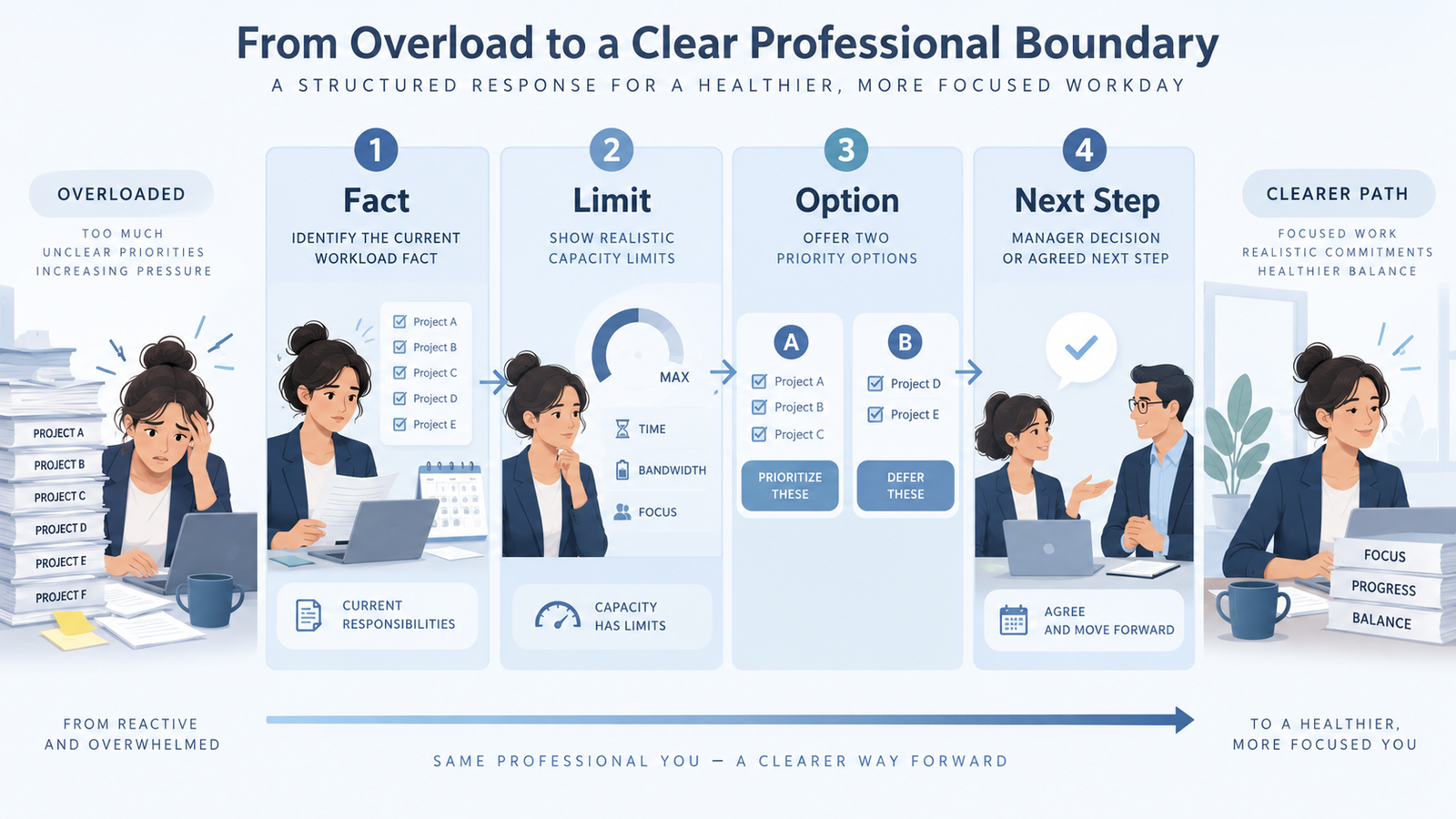
1. Fact
State what is happening without a personality judgment.
“I currently have the audit response and client proposal both due today.”
2. Limit
State the constraint.
“I cannot complete both accurately before 5 p.m.”
3. Option
Where appropriate, offer a workable choice.
“I can complete the audit first and move the proposal to tomorrow, or reverse the order.”
4. Next Step
Clarify what you need.
“Please let me know which should take priority.”
The full boundary becomes:
“I currently have the audit response and client proposal both due today. I cannot complete both accurately before 5 p.m. I can finish the audit today and move the proposal to tomorrow, or reverse the order. Please let me know which should take priority.”
Notice what is absent.
There is no:
“You never respect me.”
There is no:
“You are manipulating me.”
There is no:
“I refuse to tolerate this toxic behavior.”
The boundary is built into the work decision.
12 Professional Scripts for Setting Boundaries With a Manipulative Boss
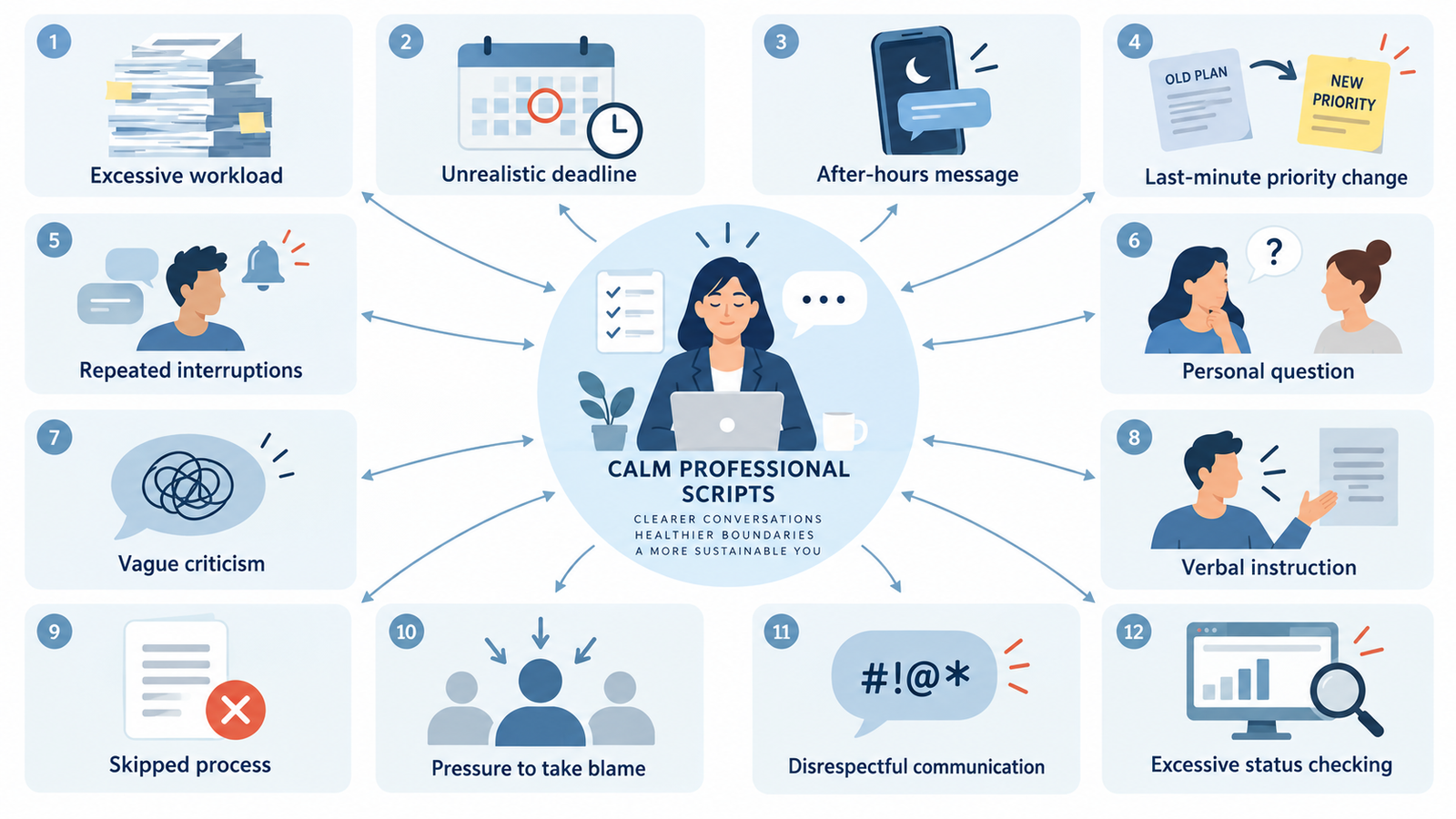
1. When Your Boss Gives You More Work Than You Can Complete
Try:
“I can take this on. With my current deadlines, I will need to move either the quarterly report or the client review. Which would you like me to prioritize?”
This avoids saying:
“No, I have too much work.”
You are showing willingness while making the trade-off visible.
2. When Your Boss Gives You an Unrealistic Deadline
Try:
“I can have a first draft ready by Tuesday. To deliver the completed version by tomorrow, I would need either additional support or reduced scope. Which option would work better?”
This turns:
“That’s impossible.”
into an operational discussion.
3. When Your Boss Messages You After Hours
If your role does not require routine after-hours availability, you might say:
“I saw your message. I am offline for the evening and will pick this up first thing tomorrow morning.”
If the expectation itself is unclear:
“I’d like to clarify the expected response time for messages outside normal working hours. For non-urgent issues, can we agree that I will respond the next working day?”
The American Psychological Association notes that expectations about issues such as off-hours email work best when there is a mutual understanding between employee and manager, and that repeatedly violated expectations may require a discussion about realignment. See APA guidance on work-life boundaries and flexibility.
4. When the Priority Keeps Changing
Try:
“I can switch to this new priority. To make sure we’re aligned, should I pause the report you asked me to finish this afternoon?”
If priorities shift repeatedly, confirm the decision afterward.
“Confirming today’s change: I am pausing the quarterly report and prioritizing the client revision until it is complete.”
This prevents you from silently carrying responsibility for two incompatible priorities.
5. When Your Boss Gives Important Instructions Only Verbally
You do not always need to demand:
“Put that in writing.”
You can create the clarity yourself.
Try:
“I’ll send a quick summary after this meeting so we’re aligned on the deadline and approval process.”
Then send:
“Confirming my understanding: I will complete the revision by Thursday and wait for your approval before sending it to the client.”
For complete templates, use our guide to writing a follow-up email after a difficult verbal conversation.
6. When Your Boss Wants Constant Progress Updates
Try:
“I can send you a progress update at noon and another before I finish today. If anything becomes blocked before then, I will let you know immediately.”
This gives the manager visibility while reducing repeated interruption.
If the checking remains excessive even after a reliable update system is established, it may overlap with micromanagement rather than ordinary supervision.
7. When Your Boss Pressures You to Skip a Process
Suppose you are being asked to bypass an approval, safety step, financial control or other established requirement.
Try:
“My understanding is that this requires finance approval before submission. If the process has changed, please confirm the new procedure so I can follow it correctly.”
If necessary:
“I can proceed once the required approval is in place.”
Do not let a conversation about loyalty replace a legitimate process requirement.
8. When Your Boss Makes Criticism Personal
Your boss says:
“You’re always defensive.”
You can respond:
“I want to address the feedback. Can you give me the specific example and the standard you expected so I can respond to it accurately?”
Or:
“I’m happy to discuss my performance. I’d like to keep the conversation focused on the specific work issue and what needs to change.”
You are not refusing feedback.
You are asking for feedback that can actually be acted on.
9. When Your Boss Uses Guilt or Loyalty
Your manager says:
“I thought you were committed to this team.”
Instead of defending your loyalty for ten minutes, return to the issue.
“I am committed to completing the work well. The question I need clarified is which of the two Friday deadlines should take priority.”
Or:
“I understand the project matters. I am not available this evening, but I can begin at 8:30 tomorrow morning.”
The guilt statement does not require a guilt-based answer.
10. When Your Boss Asks Intrusive Personal Questions
You do not always owe a detailed personal explanation for a workplace request.
You might say:
“I would prefer to keep the personal details private. I can confirm that I need to leave at 4 p.m. and have completed the required leave process.”
Or:
“I’d rather keep that separate from work, but I’m happy to discuss anything you need regarding my availability or responsibilities.”
Keep in mind that certain workplace processes may legitimately require appropriate information—for example, leave, accommodation or safety procedures.
A boundary is not a reason to withhold information you are lawfully or contractually required to provide through the proper process.
11. When Your Boss Tries to Make You Accept Blame Immediately
Try:
“I want to understand what happened before assigning responsibility. I submitted my part on Tuesday and the next step required approval. Can we review the timeline together?”
If responsibility repeatedly gets rewritten after problems occur, our guide to blame-shifting at work explains how to reconstruct deadlines, authority and approvals factually.
12. When Your Boss Raises Their Voice or Becomes Disrespectful
Depending on the situation and your safety, you might say:
“I want to resolve this, and I can continue the conversation when we can discuss the issue without shouting.”
Or more cautiously:
“I think this conversation will be more productive if we pause and return to the specific project issue.”
You do not need to match intensity with intensity.
If you feel unsafe, prioritize safety and use appropriate workplace or emergency support rather than trying to deliver the perfect boundary script.
Why Short Boundaries Often Work Better Than Long Explanations
When you are dealing with a difficult boss, you may feel compelled to explain everything.
You want them to understand that:
- you are hardworking;
- you are loyal;
- you are not lazy;
- you care about the team;
- you are not trying to create conflict;
- you have good reasons.
The explanation becomes longer.
The conversation gains more points that can be challenged.
You end up defending your character instead of maintaining the original limit.
Compare:
Long version:
“I really hope you don’t think I’m not committed because I’ve worked late so many times and I’ve always tried to help everyone, but tonight is difficult because of personal circumstances and I don’t want you to think I’m saying no because I don’t care…”
Short version:
“I am not available this evening. I can handle this first thing tomorrow morning.”
Short does not mean rude.
It means the operational message remains visible.
Do Not Overuse “No” When a Priority Question Is Stronger
In workplace advice, “just say no” is often too simplistic.
Your manager may legitimately assign work.
A better question may be:
“Which existing priority should move?”
Suppose you already have three tasks due Thursday.
Your boss adds a fourth.
Instead of:
“No. I have boundaries.”
try:
“I can add this to Thursday. I currently have A, B and C due the same day. Which item should move so I can prioritize this one?”
That protects capacity without pretending you have unilateral control over business priorities.
What If Your Boss Says, “Everyone Else Can Handle It”?
Do not let comparison pull you away from the actual workload.
You can say:
“I can only speak to my current assignments. With the deadlines I have now, I need a priority decision between these two tasks.”
Or:
“If there is a different performance expectation for this workload, please clarify the expected timeline so I can understand the standard.”
You are not debating whether your coworkers are stronger or more loyal.
You are clarifying the work requirement.
What If Your Boss Says Your Boundary Is “Bad Attitude”?
Ask for the specific behavior.
For example:
“I want to address any concern about my conduct. Can you explain specifically what I said or did that you consider inappropriate?”
If the answer returns to the boundary:
“I understand that you disagreed with my request. My intent was to clarify which deadline should take priority. What wording or process would you prefer me to use when priorities conflict?”
That allows legitimate feedback without automatically accepting a character judgment.
If reasonable questions and boundaries are repeatedly reframed as evidence that you are difficult, defensive or disloyal, compare the pattern with the signs of workplace gaslighting.
What If Your Boss Reacts Badly to the Boundary?
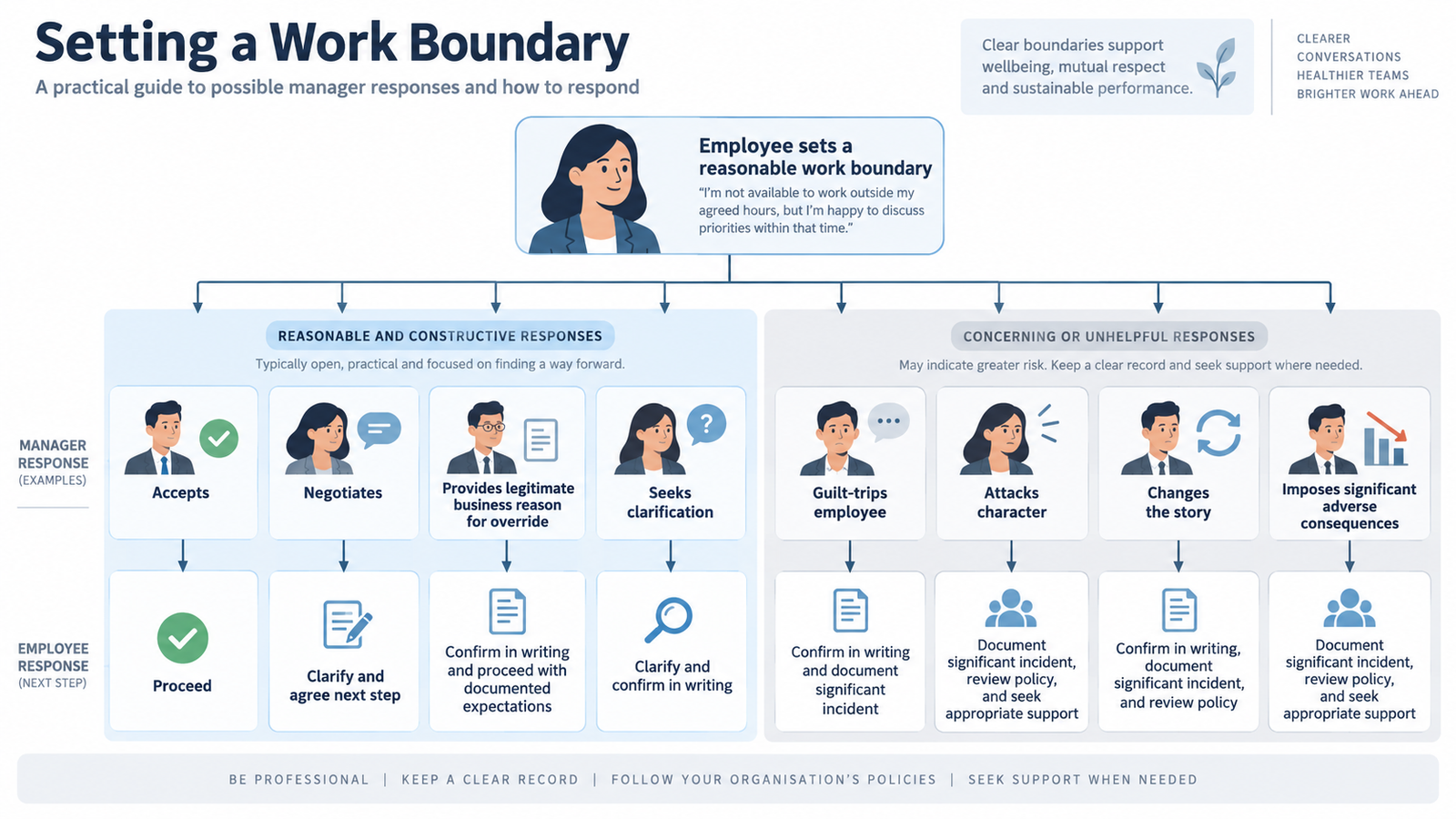
One bad reaction does not tell you everything.
Look at what happens next.
Your Boss Accepts It
The system may be healthier than the interaction initially felt.
No further action may be necessary.
Your Boss Negotiates
This is normal.
A boundary does not guarantee that you get your preferred outcome.
Your Boss Overrides the Request for a Legitimate Business Reason
Ask what expectation now applies and adjust where reasonably required.
For example:
“Understood. Since the client issue now has priority, I’ll pause the quarterly analysis and return to it tomorrow.”
Your Boss Uses Guilt or Character Attacks
Return to the issue once:
“I understand you’re concerned about commitment. I still need to clarify which deadline should take priority.”
Do not spend the entire meeting proving that you are a good person.
Your Boss Changes the Story Later
Confirm material decisions in writing.
Your Boss Repeatedly Punishes Reasonable Boundaries
Now you may be dealing with something broader than one difficult conversation.
Record significant events factually and review the appropriate workplace process.
Do Not Announce Every Boundary as a Boundary
You rarely need to say:
“I am setting a boundary with you now.”
At work, the most effective boundaries often sound ordinary.
Examples:
“I can deliver that Monday.”
“Which task should take priority?”
“I’ll respond tomorrow morning.”
“Please send the change through the project system.”
“I would prefer to keep that personal.”
“Can you give me a specific example?”
“I can continue this discussion when we can focus on the work issue.”
The behavior matters more than naming the concept.
When to Put the Boundary in Writing
Not every limit requires an email.
Written confirmation becomes especially useful when the conversation involves:
- changed priorities;
- deadlines;
- approval authority;
- after-hours expectations;
- scope changes;
- performance expectations;
- repeated disagreement over what was decided.
A short confirmation is usually enough.
For example:
“Confirming our discussion: I will prioritize the client response today and move the audit draft to Thursday.”
Do not turn every boundary into:
“For legal documentation purposes, I am formally recording your violation of my boundaries.”
Clarity is usually more useful than theatrical escalation.
When a Boundary Becomes a Documentation Issue
Suppose you clearly state that two deadlines conflict.
Your manager tells you to prioritize Project A.
You follow that instruction.
Later, you are criticized for not completing Project B.
Now the issue is no longer only boundary-setting.
It is also documentation.
Record:
- the original competing deadlines;
- the clarification you requested;
- the manager’s priority decision;
- what you completed;
- the later criticism;
- available evidence.
A structured workplace incident log can help you preserve significant events without turning every uncomfortable interaction into an accusation.
When Boundary Pushback Turns Into Role Reversal
Sometimes the conversation changes completely after you set a limit.
You say:
“I cannot complete both deadlines today. Which should take priority?”
Your manager replies:
“I cannot believe you are attacking my management. After everything I’ve done for you, now you’re trying to make me look unreasonable.”
The original capacity issue has disappeared.
Now you are defending yourself against the claim that your boundary harmed the manager.
Return to the original issue:
“I’m not making a personal accusation. I’m asking which task should take priority because both currently have the same deadline.”
If this denial-and-counterattack pattern happens repeatedly, our guide to DARVO at work explains how an original concern can become a debate about the character of the person who raised it.
When Should You Escalate a Boundary Problem?
Not every boundary disagreement belongs in HR.
Some can be resolved directly.
Escalation may become more appropriate when:
- reasonable attempts at clarification repeatedly fail;
- you are being asked to violate a policy, law or safety requirement;
- boundaries repeatedly trigger significant professional consequences;
- the issue involves harassment, discrimination or another serious concern;
- conflicting instructions are damaging your performance record;
- the manager refuses to clarify expectations that materially affect your work;
- you feel unsafe addressing the matter directly.
ACAS advises that workplace problems can often be raised informally first, while formal procedures may be appropriate where informal steps fail or the issue is too serious for informal resolution. See ACAS guidance on raising workplace problems.
When escalating, report the conduct rather than saying only:
“My boss does not respect my boundaries.”
Explain:
“I have raised the conflicting deadlines on four occasions. Each time I was told to complete both without a priority decision, and two missed deadlines have subsequently been recorded as performance concerns.”
That is something another person can examine.
Boundaries That May Need a Different Process
Some issues should not be handled only through an informal boundary script.
Examples may include:
- disability accommodation;
- medical leave;
- religious accommodation;
- formal flexible-working requests;
- harassment;
- discrimination;
- safety concerns;
- legally protected leave;
- whistleblowing;
- contractual disputes.
These areas can involve formal policies or legal rights.
A statement such as:
“This is my boundary.”
may not be enough to trigger or protect the appropriate process.
Review the relevant policy and obtain qualified advice where necessary.
What Not to Do When Setting Boundaries With a Difficult Boss
Do Not Diagnose Them During the Conversation
Avoid:
“You’re manipulating me because you’re a narcissist.”
Even if you strongly believe that interpretation, the label rarely helps resolve the immediate work decision.
Do Not Threaten HR Every Time You Disagree
Use escalation when it is actually needed.
Repeated threats can turn routine negotiation into unnecessary conflict.
Do Not Over-Promise and Hope the Problem Disappears
Saying yes to four impossible deadlines does not create a healthy boundary.
It hides the capacity problem until something fails.
Do Not Create a Boundary You Cannot or Will Not Maintain
If you repeatedly say:
“I never respond after 6 p.m.”
and then answer every non-urgent message immediately, the working expectation remains unclear.
Do Not Assume Silence Communicates a Boundary
Your manager may not know what you need unless you state it.
Do Not Use Boundaries to Avoid Legitimate Accountability
“I do not accept negative feedback” is not a useful professional boundary.
You can ask for feedback to be specific, relevant and respectful while still engaging with legitimate performance concerns.
How to Tell Whether the Boundary Is Working
Do not judge success only by whether your boss looks pleased.
Ask whether the work system becomes clearer.
| Healthier Response | More Concerning Pattern |
|---|---|
| Priorities become clearer | Priorities remain deliberately vague and blame follows |
| Manager negotiates when necessary | Every limit becomes a loyalty test |
| Feedback becomes specific | Feedback shifts into character attacks |
| Important changes are acknowledged | Instructions are repeatedly denied later |
| Occasional disagreement occurs | Reasonable disagreement produces punishment or exclusion |
| Autonomy grows with reliability | Control increases regardless of performance |
The goal is not a boss who never disagrees with you.
The goal is a working relationship where disagreements can remain about the work.
If Boundaries Keep Failing, Ask a Bigger Question
You can become excellent at boundary scripts and still work in an environment that does not respect reasonable limits.
If every attempt at clarity produces:
- new accusations;
- moving standards;
- punishment;
- exclusion;
- reputational attacks;
- constant pressure to violate process;
- increasing loss of autonomy;
the problem may no longer be how perfectly you phrase the boundary.
The question may become:
Is this workplace structurally capable of respecting a reasonable professional limit?
You may then need to consider:
- a different reporting line;
- HR or another internal process;
- union or professional support;
- a transfer;
- independent employment advice;
- a careful exit plan.
Do not interpret the failure of one script as a personal failure.
Communication skill can improve your position.
It cannot make every manager respond reasonably.
A Quick Boundary Checklist Before You Speak
- What exactly is the problem?
- What fact can I state without interpretation?
- What is the real limit—time, capacity, availability, authority or conduct?
- Does my boss legitimately control part of this decision?
- Can I offer two workable options?
- What specific next step do I need?
- Can I say it in two or three sentences?
- Does this need written confirmation afterward?
- If the boundary is rejected, what will I do next?
- If significant consequences follow, should I document the incident?
Frequently Asked Questions
How do you set boundaries with a manipulative boss?
Keep the boundary specific and work-focused. State the situation, identify the realistic limit, offer workable options where appropriate and clarify the next step. For example: “I can complete either the client report or audit response today. Which should take priority?” Avoid relying only on labels such as manipulative or toxic.
How do you say no to your boss professionally?
When possible, explain the constraint and offer an alternative rather than giving a bare refusal. For example: “I cannot complete this accurately by 2 p.m., but I can have it ready by 10 a.m. tomorrow. If today is essential, we would need to reduce the scope.”
What are examples of healthy boundaries with a boss?
Examples include clarifying competing priorities, agreeing response expectations outside work hours, asking for important instructions in writing, declining inappropriate personal questions, requesting specific feedback instead of character criticism and refusing to bypass required safety or approval procedures.
What if my boss gets angry when I set a boundary?
Stay focused on the work issue and avoid matching the intensity. Clarify the operational question once. If reasonable boundaries repeatedly trigger threats, punishment, exclusion or personal attacks, document significant incidents and review the appropriate workplace process.
Can my boss ignore my boundaries?
Some workplace preferences can legitimately be overridden by management requirements, depending on your role, contract and circumstances. A professional boundary is not unlimited authority over your job. However, formal rights involving areas such as discrimination, disability accommodation, leave or safety may involve specific policies or legal protections.
How do I set boundaries around workload?
Make the trade-off explicit. List the competing priorities, explain what can realistically be completed and ask which item should move. This places the priority decision with the manager instead of silently accepting incompatible deadlines.
How do I set boundaries around after-hours messages?
Clarify the expected response standard. For example: “For non-urgent messages after work hours, I will respond the next working morning. If there are situations that require immediate response, can we define what counts as urgent?”
Should I tell my boss they are manipulative?
Usually you can address the workplace problem more effectively by describing the specific conduct. Instead of “You manipulate me,” say: “The priority has changed three times this week. Please confirm which deadline now applies.” Labels can shift the conversation toward personality rather than the work issue.
Conclusion: Make the Boundary About the Work, Not the Battle
You do not need to become aggressive to set a strong boundary.
You also do not need to explain yourself until the other person agrees that your needs are reasonable.
Start with four things:
- the fact;
- the limit;
- the workable option;
- the next step.
Keep returning to the actual work issue.
If the workload is impossible, ask which task moves.
If the deadline is unrealistic, explain what can be delivered and when.
If expectations after hours are unclear, clarify them.
If feedback becomes personal, ask for the specific example and standard.
If an important verbal instruction matters, confirm it in writing.
And if reasonable boundaries repeatedly produce guilt, rewritten expectations, punishment or attacks on your character, stop assuming that the answer is simply finding a better sentence.
At that point, the pattern itself deserves attention.
A good professional boundary does not guarantee that your boss will like it.
It gives you a clearer way to participate in the relationship without surrendering every decision to pressure, guilt or confusion.
Turn Boundary-Setting Into a System, Not a One-Time Script
Knowing one good sentence helps.
But difficult workplace dynamics often require more than one conversation.
You may need to identify the pattern, decide which boundaries matter, document what happens when you set them, protect your professional position and determine when continued negotiation is no longer enough.
Reclaim Your Power is designed around that wider process.
The accompanying workbook includes a Boundary Reset Exercise alongside pattern-recognition, incident-documentation, exit-readiness and career-recovery tools, helping you move from vague discomfort to clearer decisions about what you will accept and how you will respond.
Explore Reclaim Your Power and the complete workplace recovery workbook.
You cannot control whether a manipulative boss respects every limit.
You can become much clearer about your capacity, your responsibilities, your communication and the point at which protecting yourself requires a larger decision.
Ready to Reclaim Your Power?
Get the 376-page digital edition with 7 chapters, 22 practical tools, reusable forms, an optional 30-entry journal, and references.
Buy Now — $4.99
Leave a Reply