
If you need to send a follow up email after verbal conversation at work, keep it short, factual and focused on what was discussed. A strong follow-up usually does six things: acknowledges the conversation, identifies the issue, summarizes the important facts or decisions, confirms who is responsible for what, records any deadlines or next steps, and gives the recipient an opportunity to correct a genuine misunderstanding.
The goal is not to prove that you were right or to recreate every uncomfortable moment. It is to leave the conversation with a clearer written record.
Why Follow Up a Difficult Verbal Conversation in Writing?
Verbal conversations disappear quickly.
Two people can leave the same meeting with different understandings of what was decided.
A deadline may have changed.
A manager may believe they assigned a responsibility that you understood differently.
You may have raised a concern but remain unsure whether anything will happen next.
A week later, everyone may remember the conversation slightly differently.
A short follow-up email reduces that uncertainty.
It creates a written reference for:
- what was discussed;
- what was agreed;
- who owns the next action;
- what deadline applies;
- what remains unresolved.
This is not unusual workplace practice. ACAS advises that even after an informal workplace meeting, recording what was agreed in writing can help everyone understand the next steps and provide something to refer back to if the problem continues. See the ACAS guidance on informal workplace meetings.
A follow-up email can therefore serve two purposes at the same time:
clarification now and documentation later.
When Should You Send a Follow-Up Email?
You do not need to summarize every hallway conversation with your manager.
Written follow-up becomes especially useful when a verbal discussion involves something that could matter later.
Consider Following Up When the Conversation Involves:
- a changed deadline;
- a new assignment;
- a disputed responsibility;
- performance feedback;
- a warning or criticism;
- a workplace concern you raised;
- an agreement about how a problem will be handled;
- a decision that affects your role;
- approval requirements;
- a request to change your work;
- an important boundary;
- something you fear may later be misunderstood or denied.
If the issue forms part of a larger pattern you are documenting, it may also belong in your workplace incident log.
When a Follow-Up Email May Not Be Necessary
Do not turn ordinary workplace communication into constant evidence creation.
You probably do not need a formal summary after:
- a routine question;
- a casual check-in;
- a minor misunderstanding that was immediately resolved;
- a normal coaching conversation where expectations are already documented elsewhere;
- every small disagreement with a coworker.
Over-documenting ordinary interactions can make communication cumbersome and may increase your own anxiety.
The question is:
Would having a clear written record of this discussion reasonably matter later?
If yes, a concise follow-up may be useful.
The Six-Part Follow-Up Email Formula
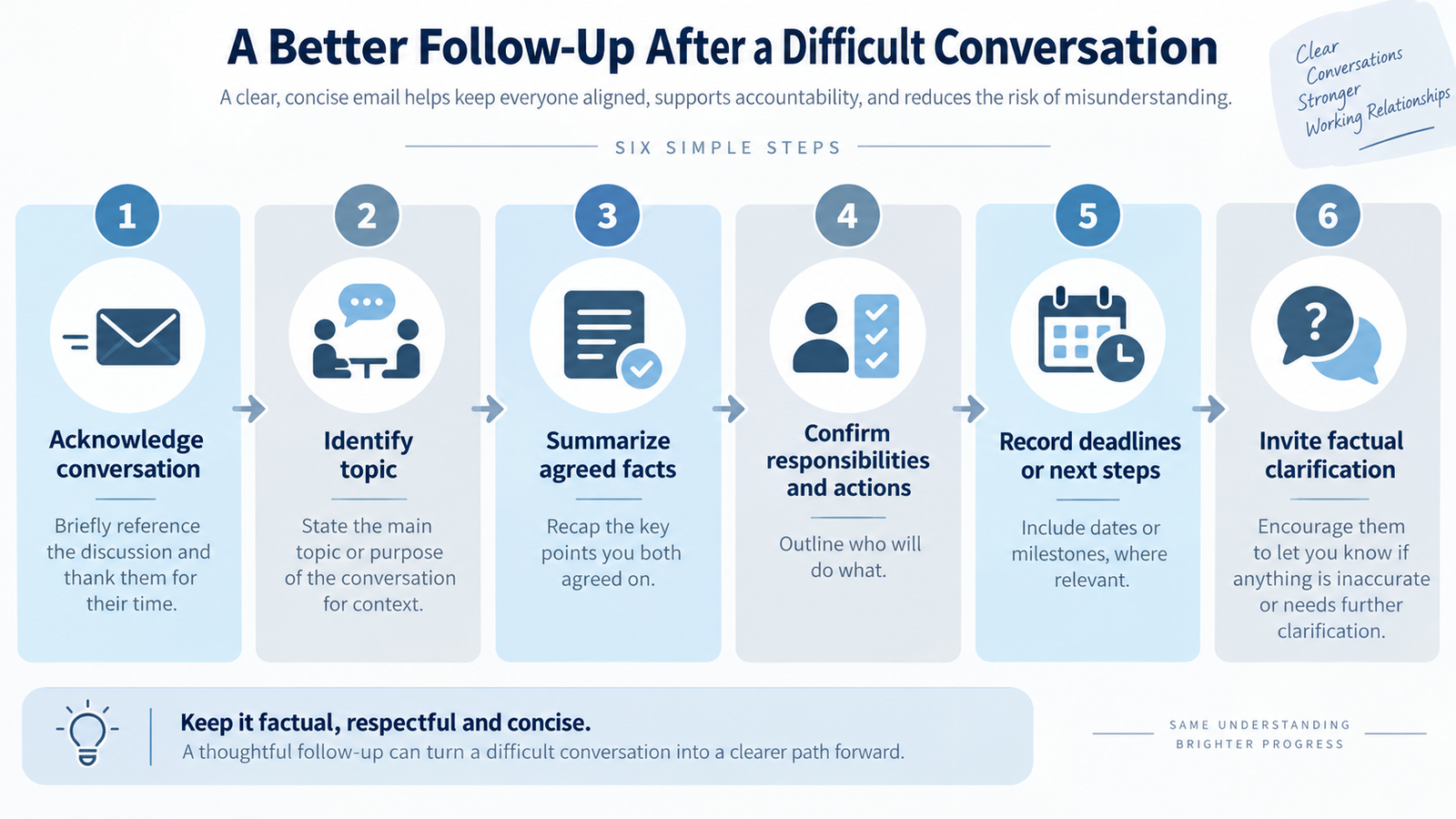
You do not need complicated language.
A strong workplace follow-up can usually be built from six parts.
1. Acknowledge the Conversation
Begin neutrally.
For example:
“Thank you for speaking with me this afternoon.”
Or:
“I wanted to follow up on our conversation this morning regarding the client deadline.”
You do not need excessive friendliness if the conversation was serious.
Professional neutrality is enough.
2. Identify the Topic
Make it obvious which conversation you are summarizing.
For example:
“I am following up on our discussion about responsibility for the revised proposal.”
This is especially useful if you and the recipient speak frequently.
3. Summarize the Important Facts or Decisions
Do not rewrite the entire conversation.
Capture what matters operationally.
For example:
“My understanding is that the client deadline remains Friday, September 25.”
Or:
“We discussed the concern regarding the August project delay and agreed that future pricing changes will require written manager approval before client submission.”
4. Confirm Responsibilities
Clarify who will do what.
For example:
“I will revise the draft, and you will review the final pricing before it is sent externally.”
This is particularly important after conversations involving shared responsibility.
5. Record Deadlines and Next Steps
Where relevant, state dates clearly.
For example:
“I will send the revised version by Thursday at 2 p.m., and we will review it Friday morning.”
6. Invite Factual Clarification
End with a low-conflict opportunity to correct a misunderstanding.
For example:
“Please let me know if I have misunderstood any of the points above.”
That sentence is useful because it communicates that you are trying to establish shared clarity rather than dictate the record unilaterally.
The Basic Follow-Up Email Template
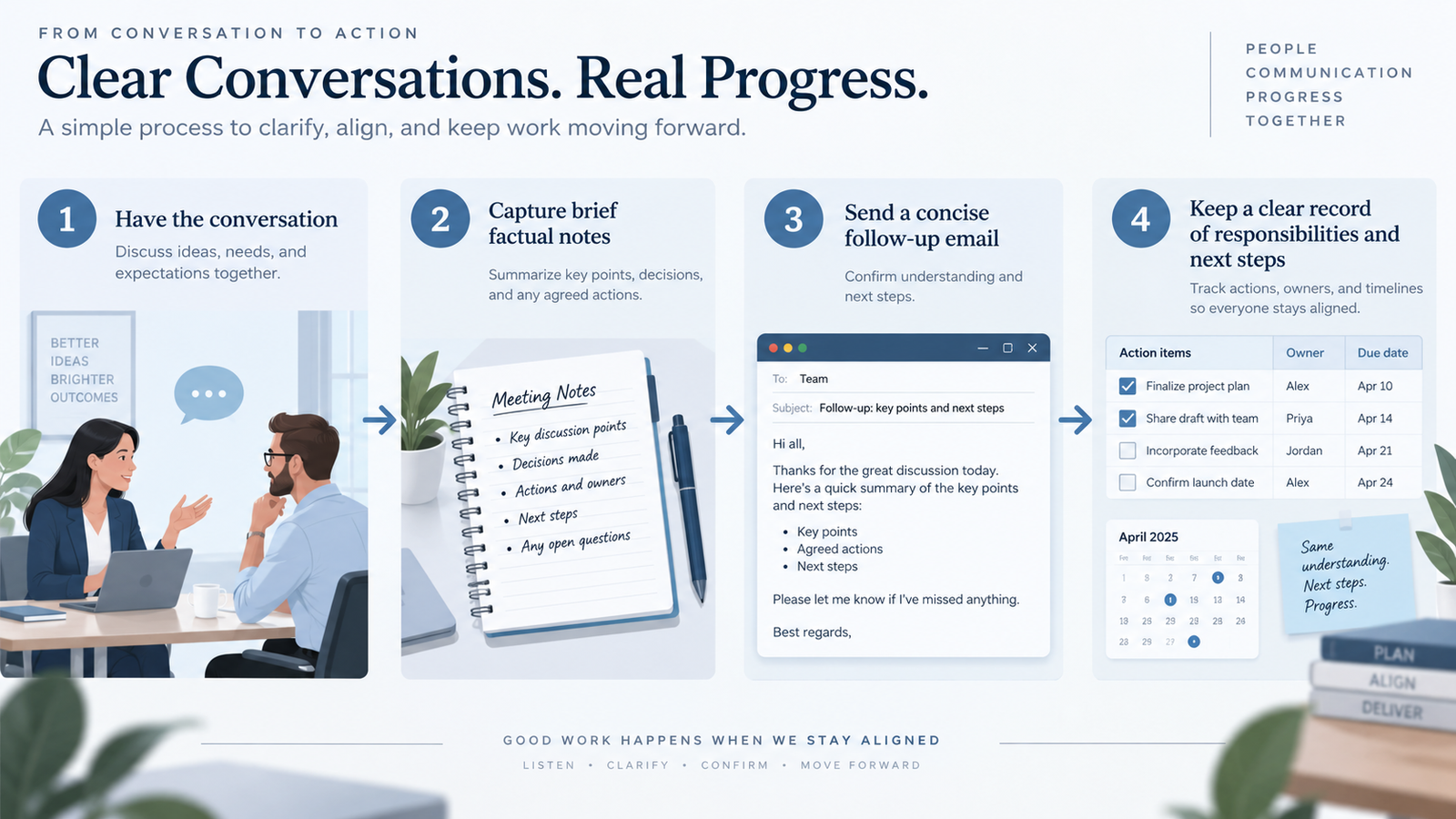
For many workplace discussions, you need nothing more complicated than this:
Subject: Follow-Up: [Topic]
Hi [Name],
Thank you for speaking with me today about [topic].
To confirm my understanding, we discussed:
- [important point or decision];
- [responsibility or action];
- [deadline or next step].
I will [your action] by [date/time]. My understanding is that [other person’s/team’s action] will happen by [date/time, if applicable].
Please let me know if I have misunderstood anything above.
Thanks,
[Name]
Simple is often stronger than elaborate.
Example 1: Follow-Up Email After a Changed Deadline
Subject: Follow-Up: Client Report Deadline
Hi Marcus,
Thank you for speaking with me this morning about the client report.
To confirm my understanding, the revised deadline is Thursday, September 24 at 3 p.m. I will complete the final edits and send the report to you for approval by noon. You will review the pricing section before the report is sent to the client.
Please let me know if I have misunderstood the revised deadline or approval process.
Thanks,
Elena
Notice what this email does not say:
“I am putting this in writing because you keep changing deadlines.”
The written confirmation itself does the useful work.
Example 2: Follow-Up Email After Difficult Performance Feedback
Performance conversations are harder because the natural impulse may be to defend your entire record.
Do not try to rebut five years of work history in one email.
Confirm the specific concern and what improvement is expected.
Subject: Follow-Up on Today’s Performance Discussion
Hi Priya,
Thank you for meeting with me today.
I want to confirm my understanding of the feedback we discussed. The main concern raised was that project updates have not been provided early enough when deadlines may be at risk.
Going forward, I will flag any potential delay as soon as I identify it and include the expected impact and proposed next step. We agreed to review progress during our weekly one-to-one meetings over the next four weeks.
If there are additional specific examples or expectations I should include in this plan, please send them so I can address them accurately.
Regards,
Daniel
This does not automatically mean that you agree with every criticism.
It creates clarity about what criticism was actually made and what is expected next.
Example 3: Follow-Up Email When You Disagree With What Was Said
A follow-up email does not have to pretend agreement when there was none.
The key is separating disagreement from accusation.
Subject: Follow-Up on Project Review Discussion
Hi Alex,
I am following up on today’s discussion regarding the delayed client submission.
During the meeting, you stated that I was responsible for the delay because the final document was not delivered by Tuesday.
I explained that I submitted the document for required approval on Monday at 10:15 a.m. and received approval Wednesday at 2:40 p.m. My understanding of the current process is that client documents cannot be sent before manager approval.
Going forward, I would appreciate clarification on whether that approval requirement has changed so I can follow the correct process on future submissions.
Regards,
Jordan
The email corrects the record without saying:
“You unfairly blamed me for your own failure.”
When responsibility repeatedly moves after problems occur, see our guide to blame-shifting at work.
Example 4: Follow-Up Email After a Verbal Instruction
This can be extremely simple.
Subject: Confirming Today’s Project Instructions
Hi Sarah,
Confirming my understanding from our conversation this afternoon: I will send the revised proposal directly to the client once the finance changes have been incorporated. No additional internal approval is required before sending.
I expect to complete this by 4 p.m. tomorrow.
Please let me know if I have misunderstood the process.
Thanks,
Amir
This kind of confirmation can be useful even when nobody is behaving badly.
People forget.
Managers communicate quickly.
Processes change.
Written clarification protects everyone from unnecessary confusion.
Example 5: Follow-Up Email After Raising a Workplace Concern
If you raised a concern verbally, your follow-up should identify the concern and the agreed next step without unnecessarily escalating the tone.
Subject: Follow-Up to Today’s Conversation
Hi Rebecca,
Thank you for speaking with me this afternoon.
As discussed, I raised concerns regarding repeated comments about my competence during team meetings, including the discussion on September 11.
My understanding is that you will review the issue and speak with me again by Friday about the appropriate next steps.
Please let me know if I have misunderstood the follow-up process.
Regards,
Nadia
If the issue is serious enough to require formal reporting, do not assume that this email alone replaces your employer’s grievance, harassment or complaint procedure.
Example 6: Follow-Up Email After Setting a Boundary
A workplace boundary often works better when it is expressed as an operational limitation rather than a declaration about another person’s behavior.
Subject: Follow-Up on Workload Priorities
Hi Michael,
Following up on our conversation today, I currently have the quarterly report, client presentation and audit response due this week.
We agreed that the audit response will become the immediate priority and that the client presentation deadline will move to Monday.
I will continue with the quarterly report after the audit response is submitted.
Please let me know if I have misunderstood the priority order.
Thanks,
Laura
The message does not say:
“I refuse to tolerate your unreasonable workload anymore.”
It creates a usable record of what will and will not be completed.
How Soon Should You Send the Follow-Up Email?
Where practical, send it while the discussion is still fresh.
That may mean:
- later the same day;
- after you have had enough time to calm down and check the wording;
- the next working morning if the meeting happened late in the day.
Do not sacrifice accuracy simply to send something immediately.
If you are angry, frightened or deeply upset, draft the message and reread it before sending.
Ask:
Does this email document the conversation, or am I using it to continue the argument?
If it continues the argument, revise it.
What Subject Line Should You Use?
Keep the subject line boring.
That is usually a good thing.
Examples include:
- Follow-Up: Project Review
- Follow-Up to Today’s Meeting
- Confirming Project Responsibilities
- Follow-Up: Client Deadline
- Summary of Today’s Discussion
- Confirming Next Steps
- Follow-Up on Performance Discussion
Avoid subject lines such as:
- Proof of What You Said
- Documentation for HR
- Your Unacceptable Behavior
- Putting This on the Record
- Formal Evidence of Today’s Conversation
There may be formal circumstances where stronger terminology is appropriate, but an ordinary clarification email generally does not need to sound like litigation correspondence.
Should You Write “For Documentation Purposes”?
Usually, you do not need to.
The email already creates a written record.
Writing:
“For documentation purposes, I am putting today’s conversation on the record…”
can unnecessarily change the tone if your main goal is simply clarity.
A calmer opening is often:
“I wanted to follow up to confirm my understanding of today’s discussion.”
There are situations where explicitly stating that you are making a formal record may be appropriate, particularly in a grievance or formal process. But that is different from routine professional follow-up.
What Not to Write in a Follow-Up Email
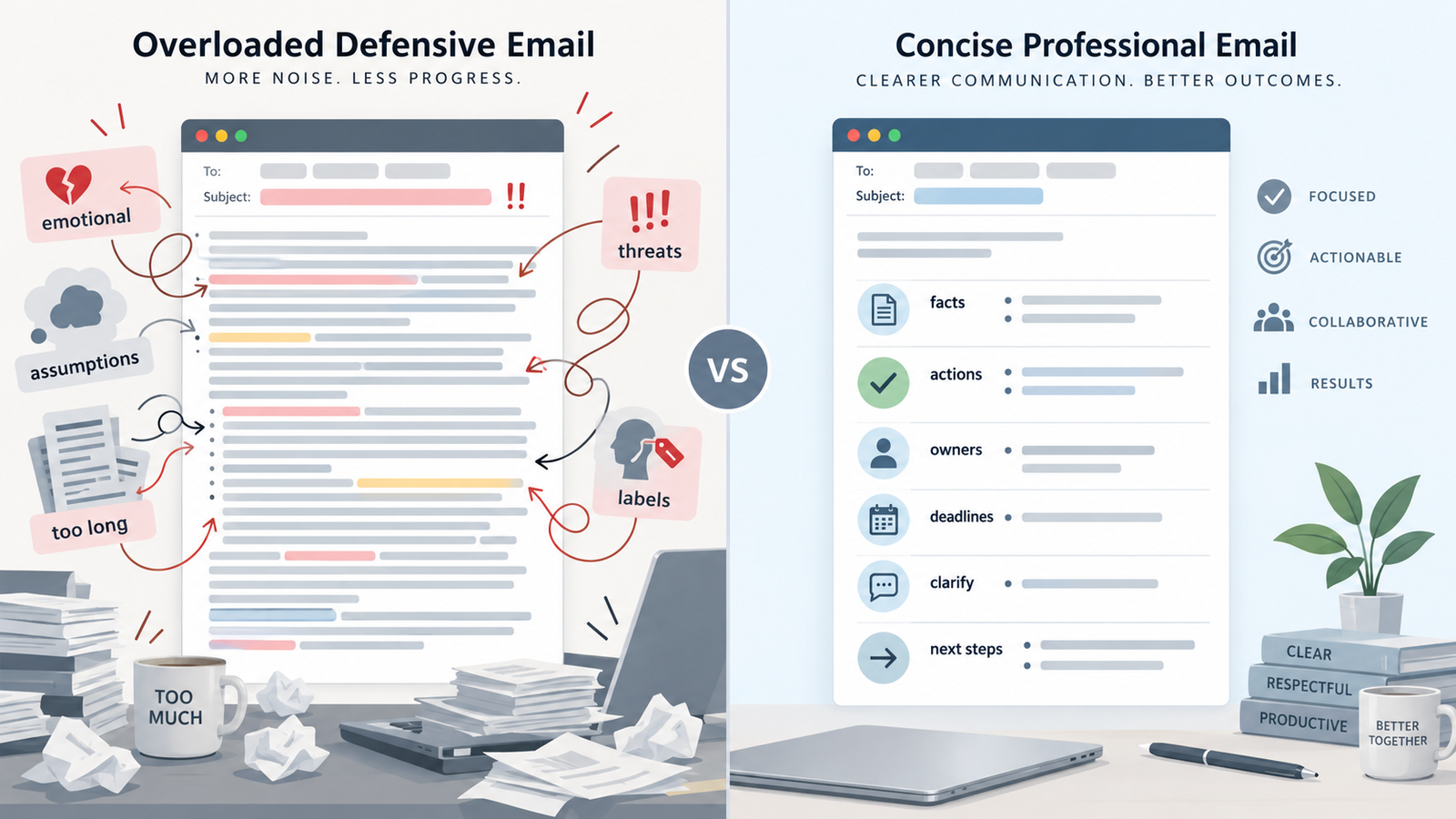
Do Not Diagnose the Person
Avoid:
“Your narcissistic behavior today was unacceptable.”
Document the conduct instead.
Do Not Claim Motive as Fact
Avoid:
“You changed the deadline because you want me to fail.”
Prefer:
“The original project schedule listed Friday. During today’s meeting, the deadline was changed to Wednesday.”
Do Not Write While Trying to Win the Emotional Argument
A 1,500-word email defending your personality, work ethic and entire career may bury the one fact that actually matters.
Do Not Include Threats You Do Not Need
Avoid unnecessarily writing:
“If this happens again, I will take this to HR and my lawyer.”
If escalation becomes necessary, you can escalate through the appropriate channel.
Do Not Copy Half the Organization to Create Pressure
Adding senior executives, HR and unrelated coworkers may escalate a situation that could have been clarified directly.
Copy only people who genuinely need to be part of the communication.
Do Not Pretend Agreement
You can confirm what the other person said without agreeing with it.
For example:
“You stated that there were concerns about my communication on Project X. I asked for specific examples and understand that these will be provided before our next meeting.”
That accurately documents disagreement without manufacturing consensus.
What If Your Boss Does Not Reply?
A follow-up email does not become useless merely because nobody responds.
You sent your understanding of the conversation and provided an opportunity for clarification.
But silence does not automatically mean that the recipient legally or formally agreed with everything you wrote.
Do not write:
“Since you did not reply, you have accepted my version as true.”
Simply retain the email as part of your records where appropriate.
If the next action depends on a response, follow up directly:
“I need confirmation of the approval requirement before sending the proposal. Please confirm which process I should follow.”
What If They Reply and Deny the Conversation?
This is where remaining calm matters.
Suppose you send:
“My understanding is that the deadline was moved to Monday.”
Your manager replies:
“I never said that.”
Avoid immediately sending:
“Yes you did, and everyone knows you are lying.”
Instead, look for clarification.
For example:
“Thank you for clarifying. Please confirm the current deadline you would like me to follow so I can proceed correctly.”
If written evidence exists:
“Thank you. The project message from Tuesday lists Monday as the deadline. Has that now changed to Friday?”
When conversations and instructions are repeatedly denied despite records, the broader pattern may be worth comparing with the signs of workplace gaslighting.
What If You Need to Correct Something You Said?
A follow-up email can also protect your credibility by correcting your own mistake.
For example:
Subject: Correction to Today’s Discussion
Hi James,
I want to correct one point from our discussion this morning.
I stated that the client approved the revised scope on September 8. After checking the project record, the approval was actually received September 9.
The rest of the timeline I described remains unchanged.
I wanted to correct that date so the record is accurate.
Regards,
Sofia
Correcting your own record when necessary does not weaken your documentation.
It can strengthen its credibility.
Follow-Up Email vs. Workplace Incident Log: What’s the Difference?
| Follow-Up Email | Incident Log |
|---|---|
| Sent to another person | Usually maintained as your own record |
| Confirms shared understanding | Preserves your chronology |
| Usually concise | Can contain more detailed context |
| Focuses on decisions and next steps | Can also record witnesses, evidence and impact |
| May invite correction | Records what you personally observed or experienced |
| Part of ongoing workplace communication | Part of broader documentation |
The two tools can work together.
Your email may say:
“Confirming that I will submit the draft Friday and wait for approval before client delivery.”
Your private incident log might additionally record the disagreement that led to the email, who was present, the prior instruction and the professional impact.
For a full structure, use our free workplace incident log template.
When Follow-Up Emails Become a Pattern of Self-Protection
There is an important difference between occasionally confirming significant conversations and feeling that every verbal interaction must be converted into evidence because nothing feels stable.
You may notice that you now:
- send summaries after every meeting;
- save screenshots of ordinary instructions;
- ask for every deadline in writing;
- fear relying on anything said verbally;
- need proof that responsibilities were assigned;
- expect previous conversations to be denied.
This does not automatically prove workplace abuse.
Your workplace may simply be disorganized.
Your manager may communicate badly.
But the reason you feel compelled to document everything may itself deserve attention.
If repeated control and constant approval are part of the problem, compare the pattern with micromanagement vs. controlling boss behavior.
For the broader documentation framework, including timelines, evidence, witnesses and escalation, read how to document workplace abuse calmly and clearly.
Do Not Use Follow-Up Emails to Build a Secret Case Against Everyone
Documentation should create clarity.
It should not turn every workplace relationship into an investigation.
If you begin reading every sentence as potential evidence, your own stress can increase dramatically.
Use written follow-up strategically when:
- the issue matters;
- responsibility needs clarification;
- a decision needs confirmation;
- the consequences could be significant;
- the conversation forms part of an existing pattern.
The purpose is not to catch someone.
The purpose is to reduce uncertainty.
SHRM’s workplace documentation guidance similarly discusses follow-up email as a way to establish that a conversation occurred and document what was discussed. See the SHRM guidance on workplace documentation.
Before You Press Send: A 10-Question Check
- Does the subject line clearly identify the topic?
- Have I accurately summarized what was discussed?
- Did I separate facts from assumptions about motive?
- Are responsibilities clear?
- Are deadlines or next steps clear?
- Did I avoid unnecessary insults, diagnoses or emotional accusations?
- Did I avoid pretending we agreed when we did not?
- Is every person copied on the email genuinely necessary?
- Have I invited correction of genuine misunderstandings?
- Would I be comfortable with this email being read later by a neutral manager or HR professional?
If the answer to the final question is no, reread the message before sending.
Frequently Asked Questions
How do you follow up after a verbal conversation at work?
Send a short email identifying the conversation, summarizing the important facts or decisions, confirming responsibilities and deadlines, stating your next action, and asking the recipient to correct anything you misunderstood. Avoid recreating every emotional detail of the conversation.
How do I professionally confirm a verbal agreement by email?
You can write: “Following up on our conversation today, my understanding is that I will complete X by Friday and you will approve Y before client submission. Please let me know if I have misunderstood anything.” Keep the wording specific and neutral.
How do I document a difficult conversation with my boss?
Record the date, issue discussed, important statements or decisions, responsibilities, deadlines and next steps. A concise follow-up email can establish shared understanding, while a separate incident log can preserve additional context, evidence, witnesses and professional impact.
Should I send a follow-up email after a verbal warning?
If the warning could affect your performance record, responsibilities, discipline or job status, written clarification may be useful. Confirm what concern was raised, any examples provided, what improvement is expected and the next review step. Review your workplace policies if the warning is part of a formal procedure.
What if my boss refuses to confirm the conversation in writing?
You can still send your own concise summary and request clarification of any points you misunderstood. A lack of response does not automatically mean the other person legally agrees with your account, but the email preserves what you understood at the time.
Can a follow-up email be used as workplace documentation?
Yes, it can form part of a broader workplace record because it shows what you understood and communicated at a particular time. Its significance depends on the circumstances. An email does not automatically prove that every statement in it is correct.
Should I copy HR on a follow-up email to my boss?
Not automatically. Copy HR when there is a genuine reason for HR to be involved, such as an existing formal process, serious complaint or instruction to include them. Copying HR on every disagreement can escalate routine issues unnecessarily.
Conclusion: Write the Email You Would Want to Read Six Months Later
A difficult verbal conversation can leave you replaying every sentence.
You may wonder:
What exactly did we agree?
Who owns the next step?
Was the deadline changed?
What if this conversation is remembered differently later?
A good follow-up email answers those questions without turning the communication into another conflict.
Keep it simple:
- acknowledge the conversation;
- identify the issue;
- summarize the important facts;
- confirm responsibilities;
- record deadlines and next steps;
- invite factual clarification.
You do not have to prove someone’s motives.
You do not have to diagnose them.
You do not have to write the longest email.
You need enough written clarity that you do not have to depend entirely on memory if the conversation becomes important later.
When One Email Is Not Enough, Build a Clearer Protection System
A follow-up email is one communication tool.
It becomes particularly important when you are dealing with changing instructions, denied conversations, blame-shifting, performance narratives, repeated boundary problems or other workplace dynamics that leave you unsure what was actually agreed.
Reclaim Your Power goes beyond the individual email.
Chapter 4 focuses on protecting yourself while difficult workplace dynamics are still happening, including calm communication, documentation, boundaries and decisions about escalation. The accompanying workbook provides a more structured system for preserving incidents, identifying patterns and deciding what to do next.
Explore Reclaim Your Power and the complete workplace protection workbook.
The goal is not to turn every conversation into evidence.
It is to stop important conversations from disappearing into confusion.
Ready to Reclaim Your Power?
Get the complete 7-chapter guide, workbook exercises, and 30-day recovery journal.
Buy Now — $4.99
Leave a Reply