
If you are comparing micromanagement vs controlling boss behavior, the simplest difference is this: a micromanager mainly tries to control how you perform your work, while a controlling boss may try to control a much wider part of your working life. That can include who you speak to, what decisions you make, how independently you operate, what information you receive, and even how you respond to the manager’s authority.
Micromanagement vs Controlling Boss: The Core Difference
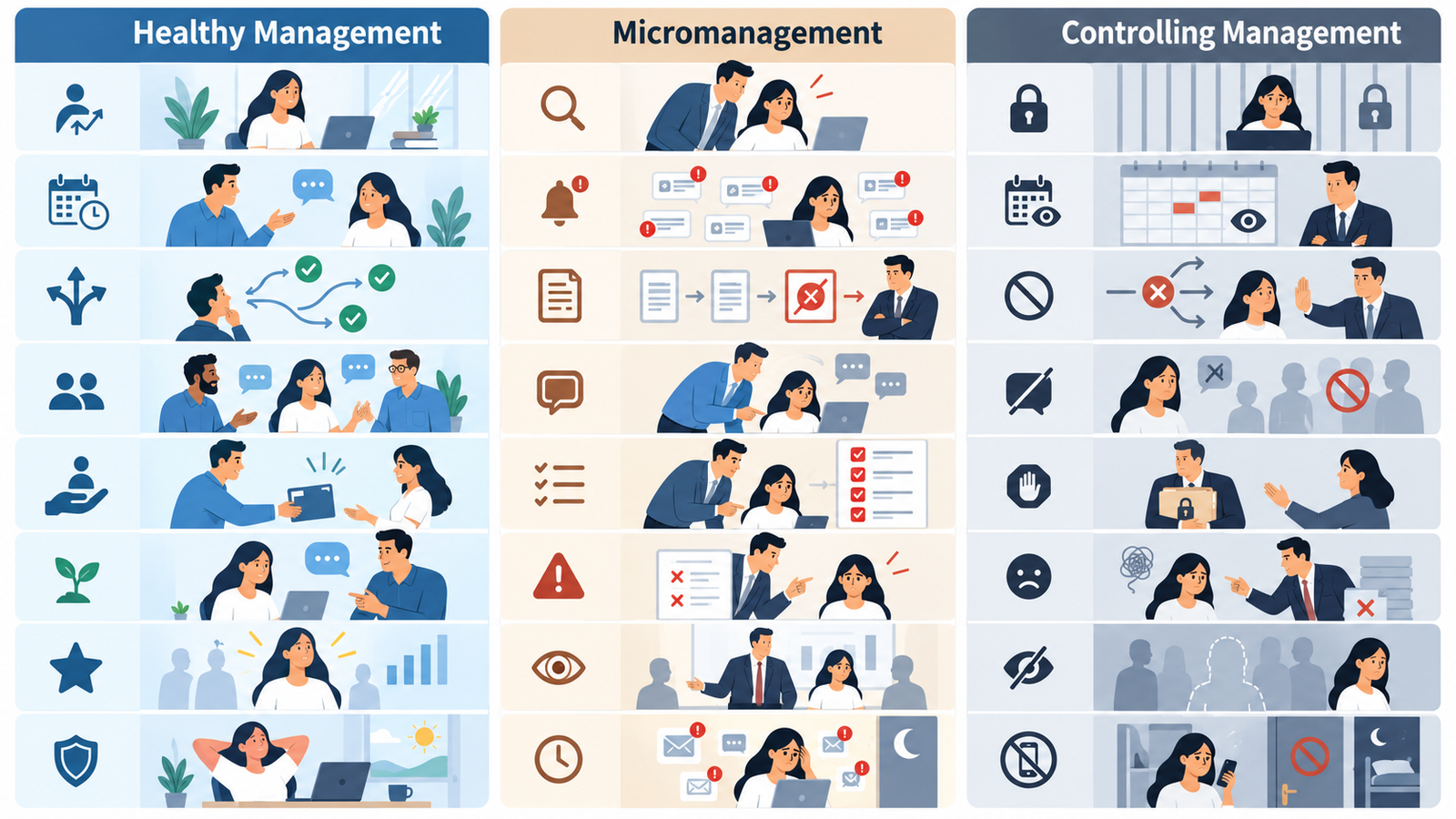
The words micromanaging and controlling are often used as though they mean exactly the same thing. In real workplaces, however, making a distinction can help you understand what kind of problem you are facing.
Micromanagement usually involves excessive involvement in the details of your work.
Your manager may want to approve every email, check every stage of a routine task, dictate exactly how something should be done, request constant progress updates, or repeatedly alter work that you were fully capable of completing independently.
Broader controlling behavior can include micromanagement, but the manager’s need for control extends beyond the task itself.
They may want to control who you communicate with, what information you receive, whether senior people see your work, how independently you make decisions, whether you form relationships outside their direct influence, or how available you remain outside normal working expectations.
One simple distinction is:
- A micromanager communicates: “I need to control how this work gets done.”
- A broadly controlling manager may communicate: “I need to control how independently you are allowed to operate.”
The categories can overlap. A manager can be both a micromanager and broadly controlling.
It is also important not to jump immediately from “controlling” to a personality diagnosis. A demanding, insecure, inexperienced, disorganized, or anxious manager can behave badly without having a personality disorder. If you are trying to separate difficult management from a deeper recurring pattern, our comparison of a narcissistic boss vs. difficult boss explains that distinction in more detail.
The purpose here is not to attach a psychological label to your boss. It is to recognize which behaviors are affecting your ability to work effectively.
| Area | Healthy Management | Micromanagement | Broader Controlling Behavior |
|---|---|---|---|
| Goals | Defines outcomes and priorities | Defines outcomes and also dictates unnecessary details | May change expectations in ways that maintain dependence |
| Check-ins | Scheduled and proportionate | Excessive or repetitive | May begin to feel like surveillance |
| Decisions | Delegates appropriate authority | Requires approval for minor decisions | May deliberately centralize decision-making around the manager |
| Communication | Encourages appropriate collaboration | Wants unnecessary visibility into communication | May restrict who you can contact independently |
| Mistakes | Corrects and coaches | Attempts to prevent every minor error | May use mistakes to justify additional restrictions |
| Professional expertise | Values employee knowledge | Frequently overrides reasonable methods | May undermine expertise when independence threatens control |
| Visibility | Provides appropriate recognition | May over-edit or take over presentations | May gatekeep leaders, opportunities, clients, or recognition |
| Boundaries | Respects reasonable limits | May over-monitor availability | May interpret boundaries as disobedience or disloyalty |
| Autonomy over time | Usually increases with competence | Remains unnecessarily limited | May remain limited because dependence preserves the manager’s control |
What Does Micromanagement Look Like at Work?
Micromanagement is not simply having a manager who checks your work.
Good managers are sometimes deeply involved in projects. They may check progress closely when deadlines are tight, when an employee is learning, or when the consequences of an error are serious.
The more useful question is whether the supervision helps you become capable of working independently or keeps you dependent on constant approval.
1. Your Boss Needs Constant Updates
You have already explained what you are doing, but an hour later another message arrives asking for progress.
Then another.
Then you are asked for a written update before a meeting where you will be asked for the same information again.
Eventually, reporting on the work begins consuming time that should have been spent doing the work.
A reasonable check-in usually serves a clear purpose. Excessive checking can reflect a manager who is uncomfortable whenever they cannot see every stage of the process.
2. Minor Decisions Require Approval
Routine decisions that clearly fall within your responsibilities still require managerial permission.
You may need approval before sending an ordinary email, contacting another department, adjusting a small project detail, arranging a normal meeting, or solving a straightforward problem.
This creates a difficult situation: you are responsible for delivering results but do not have enough authority to produce those results efficiently.
3. Your Manager Dictates the Method Instead of the Outcome
Some jobs legitimately require strict processes.
Financial controls, legal requirements, safety procedures, security protocols, medical procedures, and regulated work may all require specific steps.
But if there is no meaningful reason that one method must be followed and your manager still insists that every task be completed exactly as they would personally do it, the problem may be micromanagement.
4. Your Work Is Constantly Rewritten
Professional feedback is normal. Micromanagement is something different.
Your boss may repeatedly replace harmless wording with their own wording, rearrange work without materially improving it, or revise so many insignificant details that you stop feeling responsible for the finished product.
Eventually you may start thinking:
“Why should I decide anything? They are going to redo it anyway.”
That loss of ownership can become one of the most damaging effects of micromanagement.
5. Delegation Exists in Name Only
The manager assigns you responsibility but retains control over virtually every meaningful choice.
You carry the accountability while they retain the authority.
This is why productive coaching and micromanagement should not be confused. A good coach helps you become capable of producing the outcome. A micromanager may struggle to let go of the process itself.
6. You Spend More Time Reassuring Your Boss Than Managing the Work
You begin sending extra screenshots, drafts, progress messages, emails, status reports, and calendar updates mainly to prevent your manager from asking whether something is being handled.
Proactive communication can sometimes improve a difficult working relationship.
But when reassuring your manager becomes a second job, the management system is no longer functioning efficiently.
What Does a Controlling Boss Look Like?
A controlling boss is not a formal medical, psychological, or legal diagnosis.
Here, the term simply describes a management pattern in which efforts to maintain authority extend beyond reasonable supervision of your work.
The pattern deserves particular attention when your manager appears uncomfortable not just with errors, but with your independence itself.
1. They Control Access to Other People
Your boss may insist that nearly all communication with senior leaders, clients, vendors, or other departments must go through them.
Sometimes this is appropriate. Certain positions legitimately require centralized communication.
But if direct communication would normally be part of your role and you are repeatedly prevented from developing ordinary professional relationships, it is worth asking why.
2. They Withhold Information
Information can become a form of power in unhealthy workplaces.
You may receive incomplete instructions and later be criticized for not knowing what was never explained.
Important context may be provided after decisions have already been made.
You may discover that colleagues received information necessary to do their jobs while you did not.
One communication failure proves very little. Repeated strategic information gaps are more significant.
3. Independence Is Treated Like Disloyalty
You solve a problem without asking first and your manager becomes more concerned that you acted independently than whether the solution was correct.
You speak confidently in a meeting and notice their behavior toward you change afterward.
You build a productive relationship with another department and suddenly your boss wants to insert themselves into every interaction.
At this point, the question may no longer be whether your work is good enough. The issue may be that you are demonstrating agency outside the manager’s immediate control.
4. They Gatekeep Professional Visibility and Credit
Managers naturally represent their teams in some situations.
However, consistently preventing employees from presenting their own work, limiting contact with senior leaders, withholding recognition, or presenting an employee’s contribution as the manager’s own can damage both visibility and career progression.
If your work repeatedly becomes less visible as the audience becomes more senior, it may also help to understand the specific patterns involved in credit stealing at work and how to preserve a clearer professional record of your contributions.
5. Reasonable Boundaries Trigger an Unreasonable Reaction
A workplace boundary might include declining a non-urgent late-night request, requesting priorities before accepting additional work, asking for instructions in writing, or explaining that a new deadline requires another task to move.
A manager is allowed to disagree with you.
The more concerning pattern appears when respectful boundaries repeatedly produce hostility, exclusion, guilt, punishment, threats, or accusations that you are uncommitted.
6. The Rules Change According to Your Level of Compliance
One week you are told to show initiative.
The next week you are criticized for making a decision without permission.
You are told to ask questions, but questions are treated as incompetence.
You are told to speak honestly, but disagreement produces consequences.
When expectations repeatedly shift, employees can stop focusing on good work and start focusing on predicting the manager’s reaction.
Why the Difference Matters
If your manager is primarily micromanaging because they are inexperienced, worried about quality, under deadline pressure, or uncertain whether they can trust the process, communication changes may genuinely improve the relationship.
You may be able to reduce unnecessary involvement through scheduled updates, defined milestones, clearer responsibilities, and explicit decision boundaries.
Broader controlling behavior can be more difficult to solve through reassurance alone.
If you repeatedly prove that you are reliable and every demonstration of independence simply produces another restriction, the problem may not be lack of trust in your work.
The manager may be uncomfortable with losing control.
Autonomy is not simply a workplace luxury. The American Psychological Association’s overview of employee control and occupational stress notes that having greater control over job-related decisions can affect worker stress, motivation, morale, and the ability to handle workload.
Is It Micromanagement, Legitimate Oversight, or Something More?
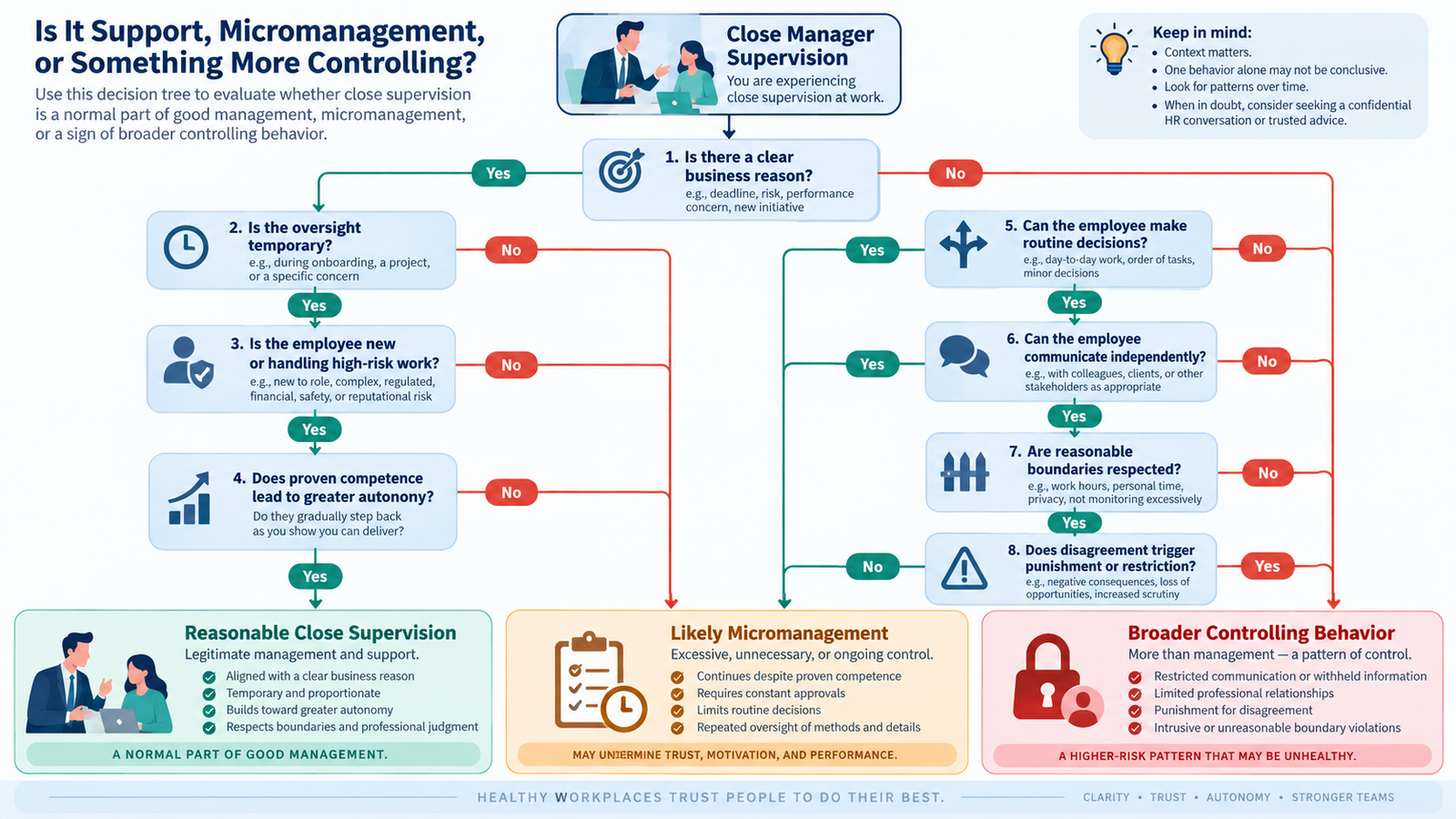
Close Supervision May Be Reasonable When:
- You have recently joined the organization.
- You are learning an unfamiliar responsibility.
- A mistake could cause serious financial consequences.
- The work involves legal, security, safety, or regulatory risk.
- A major deadline or crisis requires temporarily closer coordination.
- A client has specific approval requirements.
- Your recent work has contained significant errors.
- You are working through a formal performance improvement process.
- The organization is managing a sensitive transition.
The real test is often what happens after the need for close supervision decreases.
As you demonstrate competence, does the manager gradually step back?
Do they explain why approvals are required?
Can you earn greater authority?
Are normal decisions eventually delegated to you?
If yes, you may be dealing with intensive but legitimate management rather than chronic micromanagement.
Ask Yourself These Seven Questions
- Is there a clear business reason for the level of oversight?
- Is the supervision proportionate to the actual risk?
- Does the manager apply similar standards consistently?
- Can I earn more autonomy through reliable performance?
- Am I allowed to use professional judgment within my role?
- Can I respectfully disagree without experiencing punishment?
- Is the manager controlling the work, or also increasingly controlling my relationships, information, visibility, and boundaries?
Those answers are usually more useful than simply asking whether your boss fits a particular label.
How Micromanagement Can Affect Your Confidence
The most frustrating part of micromanagement is not always the extra checking.
It is the message that constant checking can begin communicating.
Over time, you may hear an unspoken message:
“Your judgment cannot be trusted unless someone supervises it.”
If this continues long enough, it can change the way you work.
You Start Second-Guessing Ordinary Decisions
You once made routine decisions automatically.
Now you hesitate.
Instead of asking what makes sense professionally, you ask what your manager is most likely to approve.
You Become Less Proactive
If initiative repeatedly creates criticism, asking permission can begin to feel safer than acting independently.
This can create a destructive cycle.
The employee becomes less independent because independence is punished. The manager then interprets reduced initiative as evidence that even more supervision is necessary.
Your Attention Moves From the Work to the Manager
Instead of asking:
“What does this customer, project, or problem need?”
You begin asking:
“What will keep my boss satisfied?”
That shift can damage creativity, judgment, motivation, and performance.
You May Start Doubting Skills You Previously Trusted
Constant correction can make capable employees question abilities they successfully used in previous roles.
You may wonder how you suddenly became so incapable when the real change was not your competence but the environment in which you were working.
Repeated self-doubt can also appear when instructions, standards, or past conversations are constantly rewritten. If that is part of your experience, compare it with these signs of workplace gaslighting and the ways reality-distorting workplace patterns can gradually weaken trust in your own judgment.
Workplace stress itself should not be dismissed. The CDC’s National Institute for Occupational Safety and Health describes job stress as harmful physical and emotional responses that can occur when job requirements do not match a worker’s capabilities, resources, or needs.
What to Do When Your Boss Is Micromanaging or Controlling You

You do not need to begin by telling your manager:
“You’re a micromanager.”
Labels often start arguments.
Specific behaviors create opportunities for discussion.
Step 1: Identify the Exact Behavior
Instead of writing:
“My boss is controlling.”
Write something concrete:
“For the last four routine client emails, I was required to submit each message for approval even though client correspondence is part of my assigned responsibilities.”
Or:
“I currently provide a written morning update, attend a daily status meeting, and receive additional progress requests throughout the day covering the same tasks.”
Specificity helps you understand whether a real pattern exists.
Step 2: Clarify What Success Looks Like
Before arguing about autonomy, make expectations explicit.
You can ask:
- What outcome matters most?
- Which parts specifically require your approval?
- Which decisions can I make independently?
- When would you like progress updates?
- What would reassure you that the project is on track?
Sometimes poor management processes create unnecessary supervision. Clear expectations can remove part of the problem.
Step 3: Replace Constant Interruptions With Predictable Updates
If your manager repeatedly checks progress, try creating a predictable communication system.
For example:
“I can send you an update at 11 a.m. and another before I finish for the day. If I become blocked or the deadline is at risk, I’ll tell you immediately. Would that give you enough visibility without us needing separate progress checks throughout the day?”
This provides information while protecting your concentration.
Step 4: Ask for Clear Decision Boundaries
A useful question is:
“Which decisions would you like me to make independently, and which ones should I bring to you?”
This turns an emotional issue into an operational one.
If your manager cannot identify any meaningful decision you can make without approval, that itself reveals something about the level of autonomy available in your role.
Step 5: Test Whether Reliability Creates Trust
Meet important deadlines.
Raise problems early.
Keep commitments.
Confirm priorities.
Avoid unnecessary surprises.
You are not doing this because excessive control is automatically your responsibility to fix.
You are testing an important question:
Does stronger performance produce greater autonomy?
If it does, the relationship may improve.
If performance remains strong and your manager continues increasing control, the problem may be broader than concerns about your work.
Step 6: Set Small Professional Boundaries
You do not have to begin with a dramatic confrontation.
Try specific requests connected to the work:
- “I’d like to complete the first draft independently and bring it to you at 3 p.m.”
- “I can respond tomorrow morning unless this requires action tonight.”
- “To complete this new task by Friday, which current priority should move?”
- “Could we agree on one review stage rather than reviewing every intermediate version?”
Pay attention not just to whether the answer is yes or no, but to how your manager responds to a reasonable request for clarity or independence.
Step 7: Document Important Patterns
Keep factual records of significant incidents when expectations repeatedly change, approvals delay work, instructions conflict, or you are concerned about retaliation.
Document:
- the date;
- the task;
- the instruction given;
- what action you took;
- what subsequently changed;
- the effect on the work.
For example:
“September 14: requested authorization at 10:10 a.m.; approval received at 4:40 p.m.; client submission moved to the following morning.”
This is more useful than writing:
“My boss ruined everything again.”
Good documentation can help you understand the situation and support a professional discussion with your manager, HR, a skip-level leader, or another appropriate workplace resource.
For a more detailed example of documenting timelines, approval structures, evidence, and responsibility without relying on emotional labels, see our guide to blame-shifting at work.
Step 8: Escalate Behaviors Rather Than Diagnosing Personality
If you eventually raise the issue with HR or senior management, avoid making your entire case depend on terms such as “toxic,” “narcissistic,” “control freak,” or “abusive personality.”
Describe what actually happened.
For example:
“I’m seeking help clarifying decision authority. Routine work currently requires multiple approvals, and this has delayed three deliverables this month. I proposed a structured review system with my manager, but the approval requirements remain unchanged.”
This gives the organization something concrete to evaluate.
Step 9: Recognize When the Environment May Not Change
Some management relationships improve substantially once communication and responsibilities are clarified.
Others do not.
Consider whether the workplace may require a bigger decision if:
- strong performance never produces greater trust;
- expectations constantly change;
- reasonable boundaries lead to punishment;
- you are systematically isolated from colleagues or leaders;
- your credibility is repeatedly undermined;
- you are held responsible for outcomes while being denied authority;
- raising reasonable concerns repeatedly makes your situation worse;
- workplace stress is seriously affecting the rest of your life.
Your next step might involve seeking an internal transfer, consulting HR, obtaining independent employment or legal advice where appropriate, or beginning a careful search for another role.
What Not to Do With a Micromanaging Boss
Do Not Suddenly Stop Communicating
If your manager already worries about losing visibility, disappearing from communication can intensify the behavior.
Instead of eliminating updates, try replacing random interruptions with structured updates.
Do Not Try to Diagnose Your Manager
You may believe their behavior comes from insecurity, anxiety, jealousy, perfectionism, narcissism, or fear.
You could be right.
You could also be wrong.
You usually do not need to know the private motivation behind someone’s behavior to decide whether the behavior is acceptable or workable.
Do Not Treat Every Correction as Micromanagement
Your manager is still responsible for standards, performance, quality, and deadlines.
Receiving feedback does not mean you are being controlled.
The question is whether the supervision is proportionate and whether appropriate professional judgment remains available to you.
Do Not Let the Environment Become Your Measurement of Your Worth
A highly controlling workplace can make you feel less capable than you actually are.
Keep your own record of:
- completed projects;
- positive feedback;
- measurable results;
- problems you solved;
- new skills;
- successful relationships;
- work you handled independently.
Your manager’s need for control is not an objective measure of your professional value.
When Micromanagement Starts Looking Like Workplace Manipulation
Micromanagement alone does not prove that a manager is deliberately manipulating you.
People can micromanage because they are inexperienced, under pressure, uncomfortable delegating, perfectionistic, afraid of failure, or working inside an organization that rewards excessive control.
However, the pattern deserves closer attention when excessive supervision appears alongside behaviors such as:
- repeatedly changing expectations and denying previous instructions;
- taking credit for successes while pushing blame downward;
- withholding necessary information and then criticizing you for not knowing it;
- isolating you from colleagues or decision-makers;
- using opportunities or approval to reward compliance;
- undermining your confidence while increasing your dependence;
- punishing respectful disagreement;
- creating conditions where you cannot succeed without their permission and then blaming you for slow results.
When several of these behaviors occur repeatedly, asking only “How can I stop my boss from checking my work so often?” may be too narrow a question.
Patterns involving changing expectations, boundary punishment, isolation, blame, reality distortion, and dependence can overlap with the wider dynamics discussed in our guide to workplace narcissistic abuse.
Again, recognizing overlap does not require you to diagnose another person. The goal is to identify what is happening, protect your professional position, and decide what response is appropriate.
A Simple Test: Is Your Independence Growing or Shrinking?
If you remain unsure whether you are dealing with normal supervision, micromanagement, or something more controlling, look at the direction of the relationship over time.
Imagine two employees starting new jobs.
Both managers initially review their work closely.
After several months, the first employee’s manager says:
“You’ve shown that you understand this. You don’t need me to approve routine cases anymore. Bring me anything unusual.”
The second employee performs equally well.
Instead of reducing oversight, their manager creates more approval requirements, asks for additional status updates, inserts themselves into more conversations, and restricts more decisions.
The initial supervision looked similar.
The direction was completely different.
Healthy management generally tries to build capability.
Chronic micromanagement preserves supervision.
Broader controlling behavior may preserve dependency.
That distinction can tell you much more than the number of times your manager checked your work this week.
Frequently Asked Questions
How do you know if your boss is micromanaging you?
Your boss may be micromanaging you if they demand unnecessary updates, require approval for routine decisions, dictate minor details of how you work, repeatedly redo your work, or struggle to delegate even after you have demonstrated competence. Look for a repeated pattern rather than one unusually demanding project.
What is the difference between micromanaging and being controlling?
Micromanagement usually involves excessive control over how tasks are performed. Broader controlling behavior can extend into communication, relationships, information, professional visibility, boundaries, and your ability to operate independently. A manager can display both patterns at the same time.
How do you deal with a controlling boss without losing your job?
Start with low-conflict strategies. Clarify expectations, establish predictable updates, ask which decisions you can make independently, document important instructions, and frame requests around productivity rather than personality. If the behavior continues or retaliation occurs, consider appropriate internal escalation or independent professional advice.
Can micromanagement be considered workplace harassment?
Micromanagement by itself is not automatically workplace harassment. Legal definitions depend on the jurisdiction and the circumstances. In the United States, for example, EEOC guidance on workplace harassment explains that unlawful harassment under federal equal-employment laws involves additional legal requirements, including connections to protected characteristics. Other countries and jurisdictions have different laws and standards. If you are concerned about your rights, review your workplace policies and seek qualified advice applicable to your location.
Conclusion: Focus Less on the Label and More on the Pattern
The difference between micromanagement and a controlling boss becomes easier to recognize when you ask a simple question:
What exactly is my manager trying to control?
If they repeatedly interfere with the details of your work, require unnecessary approvals, dictate methods, and struggle to delegate, micromanagement may be the most useful description.
If that control expands into your relationships, communication, information, professional visibility, boundaries, and ability to make independent decisions, you may be dealing with a broader workplace control problem.
You do not need to confront your boss with either label.
Your strongest position comes from identifying specific behaviors, documenting their effect, clarifying responsibilities, testing whether trust can improve, and deciding what boundaries or next steps are appropriate.
Most importantly, do not allow months of being second-guessed to convince you that you have lost the ability to think for yourself.
A difficult workplace can gradually train capable people to doubt decisions they once made confidently.
Recognizing the pattern is often the first step toward rebuilding that confidence.
Ready to Reclaim More of Your Confidence at Work?
If constant control, second-guessing, shifting expectations, or workplace manipulation has left you doubting yourself, identifying what is happening is only the beginning.
Reclaim Your Power is a practical guide created to help you recognize manipulation, understand how difficult workplace experiences can affect your confidence, establish stronger boundaries, and begin rebuilding your sense of agency.
Explore Reclaim Your Power and start rebuilding your confidence.
You may not be able to control how your manager chooses to behave. You can become clearer about what you will accept, how you will respond, and where you want your professional life to go next.
Ready to Reclaim Your Power?
Get the complete 7-chapter guide, workbook exercises, and 30-day recovery journal.
Buy Now — $4.99
Leave a Reply