
Your notes do not need to sound dramatic to be useful. In fact, calm and specific documentation is often stronger than a long description of someone’s personality or intentions. The goal is to create a record that helps you remember events accurately, identify patterns, and explain the situation clearly if you later need support.
Why Documenting Workplace Abuse Can Feel So Difficult
People often imagine that if something serious happens at work, they will immediately recognize it, write it down, report it, and know exactly what to do.
Real situations are often much messier.
A difficult workplace pattern may develop slowly. One incident can look like poor communication. Another can look like ordinary criticism. A changed instruction might seem like a misunderstanding. An exclusion from one meeting may appear insignificant.
Only later do you begin noticing that the same type of event keeps happening.
This is one reason workplace abuse can be hard to recognize while you are still inside the situation.
You may also be dealing with stress, deadlines, fear about your job, financial pressure, uncertainty about what is normal, or concern that documenting the situation will somehow make you look difficult.
That is why the purpose of documentation should remain simple:
You are creating clarity.
You do not need to write a legal argument every night.
You do not need to prove another person’s motives.
You do not need to decide immediately whether the correct label is bullying, harassment, gaslighting, discrimination, retaliation, narcissistic abuse, poor management, or something else.
You need a reliable record of what actually happened.
What Workplace Documentation Is — and What It Is Not
Workplace documentation is a chronological record of relevant events, communications, decisions, evidence, and consequences.
It can help you:
- remember events more accurately;
- identify repeated patterns;
- compare later claims with earlier instructions;
- reconstruct who was responsible for which decisions;
- prepare for a conversation with a manager or HR;
- explain a situation to a union representative or employment adviser;
- recognize whether treatment changes after you raise a concern;
- reduce the confusion that can develop when events are repeatedly disputed.
Documentation is not the same as proving that workplace abuse occurred.
It is also not a substitute for legal advice, an investigation, or a formal finding.
The phrase “workplace abuse” itself can describe a wide range of harmful experiences, and legal definitions vary considerably between countries and situations.
If you are unsure whether what you are experiencing is bullying, gaslighting, harassment, or another workplace problem, you can still document it. Our guide comparing bullying, gaslighting, and harassment at work explains why you do not need to settle on a label before protecting your factual record.
What Should You Include in a Workplace Abuse Incident Log?
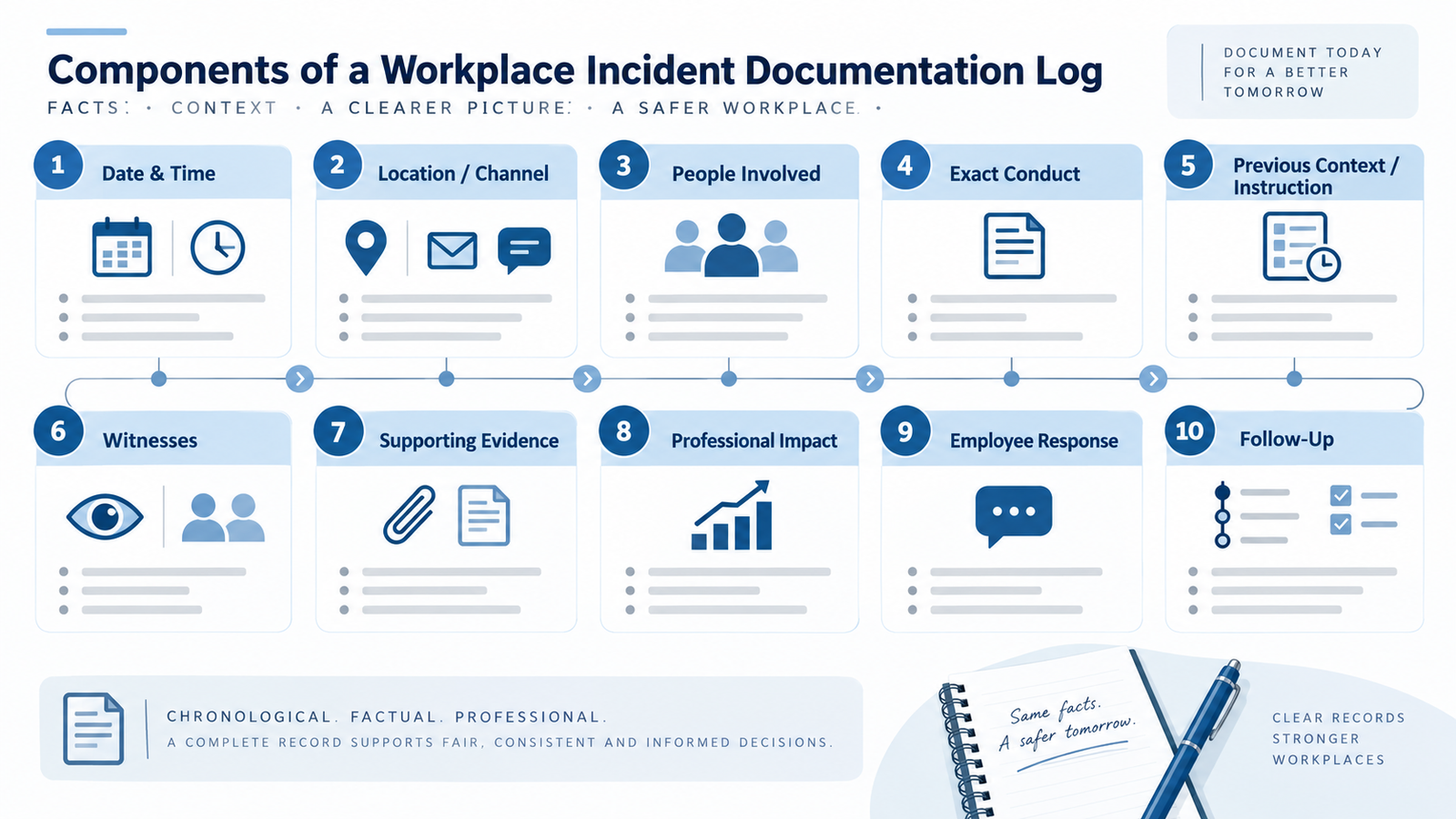
A useful incident log should allow someone who was not present to understand the basic event.
The UK’s Advisory, Conciliation and Arbitration Service recommends keeping a record of workplace bullying that includes what happened, how it affected you, dates and times, evidence, and witnesses. You can review the ACAS guidance on keeping a workplace bullying record.
A practical incident record can include the following fields:
| Field | What to Record |
|---|---|
| Date and time | When the incident or communication occurred |
| Location or channel | Office, meeting room, video call, phone call, email, messaging platform, client site, or another setting |
| People involved | Who participated directly |
| Witnesses | Who was present or may have relevant first-hand information |
| What happened | A factual description of the conduct, decision, statement, omission, or event |
| Exact wording | Important phrases as accurately as you can recall them, clearly distinguishing exact quotes from summaries |
| Previous context | Relevant instructions, responsibilities, deadlines, agreements, or previous events |
| Supporting evidence | Relevant emails, messages, documents, calendars, project logs, legitimate screenshots, or other records |
| Professional impact | How the incident affected deadlines, assignments, reputation, access, performance, clients, pay, opportunities, or work relationships |
| Your response | What you said or did at the time or immediately afterward |
| Follow-up | Any later clarification, correction, escalation, changed treatment, or additional incident |
You do not need every field for every event.
The point is consistency.
Write Facts First, Interpretations Second
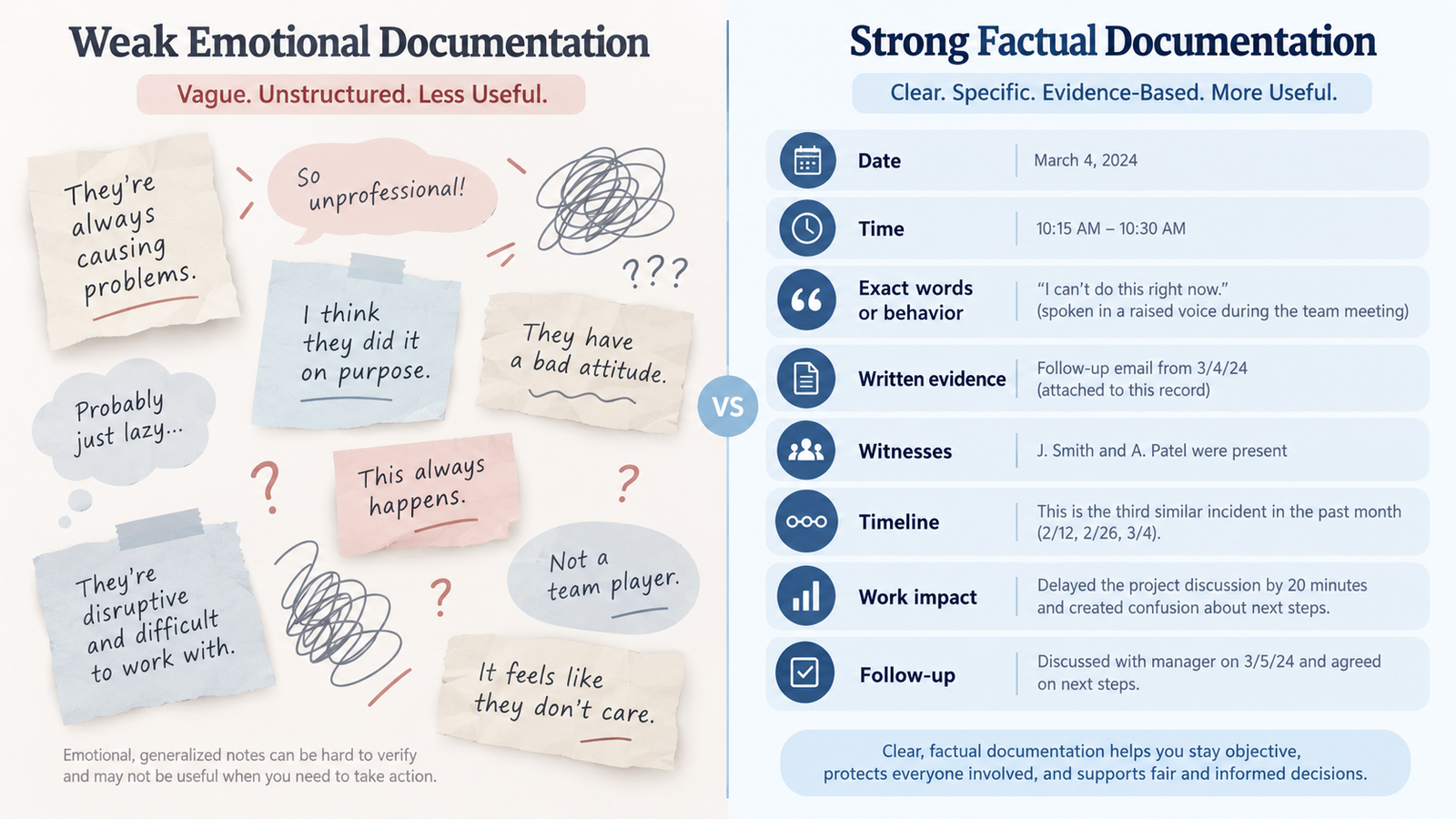
When something humiliating, threatening, confusing, or unfair happens, your emotional reaction is real. But the first version you write may naturally contain conclusions about motives.
For example:
Weak documentation:
“My boss humiliated me because they are threatened by my success and want everyone to think I am incompetent.”
This may describe how the incident felt, but it contains several conclusions that another person cannot independently verify.
A stronger incident record might say:
Stronger documentation:
“On September 8 at approximately 10:20 a.m., during the weekly team meeting, my manager stated that I had failed to send the client report by the agreed deadline. The project email dated September 5 listed the deadline as September 10. I referred to that email during the meeting. My manager said we would discuss it later and continued to state that the report was late. Six members of the project team were present.”
This version does not require the reader to agree with your interpretation.
It gives them an event they can evaluate.
Facts Can Include Emotional Impact
Writing factually does not mean pretending you had no emotional response.
You can record:
“After the meeting, I felt distressed and had difficulty concentrating for the remainder of the afternoon.”
Just keep the reaction separate from the description of the event.
For example:
- Event: what happened.
- Evidence: what supports the account.
- Impact: what changed professionally or personally afterward.
This structure helps prevent your emotional reaction from being used to obscure the underlying facts.
Avoid Trying to Prove Motive
One of the easiest ways to weaken an otherwise useful record is to fill it with claims about what another person secretly intends.
Examples include:
- “They want me fired.”
- “She is jealous of me.”
- “He wants to destroy my confidence.”
- “They are trying to make me quit.”
- “My manager hates successful employees.”
Any of those possibilities could eventually appear consistent with a broader pattern.
But motive is usually harder to establish than conduct.
Instead of documenting:
“My boss is trying to make me quit.”
record the events that led you to worry about that possibility:
“Since I raised the workload concern on August 12, I have been removed from two client meetings I previously attended, reassigned from Project A, and told on August 21 that my role may need to be reconsidered. Before August 12, my last written performance feedback described my work on Project A as meeting expectations.”
Now the sequence can be evaluated without requiring anyone to accept your theory about motive first.
Document Exact Words Carefully
Quotes can be powerful, but only when they are accurate.
If you remember the wording exactly, place it in quotation marks.
If you remember only the meaning, make that clear.
For example:
“My manager said words to the effect that I was not sufficiently loyal to the team.”
That is better than inventing an exact sentence months later.
Pay Particular Attention to Statements About:
- your performance;
- your job security;
- discipline;
- promotion or advancement;
- pay or hours;
- deadlines and approvals;
- client responsibilities;
- your reputation;
- complaints you have raised;
- reasons given for employment decisions.
If an important verbal conversation occurs, a neutral written follow-up can sometimes create useful clarity.
For example:
“Confirming my understanding from today’s meeting: the client presentation is now due Friday, and I should send the draft to you for approval before sharing it externally.”
The purpose is not to trap someone.
It is to establish a shared understanding of an important work decision.
Document Changing Instructions and Denied Conversations
Some of the most confusing workplace situations involve an instruction being changed and the earlier instruction later being denied.
Suppose your manager tells you verbally:
“Send the report directly to the client.”
You do so.
Later, you are told:
“I never told you to send that without approval.”
Do not spend your documentation entry arguing that you know what you heard.
Record:
- when the original instruction was given;
- where the conversation occurred;
- who was present;
- what you understood the instruction to mean;
- what action you took;
- what was later said;
- any relevant messages or records;
- the effect on your work.
If repeated denial of instructions or conversations is making you question your own memory, compare the pattern with these signs of workplace gaslighting.
Again, you do not need to write “gaslighting” in every incident entry.
The record itself should show the contradiction.
Document Responsibility, Not Just Blame
Workplace mistreatment sometimes appears through responsibility being rewritten after something goes wrong.
You may be blamed for a delay even though another person controlled approval.
You may be blamed for missing information you were never given.
A project failure may be described as yours even though decisions were shared among several people.
In these cases, good documentation reconstructs responsibility.
Record:
- what you were responsible for;
- what other people were responsible for;
- who controlled approvals;
- when you submitted your part;
- what you were waiting for;
- whether the scope changed;
- whether resources or information were missing;
- what explanation was later given for the outcome.
For example:
“I submitted the final draft for approval at 9:15 a.m. on May 4. The project plan required director approval before client delivery. Approval was received at 4:50 p.m., after the client’s 3 p.m. deadline. On May 5, I was told that I had failed to deliver the document on time.”
This is much more useful than:
“My manager blamed me for their mistake.”
For situations where responsibility is repeatedly redirected after problems occur, see our guide to blame-shifting at work.
Preserve Evidence, but Preserve Context Too
An incident log and supporting evidence serve different functions.
Your log explains the sequence.
The evidence helps support individual parts of that sequence.
Potentially relevant records may include:
- emails;
- workplace messages;
- meeting invitations;
- approved project documents;
- performance reviews;
- written instructions;
- project-management records;
- legitimate screenshots;
- version histories;
- formal warnings;
- work schedules;
- records of assignments or responsibilities.
But do not treat “collect evidence” as permission to take everything.
Your employer may have rules governing confidential business information, customer data, personnel records, intellectual property, internal systems, or the removal of company documents.
Applicable privacy, employment, recording, and data-protection laws also vary by location.
Do not illegally access information, secretly obtain records you are not entitled to see, or violate legitimate confidentiality obligations in an attempt to build a case.
If the situation may have serious legal consequences, qualified advice about what you may lawfully preserve can be more useful than trying to guess.
Should You Secretly Record Your Boss?
Do not assume that recording a workplace conversation is automatically lawful or wise.
Recording laws differ between countries and, in some places, between states or regions. Workplace policies may also restrict recording even where a recording would otherwise be lawful.
A recording can additionally capture confidential information belonging to coworkers, customers, clients, or the organization.
Before recording a conversation without everyone’s knowledge, check the law that applies where you are located and any relevant workplace rules. If the stakes are serious, seek qualified advice.
In many situations, safer documentation methods include contemporaneous written notes and neutral follow-up emails confirming important decisions.
Record Witnesses Without Recruiting a Side
If other people witnessed an incident, record their names.
Do not pressure coworkers to agree with your interpretation.
Do not ask them to exaggerate.
Do not turn documentation into an office campaign.
A simple note may be enough:
“Present during the discussion: Sarah Khan, David Lee, and Omar Ahmed.”
If a formal investigation occurs later, the appropriate investigator can determine whose evidence is relevant.
Your job at the documentation stage is simply to preserve who may have first-hand knowledge.
Document Professional Impact
A record becomes much more useful when it explains why the incident mattered.
Instead of documenting only what someone said, ask:
What happened to the work because of this?
Possible professional impacts include:
- a missed deadline;
- loss of a project;
- removal from meetings;
- loss of client contact;
- changed duties;
- an inaccurate performance record;
- loss of credit;
- blocked promotion opportunities;
- reduced access to information;
- schedule changes;
- disciplinary action;
- damage to working relationships;
- increased rework caused by changing instructions.
For example:
“After I was removed from the weekly client meeting on July 7, I no longer received the client’s direct requirements. On July 15, I was criticized for not incorporating a requirement discussed during the July 10 meeting that I had not attended.”
The impact shows why the event belongs in your record.
How to Turn Separate Incidents Into a Clear Pattern
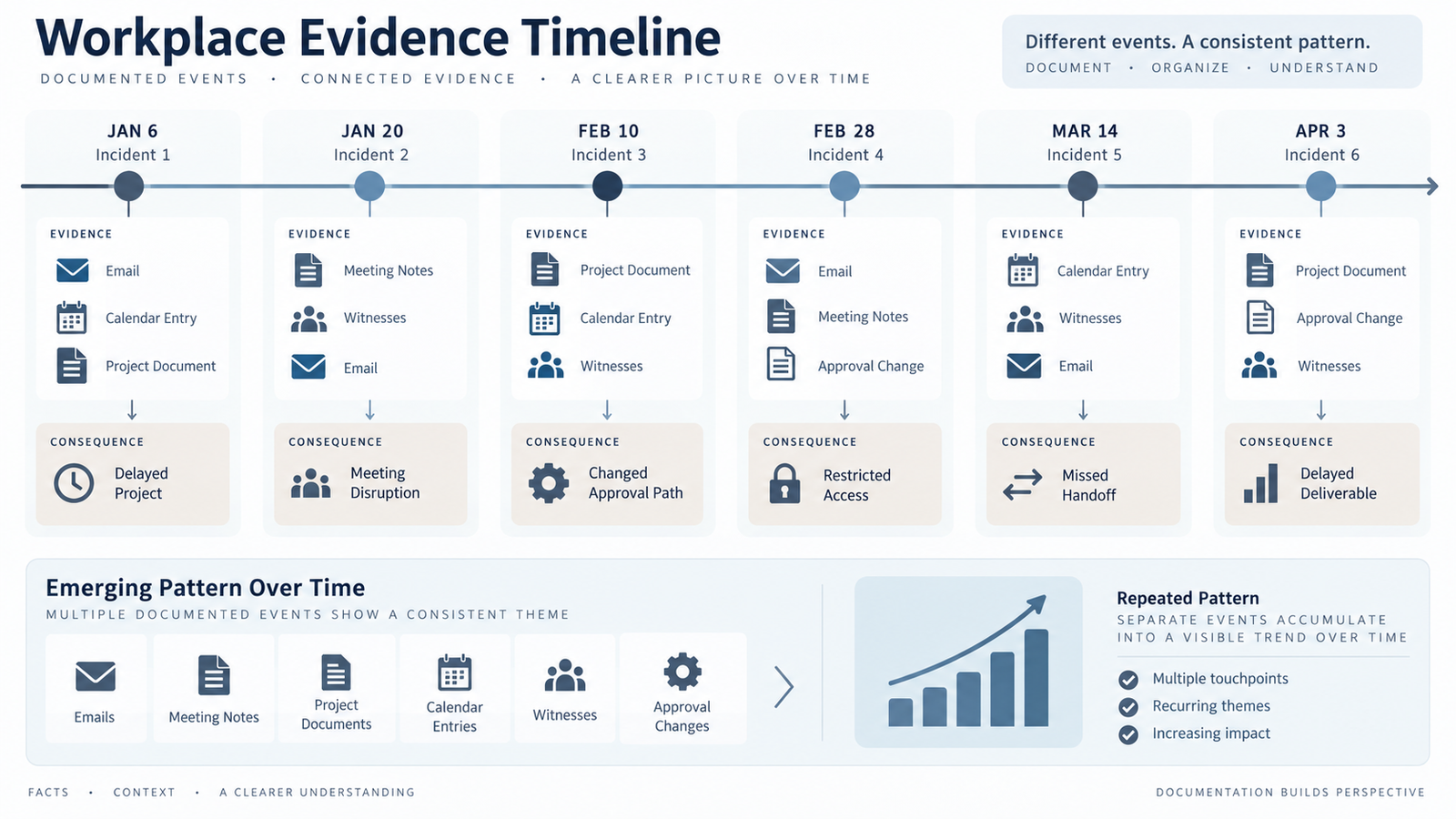
A chronological timeline can help you see whether separate events connect.
For example:
| Date | Event | Evidence | Impact |
|---|---|---|---|
| March 4 | Employee raises concern about changing project requirements | Email summary | Manager acknowledges concern |
| March 8 | Employee removed from client update | Calendar change | Loss of direct project information |
| March 12 | Employee criticized for missing new client requirement | Meeting notes | Negative feedback |
| March 18 | Employee asks for written clarification of role | No response | |
| March 22 | Project responsibility reassigned | Team announcement | Reduced responsibilities |
A timeline does not automatically establish retaliation, abuse, or intent.
What it does is make the sequence visible.
That is far stronger than trying to remember several months of events during a stressful meeting.
Keep a Professional Record Separate From Your Emotional Journal
Many people benefit from writing privately about how a difficult workplace is affecting them.
That kind of reflection can serve a different purpose from your incident documentation.
You might maintain:
Record 1: The Factual Incident Log
- dates;
- events;
- people involved;
- evidence;
- witnesses;
- professional consequences;
- follow-up.
Record 2: Your Personal Reflection
- fear;
- anger;
- confusion;
- self-doubt;
- sleep problems;
- questions you are asking yourself;
- how the experience is affecting your confidence.
Your feelings deserve space.
Separating the two records simply prevents a formal workplace chronology from becoming so emotionally dense that the underlying events are difficult to follow.
What Not to Put in a Workplace Incident Log
Try to avoid filling your professional record with:
- unsupported diagnoses;
- insults;
- rumors;
- claims about motives presented as facts;
- information you know only second-hand without identifying it as second-hand;
- exaggeration;
- every minor annoyance that has no connection to the pattern;
- edited quotations presented as exact quotations;
- evidence obtained through improper or unlawful access.
Statements such as these usually add little:
“My boss is a psychopath.”
“Everyone knows she is evil.”
“He obviously wants to ruin my life.”
Compare those with:
“On August 6, the manager told me privately that my performance was satisfactory. During the August 9 department meeting, the same manager stated that there had been ‘serious concerns for months.’ I requested examples by email on August 9 and again on August 12. I had not received examples as of August 16.”
The second version gives you something concrete to work with.
What If You Did Not Start Documenting Immediately?
Start now.
Do not invent detail in order to fill the gaps.
You can create a retrospective timeline using records that already exist.
Review legitimate sources such as:
- your calendar;
- emails;
- work messages;
- project history;
- performance records;
- meeting invitations;
- notes you already made;
- documents showing deadlines or responsibilities.
If you are uncertain about a date, say so.
For example:
“This occurred during the week of April 6; I do not remember the exact date.”
Accuracy is more important than making the record look perfect.
What If There Is No Written Evidence?
Not every important workplace incident produces an email.
A private conversation, verbal insult, threatening tone, exclusion, or inappropriate comment may occur without written proof.
You can still document the event.
Record it as soon as possible and include:
- date and time;
- location;
- people present;
- what was said or done;
- your response;
- what happened immediately afterward.
Do not change the entry later simply to make it sound stronger.
If you later remember an important detail, you can add a dated note explaining that it was added afterward.
A contemporaneous record does not guarantee that another person will agree with your account, but it is still more useful than relying entirely on memory months later.
Document What Happens After You Raise a Concern
Your documentation should not necessarily end when you complain.
Record what happens afterward too.
That might include:
- whether the concern was acknowledged;
- who responded;
- what action was promised;
- whether an investigation occurred;
- whether the conduct stopped;
- whether your duties changed;
- whether your treatment changed;
- whether new performance criticisms appeared;
- whether you lost access, assignments, meetings, or opportunities.
In some unhealthy dynamics, raising a concern may be followed by denial, attack, or an attempt to portray the person who raised the concern as the real problem. If that pattern appears, our guide to DARVO at work explains how denial, counterattack, and reversal of victim and offender can appear in professional settings.
Do not assume that every defensive response is DARVO or retaliation.
Simply document what happened next.
When Should You Take Your Documentation to HR or Management?
There is no universal moment that is right for every employee.
The seriousness of the conduct, workplace policies, power imbalance, possible safety issues, your employment situation, and local law can all affect the decision.
Before reporting, review your organization’s policies if they are available.
Look for:
- anti-bullying or anti-harassment policies;
- grievance procedures;
- ethics or conduct policies;
- reporting channels;
- whistleblowing procedures where relevant;
- retaliation policies;
- union procedures;
- complaint deadlines.
For U.S. employees dealing with conduct that may fall under federal discrimination or harassment laws, the U.S. Equal Employment Opportunity Commission’s guidance on workplace harassment reporting recommends checking the employer’s anti-harassment policy and following the available reporting process. Legal protections and deadlines vary, so employees outside the United States should consult the relevant rules in their own jurisdiction.
When You Report, Lead With the Pattern
Instead of:
“My boss is abusive and everyone needs to know what kind of person they are.”
consider:
“I would like to raise a repeated pattern affecting my work. I have prepared a chronology of six incidents from May through August, along with the relevant emails, project records, witnesses where applicable, and the professional impact. I would like guidance on the appropriate process for reviewing this concern.”
This does not guarantee a particular response.
But it gives the recipient a much clearer issue to assess.
Protect Your Documentation Carefully
Your record itself may contain sensitive information.
Think carefully about where and how it is stored.
Follow applicable laws and workplace rules regarding confidential information, personal data, company devices, and company records.
Do not assume that a work email account, employer laptop, shared drive, or workplace chat is private from the employer.
At the same time, do not transfer confidential company material to personal systems merely because you want an external copy.
The correct approach depends on what the information is, what policies apply, and where you live.
If your documentation contains sensitive business, medical, personnel, client, or legally protected information, obtain appropriate guidance before copying or moving it.
A Simple Workplace Abuse Documentation Template
You can use the following structure for each significant incident:
- Date and time: When did it happen?
- Location or channel: Where did it happen?
- People involved: Who participated?
- Witnesses: Who else was present?
- Context: What relevant instruction, deadline, responsibility, complaint, or event came before it?
- Conduct: What exactly was said, written, done, or withheld?
- Evidence: What legitimate records support the entry?
- Your response: What did you do or say?
- Professional impact: What changed in the work?
- Follow-up: What happened next?
Example
Date and time: September 9, approximately 2:30 p.m.
Location: Weekly project video meeting.
People involved: Manager and project team.
Context: The project plan dated September 3 assigned final pricing approval to the manager.
Conduct: The manager stated during the meeting that I had delayed the client proposal because I had not finalized pricing independently.
Evidence: Project plan dated September 3 and my approval request sent September 7 at 9:05 a.m.
Witnesses: Four project-team members attended the meeting.
My response: I stated that I had submitted the pricing for approval on September 7 and asked whether the approval process had changed.
Professional impact: The delay was attributed to me during the team meeting.
Follow-up: I sent an email after the meeting asking for written clarification of pricing approval responsibility.
Notice what this example does not contain.
It does not say:
“My manager deliberately humiliated me because they are jealous.”
The facts are strong enough to stand on their own.
Frequently Asked Questions
How do I document workplace abuse?
Record each significant incident with the date, time, location, people involved, exact conduct, relevant context, witnesses, supporting evidence, professional impact, your response, and any follow-up. Keep the wording factual and chronological rather than relying mainly on labels or assumptions about motive.
What counts as evidence of workplace harassment or mistreatment?
Depending on the situation, useful evidence may include emails, messages, work records, meeting notes, calendars, project documents, performance records, witness information, and contemporaneous incident notes. What evidence is legally relevant depends on the type of claim and your jurisdiction.
How do I document a toxic boss for HR?
Focus on specific work-related behavior rather than calling the manager toxic. Create a short chronology showing what happened, when it happened, available evidence, witnesses, the effect on your work, any previous attempts to resolve the issue, and what outcome or clarification you are requesting.
Should I keep a diary of workplace bullying?
A factual incident diary can be useful for identifying patterns and remembering events. Include dates, times, conduct, witnesses, evidence, and impact. Keep emotional reflection separate when possible so the professional chronology remains easy to understand.
Can I document workplace abuse without proof?
Yes. You can record an incident even if no email or witness exists. Clearly describe what you personally experienced and avoid presenting uncertain details as facts. A written record is not automatic proof, but it can preserve information that would otherwise depend entirely on memory.
Should I secretly record conversations with my boss?
Do not assume secret recording is lawful or permitted. Recording and privacy laws vary by jurisdiction, and workplace policies may also restrict recordings. Check the rules that apply to you and obtain qualified advice when necessary.
Conclusion: Your Record Should Create Clarity, Not More Chaos
Learning how to document workplace abuse is not about writing the most dramatic account possible.
It is about creating a calm, reliable record of events while the details are still available.
Record:
- what happened;
- when it happened;
- who was involved;
- what came before it;
- what evidence exists;
- who witnessed it;
- what changed afterward;
- how it affected your work.
Then allow the pattern to emerge from the facts.
You do not have to diagnose another person.
You do not need perfect evidence before you begin.
You do not need to remember every detail of the last six months tonight.
Start with the next clear incident.
Then reconstruct what you reasonably can.
Good documentation cannot guarantee that a workplace will respond well. But it can give you something that confusing workplace dynamics often take away: a clearer account of what happened, what changed, and what you may need to do next.
Need a Structured Way to Document What Is Happening?
Knowing that you should “keep records” is very different from knowing what to record, how to stay calm while doing it, and how documentation fits into a wider self-protection strategy.
Reclaim Your Power goes further than recognition alone. Chapter 4, Crisis First Aid: Protecting Yourself Right Now, focuses on practical protection while you are still dealing with a harmful workplace dynamic, and the accompanying workbook gives you structured exercises for turning confusion into a clearer record and plan.
The guide is designed for professionals dealing with workplace gaslighting, manipulation, credit stealing, toxic leadership, or the gradual loss of confidence that can develop in a harmful work environment.
Explore Reclaim Your Power and its workplace protection workbook.
Your documentation does not need to be perfect. It needs to help you see the situation more clearly and make your next decision from facts rather than confusion.
Ready to Reclaim Your Power?
Get the complete 7-chapter guide, workbook exercises, and 30-day recovery journal.
Buy Now — $4.992 Comments
-
Pingback: Workplace Incident Log: What to Record and Leave Out
-
Pingback: How to Collect Evidence of Workplace Bullying Safely