DARVO at work can make a simple concern feel suddenly dangerous.
You raise an issue.
The person denies it.
Then they attack your credibility.
Then the story reverses.
Now they are the injured party, and you are treated as the person who caused harm by speaking up.
This can happen after you question a changed deadline, challenge a false performance claim, report inappropriate behavior, correct credit stealing, document blame-shifting, or ask for fair treatment.
Instead of the original concern being reviewed, the conversation becomes about your tone, your motives, your loyalty, your memory, your attitude, or the alleged damage you caused by raising the concern.
That pattern is called DARVO: Deny, Attack, and Reverse Victim and Offender.
DARVO is not a workplace diagnosis. It is a pattern-recognition framework. It helps you notice when accountability is being avoided by denying the issue, attacking the person who raised it, and reversing the roles so the person confronted appears to be the victim.
This article explains how DARVO can appear at work, how it overlaps with gaslighting, blame-shifting, smear campaigns, and retaliation, and how to respond professionally without getting pulled into a reputation fight.
For the broader context of manipulation, denial, blame reversal, and professional recovery, read our guide to workplace narcissistic abuse.
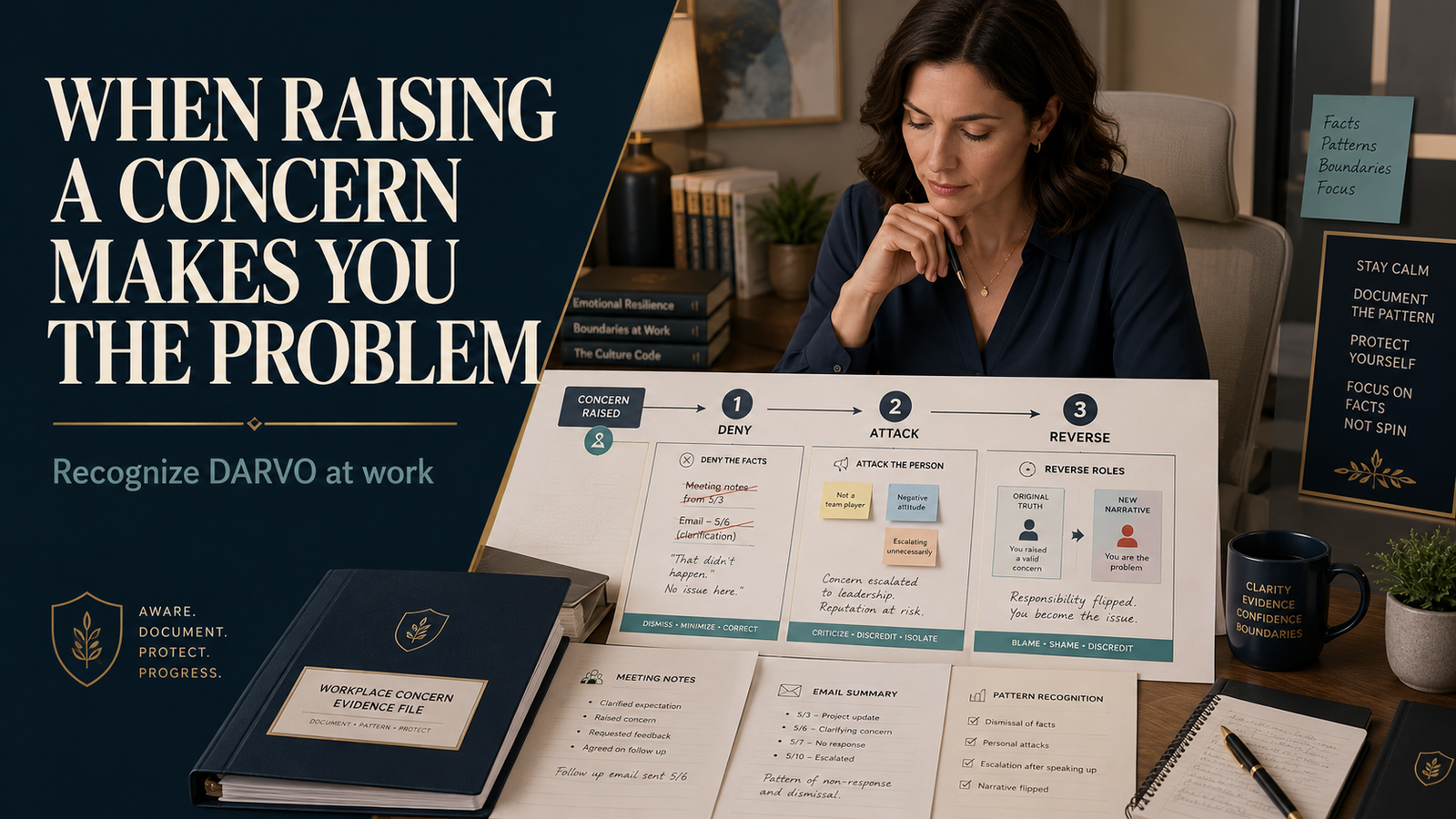
What Does DARVO Mean?
DARVO stands for:
- Deny: The person denies the behavior, impact, responsibility, or facts.
- Attack: The person attacks the credibility, motives, tone, memory, competence, or character of the person raising the concern.
- Reverse Victim and Offender: The person positions themselves as the harmed party and frames the person raising the concern as the real problem.
Psychologist Jennifer Freyd popularized the term DARVO to describe a response some people may use when confronted with wrongdoing.
You can read her explanation here: Jennifer Freyd’s DARVO explanation.
In a workplace context, DARVO may look like this:
Employee: “The instruction changed after I completed the report, and I would like to clarify the record.”
Manager: “I never changed anything. You are always looking for someone to blame. I am tired of being attacked when I am only trying to help you improve.”
The original issue was the changed instruction.
The new issue becomes the employee’s supposed unfair attack on the manager.
That is the reversal.
DARVO at Work Is Not Every Defensive Response
People can become defensive when criticized.
A manager may deny something because they genuinely remember it differently.
A coworker may feel hurt by how feedback was delivered.
An employee may raise a concern in a way that needs improvement.
Not every denial, disagreement, or emotional response is DARVO.
The pattern becomes more concerning when denial, attack, and reversal appear together and shift attention away from the original concern.
Ask These Questions
- Was a specific workplace concern raised?
- Was the concern denied without fair review?
- Did the conversation move toward attacking the person who raised it?
- Was the person confronted repositioned as the harmed party?
- Did the original issue disappear?
- Did the person raising the concern become afraid to speak again?
- Did the reversal affect reputation, work, opportunities, or records?
DARVO is most useful as a pattern to document, not as an insult to throw during conflict.
The Three Parts of DARVO at Work
1. Deny
Denial may sound like:
- “That never happened.”
- “I never said that.”
- “You misunderstood.”
- “That was not the instruction.”
- “I did not exclude you.”
- “I never promised that.”
- “Nobody treated you unfairly.”
Denial is not automatically manipulation.
People forget. Misunderstandings happen. Records may be incomplete.
Denial becomes more concerning when it continues despite evidence, when it repeats across incidents, or when it prevents any fair review of what happened.
Workplace Example
You ask why you were removed from a client meeting after raising a concern about scope changes.
Your manager says:
“You were not removed. You were never supposed to be in that meeting.”
But the calendar invitation, project notes, and previous messages show that you were expected to attend.
2. Attack
After denial, the focus may shift to attacking the person who raised the concern.
The attack may target:
- your tone
- your attitude
- your memory
- your competence
- your loyalty
- your motives
- your emotional stability
- your ability to receive feedback
Attack phrases may include:
- “You are being dramatic.”
- “You always twist things.”
- “You are trying to make me look bad.”
- “You cannot handle feedback.”
- “You are creating a hostile environment.”
- “You are not a team player.”
- “You are making false accusations.”
The attack does not need to be loud.
It can be calm, polished, and professional-sounding while still redirecting attention away from the facts.
Workplace Example
You say:
“The project standard changed after the first draft. I would like the original and revised expectations documented.”
Your boss responds:
“This is exactly your problem. You are defensive and always need to prove someone else wrong.”
The issue is no longer the changing standard.
The issue becomes your character.
3. Reverse Victim and Offender
This is the role reversal.
The person whose conduct was questioned presents themselves as the harmed person.
The person raising the concern becomes the offender.
Reversal phrases may include:
- “I am being attacked.”
- “You are trying to ruin my reputation.”
- “You are creating a toxic environment for me.”
- “I cannot do my job if you keep accusing me.”
- “You are bullying me by documenting everything.”
- “You are retaliating because I gave you feedback.”
- “I am the one being mistreated here.”
Sometimes the person may genuinely feel criticized or uncomfortable.
The key question is whether their discomfort is being used to erase the original issue.
Workplace Example
You raise a concern about repeated public criticism.
Your manager says:
“I cannot believe you would accuse me after everything I have done for you. I have been nothing but supportive, and now you are attacking my character.”
The original issue was public criticism.
The new story is that you harmed the manager by raising it.
DARVO at Work: Quick Comparison Table
| DARVO Stage | What It Sounds Like | What It Does | Grounded Response |
|---|---|---|---|
| Deny | “That never happened.” | Challenges the facts or your memory. | “Let’s review the written record and confirm what happened.” |
| Attack | “You are being defensive.” | Moves attention from the concern to your character or tone. | “I am focused on the specific work issue and the evidence.” |
| Reverse | “You are attacking me.” | Frames the person confronted as the victim and you as the offender. | “I am not making a personal attack. I am asking for the concern to be reviewed accurately.” |
Common Examples of DARVO at Work
1. DARVO After a Changed Deadline
You say:
“The original deadline was Friday, but I was criticized for not submitting it Wednesday. I would like to clarify which deadline was communicated.”
The response:
“I never said Friday. You are always trying to blame other people for your poor planning. I am tired of being made responsible for your mistakes.”
The structure:
- Deny: “I never said Friday.”
- Attack: “You are always trying to blame other people.”
- Reverse: “I am tired of being made responsible.”
This may connect with moving goalposts at work when the standard changes and the change is denied.
2. DARVO After Credit Stealing
You say:
“I developed the original analysis, and I would like my contribution reflected in the project record.”
The response:
“Nobody stole anything from you. You are being petty and obsessed with recognition. It is hurtful that you would accuse me when I gave you the opportunity to work on this.”
The structure:
- Deny: “Nobody stole anything.”
- Attack: “You are petty and obsessed with recognition.”
- Reverse: “It is hurtful that you would accuse me.”
For practical evidence and visibility guidance, read credit stealing at work.
3. DARVO After Reporting Public Humiliation
You say:
“I felt the comments about my competence in the meeting were not appropriate, and I would like feedback to be given privately and specifically.”
The response:
“I never humiliated you. You cannot handle feedback. Now I have to walk on eggshells because you turn coaching into an accusation.”
The structure:
- Deny: “I never humiliated you.”
- Attack: “You cannot handle feedback.”
- Reverse: “I have to walk on eggshells.”
4. DARVO After a Harassment or Discrimination Concern
You raise a concern about conduct that may relate to discrimination, harassment, or protected activity.
The response becomes:
“You are weaponizing HR. You are trying to destroy my career. I am the one being targeted here.”
This type of response should be handled especially carefully.
If the concern involves protected characteristics, protected activity, or retaliation, review workplace policy and consider qualified advice.
You can also review general EEOC information about workplace harassment and EEOC information about retaliation.
5. DARVO After You Document a Pattern
You say:
“I have documented three instances where the project scope changed after completion. I would like the expectations clarified going forward.”
The response:
“You are building a case against me. This is threatening and toxic. I am concerned about your attitude.”
The original concern was changing project scope.
The new concern becomes your documentation.
Why DARVO Is So Confusing at Work
It Changes the Subject
You begin with a specific issue:
- a denied instruction
- a changed deadline
- a credit issue
- a public criticism
- a false accusation
- a boundary violation
After DARVO, the subject becomes you.
Your tone.
Your motives.
Your attitude.
Your loyalty.
Your supposed unfairness.
It Makes Self-Defense Look Like Proof
If you defend yourself strongly, the person may say:
“See? This is exactly what I mean. You are attacking me.”
If you stay silent, the false narrative may continue.
This is why calm, factual correction is usually stronger than emotional argument.
It Can Pull Observers Into the Reversal
Other people may see only the second part of the conflict.
They may see you defending yourself but not the original issue you raised.
This can connect with a workplace smear campaign when the reversal begins shaping your reputation.
It Can Make You Feel Guilty for Speaking Up
You may begin thinking:
- “Maybe I was too harsh.”
- “Maybe I should not have raised it.”
- “Maybe documenting it was wrong.”
- “Maybe I really did hurt them.”
Self-reflection is healthy.
But guilt should not be used to erase the original concern without review.
DARVO vs. Gaslighting, Blame-Shifting, and Smear Campaigns
DARVO often overlaps with other workplace manipulation patterns.
| Pattern | Main Focus | How It Can Connect With DARVO |
|---|---|---|
| Workplace gaslighting | Making someone doubt memory, perception, or judgment | The denial stage may rewrite events and make you doubt what happened |
| Blame-shifting | Moving responsibility away from the person or system that contributed | The reversal stage may make you responsible for the harm you reported |
| Smear campaign | Damaging reputation through repeated negative narratives | The attack stage may spread claims that you are unstable, dishonest, or malicious |
| Triangulation | Using third parties to control communication and alliances | The reversal may be repeated privately to coworkers, HR, or leadership |
For related guidance, read our articles on workplace gaslighting, blame-shifting at work, and workplace triangulation.
DARVO by a Boss
DARVO by a boss can carry professional risk because the boss may control performance records, assignments, access, promotion, references, or disciplinary narratives.
Common Boss DARVO Patterns
- The boss denies changing instructions.
- The boss attacks the employee’s attitude for asking for clarification.
- The boss says they are being unfairly accused.
- The boss describes documentation as hostility.
- The boss frames the employee’s boundary as betrayal.
- The boss says a complaint is an attempt to ruin their reputation.
- The boss tells others they are the real victim of the employee’s behavior.
Professional Response
Focus on the original issue, not the emotional reversal.
“I am not making a personal attack. I am asking that we review the project timeline and clarify the instruction that applies going forward.”
or:
“I understand this is uncomfortable. The specific issue I am raising is the difference between the written deadline and the later performance criticism.”
DARVO by a Coworker
A coworker may use DARVO when confronted about credit-taking, gossip, information withholding, or blame-shifting.
Example
You say:
“The shared notes show that I owned the analysis section. In today’s meeting, it was presented as your work. I would like the contribution clarified.”
The coworker responds:
“I cannot believe you are accusing me. You are always competitive and trying to make me look bad. I thought we were friends, but clearly you are trying to undermine me.”
The concern was attribution.
The reversal turns the coworker into the harmed party and you into the aggressor.
For broader peer-to-peer manipulation patterns, read narcissistic coworker signs.
How to Respond to DARVO at Work
The safest response is usually calm, factual, and narrow.
Do not try to prove the person is using DARVO in the moment.
Instead, protect the original concern from disappearing.
1. Name the Original Issue Privately in Your Notes
Before responding, write down:
- What concern did I raise?
- What fact, event, or conduct was I trying to address?
- What evidence exists?
- How did the conversation shift?
This protects you from getting lost inside the reversal.
2. Do Not Debate Every Attack
If the person says:
“You are dramatic and trying to make me look bad.”
you may want to defend your personality.
Instead, respond:
“I am not trying to make this personal. I am asking to clarify the specific work issue.”
3. Return to the Evidence
“The written instruction from Monday shows the deadline as Friday. The later review says the deadline was Wednesday. I would like to clarify which standard should be used.”
4. Use Short Corrections
Long explanations can be twisted.
Use concise wording:
- “That is not the concern I raised.”
- “I am asking about the project timeline.”
- “I am not making a personal accusation.”
- “Please address the specific example.”
- “Let’s return to the documented instruction.”
5. Confirm the Conversation in Writing
After a DARVO-like conversation, send a neutral summary if appropriate.
“Confirming my understanding from today’s discussion: the concern I raised was the difference between the original Friday deadline and the later Wednesday standard. Going forward, project deadlines will be confirmed in the task system before work begins.”
6. Avoid Public Counter-Attacks
Do not respond to reversal with your own broad accusation.
Instead of:
“You are manipulating everyone and pretending to be the victim.”
say:
“I want to keep the discussion focused on the specific project record and the correction needed.”
Professional Responses to DARVO Statements
| DARVO Statement | What It Does | Grounded Response |
|---|---|---|
| “That never happened.” | Denies the original issue. | “Let’s review the written record and confirm what happened.” |
| “You are making false accusations.” | Attacks your credibility. | “I am raising a specific work concern and asking for it to be reviewed with the available evidence.” |
| “You are trying to ruin my reputation.” | Reverses the harm. | “My goal is to clarify the record, not attack your reputation.” |
| “You cannot handle feedback.” | Turns the concern into a character issue. | “I am willing to discuss feedback. The specific issue I am raising is the changed instruction.” |
| “I am the one being attacked.” | Places the person confronted into the victim role. | “I understand this feels difficult. I am asking to address the original workplace concern.” |
| “You are creating a toxic environment.” | Frames your concern as the problem. | “Please identify the specific behavior you believe is inappropriate. I also want the concern I raised reviewed.” |
| “You are retaliating because I gave feedback.” | Reframes your concern as revenge. | “The concern is based on the documented timeline. I am asking for clarification, not retaliation.” |
| “You are bullying me with documentation.” | Frames recordkeeping as aggression. | “I am keeping factual records because there have been repeated differences between instructions and later accounts.” |
For more communication scripts, read gaslighting phrases at work.
How to Document DARVO at Work
Documentation should preserve both the original concern and the reversal.
Do not document only your emotional reaction.
Document the sequence.
General ACAS guidance on keeping workplace records recommends noting what happened, dates, times, evidence, and witnesses when dealing with bullying concerns.
DARVO Documentation Template
| Field | What to Record |
|---|---|
| Original concern | The issue you raised before the reversal began |
| Date and setting | When and where the conversation happened |
| Denial | What was denied, minimized, or contradicted |
| Attack | What was said about your credibility, tone, motives, memory, or character |
| Reversal | How the other person positioned themselves as harmed and you as the problem |
| Evidence | Messages, notes, project records, witnesses, timelines, or prior summaries |
| Professional impact | Reputation damage, exclusion, performance note, changed assignment, stress, or escalation risk |
| Your response | How you redirected to facts or confirmed the record |
| Follow-up needed | Clarification, HR, manager review, professional advice, or no action |
Weak Documentation
“My boss used DARVO and made me look like the bad person.”
Stronger Documentation
“On August 12, I raised that the deadline in the July 30 email was Friday, while the performance note said the deadline had been Wednesday. My manager denied that Friday had been given, said I was trying to blame others for my poor planning, and stated that they felt attacked by my documentation. I attached the July 30 email and asked that future deadlines be confirmed in the project system.”
The stronger record shows the sequence:
- original concern
- denial
- attack
- role reversal
- evidence
- corrective request
When DARVO Becomes a Workplace Risk
DARVO becomes more serious when it affects:
- performance records
- disciplinary processes
- promotion opportunities
- client access
- team trust
- HR narratives
- legal or compliance concerns
- your mental wellbeing
- your ability to safely raise future concerns
The pattern can become especially risky when it appears after:
- you report harassment or discrimination
- you document a safety or compliance concern
- you correct credit stealing
- you challenge false blame
- you ask for written clarification
- you set a boundary
If the reversal leads to negative treatment after protected activity, consider getting qualified advice relevant to your location.
When to Escalate DARVO at Work
Consider escalation when the pattern is repeated, documented, and materially affects your work or professional safety.
Possible support channels may include:
- a trusted manager
- HR
- a union representative
- an employee assistance program
- a professional mentor
- an employment adviser
- a qualified legal professional
Escalate the Pattern, Not the Label
Instead of saying:
“My manager is using DARVO.”
say:
“I would like to raise a repeated pattern where specific work concerns are denied, then reframed as personal attacks by me. I have documented three examples showing the original concern, the denial, the statements made about my credibility, and the effect on my work record.”
You can mention DARVO if the audience understands the term, but the evidence should not depend on the label.
What Not to Do When You Notice DARVO
Try to avoid:
- arguing endlessly about their motive
- diagnosing the person
- calling them abusive in the middle of a heated meeting
- responding with counter-attacks
- trying to convince them to admit the pattern
- ignoring your own actual contribution to a conflict
- rejecting legitimate feedback because the person also became defensive
- removing confidential company records
- secretly recording conversations without checking law and policy
- waiting until the story has spread widely before preserving evidence
The goal is not to win the emotional reversal.
The goal is to keep the original issue visible and documented.
Chapter 2: DARVO in the Manipulation Playbook
Chapter 2 of Reclaim Your Power focuses on recognizing manipulation tactics.
DARVO is important because it can combine several tactics at once:
- denial of facts
- gaslighting
- attack on credibility
- blame-shifting
- smear campaign language
- reversal of responsibility
- discouragement of future reporting
Once you recognize the structure, you can stop trying to answer every emotional accusation separately.
You can ask:
- What was the original concern?
- What was denied?
- How was I attacked?
- How were the roles reversed?
- What evidence preserves the original issue?
- What professional protection is now needed?
The purpose is not to become suspicious of every disagreement.
The purpose is to recognize when accountability has been replaced by reversal.
Frequently Asked Questions
What does DARVO mean at work?
DARVO at work means a person responds to a workplace concern by denying the issue, attacking the person who raised it, and reversing victim and offender roles so the person raising the concern is treated as the problem.
What is an example of DARVO at work?
An employee raises that a deadline changed after completion. The manager denies the change, says the employee is blaming others, and then claims they are being attacked by the employee’s documentation.
Is DARVO the same as gaslighting?
No. DARVO and gaslighting can overlap, but they are not identical. Gaslighting often focuses on making someone doubt reality. DARVO focuses on denial, attack, and role reversal after accountability is raised.
Can a boss use DARVO?
Yes. A boss may use a DARVO-like pattern when denying changed instructions, attacking the employee’s credibility, and presenting themselves as the victim of the employee’s concern or documentation.
Can coworkers use DARVO?
Yes. A coworker may deny credit-taking, gossip, information withholding, or blame-shifting, then accuse the person confronting them of being competitive, hostile, or unfair.
Should I tell HR someone is using DARVO?
You can use the term if helpful, but it is usually stronger to present the facts: the original concern, the denial, the attack, the reversal, the evidence, and the impact on work.
How do I respond to DARVO professionally?
Keep the response brief and factual. Return to the original issue, use records, avoid debating character attacks, and confirm important conversations in writing.
What should I document?
Document the original concern, date, denial, attack, reversal, evidence, witnesses, professional impact, and your response.
Can DARVO be retaliation?
DARVO is not automatically legal retaliation. It may raise retaliation concerns if negative treatment follows protected activity, such as reporting or opposing unlawful discrimination or harassment. Seek qualified advice for your circumstances.
What if I did make a mistake?
Acknowledging your actual mistake does not require accepting the entire reversal. You can say: “I accept responsibility for my part, and I still want the original concern reviewed accurately.”
Why does DARVO make me feel guilty?
DARVO can make you feel guilty because it turns attention from the original concern to the discomfort or reputation of the person confronted. This can make you feel responsible for the conflict instead of the issue you raised.
What is the best protection against DARVO?
The best protection is preserving the original concern, documenting the sequence, using calm factual responses, avoiding counter-attacks, and escalating with evidence when the pattern affects your work or reputation.
Final Thoughts
DARVO at work can make you feel as if raising a concern was the real problem.
You asked for accountability.
They denied the issue.
They attacked your credibility.
They reversed the roles.
Now you are defending your tone, your motives, your character, and your right to speak.
When that happens, pause.
Return to the original concern.
What did you raise?
What evidence exists?
What was denied?
What attack shifted attention away from the issue?
How were the roles reversed?
What professional impact followed?
You do not need to diagnose anyone to protect yourself from a reversal pattern.
You can keep the record clear.
You can respond without counter-attacking.
You can correct the facts.
You can document the sequence.
You can ask for the original concern to be reviewed.
You can choose the right support channel when the pattern affects your reputation, performance record, or safety at work.
Continue with our guides to workplace smear campaigns, blame-shifting at work, workplace gaslighting, and the broader guide to workplace narcissistic abuse.
When you are ready for a structured process for recognizing manipulation tactics, documenting patterns, protecting your professional position, and rebuilding confidence, explore the complete seven-chapter recovery path.
Educational disclaimer: This article provides general educational information. It does not diagnose any person, determine whether specific conduct is unlawful, or replace legal, employment, medical, or mental-health advice. Workplace policies, rights, retaliation protections, and reporting procedures vary by location. Seek appropriately qualified support for your circumstances.
Ready to Reclaim Your Power?
Get the 376-page digital edition with 7 chapters, 22 practical tools, reusable forms, an optional 30-entry journal, and references.
Buy Now — $4.99
Leave a Reply