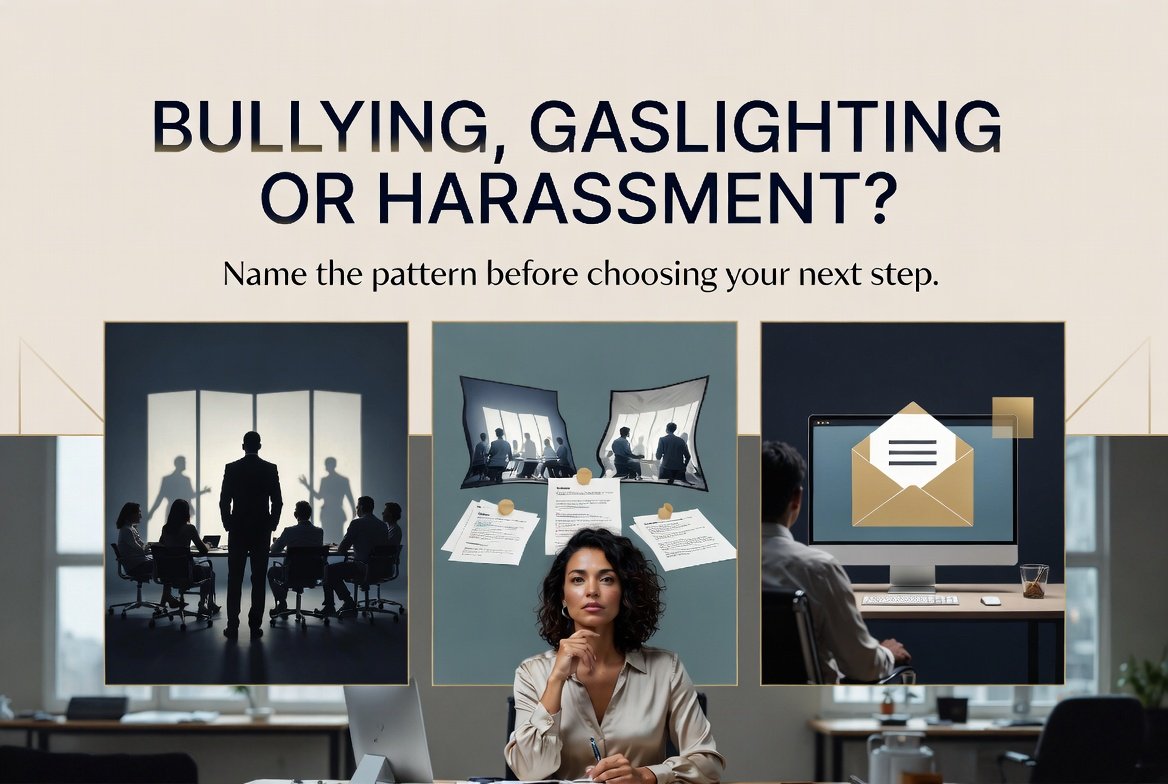
Workplace bullying, gaslighting and harassment can feel similar when you are the person experiencing them.
All three may leave you anxious before meetings, replaying conversations after work or wondering whether you are overreacting. They may also overlap inside the same harmful workplace relationship.
However, they are not identical.
Workplace bullying generally describes intimidating, humiliating, undermining or harmful conduct.
Workplace gaslighting describes a pattern of psychological manipulation that distorts reality and weakens your confidence in your own memory or judgment.
Workplace harassment can have a specific legal meaning, particularly when unwelcome conduct is connected with a protected characteristic such as race, religion, sex, age or disability.
Understanding the difference can help you describe the problem accurately, preserve useful evidence and choose a more appropriate next step.
This article provides a clear comparison of bullying vs gaslighting at work, explains where harassment fits and shows how to document conduct without making unsupported conclusions.
For a wider explanation of manipulation, blame-shifting, boundary punishment and emotional harm in professional settings, read our guide to workplace narcissistic abuse.
Workplace Bullying vs. Gaslighting vs. Harassment: The Quick Answer
The simplest distinction is:
- Bullying targets your safety, dignity, position or ability to work.
- Gaslighting targets your confidence in your perception of reality.
- Harassment involves unwanted conduct and may have a legal definition when it is linked to a protected characteristic or meets another applicable legal standard.
A single situation can involve more than one category.
For example, a manager may repeatedly humiliate an employee, deny that the humiliation occurred and connect the behavior to the employee’s race or disability.
That situation may involve bullying, gaslighting and potentially legally relevant harassment at the same time.
The categories are tools for understanding the conduct. They are not substitutes for a workplace investigation or qualified legal advice.
Why Naming the Problem Matters
The words you use can influence what happens next.
If you describe every disagreement as gaslighting, the underlying concern may be dismissed as a communication problem.
If you describe all bullying as illegal harassment, an employer may focus on whether a protected characteristic is involved instead of addressing the harmful conduct through its general workplace policies.
If you describe a reality-distorting pattern only as “rudeness,” the psychological effect of repeated denial and manipulation may be missed.
Accurate language helps you identify:
- what behavior is occurring
- whether it is repeated
- what evidence exists
- which workplace policy may apply
- whether a protected characteristic is involved
- what outcome you are requesting
- whether professional or legal advice may be needed
You do not need the perfect label before protecting yourself. But a clearer description can make your next step more focused.
What Is Workplace Bullying?
Workplace bullying generally refers to unwanted behavior that intimidates, humiliates, undermines, excludes or harms another person at work.
ACAS workplace bullying guidance describes bullying as behavior that may be offensive, intimidating, malicious or insulting, or an abuse or misuse of power that undermines, humiliates or causes harm.
Bullying may come from:
- a manager
- a coworker
- a group of colleagues
- a subordinate
- a client or customer
- someone with informal influence rather than formal authority
Common Workplace Bullying Examples
Examples may include:
- repeatedly humiliating someone in meetings
- spreading malicious rumors
- constantly criticizing one employee without a fair basis
- deliberately excluding someone from information they need
- assigning unreasonable workloads as punishment
- making threatening, insulting or degrading comments
- undermining a person’s authority or professional reputation
- using silence, exclusion or social isolation as punishment
- mocking someone’s competence in front of other people
- repeatedly interfering with their ability to complete work
Does Bullying Have to Be Repeated?
Workplace bullying is often understood as a repeated pattern. However, workplace policies and legal systems differ, and some may also recognize a severe one-off incident.
The more useful questions are:
- How serious was the conduct?
- Has it happened before?
- Is there a power imbalance?
- What effect has it had on the employee’s work or wellbeing?
- Does the conduct violate a workplace policy?
Is Workplace Bullying Illegal?
Bullying is not automatically unlawful in every country or situation.
Conduct may become legally relevant when it involves discrimination, harassment, retaliation, threats, assault, health and safety violations, contractual breaches or other protected rights.
Even when conduct does not meet a legal definition, it may still violate an employer’s respectful-workplace, anti-bullying, conduct or grievance policies.
What Is Workplace Gaslighting?
Workplace gaslighting is a pattern of psychological manipulation in which someone repeatedly denies, distorts, hides or rewrites information in ways that can make another person doubt their memory, perception or professional judgment.
Research on workplace gaslighting has examined gaslighting as a distinct form of harmful workplace behavior and developed measures for studying it in professional relationships.
Gaslighting is not simply:
- a disagreement
- someone remembering an event differently
- a manager changing a decision and admitting it
- an isolated lie
- poor communication
- feedback that you dislike
The concern is a repeated pattern that causes reality, responsibility or evidence to become unstable in a way that disadvantages one person.
Common Workplace Gaslighting Examples
Examples may include:
- denying instructions that were previously given
- claiming an employee agreed to something they rejected
- changing a deadline and insisting it was always the deadline
- telling someone that everyone has concerns about them without providing evidence
- removing information and later blaming the employee for not knowing it
- calling reasonable questions irrational, dramatic or confused
- rewriting the history of a project to redirect responsibility
- repeatedly telling an employee that events they witnessed did not happen
- using the person’s understandable distress as proof that their account is unreliable
What Makes Gaslighting Different From Lying?
A lie attempts to make you believe something untrue.
Gaslighting goes further by weakening your confidence in your own ability to know what is true.
For example, a coworker may falsely claim that they completed your work. That is dishonest.
If they repeatedly alter records, deny conversations, tell others that you are confused and use your frustration as evidence that your memory cannot be trusted, the pattern moves closer to workplace gaslighting.
Why Workplace Gaslighting Can Be Difficult to Prove
Gaslighting often occurs through small, deniable incidents.
Each event may appear unimportant on its own:
- a changed instruction
- a missing message
- a denied conversation
- a vague statement about what “everyone” thinks
- a suggestion that you are too emotional
The pattern becomes clearer when incidents are recorded together.
What Is Workplace Harassment?
“Harassment” has both an everyday meaning and a legal meaning.
In ordinary conversation, people may use harassment to describe persistent unwanted behavior that frightens, humiliates, insults or pressures someone.
Legal definitions are more specific and depend on the country, state, province or jurisdiction.
Harassment Under US Federal Employment Law
According to the EEOC guidance on workplace harassment, harassment under US federal employment discrimination law involves unwelcome conduct based on a legally protected characteristic.
Protected characteristics covered by the laws enforced by the EEOC can include:
- race
- color
- religion
- sex
- pregnancy
- national origin
- age, beginning at age 40 under applicable federal law
- disability
- genetic information
Applicable protections can also include retaliation for participating in or opposing certain discriminatory practices.
Under this framework, the conduct must also meet the relevant legal threshold. Petty slights and ordinary annoyances generally do not become unlawful harassment unless the conduct is extremely serious or sufficiently severe or pervasive under the applicable standard.
Important: Other countries and local jurisdictions use different definitions and may protect additional characteristics or conduct.
Common Harassment Examples
Depending on the facts and applicable law, examples may include:
- racial slurs or degrading comments
- sexual comments, unwanted advances or offensive sexual material
- mocking a disability
- religious insults or pressure
- age-based humiliation
- threats connected with a protected characteristic
- offensive images or messages
- retaliation after a discrimination or harassment complaint
- interference with someone’s work because of a protected identity
Not Every Bullying Incident Is Legal Harassment
A manager may bully an employee because they dislike being questioned, want control or routinely mistreat everyone.
That behavior may be unacceptable and may violate company policy. However, under some legal frameworks, it may not qualify as unlawful harassment unless the required connection with a protected characteristic or another legal right exists.
This distinction should never be used to excuse bullying.
It only means that different policies, reporting procedures and legal protections may apply.
Workplace Bullying vs. Gaslighting vs. Harassment Comparison
| Question | Workplace Bullying | Workplace Gaslighting | Workplace Harassment |
|---|---|---|---|
| What is primarily targeted? | Dignity, safety, reputation, power or ability to work | Confidence in memory, perception and judgment | A person through unwanted conduct, sometimes connected to a legally protected characteristic |
| Typical behavior | Humiliation, intimidation, exclusion, threats or repeated undermining | Denial, distortion, rewriting events, withholding facts or making someone doubt reality | Offensive, hostile, degrading or intimidating conduct that may meet a legal or policy definition |
| Does it usually involve repetition? | Often, although severe one-off incidents may also matter | Usually a repeated pattern | Can involve repeated conduct or a sufficiently serious incident, depending on the applicable standard |
| Must a protected characteristic be involved? | Not necessarily | No | Often yes for claims under employment discrimination laws such as US federal law |
| Is it automatically illegal? | No | No | Not automatically; the legal definition and threshold must be met |
| Can it violate workplace policy? | Yes | Yes, depending on the conduct and policy | Yes |
| Useful evidence | Repeated incidents, witnesses, messages, workload records and exclusion patterns | Written instructions, timelines, conflicting accounts, edits and contemporaneous notes | Messages, witnesses, protected-context evidence, complaints, policy records and retaliation evidence |
Where Bullying, Gaslighting and Harassment Overlap
These categories are not separate boxes with solid walls.
A person may use gaslighting as a bullying tactic. Harassment may include bullying. A harasser may also deny the conduct in a way that becomes gaslighting.
Bullying That Includes Gaslighting
A manager repeatedly gives an employee verbal instructions and later denies giving them.
The manager then criticizes the employee publicly for failing to follow the “correct” process.
The humiliation and repeated professional undermining may resemble bullying.
The denial and reality distortion may resemble gaslighting.
Bullying That May Also Be Harassment
A supervisor repeatedly mocks an employee’s accent and excludes them from client meetings because of assumptions about their national origin.
The repeated humiliation may be workplace bullying.
Because the conduct is connected with national origin, it may also raise harassment or discrimination concerns under applicable law.
Harassment Followed by Gaslighting
A coworker makes repeated sexual comments.
When the employee objects, the coworker says the comments never happened, claims the employee encouraged them and tells others that the employee is inventing the problem.
The unwanted comments may raise harassment concerns.
The later denial and rewriting of events may resemble gaslighting.
Gaslighting Without Obvious Bullying
A manager calmly and privately changes instructions, removes records and denies previous decisions.
There may be no shouting, insult or public humiliation.
However, the repeated distortion may still weaken the employee’s confidence and professional position.
Bullying Without Gaslighting
A manager openly shouts at an employee, insults them in meetings and assigns punitive workloads.
The conduct may be bullying even if the manager never denies or rewrites what occurred.
Seven Workplace Examples and How to Classify Them
Example 1: Public Humiliation
A manager repeatedly calls one employee incompetent during team meetings.
Most likely category: Workplace bullying.
It may also become harassment if the comments are linked with a protected characteristic or meet another applicable legal definition.
Example 2: Denied Instructions
A manager gives a verbal instruction, later denies it and tells the employee that their memory is unreliable.
Most likely category: Possible workplace gaslighting, particularly if it is repeated.
If the employee is then publicly punished, the situation may also involve bullying.
Example 3: Disability-Based Mockery
Coworkers repeatedly imitate an employee’s disability and circulate offensive messages.
Most likely category: Potential harassment and bullying.
The employee should consider reviewing workplace policy and obtaining advice relevant to their location.
Example 4: Exclusion From Information
A coworker repeatedly leaves someone out of important emails and later says that everyone received the information.
Most likely category: Possible bullying, gaslighting or both, depending on repetition, intention, effect and evidence.
Example 5: One Rude Comment
A stressed manager makes one dismissive comment and later apologizes.
Most likely category: Poor conduct, but not necessarily bullying, gaslighting or unlawful harassment.
Context and repetition matter.
Example 6: Racial Jokes
A team repeatedly shares jokes about an employee’s race after being asked to stop.
Most likely category: Potential workplace harassment and bullying.
Legal significance depends on the jurisdiction and full circumstances.
Example 7: Changing Performance Standards
A manager repeatedly changes the standard after an employee completes the work and insists that the requirement never changed.
Most likely category: Possible gaslighting and workplace bullying.
Written instructions and version history may be particularly useful evidence.
How to Identify What You Are Experiencing
You do not need to choose one label immediately.
Begin with five practical questions.
1. What Exactly Happened?
Describe the conduct without interpretation.
Instead of:
“My manager gaslighted and harassed me.”
Write:
“During the June 10 meeting, my manager instructed me to send the report directly to the client. On June 12, after I sent it, the manager denied giving the instruction and said in front of the team that I had acted without approval.”
2. Is It a Pattern or an Isolated Incident?
Record how often similar conduct has occurred.
A repeated pattern may support concerns about bullying or gaslighting. A sufficiently serious one-off incident may still require attention.
3. Is a Protected Characteristic or Protected Activity Involved?
Consider whether the conduct relates to:
- race
- religion
- sex or pregnancy
- national origin
- age
- disability
- another characteristic protected in your location
- a previous discrimination or harassment complaint
- participation in a protected investigation
If so, seek location-specific advice promptly because reporting deadlines may apply.
4. What Is the Professional Impact?
Record whether the conduct has affected:
- your assignments
- performance evaluation
- access to information
- client relationships
- promotion opportunities
- attendance
- health or ability to work
- reputation
- pay, hours or employment status
5. What Evidence Exists?
Relevant evidence may include:
- emails
- messages
- meeting invitations
- project history
- witnesses
- performance records
- written instructions
- policy documents
- contemporaneous notes
- records of previous complaints
What to Do If You Are Experiencing Workplace Bullying
Document the Pattern
Record dates, locations, participants, witnesses, exact conduct and professional impact.
Review Workplace Policies
Look for policies covering:
- bullying
- respectful conduct
- grievances
- workplace violence
- discipline
- retaliation
Consider an Informal Approach When Appropriate
If the conduct is lower-risk and you feel safe doing so, a calm direct statement may help:
“Comments about my competence during team meetings are affecting our ability to work together. Please raise performance concerns with me privately and provide specific examples.”
You are not required to confront someone personally when doing so feels unsafe or inappropriate.
Use Formal Procedures When Necessary
If the conduct is serious, repeated or unresolved, consider reporting it through the designated manager, HR representative, union representative or formal grievance channel.
Focus the Report on Four Elements
- specific conduct
- supporting evidence
- effect on the work
- the outcome you are requesting
What to Do If You Are Experiencing Workplace Gaslighting
Create a Contemporaneous Record
Write down important events soon after they happen, while details are fresh.
Confirm Verbal Instructions in Writing
Use neutral messages such as:
“Confirming my understanding from today’s meeting: I will revise the proposal, send it for your approval on Thursday and wait for written approval before sending it to the client.”
Preserve Version History
Where workplace systems permit it, retain:
- document versions
- task assignments
- approval messages
- calendar records
- project updates
Follow confidentiality rules and applicable law. Do not remove restricted company information or make secret recordings without checking whether doing so is permitted.
Use External Reality Checks
A trusted mentor, therapist, representative or adviser may help you distinguish factual inconsistencies from stress-driven uncertainty.
Avoid Debating Motives
Instead of saying:
“You are trying to make me doubt myself.”
Say:
“The instruction in this email differs from the account provided today. I would like us to confirm which instruction applies.”
What to Do If You May Be Experiencing Harassment
Preserve Relevant Evidence
Keep appropriate records of:
- unwanted comments or conduct
- who was present
- messages and images
- the connection with a protected characteristic
- your request for the conduct to stop, if one was made
- reports to management or HR
- changes that occurred after reporting
Review the Employer’s Reporting Procedure
Identify:
- who complaints should be reported to
- whether an alternative contact exists when the manager is involved
- what confidentiality can and cannot be promised
- how retaliation is addressed
- how investigations are conducted
Consider Location-Specific Advice Promptly
Legal definitions and deadlines vary.
An employment lawyer, government employment body, union or qualified local adviser can explain the options that apply to your specific location and circumstances.
Document Possible Retaliation
After a complaint, record unexpected changes involving:
- assignments
- hours
- discipline
- exclusion
- performance ratings
- promotion opportunities
- termination or threats
A change after reporting does not automatically prove retaliation, but the timeline may be important.
How to Document the Problem Without Choosing a Label
You can create useful records without deciding whether the conduct is bullying, gaslighting or harassment.
Use This Basic Incident Format
- Date and time: When did it happen?
- Location or channel: Meeting, email, chat, call or office?
- People involved: Who participated or witnessed it?
- Exact conduct: What was said, written or done?
- Relevant context: What instruction, assignment or complaint came before it?
- Evidence: Which messages, records or documents support the account?
- Impact: How did it affect the work?
- Response: What did you do afterward?
Weak Documentation
“My boss bullied and gaslighted me all week.”
Stronger Documentation
“On June 15 at 10:30 AM, my manager stated during the team call that the deadline had always been June 14. The attached project message dated June 8 records the deadline as June 17. When I referred to that message, the manager said I was confused and removed me from the client update meeting. Team members A and B were present.”
The second version allows another person to review the conduct without first agreeing with your label.
What Not to Do
Try to avoid:
- sending an emotional complaint while highly distressed
- diagnosing the person responsible
- assuming that every inconsistency is gaslighting
- assuming all bullying is automatically illegal harassment
- deleting messages or altering records
- removing confidential company documents
- secretly recording conversations without checking policy and law
- posting detailed allegations publicly before obtaining appropriate advice
- retaliating through gossip, threats or sabotage
- waiting indefinitely when conduct involves threats, discrimination or safety concerns
When to Seek Immediate or Professional Help
Consider prompt professional assistance when the situation involves:
- physical threats or violence
- stalking
- sexual coercion or unwanted physical conduct
- discriminatory threats or severe slurs
- retaliation after a protected complaint
- pressure to break the law or professional rules
- serious damage to health or ability to function
- termination, demotion or loss of pay
- possible legal reporting deadlines
Use appropriate emergency, law-enforcement, medical, employment or legal resources for the circumstances and location.
How These Patterns Connect With Narcissistic Workplace Behavior
Bullying, gaslighting and harassment are behaviors or legal concepts. They are not diagnoses of Narcissistic Personality Disorder.
A person displaying narcissistic traits may use bullying or gaslighting, but not every person who bullies or gaslights has NPD.
Similarly, harassment may be committed by someone with no known personality disorder.
The responsible approach is to focus on observable conduct.
For leadership-related patterns, read:
- Narcissistic Boss vs. Difficult Boss: 10 Differences That Matter
- 15 Signs of Narcissistic Leadership at Work
For peer-to-peer behavior, read our guide to narcissistic coworker signs.
Name the Problem Before Choosing the Next Step
You may not be able to determine immediately whether a situation is bullying, gaslighting, legally relevant harassment or a combination.
You can still begin with what is known:
- what happened
- how often it happened
- who was involved
- what evidence exists
- whether identity or protected activity was involved
- how the conduct affected your work
- what outcome you need
This is the approach used throughout Reclaim Your Power.
The guide does not ask you to diagnose another person or force every workplace experience into one label.
It helps you move from confusion toward:
- pattern recognition
- clearer documentation
- professional protection
- stronger boundaries
- more informed stay, report or exit decisions
- emotional and career recovery
Explore the complete seven-chapter recovery path when you are ready to move from naming the problem toward protecting yourself and rebuilding confidence.
Frequently Asked Questions
What is the difference between workplace bullying and gaslighting?
Workplace bullying generally targets someone through intimidation, humiliation, exclusion, threats or repeated undermining.
Gaslighting targets confidence in reality by repeatedly denying, distorting or rewriting information in ways that can make someone doubt their memory or judgment.
Gaslighting can be used as a bullying tactic, but not all bullying involves gaslighting.
Is workplace gaslighting a form of harassment?
Gaslighting may occur as part of harassment, but it is not automatically unlawful harassment.
Legal harassment definitions vary. Under US federal employment discrimination law, the conduct generally must be connected with a protected characteristic and meet the applicable legal standard.
Is workplace bullying illegal?
Not always.
Bullying may violate company policy even when it does not meet a specific legal definition. It may become legally relevant when it involves discrimination, harassment, retaliation, threats or other protected rights.
Can one incident be workplace bullying?
Bullying is commonly associated with repeated behavior, but a severe one-off incident may still violate workplace policy or law.
The definition depends on the employer’s policy and applicable jurisdiction.
Is lying the same as gaslighting?
No.
A lie is a false statement. Gaslighting generally involves a broader pattern that weakens another person’s confidence in their own perception, memory or judgment.
Can a difficult manager be mistaken for a bully?
Yes.
A manager may be demanding, disorganized or poor at communication without deliberately bullying employees.
The distinction becomes clearer through repetition, fairness, accountability, proportionality and whether the behavior improves after concerns are raised.
What evidence is useful for workplace gaslighting?
Useful evidence may include written instructions, meeting summaries, project histories, version records, conflicting messages, witnesses and notes made shortly after incidents.
How should I report workplace bullying to HR?
Describe specific conduct, dates, witnesses, evidence, effect on the work and the outcome you are requesting.
Avoid relying only on general labels such as “toxic,” “bullying” or “gaslighting.”
What makes workplace conduct unlawful harassment?
The answer depends on local law.
Under US federal employment law, unlawful harassment generally involves unwelcome conduct connected with a protected characteristic and conduct that meets the applicable legal threshold.
Seek qualified advice for your location and circumstances.
Can bullying, gaslighting and harassment happen together?
Yes.
A person may bully someone through humiliation, gaslight them by denying the conduct and harass them through comments connected with a protected characteristic.
Should I confront the person responsible?
Not automatically.
Consider the seriousness of the conduct, power imbalance, available evidence, safety, workplace policy and possible retaliation.
In some situations, a brief direct boundary may help. In others, formal reporting or professional guidance may be safer.
What should I do if I cannot decide which label applies?
Document the observable facts without choosing a label.
You can ask a manager, HR professional, union representative, therapist, employment adviser or lawyer to help you assess the appropriate next step.
Final Thoughts
Workplace bullying, gaslighting and harassment can overlap, but they describe different aspects of workplace harm.
Bullying often attacks dignity, position or safety.
Gaslighting attacks confidence in reality.
Harassment describes unwanted conduct and may carry a specific legal meaning depending on its connection with protected characteristics and the law that applies.
You do not need perfect terminology before taking your experience seriously.
Start with the facts.
What happened?
Did it repeat?
What evidence exists?
Was a protected characteristic or complaint involved?
How did the conduct affect your work?
What needs to happen next?
Clear language will not solve every workplace problem, but it can help you move from confusion toward a more deliberate response.
Continue with our guide to workplace narcissistic abuse, or explore the complete seven-chapter recovery path for practical guidance on recognition, documentation, boundaries, decision-making and recovery.
Educational and legal disclaimer: This article provides general educational information. It does not determine whether specific conduct is unlawful and does not replace legal, employment, medical or mental-health advice. Workplace policies, legal definitions and reporting deadlines vary by location. Seek advice from an appropriately qualified professional for your circumstances.
Ready to Reclaim Your Power?
Get the 376-page digital edition with 7 chapters, 22 practical tools, reusable forms, an optional 30-entry journal, and references.
Buy Now — $4.99
Leave a Reply