
A workplace incident log is a factual, chronological record of significant events at work. A useful entry normally records when an incident happened, who was involved, what was said or done, relevant context, witnesses, available evidence, how you responded, the effect on your work, and what happened next.
The goal is not to make every incident sound as serious as possible. The goal is to preserve what happened clearly enough that you can understand the pattern later and explain it accurately if necessary.
What Is a Workplace Incident Log?
A workplace incident log is a structured record of events that may become important later.
You might use one if you are experiencing repeated:
- changing instructions;
- public humiliation;
- blame-shifting;
- exclusion;
- credit stealing;
- unreasonable criticism;
- denial of previous conversations;
- retaliatory-looking changes after raising a concern;
- bullying or intimidation;
- possible harassment;
- inconsistent performance claims;
- interference with your ability to do your job.
The incident log itself does not determine whether these events legally constitute harassment, retaliation, discrimination or another violation.
It creates a record.
That distinction matters.
You do not need to decide whether someone is abusive before you write down what happened.
If you need the wider strategy behind documentation, including evidence, witness information, timelines, verbal conversations and reporting options, read our full guide on how to document workplace abuse calmly and clearly.
Why an Incident Log Is More Useful Than Relying on Memory
Workplace problems rarely arrive in a neat sequence.
You may have a difficult meeting on Monday, receive a contradictory message the following week, be excluded from a project two weeks later, and only months afterward realize that those events may be connected.
By then, remembering exact dates and wording can become difficult.
Stress can make this even harder.
An incident log helps you preserve details closer to the time they happened.
It can also reveal something memory alone may hide:
the pattern.
One changed deadline might be a misunderstanding.
Six changed deadlines followed by criticism that you cannot meet expectations may deserve more attention.
One meeting exclusion may be administrative.
A sequence of exclusions immediately after you raised a concern may be worth documenting.
An incident log does not tell you automatically what those events mean.
It lets you see them together.
What Belongs in a Workplace Incident Log?
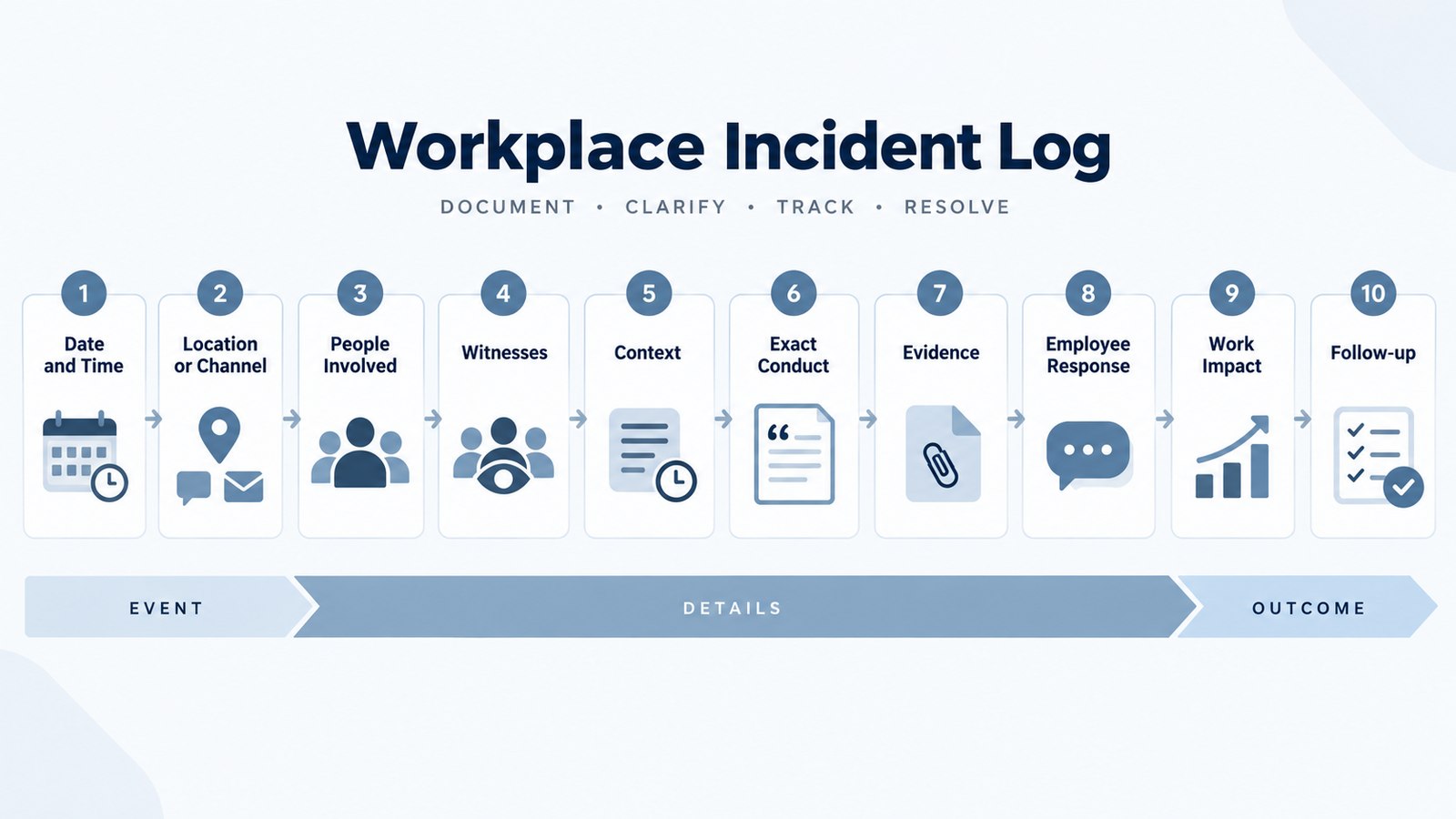
They need enough information for you — or another reader later — to reconstruct the event.
General ACAS guidance on workplace bullying recommends keeping a record of what happened, how it affected you, dates and times, available evidence, and witnesses. You can review the ACAS guidance on keeping a workplace bullying record.
A practical workplace incident log can include these fields:
| Field | What to Record |
|---|---|
| Date | The date the incident happened |
| Time | The exact or approximate time, if relevant |
| Location or channel | Office, meeting, video call, phone, email, workplace chat or other setting |
| People involved | The people directly participating in the incident |
| Witnesses | Anyone who directly saw, heard or otherwise witnessed relevant parts of the event |
| Context | Important instructions, responsibilities, agreements, deadlines or previous events |
| What happened | A factual description of what was said, written, done, changed or withheld |
| Evidence | Relevant legitimate emails, messages, meeting invitations, project records or other records |
| Your response | What you said or did at the time |
| Professional impact | What happened to the work, your responsibilities, reputation, deadlines, access or opportunities |
| Follow-up | What happened afterward, including later clarification or additional events |
You will not need every field for every incident.
Use what is relevant.
1. Record the Date and Time
Start with the simplest information.
Write the date.
If time matters, record the time too.
For example:
September 15, approximately 11:20 a.m.
If you do not know the precise time, do not invent one.
You can write:
September 15, during the weekly project meeting.
Accuracy is more useful than artificial precision.
2. Record Where the Incident Happened
Location may help reconstruct who was present and what records may exist.
Examples include:
- conference room;
- manager’s office;
- open-plan office;
- Zoom or Teams meeting;
- phone call;
- email;
- Slack or another workplace messaging system;
- client site;
- company event.
For digital communication, recording the platform can make it easier to locate the original message later.
3. Record Who Was Involved
List the people directly involved.
Where appropriate, include job roles because they may provide useful context.
For example:
People involved: me, project manager, department director.
Do not add everyone who has ever been connected with the wider issue.
Keep each entry focused on the actual event.
4. Record Witnesses Separately
A witness is not necessarily someone who agrees with your interpretation.
A witness is someone who may have direct knowledge of what happened.
For example:
Witnesses present: three members of the project team.
You do not need to persuade them to take your side.
You do not need to ask them to write statements immediately.
Simply recording who was present can be useful if the event later needs to be reviewed.
5. Record the Relevant Context
Context is one of the most overlooked parts of a workplace incident log.
Consider this entry:
“Manager told me I had missed the deadline.”
That tells us very little.
Now add context:
“The project email dated September 2 listed the submission deadline as September 12. I submitted the completed draft on September 11. During the September 13 team meeting, my manager stated that I had failed to meet the September 10 deadline.”
Now the incident can be evaluated.
Useful context might include:
- previous instructions;
- documented deadlines;
- defined responsibilities;
- approval requirements;
- previous performance feedback;
- a complaint you recently raised;
- a change in project scope;
- an earlier conversation.
Context turns isolated statements into understandable events.
6. Record What Actually Happened
This is the heart of the incident entry.
Describe observable conduct.
Instead of:
“My boss tried to humiliate me.”
write:
“During the weekly team meeting, my manager stated, ‘You clearly cannot manage a basic project,’ after asking why the client report had not been sent. Seven team members were present.”
The first statement gives a conclusion.
The second gives an event.
Readers can reach their own conclusions about the behavior.
7. Use Exact Quotes Only When They Are Actually Exact
Do not make reconstructed wording look like a direct quotation.
If you remember the precise words, quotation marks can be appropriate.
If you remember the meaning but not the exact wording, say so.
For example:
“My manager said words to the effect that raising the concern showed I was not a team player.”
This is more credible than confidently inventing an exact sentence several weeks later.
If an important instruction was verbal, a neutral follow-up email may help establish clarity:
“Confirming my understanding from today’s meeting: I should wait for your written approval before sending the proposal to the client.”
You are documenting the work process, not creating a trap.
8. Record Evidence That Supports the Entry
Your incident log tells the story.
Supporting evidence may confirm parts of it.
Examples can include:
- emails;
- work messages;
- calendar invitations;
- project documents;
- approval requests;
- performance reviews;
- written feedback;
- work schedules;
- version histories;
- formal notices;
- other legitimate workplace records.
Your entry might say:
Evidence: email dated September 2 confirming the September 12 deadline.
You do not need to paste every email into the log itself.
You simply need a system that allows you to identify the relevant record later.
9. Record Your Response
What you did after the event can be important.
For example:
“I stated that the project email listed September 12 as the deadline and asked whether the deadline had been changed.”
Or:
“I did not respond during the meeting. At 3:15 p.m., I emailed my manager asking for clarification.”
Do not rewrite your response afterward to make yourself appear perfect.
The value of the record comes from accuracy.
10. Record the Professional Impact
An event becomes more meaningful when you record what changed because of it.
Professional impact may include:
- delayed work;
- lost project access;
- removal from a meeting;
- loss of client responsibility;
- negative performance feedback;
- reassignment;
- loss of credit;
- changed work hours;
- blocked promotion opportunities;
- disciplinary action;
- damage to professional relationships;
- extra work caused by changing instructions.
For example:
“Because approval was not received until 4:45 p.m., the client submission moved to the following morning.”
That information helps explain why the event mattered.
11. Record What Happened Next
The follow-up can sometimes become more important than the original incident.
Record whether:
- the manager clarified the instruction;
- a mistake was corrected;
- you received an apology;
- the behavior repeated;
- you were excluded afterward;
- a new criticism appeared;
- you raised the issue with HR;
- your responsibilities changed;
- nothing happened at all.
Do not assume what the follow-up means.
Just preserve it.
What Should You Leave Out of an Incident Log?
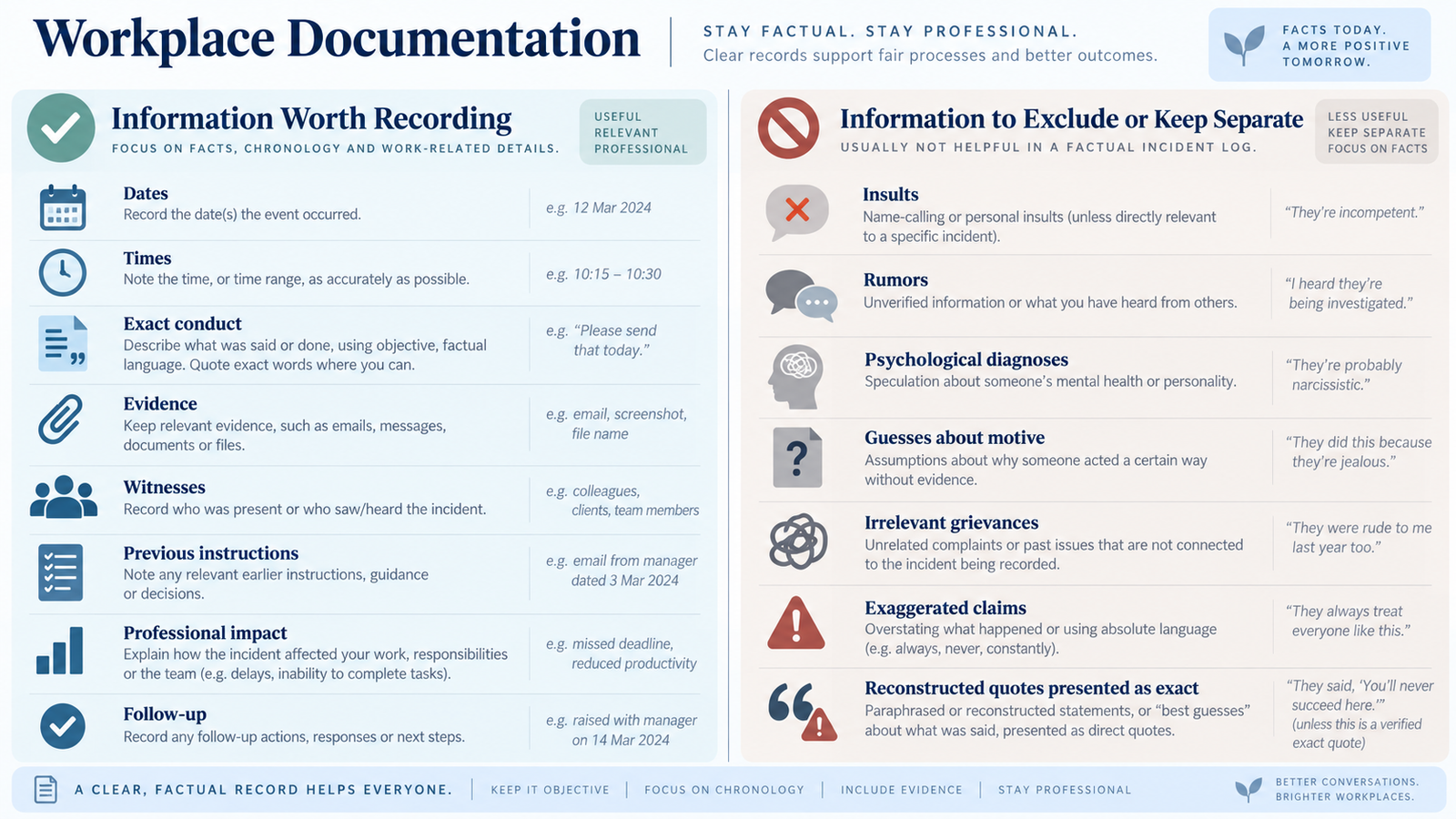
This does not mean your emotions are unimportant.
It means your factual record has a specific job.
1. Leave Out Unsupported Personality Diagnoses
A professional incident log usually does not become stronger because you write:
“My boss is a narcissist.”
Or:
“She is a psychopath.”
Or:
“He has serious mental problems.”
You may have strong opinions about the person involved.
Those opinions are not the incident.
Record the behavior instead.
Weak:
“My narcissistic boss attacked me again.”
Stronger:
“During the project meeting, my manager interrupted me three times while I attempted to explain the approval delay and stated that I was ‘making excuses.'”
The second entry gives you something usable.
2. Leave Out Guesses About Motive
Statements such as these are difficult to establish:
- “She wants me fired.”
- “He is jealous of me.”
- “They are trying to destroy my reputation.”
- “My boss wants me to quit.”
- “They excluded me because they are threatened by me.”
You may genuinely suspect those motives.
But your log should preserve the events that caused the concern.
For example:
“After I raised the workload concern on July 3, I was removed from two client meetings and reassigned from the project on July 11.”
The sequence is factual.
The motive can be evaluated later.
3. Leave Out Office Rumors
If a coworker tells you:
“Everyone says the manager is trying to get rid of you.”
do not automatically turn that into:
“The whole office knows my manager wants me fired.”
If the statement itself matters, you can record it accurately as second-hand information:
“On June 6, a coworker told me that they had heard concerns about my role. I have not independently confirmed the source or accuracy of that information.”
Distinguishing first-hand knowledge from rumor protects the reliability of the rest of your record.
4. Leave Out Unrelated Complaints
A manager may behave unfairly in one situation and also have habits you simply dislike.
Your incident log does not need entries such as:
- “Boss looked annoyed today.”
- “Manager did not say good morning.”
- “They prefer another brand of software.”
- “They have an irritating communication style.”
unless those details have clear relevance to the pattern you are recording.
Recording everything can make genuinely important incidents harder to find.
5. Do Not Rewrite Your Memory to Make an Entry Stronger
Uncertainty is allowed.
If you cannot remember the exact date, write:
“During the week beginning August 3; exact date uncertain.”
If you cannot remember the exact words, write:
“Manager said words to the effect that…”
Your log does not have to look perfect.
It needs to be honest.
6. Do Not Include Evidence You Obtained Improperly
Keeping a workplace incident log does not give you permission to access information you are not entitled to see.
Do not assume you can lawfully:
- access another employee’s private files;
- take confidential client information;
- send restricted company documents to a personal account;
- copy protected personnel records;
- secretly record conversations without checking applicable law and workplace policy.
Employment rules, privacy rules, recording laws and data-protection requirements vary by location.
If the matter is serious enough that evidence preservation may affect your legal rights, get qualified advice rather than guessing.
Should You Record Your Feelings?
Yes — but separate them from the factual event.
For example:
Incident:
“Manager stated during the department meeting that I had ignored the client request. The client email had not been forwarded to me before the meeting.”
Impact:
“I felt embarrassed and distressed after the meeting and had difficulty concentrating for the remainder of the afternoon.”
Your emotional response can matter.
The important thing is not to replace the event with the emotion.
“I felt humiliated” and “my manager deliberately humiliated me because they hate me” are not the same type of statement.
What If Instructions Keep Changing?
Changing instructions are exactly the kind of situation where an incident log can help.
Record:
- the original instruction;
- when it was given;
- who gave it;
- what you did based on it;
- the later instruction;
- whether the earlier instruction was acknowledged;
- what consequence followed.
For example:
“September 4: manager instructed me during the project call to send the draft directly to the client after completing revisions. September 5: I sent the draft. September 6: manager stated that I should never have sent client material without prior approval and denied authorizing direct submission.”
Do not spend the log entry arguing with the contradiction.
Preserve it.
If repeated denial of instructions or prior conversations is making you question your memory, read our guide to the signs of workplace gaslighting.
What If You Are Being Blamed for Something You Did Not Control?
Document the responsibility chain.
Record:
- what you controlled;
- what required someone else’s approval;
- when you completed your part;
- when you requested approval;
- when approval arrived;
- when the final deadline occurred;
- how responsibility was later described.
For example:
“I submitted the final design for director approval at 9:10 a.m. on October 4. The process required approval before client release. Approval arrived at 5:05 p.m., after the client’s 4 p.m. deadline. On October 5, I was told I had failed to deliver the design on time.”
This reconstructs responsibility without requiring you to write:
“My boss threw me under the bus.”
If this kind of responsibility reversal keeps happening, see our detailed guide to blame-shifting at work.
One Incident Is a Note; Several Connected Incidents May Reveal a Pattern
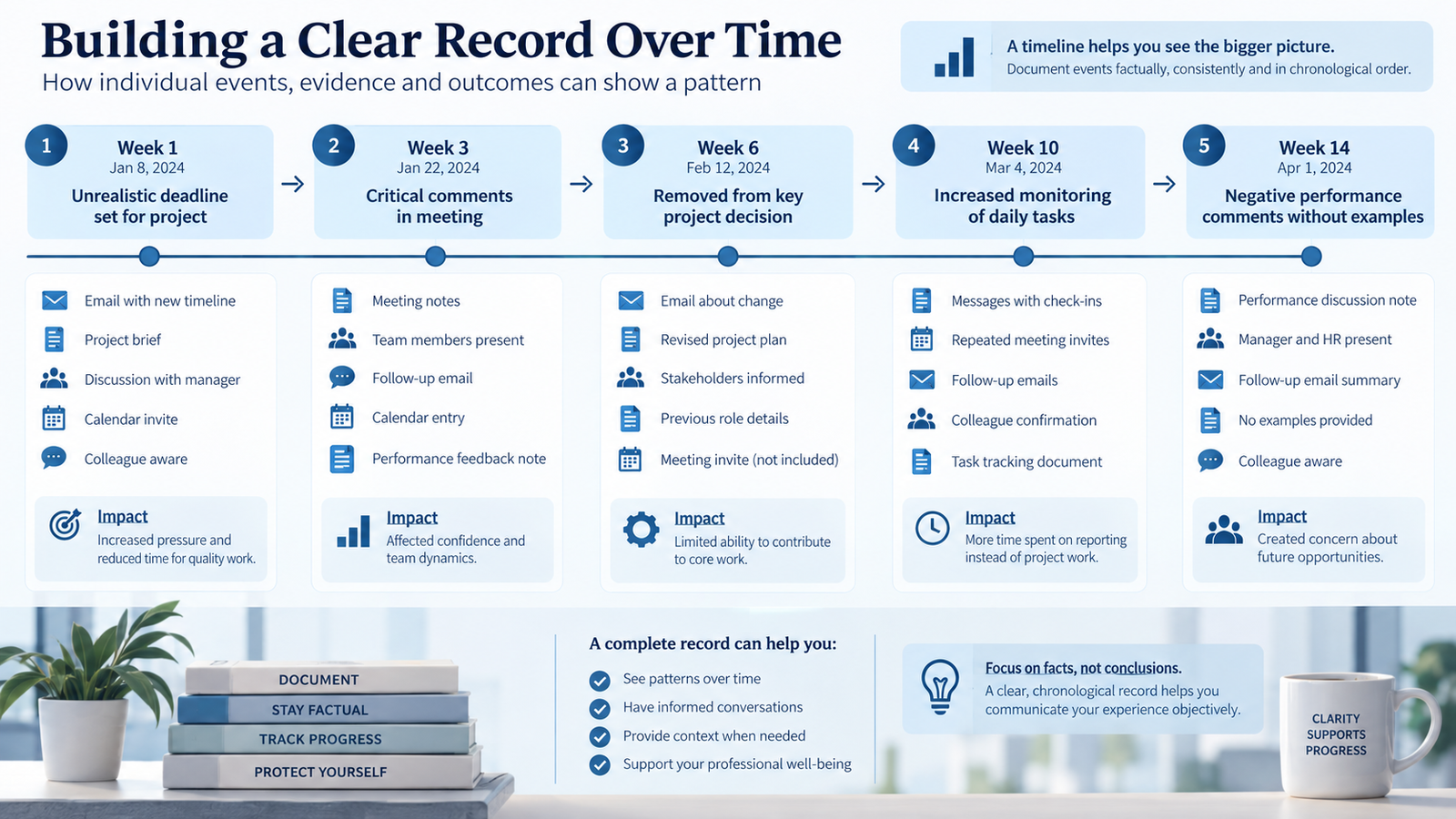
The real value of a workplace incident log often appears over time.
Imagine these entries:
| Date | Incident | Evidence | Impact |
|---|---|---|---|
| April 3 | Employee asks for clarification about changing project requirements | Manager provides no written clarification | |
| April 8 | Employee removed from client meeting | Calendar update | Loss of direct project information |
| April 12 | Employee criticized for missing client requirement discussed in that meeting | Meeting notes | Negative performance feedback |
| April 15 | Employee asks again for clarification of responsibilities | No response | |
| April 21 | Responsibility reassigned | Team announcement | Reduced project ownership |
No single row establishes why these events occurred.
But the timeline makes the sequence visible.
This is one reason a structured log is more valuable than isolated screenshots stored across your phone and inbox.
Do You Need to Decide Whether It Is Bullying, Gaslighting or Harassment?
No.
Not before recording the event.
Suppose a manager publicly criticizes you, later denies the words used, and the conduct may also relate to a legally protected characteristic.
Several different concepts may eventually become relevant.
Your first job is still to record:
- what happened;
- what was said;
- who was present;
- the context;
- the evidence;
- the impact.
The classification can come later.
If you need help understanding the distinctions, read our comparison of workplace bullying, gaslighting and harassment.
Keep the Original Concern Visible if the Conversation Turns Against You
Sometimes an employee raises a specific issue and the conversation quickly shifts.
You say:
“The deadline was changed after the work was completed.”
The response becomes:
“Your real problem is your attitude.”
You raise a concern about public criticism.
The discussion becomes about whether you are difficult to manage.
You present written evidence.
You are accused of being aggressive for keeping records.
When this happens, your incident log should preserve both:
- the original issue you raised; and
- what happened after you raised it.
This prevents the original concern from disappearing inside the later conflict.
Where the sequence involves denial, attack and reversal of the roles, our guide to DARVO at work explains that pattern in more detail.
How Detailed Should a Workplace Incident Log Be?
Detailed enough to reconstruct the event.
Not so detailed that you create a ten-page essay about every uncomfortable interaction.
A useful entry may be only a few paragraphs.
For significant events, include more detail.
For minor events that may become relevant only as part of a pattern, a concise entry may be enough.
Ask:
If I read this six months from now, would I understand what happened?
If the answer is yes, you probably have enough.
Free Basic Workplace Incident Log Template
You can copy the following template into a private document or other appropriate recordkeeping system and use one copy for each significant incident.
This is intentionally simple.
Workplace Incident Log
Incident number: ____________________
Date: ____________________
Time: ____________________
Location / communication channel:
________________________________________________________
People directly involved:
________________________________________________________
Witnesses:
________________________________________________________
Relevant context or previous instruction:
________________________________________________________
________________________________________________________
What happened?
Describe what was said, written, done, changed or withheld.
________________________________________________________
________________________________________________________
________________________________________________________
Exact words or phrases, if known:
________________________________________________________
________________________________________________________
Supporting evidence:
Emails, messages, calendar entries, project records, documents or other legitimate evidence.
________________________________________________________
________________________________________________________
What did I do or say in response?
________________________________________________________
________________________________________________________
Professional impact:
What changed regarding the work, deadline, responsibility, access, reputation, opportunity or relationship?
________________________________________________________
________________________________________________________
Follow-up:
What happened afterward?
________________________________________________________
________________________________________________________
Date this entry was written: ____________________
Tip: Complete an entry as soon as reasonably possible while the details are still fresh. If you add information later, consider noting when that addition was made rather than silently rewriting the original record.
Example of a Completed Workplace Incident Log
Incident number: 07
Date: September 16
Time: Approximately 10:15 a.m.
Location: Weekly project video meeting
People involved: Employee and project manager
Witnesses: Five members of the project team
Relevant context: The project email sent September 10 listed the final deadline as September 18. The employee’s assigned role was to prepare the draft; final client approval remained with the project manager.
What happened: During the team meeting, the manager stated that the employee had failed to deliver the client document by September 15 and said the delay demonstrated poor planning.
Exact wording: Manager stated, “This should have gone yesterday. You need to take more responsibility for deadlines.”
Evidence: September 10 project email listing September 18 as the deadline.
Response: Employee stated that the written project schedule listed September 18 and asked whether the deadline had changed.
Professional impact: Employee’s performance was criticized in front of the project team based on an apparent deadline discrepancy.
Follow-up: Employee emailed the manager at 11:05 a.m. asking for written confirmation of the current deadline. Manager replied at 2:10 p.m. confirming September 18.
Date entry written: September 16.
Notice what the entry does not say.
It does not say the manager is evil.
It does not claim the manager intentionally lied.
It does not diagnose a personality disorder.
The chronology is enough.
What If You Are Starting the Log Months Later?
Start with what you can establish accurately.
Do not invent missing detail.
You may be able to reconstruct parts of the timeline from legitimate records such as:
- calendar invitations;
- emails;
- work messages;
- project files;
- performance feedback;
- meeting notes;
- assignment histories.
If you are uncertain about something, say so.
For example:
“Incident occurred during the second week of June. Exact date unknown.”
That is better than selecting a date simply because the form has a date field.
What If There Is No Evidence or Witness?
You can still record the incident.
Not every significant workplace event happens in front of other people.
ACAS specifically notes that workplace bullying often occurs without witnesses and that a lack of witnesses should not automatically prevent someone from raising a concern.
For an unwitnessed event, record:
- when it happened;
- where;
- who was involved;
- what happened;
- what you said or did;
- what happened immediately afterward.
Your contemporaneous note does not automatically prove the incident occurred.
It preserves your account while your memory is relatively fresh.
When Should You Show the Incident Log to HR?
A workplace incident log can help you prepare for a discussion, but you do not necessarily need to hand over your entire private record immediately.
First identify:
- what concern you are raising;
- which incidents are most relevant;
- what evidence supports those incidents;
- what workplace policy applies;
- what outcome or clarification you are seeking.
If you believe conduct may constitute workplace harassment, check your organization’s reporting procedure.
For workers in the United States, the U.S. Equal Employment Opportunity Commission’s harassment guidance recommends checking whether the employer has an anti-harassment policy and following the reporting options provided there.
Legal definitions, procedures and deadlines differ by jurisdiction, so use advice relevant to where you work.
Frequently Asked Questions
What should be included in a workplace incident log?
A workplace incident log should generally include the date, time, location, people involved, witnesses, relevant context, what happened, important exact wording where known, supporting evidence, your response, professional impact and subsequent follow-up.
How do you document workplace bullying?
Document specific incidents rather than simply writing that you were bullied. Record what happened, dates and times, who was involved, witnesses, supporting evidence, professional impact and what happened afterward. A repeated chronology may make the pattern clearer.
What should I leave out of an incident report for HR?
Avoid unsupported diagnoses, insults, rumors, speculation presented as fact, irrelevant complaints, exaggerated language and reconstructed quotes presented as exact wording. Concentrate on conduct, context, evidence and work-related consequences.
Should I include my feelings in a workplace incident log?
You can record emotional or physical impact, but keep it distinct from the factual description. First describe what happened. Then separately record how the incident affected you.
Can I keep a workplace incident log without evidence?
Yes. Not every incident creates documentary evidence or has witnesses. Record what you personally experienced as accurately and promptly as possible. A note is not automatic proof, but it helps preserve your account.
How long should a workplace incident log entry be?
There is no required length. Use enough detail that you could understand and reconstruct the incident months later without turning every minor event into a lengthy narrative.
Conclusion: Let the Record Do the Work
A strong workplace incident log does not need dramatic language.
It needs clarity.
Record:
- when the incident happened;
- where it happened;
- who was involved;
- what came before it;
- what was actually said or done;
- what evidence exists;
- who witnessed it;
- how you responded;
- what effect it had on the work;
- what happened next.
Leave out unsupported diagnoses, rumors, insults and conclusions you cannot establish.
You do not need to make the person involved sound terrible.
If a serious pattern exists, a clear chronology can often communicate more than emotionally charged language ever could.
Start With the Free Template — Go Deeper When You Need To
The basic workplace incident log above is free to use as a starting point.
For many people, simply having structured fields for dates, conduct, evidence, witnesses, impact and follow-up is enough to replace scattered notes with a clearer record.
But documentation can become more complicated when you are dealing with repeated gaslighting, blame-shifting, changing instructions, professional retaliation, loss of confidence, or uncertainty about what to do next.
Reclaim Your Power provides the fuller framework.
The book is designed to help professionals move from confusion toward recognition, documentation, protection, boundaries and recovery. Its accompanying workbook expands beyond a basic incident log with structured exercises and tools for understanding patterns and planning your next steps.
Explore Reclaim Your Power and the complete workbook.
You do not need to document every uncomfortable moment at work.
You need a system that helps you preserve the moments that matter — clearly enough that confusion does not rewrite them later.
Ready to Reclaim Your Power?
Get the complete 7-chapter guide, workbook exercises, and 30-day recovery journal.
Buy Now — $4.99One Comment
-
Pingback: Follow Up Email After Verbal Conversation at Work