
If you are wondering what to do when HR sides with your manager, do not begin by sending another angry complaint or assuming you have no options left. First get the outcome in writing, identify exactly what HR accepted or rejected, compare the reasoning with your evidence and workplace policy, use any available appeal or review process where appropriate, and continue documenting what happens afterward.
An unfavorable HR decision can be disappointing. But “HR sided with my manager” can describe several very different outcomes. Understanding which one actually occurred is the first step toward deciding whether to clarify, appeal, seek outside advice, protect yourself more carefully, or begin planning an exit.
First, Work Out What HR Actually Decided
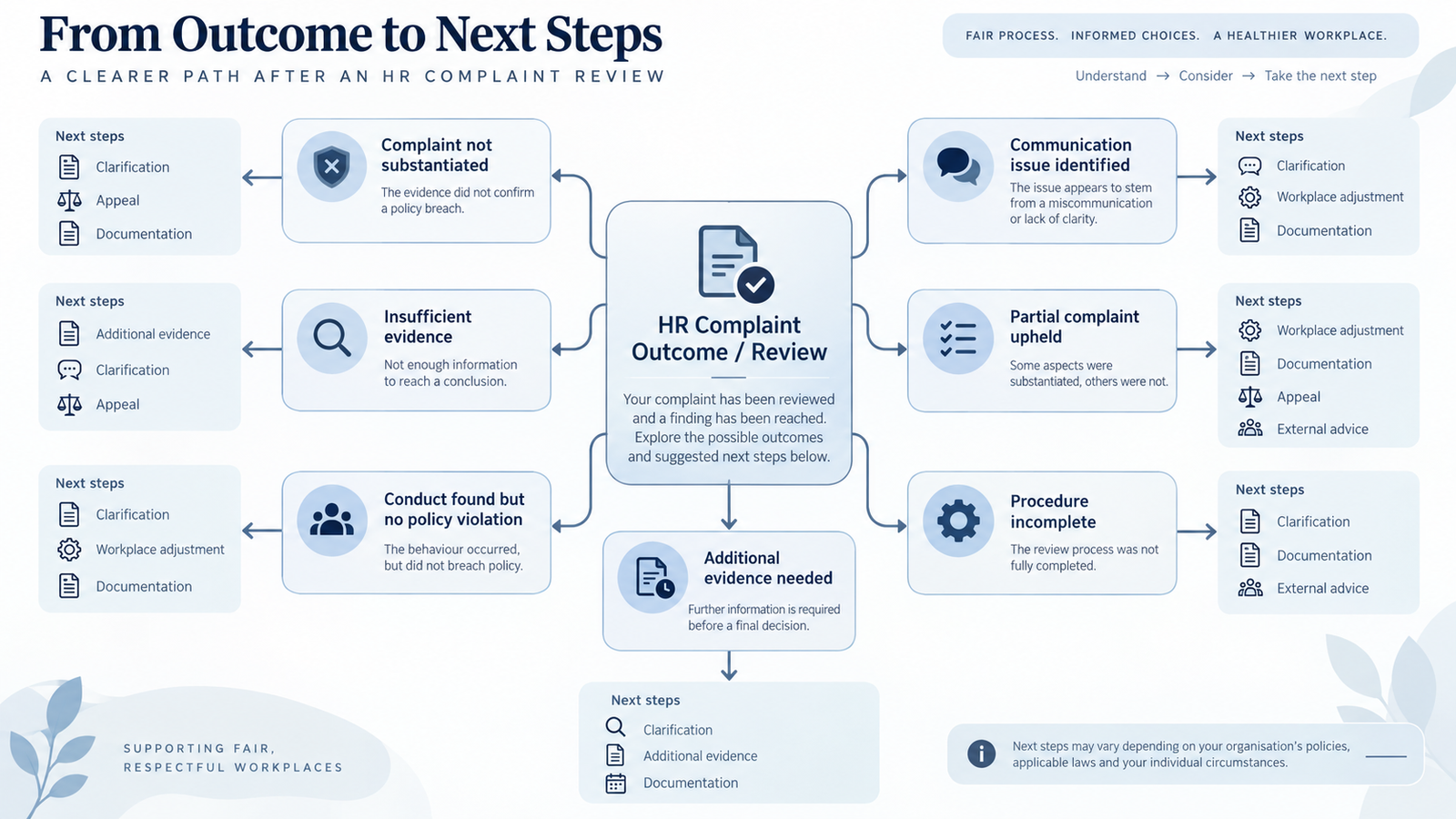
“HR sided with my manager” is an understandable emotional summary.
But before deciding what to do next, translate that feeling into the actual outcome.
HR may have concluded:
- your complaint was not substantiated;
- there was not enough evidence to determine what happened;
- the conduct occurred but did not violate workplace policy;
- both you and the manager contributed to a communication problem;
- some incidents were supported and others were not;
- the manager handled something poorly but formal action was not considered appropriate;
- your requested outcome was not something HR could or would provide;
- a separate performance concern about you also needed review.
These are not equivalent.
Suppose HR says:
“We could not establish what was said during the private meeting because there were no witnesses or contemporaneous records.”
That is different from:
“We established that the manager made the statement, but we do not consider it a violation of the respectful workplace policy.”
And both are different from:
“Our investigation found that the manager’s account was supported by the project records.”
Your next step depends on which finding HR actually made.
Ask for the Outcome in Writing
If you received the decision verbally, ask whether a written outcome will be provided.
You can write:
“Thank you for meeting with me today. Could you please provide the outcome and any next steps in writing so I can make sure I understand the decision accurately?”
If HR will not provide a detailed report, you can still send a neutral summary of what you understood:
“My understanding from today’s meeting is that the complaint was not upheld because HR did not find sufficient evidence to establish that the disputed instruction occurred. Please let me know if I have misunderstood the outcome.”
Do not write:
“I am putting this in writing because HR is protecting my boss.”
Your immediate goal is to preserve the decision accurately.
If you need help wording a neutral written confirmation, use our guide to a follow-up email after a difficult verbal conversation.
Do Not Re-Argue the Entire Case Immediately
An unfavorable decision can create a powerful urge to reply instantly.
You may want to send:
- every screenshot again;
- a long explanation of why HR is wrong;
- accusations that the investigation was biased;
- an emotional description of everything you have experienced;
- threats to escalate publicly or legally.
Usually, a better first step is to review the outcome before responding.
Ask:
- What exactly did HR decide?
- What reasons did they give?
- Which incidents did they actually address?
- What evidence did they rely on?
- Was relevant evidence missing or misunderstood?
- Which workplace policy or standard did they apply?
- Is there an appeal or review process?
You are looking for a reasoned basis for your next step, not simply another opportunity to repeat that the original situation was unfair.
The Nine-Step Response When HR Sides With Your Manager
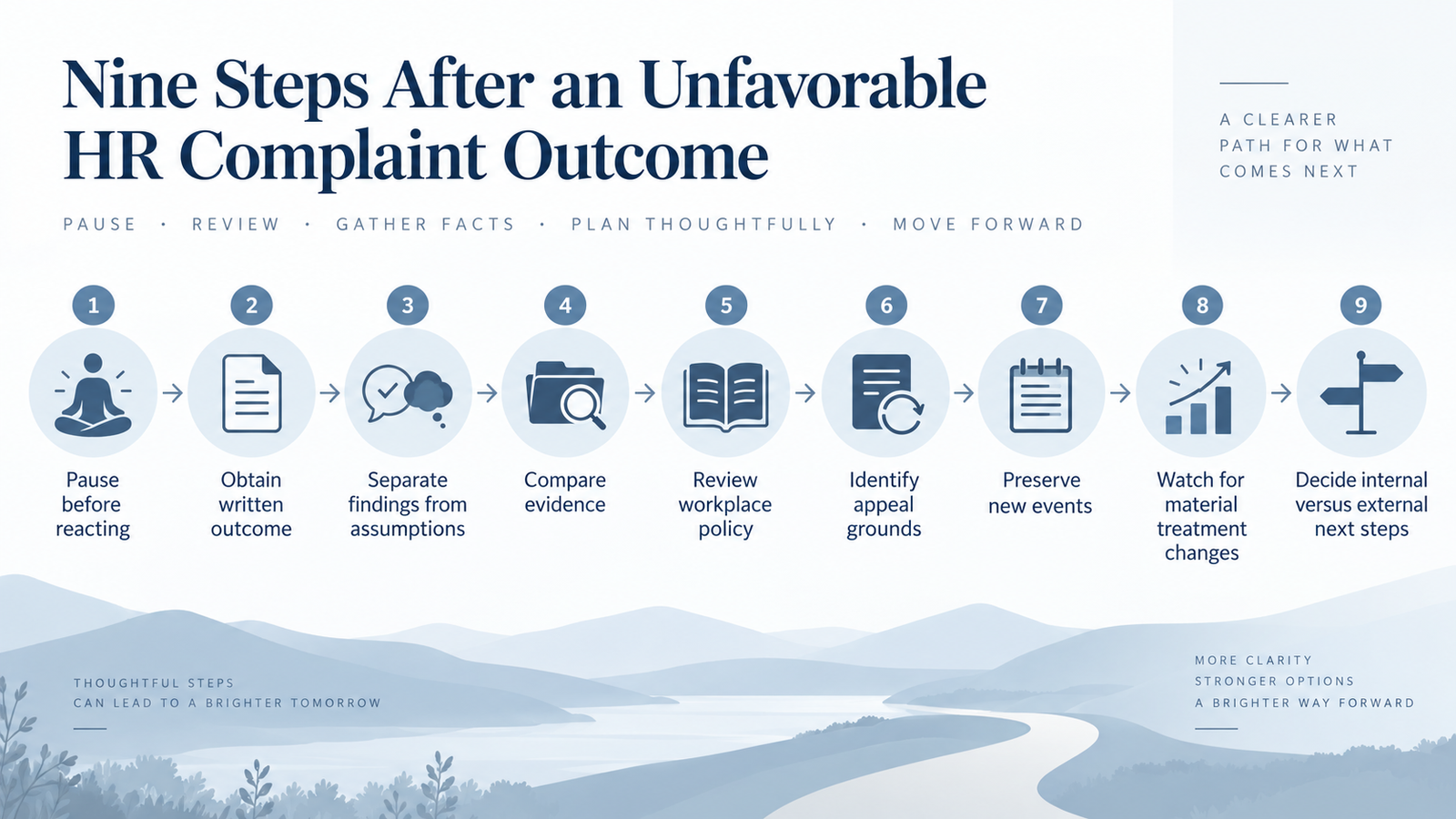 Move from reaction to review: understand the decision, preserve the record, identify gaps, use appeal options, monitor what changes and decide whether staying remains workable.[/caption]
Step 1: Pause Before Sending an Emotional Response
You can disagree strongly with the outcome without replying immediately.
Give yourself enough time to distinguish:
- what HR decided;
- how you feel about it;
- what evidence may have been missed;
- what you want to happen next.
This does not mean delaying indefinitely if an appeal deadline applies.
It means avoiding a response written purely from shock or anger.
Step 2: Obtain or Confirm the Written Outcome
Preserve the date, decision, reasons and next steps.
Where the decision was explained verbally, send a concise confirmation.
Step 3: Separate Findings From Assumptions
Write two columns.
| What HR Actually Said | What I Am Inferring |
|---|---|
| “We could not substantiate the allegation.” | “HR thinks I am lying.” |
| “The behavior did not breach this policy.” | “HR thinks the behavior was acceptable.” |
| “There is conflicting evidence.” | “HR automatically believes my manager.” |
| “No formal action will be taken.” | “Nothing I reported mattered.” |
Your inference may eventually prove accurate.
But do not build an appeal on something HR did not actually say.
Step 4: Compare the Decision With Your Evidence
Review your chronology carefully.
Ask whether HR:
- missed a relevant email;
- used an incorrect date;
- overlooked a witness;
- misunderstood an approval chain;
- failed to consider written instructions;
- treated separate incidents in isolation when the complaint concerned a pattern.
If your evidence is scattered, rebuild it using how to document workplace abuse calmly and clearly and your workplace incident log.
Step 5: Review the Workplace Policy
Find the policy HR said it applied.
Look for:
- the definition of prohibited conduct;
- how investigations should be handled;
- whether outcomes must be written;
- whether appeals are available;
- who should hear an appeal;
- any time limit.
Your strongest argument may not be:
“HR should believe me.”
It may be:
“The policy says relevant witnesses should be interviewed, but the two employees present during the July 8 meeting were not contacted.”
Step 6: Identify Whether You Have Real Grounds for Appeal
An appeal is more persuasive when based on something specific.
Possible grounds can include:
- important evidence was not considered;
- new evidence has become available;
- a factual finding is demonstrably incorrect;
- the grievance procedure was not followed;
- the person deciding the case had a conflict that the process did not address;
- the outcome does not address the problem raised.
For UK workplaces, ACAS explains that employees may appeal where they believe the grievance outcome is wrong, the procedure was unfair or new evidence should be considered. The appeal should explain why the outcome should change and what the employee wants to happen next. See ACAS guidance on appealing a grievance outcome.
Other countries use different procedures, so follow the policy and law relevant to your workplace.
Step 7: Continue Documenting Significant Events
The HR decision is not the end of the timeline.
Record significant developments such as:
- new instructions;
- performance criticism;
- changes in responsibilities;
- changes in access;
- meeting exclusions;
- disciplinary action;
- important conversations with HR or management.
Do not turn every ordinary workplace event into evidence.
Use a structured record for material events.
Step 8: Watch for Material Changes, Not Just Bad Feelings
After a complaint, you may feel unusually alert to everything your manager does.
That reaction is understandable.
But instead of writing:
“My manager is retaliating because they looked angry today.”
record measurable changes:
- assignment removed;
- hours changed;
- access withdrawn;
- new discipline issued;
- performance rating changed;
- meetings removed;
- promotion opportunity withdrawn;
- job threatened.
A change occurring after a complaint does not automatically prove retaliation.
The chronology may nevertheless become important.
Step 9: Decide Whether the Workplace Is Still Workable
After internal review or appeal, you may reach a point where the central question changes.
Instead of:
“How do I make HR agree with me?”
you may need to ask:
“Can I continue working here safely, effectively and professionally under the conditions that now exist?”
Your options might include:
- continuing with clearer safeguards;
- requesting a transfer;
- seeking union or representative support;
- obtaining independent employment advice;
- beginning a careful job search;
- planning an exit rather than resigning impulsively.
When an Appeal Makes Sense
An appeal should usually do more than say:
“I disagree with HR.”
A stronger appeal identifies a reviewable problem.
Example 1: Missing Evidence
“The outcome states there was no documentary evidence showing the deadline had been changed. The project email dated August 6, which I provided with my original complaint, states that the revised deadline was August 12. I am asking that this record be considered in the appeal.”
Example 2: Witnesses Not Interviewed
“The outcome describes the July 14 discussion as a private disagreement. Two employees were present throughout the meeting and were listed in my original chronology. My understanding is that they were not interviewed. I am requesting that their evidence be considered.”
Example 3: Complaint Not Actually Addressed
“The outcome focuses on whether the manager intended to cause harm. My complaint concerned repeated changes to written instructions and the resulting performance criticism. I am requesting review of whether those documented inconsistencies occurred and how the performance record should reflect them.”
These arguments are much stronger than simply stating that HR was biased.
Sample Email: Requesting Review or Appealing an HR Outcome
Subject: Appeal / Request for Review of Grievance Outcome
Hi [Name],
Thank you for providing the outcome of my workplace complaint dated [date].
I would like to request a review / submit an appeal in accordance with the grievance procedure.
My concern is not simply that I disagree with the outcome. I believe the following points require further consideration:
- [specific evidence that appears not to have been considered];
- [specific factual finding you believe is incorrect];
- [specific procedural issue, if applicable].
For example, the outcome states that [finding]. The [email/project record/document] dated [date] appears to show [relevant fact].
I am requesting that this information be reviewed and that I receive clarification on [specific outcome sought].
Please let me know the next step in the appeal or review process and any applicable deadline or documentation requirement.
Regards,
[Name]
The email does not accuse HR of corruption.
It identifies what should be reviewed.
What If HR Says There Is “Not Enough Evidence”?
This can be one of the most frustrating outcomes.
But ask what “not enough evidence” actually means.
You can ask:
- Which allegation could not be established?
- Was conflicting evidence received?
- Were the witnesses I identified interviewed?
- Were the written records I supplied reviewed?
- Would additional evidence be considered?
- Is the finding that the event did not occur, or only that HR could not determine whether it occurred?
That last distinction matters.
“We determined this did not happen” is not the same as:
“We could not determine what happened.”
If additional records are relevant, preserve them carefully. Our guide on how to preserve workplace evidence without violating policy or privacy explains why you should not respond to an unfavorable outcome by suddenly downloading or forwarding everything you can access.
What If HR Calls It a “Communication Problem”?
Sometimes HR acknowledges conflict but avoids the label you used.
That does not necessarily mean the process is useless.
Ask what practical changes follow from that conclusion.
For example:
“If HR considers this primarily a communication issue, can we establish a process where deadlines, approvals and material changes to assignments are confirmed through the project system?”
Or:
“Can performance concerns be provided with specific examples and expectations in writing going forward?”
You may not obtain the label you expected.
You may still obtain safeguards that reduce the underlying problem.
What If HR Starts Focusing on Your Performance Instead?
This situation requires care.
Two things can theoretically be true at once:
- you raised a legitimate workplace concern;
- your employer also has legitimate performance concerns.
Do not assume that every performance discussion after a complaint is automatically punishment.
But do not allow unrelated performance claims to erase the original concern either.
Keep the two tracks separate.
Track A: The Original Complaint
What conduct did you report?
What evidence supports it?
What outcome did HR reach?
Track B: Performance Concerns
What specific issue is now being raised?
When did it first appear?
What examples are provided?
What standard applies?
What improvement is expected?
If responsibility is being rewritten after the fact, the pattern may also resemble blame-shifting at work.
But again, document the chronology before choosing the label.
When the Story Turns Against You After Reporting
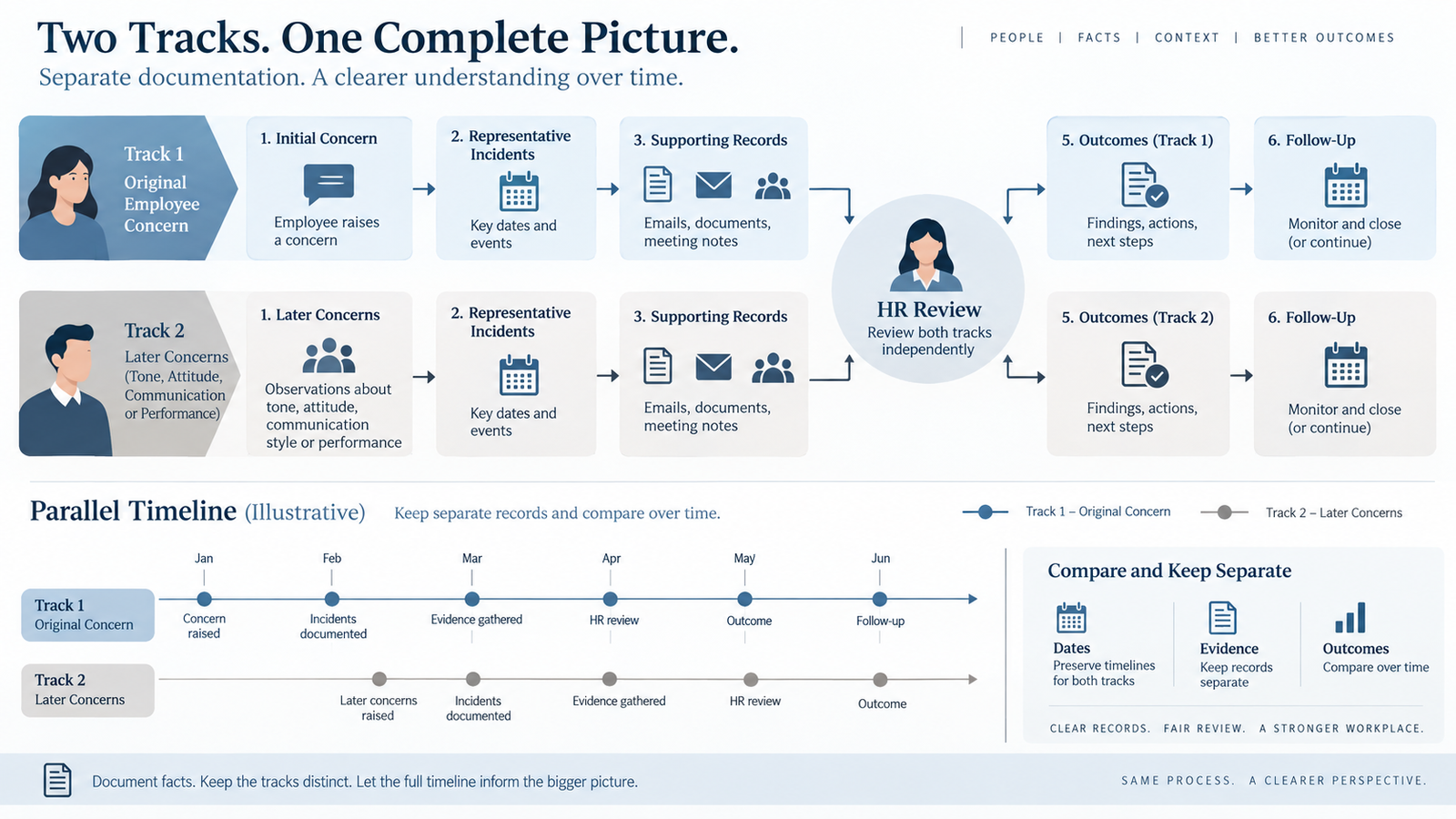
Sometimes an employee raises:
“My manager changed the deadline and then blamed me.”
The conversation gradually becomes:
“The real issue is that you are defensive and difficult to manage.”
This does not automatically prove manipulation.
Your communication style may genuinely become relevant.
But preserve the original concern separately so it does not disappear.
Document:
- what you originally reported;
- what evidence you provided;
- how HR responded;
- when criticism of you began or intensified;
- what examples are being used;
- whether the original issue was resolved.
If the pattern involves denial of the original concern, attacks on your credibility and a reversal where you become framed as the main problem, compare the facts with our guide to DARVO at work.
If the issue spreads into broader reputational claims among colleagues, the related guide on a workplace smear campaign may also help you separate rumor, reputation harm and documented facts.
What If HR and Your Manager Were Both in the Meeting?
Do not assume that the presence of HR means every statement made in the meeting becomes an official finding.
Afterward, document:
- who attended;
- what decisions were made;
- what expectations were established;
- what deadlines or next steps were agreed;
- what remained disputed.
You can send a short follow-up:
“Thank you for today’s meeting. My understanding is that the current expectation is X, the complaint outcome remains Y, and we will meet again on Z date to review progress. Please let me know if I have misunderstood any of those points.”
This is much more useful than writing:
“Now I have proof that HR is on my manager’s side.”
Should You Go Above HR?
Sometimes there is another internal route.
Depending on the organization, that might include:
- a formal grievance appeal;
- a senior HR leader;
- an ethics or compliance channel;
- a whistleblowing channel where legally relevant;
- a union representative;
- a higher-level manager;
- an ombuds or employee-relations function.
Do not escalate simply by emailing every executive you can find.
First identify the designated process.
Your escalation should explain:
- what the original complaint concerned;
- what outcome was reached;
- why you believe further review is justified;
- what evidence or procedural issue supports that request;
- what outcome you are seeking.
Structured escalation is more credible than escalating the emotional intensity of the language.
What About Retaliation After an HR Complaint?
Be precise with this word too.
In everyday language, employees may call any negative treatment after a complaint retaliation.
Legally, retaliation protections depend on the type of complaint and the law that applies.
For example, in the United States, laws enforced by the EEOC prohibit retaliation for certain protected activity involving discrimination, including reporting or opposing unlawful discrimination and participating in relevant investigations or proceedings. See EEOC guidance on retaliation.
A general disagreement with a manager does not automatically create the same legal protections.
Regardless of legal terminology, preserve significant post-complaint changes factually.
| Date | Change | Previous Situation | Evidence |
|---|---|---|---|
| Oct. 3 | Removed from client meeting | Attended weekly for 8 months | Calendar history |
| Oct. 7 | Project responsibility reassigned | Previously project lead | Team email |
| Oct. 11 | New written performance concern | No similar issue in September review | Performance records |
The chronology is more useful than writing:
“Everything happening now is retaliation.”
Continue Doing Your Job Carefully
One of the most important things after an unfavorable HR decision is also one of the least dramatic.
Keep doing your job.
Where reasonably possible:
- meet deadlines;
- ask for clarification when necessary;
- confirm important changes in writing;
- avoid workplace gossip about the investigation;
- do not recruit coworkers into factions;
- keep communication professional;
- follow legitimate instructions and policy.
This is not about pretending nothing happened.
It protects your professional record while you decide what to do next.
Do Not Turn Coworkers Into Witnesses for Your Side
If coworkers witnessed relevant incidents, record their names.
But avoid:
- pressuring them to support you;
- telling them what they should remember;
- coordinating stories;
- asking them to confront HR on your behalf;
- sharing confidential investigation details unnecessarily.
A witness is valuable because they have independent knowledge.
Trying to manufacture agreement can damage that independence.
When External Advice May Be Worth Considering
Independent advice may become more useful when:
- your job appears at risk;
- you are facing formal discipline;
- you believe discrimination or legally protected retaliation may be involved;
- you raised protected whistleblowing concerns;
- you are considering resignation because of the situation;
- significant pay, status or contractual issues are involved;
- internal appeals are exhausted;
- you are unsure how to preserve sensitive evidence lawfully.
Depending on your location and situation, support might come from:
- a trade union;
- an employment lawyer;
- a worker advocacy organization;
- a government employment service;
- a professional association;
- another qualified adviser.
Do not wait for an internet article to tell you whether you have a legal claim.
That assessment depends heavily on jurisdiction and facts.
When Staying May Still Be Reasonable
An unfavorable HR outcome does not automatically mean you must leave.
The workplace may still become workable if:
- expectations are clarified;
- the disputed behavior stops;
- communication becomes more structured;
- you retain meaningful career opportunities;
- your manager respects the new process;
- HR remains willing to address future problems;
- your health and confidence begin stabilizing.
Sometimes the complaint does not produce the formal finding you wanted but still results in better boundaries or oversight.
Judge what happens next, not only the wording of the outcome letter.
When an Exit Plan May Be the More Rational Choice
Leaving should not be framed as losing.
Nor should leaving be the automatic advice after every difficult HR outcome.
Consider a careful exit strategy when the evidence increasingly suggests:
- the underlying behavior continues;
- your professional credibility is deteriorating;
- every safeguard fails;
- your role is becoming structurally unworkable;
- internal options are exhausted;
- the environment is significantly affecting your life outside work;
- there is no realistic path to rebuilding trust.
The best exit is usually planned rather than impulsive.
Protect:
- your financial stability;
- references;
- your résumé;
- your professional network;
- your explanation for leaving;
- appropriate records you are lawfully entitled to retain.
A Simple Decision Audit After HR Rejects Your Complaint
| Question | Why It Matters |
|---|---|
| Did HR give me a written outcome? | You need to know exactly what was decided. |
| Did HR address the issue I actually raised? | A decision about a different issue may not resolve the original concern. |
| Was important evidence missed? | This may support review or appeal. |
| Was the stated procedure followed? | Procedural gaps may be relevant to an appeal. |
| Is an appeal available? | There may still be an internal remedy. |
| Has the underlying behavior stopped? | Practical improvement can matter even without a formal finding. |
| Has my treatment materially changed? | The post-complaint timeline may require documentation. |
| Can I still do my job effectively? | The workplace must remain operationally workable. |
| Do I need independent advice? | Serious consequences may require expertise outside HR. |
| If nothing changes, am I prepared to leave carefully? | Having an option reduces dependence on one internal process. |
Frequently Asked Questions
What should I do if HR sides with my manager?
Get the outcome in writing, identify exactly what HR decided and why, compare the reasoning with your evidence and workplace policy, and check whether an appeal or review process exists. Continue documenting significant events afterward and consider independent advice if the consequences are serious.
Can HR automatically believe my manager over me?
An HR investigation should ideally assess available evidence rather than decide purely based on job title. However, evidence may conflict or be incomplete. If you believe relevant evidence was missed or the procedure was not followed, identify those specific issues through the organization’s review or appeal process where available.
Can I appeal an HR grievance decision?
Many organizations provide an appeal process, but the exact rights and procedure depend on workplace policy and local law. In the UK, ACAS guidance states that employees should generally be given an opportunity to appeal grievance outcomes. Review your own organization’s policy promptly because deadlines may apply.
What if HR says there is not enough evidence?
Ask whether HR concluded that the event did not occur or simply could not determine what happened. Find out what evidence was reviewed, whether relevant witnesses were contacted and whether additional evidence can be submitted.
What if HR does nothing about my manager?
Ask what outcome was reached, whether any workplace adjustments or expectations will change, and what process to use if the conduct repeats. If internal processes are exhausted and the problem continues, consider union support, independent employment advice, a transfer or a careful exit plan depending on your circumstances.
Is HR retaliation after a complaint illegal?
Not every negative event after a complaint is legally defined as retaliation. Legal protection depends on the type of complaint and jurisdiction. For example, U.S. federal anti-discrimination laws protect certain employees from retaliation for legally protected activity involving discrimination. Seek location-specific advice where this may apply.
Should I resign if HR sides with my boss?
Not automatically. First assess whether the underlying behavior continues, whether an appeal or transfer is available, whether the workplace can become workable and whether leaving is financially and professionally manageable. If you decide to leave, a planned exit is usually safer than resigning impulsively.
What if HR starts criticizing me after I complain?
Ask for specific examples and expectations in writing and continue documenting the original complaint separately from any performance issues now being raised. Do not assume automatically that criticism is retaliation, but preserve the chronology if treatment materially changes after the complaint.
Conclusion: An HR Decision Is Information, Not the End of Your Agency
When HR sides with your manager, it can feel as though the organization has decided that your experience does not matter.
Sometimes an unfavorable outcome does reveal serious limitations in the workplace.
But before reaching that conclusion, understand what actually happened.
Get the decision in writing.
Separate findings from assumptions.
Compare the reasoning with your evidence.
Review the policy.
Appeal when you have concrete grounds.
Document significant changes afterward.
Continue protecting your professional record.
And if internal systems ultimately cannot give you a workable path forward, remember that the next decision is still yours.
You may not control what HR decides.
You can control how clearly you understand the decision, how carefully you preserve your record and how deliberately you choose what comes next.
When the Internal Process Fails, You Still Need a Protection Plan
An HR complaint is only one tool.
It should not become the point where your entire sense of control depends on whether someone inside the organization agrees with you.
Reclaim Your Power is designed for the wider problem: understanding harmful workplace patterns, documenting them clearly, protecting yourself while they are happening, setting boundaries, making careful career decisions and rebuilding confidence afterward.
Chapter 4 focuses on immediate protection and documentation, while the accompanying workbook includes structured tools such as the incident documentation log and other exercises that help turn confusion into a clearer decision process.
Explore Reclaim Your Power and the complete workplace protection workbook.
The goal is not to win every internal argument.
The goal is to leave the situation with your clarity, professional judgment and future options intact.
Ready to Reclaim Your Power?
Get the 376-page digital edition with 7 chapters, 22 practical tools, reusable forms, an optional 30-entry journal, and references.
Buy Now — $4.99
Leave a Reply