
Useful evidence can include emails, messages, calendar entries, project records, performance feedback, contemporaneous notes, witness information and written follow-ups after important conversations. But relevance does not automatically give you permission to take or copy a document.
The goal is to preserve clarity without creating a second problem.
What Does “Collecting Evidence” Actually Mean at Work?
The phrase collect evidence can sound as though you should begin gathering everything you can find.
That is usually the wrong mindset.
In a workplace context, evidence preservation is better understood as:
- recording what you personally experienced;
- identifying records that already exist;
- preserving legitimate communications relevant to the event;
- maintaining chronology and context;
- noting witnesses who may have first-hand knowledge;
- keeping track of where supporting records can be found.
You are not trying to become a private investigator.
You are trying to create a reliable record of what happened.
If you need the broader method for dates, exact wording, witnesses, professional impact, timelines and reporting, start with our guide on how to document workplace abuse calmly and clearly. This article focuses specifically on preserving the supporting evidence without unnecessarily breaching privacy, confidentiality or policy.
The Safest Principle: Preserve, Don’t Investigate
Suppose your manager sends you an email changing a deadline and later criticizes you for missing the original deadline.
The email is already part of your work.
Identifying it as relevant evidence is very different from searching your manager’s private folders for other material.
Likewise, if you attended a meeting, you can record what you personally heard.
That does not mean you should access another employee’s account to search for messages about the meeting.
A useful rule is:
Preserve what you are legitimately connected to. Do not expand your access simply because you believe a workplace problem exists.
This distinction protects both the credibility of your documentation and your professional position.
What Evidence Can Be Useful in Workplace Bullying Situations?
ACAS recommends keeping a record of workplace bullying that includes what happened, dates and times, evidence such as emails or screenshots, and witnesses. It also notes that bullying often occurs without witnesses, so the absence of a witness does not automatically make an incident unreportable.
You can review the ACAS guidance on recording workplace bullying.
Potentially relevant evidence may include several categories.
Emails and Workplace Messages
Emails and messages can help establish:
- what instruction was given;
- when it was given;
- who received it;
- whether a deadline changed;
- whether you requested clarification;
- whether someone later described the event differently.
The strongest evidence is usually the actual message in context, not your memory of what it said.
Calendar Entries and Meeting Invitations
Calendar records can sometimes establish:
- that a meeting occurred;
- who was invited;
- when an invitation was changed;
- whether you were removed from a recurring meeting;
- the approximate timing of an important conversation.
Project and Task Records
Project-management systems can help reconstruct:
- assignments;
- deadlines;
- approvals;
- status changes;
- who completed particular actions;
- when responsibility moved from one person to another.
This can be especially useful where blame-shifting at work involves a dispute over who controlled a decision or approval.
Performance Records
Formal reviews, written feedback, recognition, targets and performance plans can help show how your performance was described at different points in time.
For example, a positive review from March does not automatically disprove criticism raised in June. But it may provide relevant context if someone later claims there had been serious performance problems “for years.”
Your Own Factual Notes
Contemporaneous notes can preserve information that never appeared in an email.
Record:
- date and approximate time;
- location;
- people present;
- what happened;
- important wording;
- your response;
- what happened afterward.
Do not rewrite the event later to make the language stronger.
Witness Information
If someone witnessed an incident, record their name and what part of the event they may have directly observed.
A witness is not someone you recruit to agree with your interpretation.
They are someone who may have first-hand information.
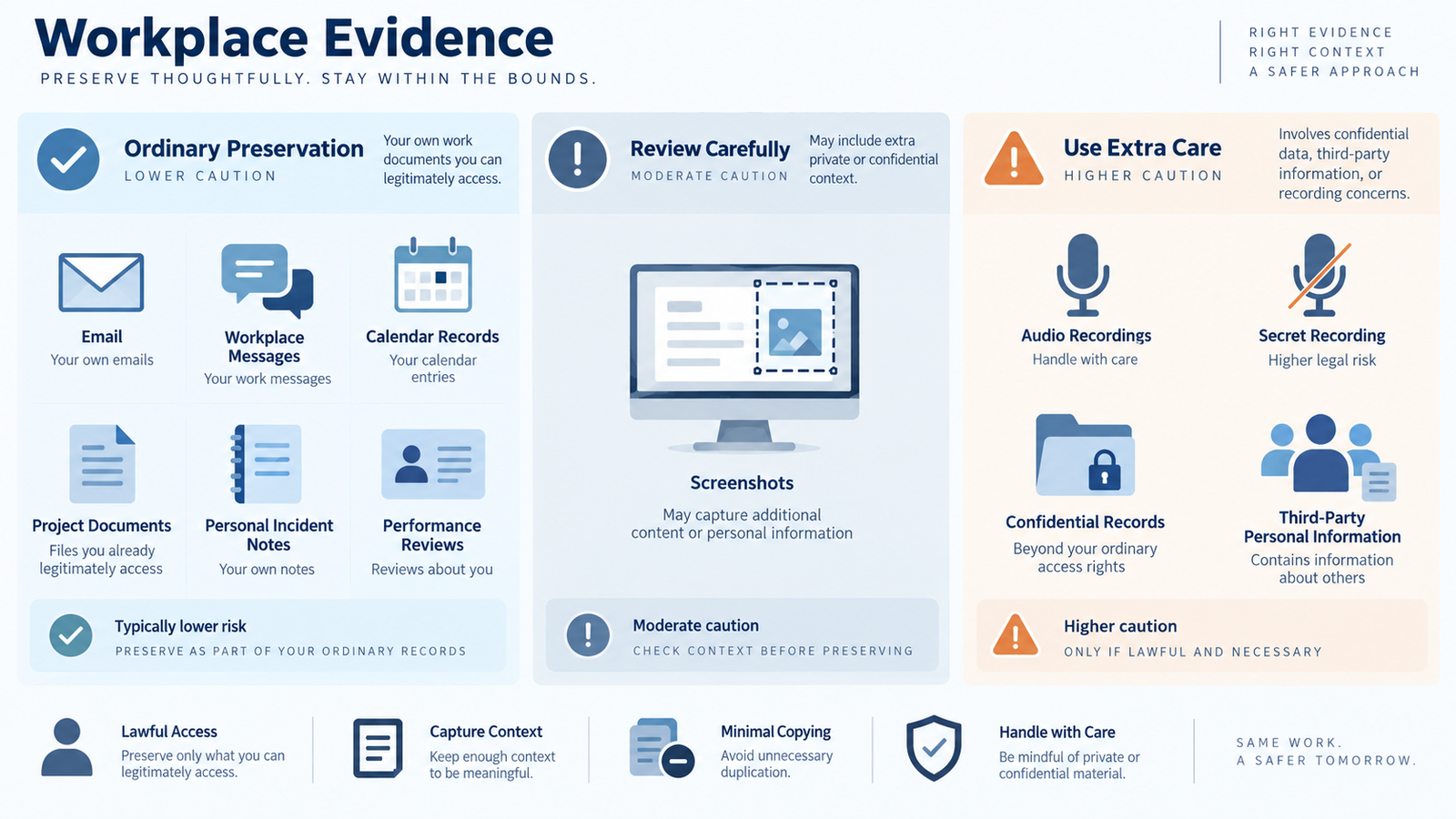
Evidence Preservation Matrix: What to Keep and What to Watch
| Evidence Type | What It May Help Establish | Lower-Risk Preservation Approach | Main Caution |
|---|---|---|---|
| Email or workplace message | Instructions, dates, statements, approvals | Identify and preserve the original record where you are authorized to do so | Do not automatically forward confidential messages to a personal account |
| Calendar or meeting invitation | Timing, attendance, exclusion, scheduling changes | Record the meeting details and source | Calendar entries may contain third-party information |
| Project-management record | Responsibility, deadlines, task history, approvals | Record relevant task identifiers and chronology | Do not bulk-export restricted project data |
| Performance review | Historical performance descriptions and expectations | Use copies you are entitled to receive or access | Personnel systems may contain confidential information about others |
| Personal incident note | Your contemporaneous account | Write factual notes soon after the event | Avoid inserting unnecessary confidential client or coworker data |
| Screenshot | Visible message, status or statement | Capture enough context to understand the source | Cropping can remove context; screenshots can also capture private third-party information |
| Witness information | Who may have first-hand knowledge | Record who was present and what they may have observed | Do not pressure coworkers to create supporting statements |
| Audio or video recording | What was said or occurred | Check law and workplace policy before recording | Recording rules vary significantly by jurisdiction and context |
How to Preserve Emails and Messages Without Creating a New Policy Problem
“Save the emails” sounds simple until the email contains confidential company information, customer data, personnel details or material that your employer restricts from leaving its systems.
Do not automatically forward every relevant message to your personal email.
Instead, first ask:
- Am I authorized to retain or export this record?
- Does it contain confidential client or company information?
- Does it include personal information about another employee?
- Does company policy restrict sending work material to personal accounts?
- Could I identify the record later without making an unauthorized copy?
Sometimes the safer approach is to record:
Email from manager, September 18, 10:42 a.m., subject “Project Deadline Update,” stored in company email.
Your evidence index now tells you what exists and where.
You have not unnecessarily transferred the contents outside the company system.
If the record may become legally significant and you are worried that it could disappear, obtain appropriate advice about preservation rather than assuming that copying it to yourself is automatically permitted.
Screenshots Can Be Useful — but Context Matters
A screenshot can preserve a visible message, but it has limitations.
A tightly cropped screenshot might show:
“This was your responsibility.”
But it may hide the previous message showing that responsibility had been assigned to someone else.
Where permitted, preserve enough context to understand:
- who sent the message;
- when it was sent;
- which conversation or channel it came from;
- what came immediately before or after it.
Do not edit the original screenshot to emphasize your case.
If you later create a highlighted or redacted version for explanation, treat it as a working copy and retain the unedited original where you are lawfully entitled to do so.
Also look at what else the screenshot captures.
A screenshot relevant to your complaint may also reveal:
- another employee’s private message;
- client information;
- medical information;
- financial information;
- confidential project details.
Evidence does not become exempt from privacy concerns simply because part of it is relevant to you.
Use a Workplace Incident Log to Connect Evidence to Events
A folder containing 200 screenshots is not the same thing as clear documentation.
An incident log explains why each item matters.
For example:
Incident: September 11 team meeting.
Issue: Manager stated that I had not warned them about the client delay.
Supporting evidence: Email sent September 8 at 9:34 a.m. with subject “Potential Client Delay,” addressed to manager.
Professional impact: The alleged failure to communicate was cited as a performance concern.
The evidence now has context.
You can use the free workplace incident log to connect dates, conduct, evidence, witnesses and professional impact without turning the record into a pile of disconnected files.
Follow Up Important Verbal Conversations in Writing
Some of the most important workplace events leave no automatic record.
Your manager may verbally:
- change a deadline;
- give a new instruction;
- criticize your performance;
- change an approval requirement;
- assign responsibility;
- agree to investigate a concern.
When appropriate, a calm follow-up email can confirm your understanding.
For example:
“Following up on today’s conversation, my understanding is that the client deadline is now Friday and that I should wait for your approval before sending the final proposal. Please let me know if I have misunderstood either point.”
This is often more useful than writing:
“I’m emailing so you cannot deny this later.”
For complete templates, see our guide to writing a follow-up email after a difficult verbal conversation.
What About Secret Recordings?
A recording can feel like the strongest possible evidence because it appears to preserve the conversation exactly.
It can also create significant legal, privacy and workplace-policy issues.
Do not assume that because you participated in a conversation you automatically have the right to record it secretly.
Recording laws differ between countries and, in some jurisdictions, between states or regions. Workplace policies may impose additional restrictions. A recording can also capture confidential business information or private information about other people.
Before making a covert audio or video recording, check:
- the law where the conversation takes place;
- the law that applies to the participants if relevant;
- your employer’s recording and device policies;
- whether the conversation contains confidential or protected information;
- whether another lawful documentation method would meet your needs.
When in doubt, contemporaneous notes and neutral written follow-ups are often lower-risk forms of documentation while you obtain proper advice.
Privacy: Other People’s Information Is Not Automatically Yours to Copy
A workplace record can contain information about several people at the same time.
Imagine an email thread that supports your account but also contains:
- a coworker’s medical information;
- another employee’s disciplinary history;
- customer contact details;
- salary information;
- personal phone numbers;
- confidential HR discussions.
The fact that one sentence is useful to your workplace complaint does not automatically give you unrestricted permission to copy, publish or distribute everything around it.
In the UK, the Information Commissioner’s Office treats employment records and monitoring information as areas involving personal-data obligations, including accuracy, security and appropriate handling. See the ICO guidance on employment records and data protection.
Other countries have different privacy frameworks.
The broader principle remains useful:
Collect the minimum information you reasonably need and avoid spreading unrelated personal information.
Company Confidentiality and Trade Secrets: Relevance Does Not Equal Permission
A document may be relevant to your experience and still contain information the company legitimately protects.
Examples can include:
- customer databases;
- pricing models;
- security information;
- source code;
- financial forecasts;
- product plans;
- confidential contracts;
- investigation files;
- personnel records.
Do not use workplace bullying as a reason to take material that you would otherwise have no right to possess.
If a confidential record is genuinely important, note:
- what the record is;
- where it is stored;
- the date;
- why it is relevant.
Then seek guidance on the correct way to preserve or request it.
This is particularly important when litigation, regulatory issues, whistleblowing, trade secrets or highly sensitive personal information may be involved.
Work Devices, Work Email and Cloud Accounts: Don’t Assume Privacy
Your employer’s laptop, email service, messaging platform or cloud storage may be administered by the organization.
Policies may govern:
- monitoring;
- retention;
- downloads;
- USB devices;
- personal cloud services;
- email forwarding;
- screenshots;
- confidential data.
Do not assume that a folder named “Private Evidence” on your work laptop is inaccessible to the employer.
At the same time, do not respond by automatically transferring company files to a personal device.
The safest method depends on the type of record, workplace policy, applicable law and the seriousness of the issue.
Preserve Originals; Do Not Edit the Evidence
If you are lawfully entitled to retain a piece of evidence, keep the original version intact.
Do not:
- change timestamps;
- rewrite a message;
- remove inconvenient parts of a conversation;
- combine separate screenshots so they look like one exchange;
- rename something in a misleading way;
- add text to the original image or file.
You can create separate notes explaining why something matters.
For example:
“This email confirms that approval remained with the director until May 12.”
That note should remain separate from the source record itself.
Your documentation becomes more credible when the underlying evidence can speak for itself.
Build an Evidence Index Instead of a Secret Archive
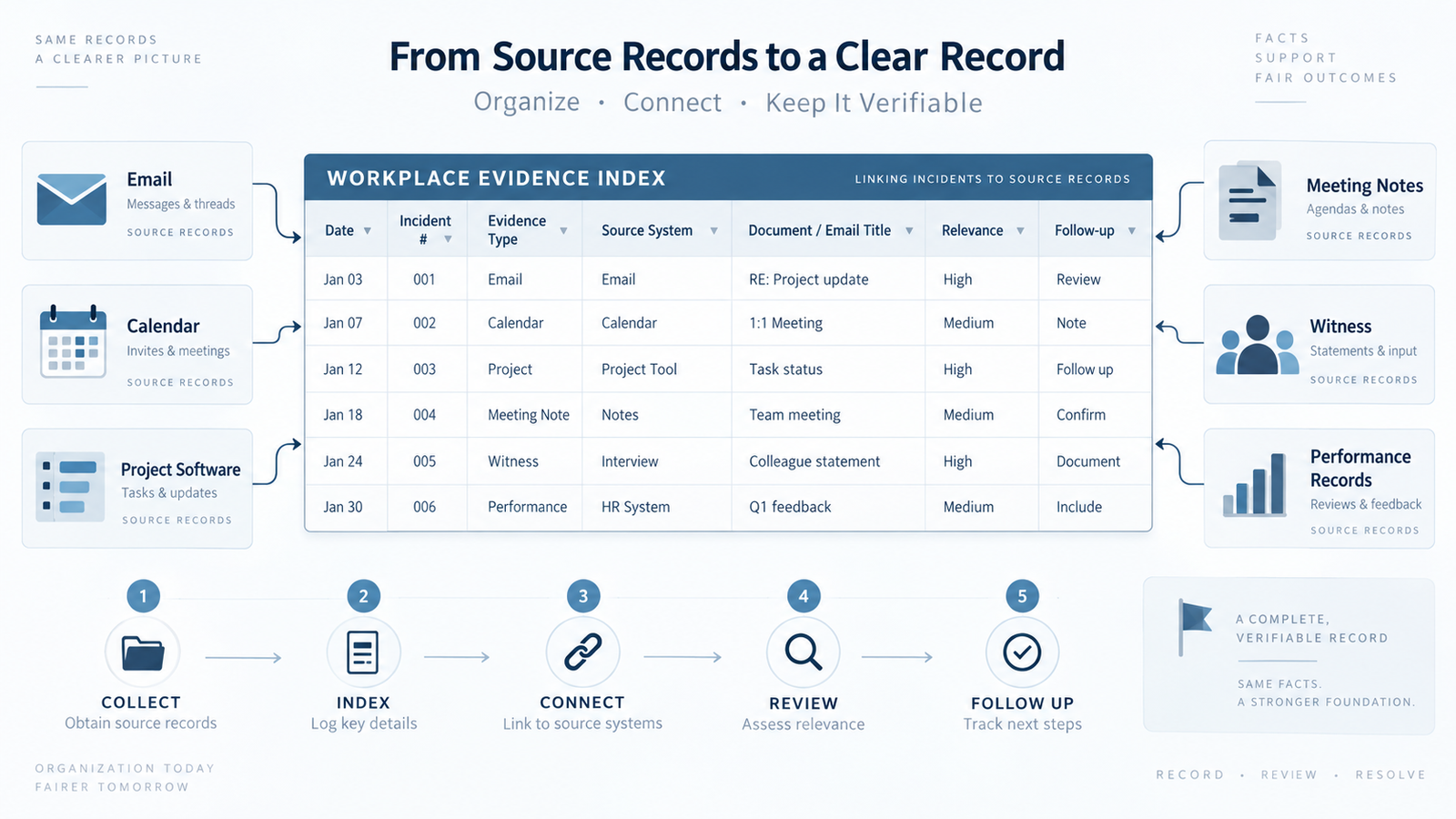
You often do not need copies of every document.
An evidence index can help you organize relevant records while reducing unnecessary duplication.
| Incident | Date | Evidence | Where It Exists | Why It Matters |
|---|---|---|---|---|
| Deadline changed | Sept. 4 | Email: “Revised Delivery Date” | Company email | Shows Friday deadline |
| Public criticism | Sept. 8 | Team meeting | Calendar + personal notes | Manager said deadline had been Wednesday |
| Clarification request | Sept. 8 | Follow-up email | Company email | Asked which deadline applied |
| Performance criticism | Sept. 12 | Written feedback | HR/performance system | References alleged missed deadline |
This structure tells you:
- what happened;
- which record matters;
- where the record exists;
- why it is relevant.
You are building a map, not secretly duplicating the entire company archive.
What If Instructions or Events Keep Being Denied?
If important conversations are repeatedly denied later, evidence preservation becomes especially useful.
Suppose the pattern is:
- Your manager gives a verbal instruction.
- You act on it.
- The outcome is criticized.
- Your manager says the instruction was never given.
After an important verbal instruction, you might use a neutral confirmation email.
You can also record the event in your incident log and identify any supporting calendar or project records.
If this becomes a repeated pattern that leaves you questioning your memory or understanding, read our guide to the signs of workplace gaslighting.
The goal remains the same:
Do not build an argument about someone’s personality.
Preserve the chronology.
What Not to Collect or Do
Evidence preservation does not justify every method of obtaining information.
Avoid actions such as:
- guessing passwords or accessing accounts you are not authorized to use;
- opening private coworker files merely because you think they may mention you;
- taking personnel records you are not entitled to receive;
- forwarding an entire confidential mailbox to yourself;
- bulk-downloading customer or company databases;
- removing trade secrets or proprietary material;
- editing screenshots to change their apparent meaning;
- asking coworkers to exaggerate or coordinate stories;
- secretly recording conversations without checking applicable law and policy;
- deleting inconvenient messages from the evidence set;
- publishing allegations or private workplace records on social media as a substitute for proper reporting.
Good evidence should help clarify the original workplace problem.
It should not create a separate allegation of unauthorized access, confidentiality breach or misconduct.
If You Think You May Lose Access to Your Work Account
This is one of the moments when people are most tempted to download everything.
Resist that impulse.
If you are worried that resignation, dismissal, leave or account suspension could remove access, start by creating an index of relevant records that you are allowed to reference.
Record information such as:
- document title;
- email subject;
- date;
- sender and recipient where appropriate;
- project or case number;
- where the record is stored;
- why it matters.
If particularly important company-held evidence may need formal preservation, an employment lawyer, union representative or appropriate adviser can help you determine what steps are available in your jurisdiction.
Do not assume that impending loss of access gives you permission to remove restricted information.
When to Take Evidence to HR, a Union or an Adviser
Your evidence is most useful when it supports a clear concern.
Instead of arriving with hundreds of screenshots and saying:
“Everything is toxic.”
you might say:
“I am raising a repeated issue concerning changed instructions and subsequent performance criticism. I have prepared a chronology of five incidents and identified the emails, project records and witnesses relevant to each one.”
That gives the recipient a structure to review.
For U.S. employees dealing with conduct that may fall under federal anti-discrimination or harassment law, the EEOC’s workplace harassment guidance recommends checking the employer’s anti-harassment policy and following the reporting options available.
For other jurisdictions, use the relevant local process.
If you are unsure whether a particular document can safely be copied or shared, ask before distributing it.
A Useful Question to Ask HR or an Adviser
“I want to preserve records relevant to this concern without breaching confidentiality or data policy. What is the appropriate way for me to identify or submit the records?”
That question communicates both seriousness and restraint.
Example: Safe vs. Risky Evidence Preservation
Imagine this situation:
Your manager criticizes you for failing to obtain approval before sending a proposal. You remember that the manager had previously told you that additional approval was unnecessary.
Riskier Response
You begin searching folders belonging to coworkers, export an entire project archive, forward confidential client documents to your personal email and secretly record your manager the next morning without checking local rules.
You may now have created several new issues unrelated to whether the original criticism was fair.
More Careful Response
You:
- write a factual incident note while the conversation is fresh;
- identify the email thread and calendar meeting connected with the instruction;
- record the project-task history showing who controlled approval;
- send a neutral follow-up asking what approval process should apply going forward;
- list the relevant records in your evidence index;
- avoid transferring confidential material until you know what you are permitted to retain;
- seek advice if the matter becomes formal or employment consequences increase.
The second approach is less dramatic.
It is also usually much easier for another person to understand.
Free Workplace Evidence Preservation Checklist
Before saving, copying, exporting, photographing, forwarding or recording something as evidence, ask:
- Is this directly relevant? What incident or issue does it support?
- Do I already have legitimate access to it?
- Am I permitted to copy or remove it?
- Does it contain confidential company information?
- Does it contain personal information about coworkers, clients or customers?
- Can I preserve the important fact by indexing the record instead of copying the entire document?
- Have I preserved the surrounding context?
- Am I keeping the original unedited?
- Would a neutral reviewer understand what this evidence shows?
- If it is a recording, have I checked applicable law and policy?
- Am I storing the information in an appropriate and secure place?
- If I am uncertain, should I ask HR, my union, an employment adviser or a lawyer before copying it?
This checklist is intentionally cautious.
The goal is not to collect the largest possible evidence file.
The goal is to preserve the most useful evidence without creating avoidable risk.
Frequently Asked Questions
What evidence can prove workplace bullying?
No single type of evidence automatically proves workplace bullying. Depending on the situation, relevant material can include emails, messages, incident notes, calendar records, project histories, performance documents, witness information and written follow-ups. A repeated chronology can be more informative than one isolated document.
How do I collect evidence of workplace bullying?
Start by documenting incidents factually and identifying records you already lawfully receive or use, such as relevant emails, messages, project records, calendar entries and performance feedback. Preserve context and avoid accessing, copying or removing material you are not authorized to take.
Can I screenshot work messages as evidence?
A screenshot may be useful, but check workplace policy and privacy considerations. Capture enough context to understand the message, do not edit the original, and be careful if the image contains confidential company information or personal information about other people.
Can I forward work emails to my personal email for evidence?
Do not assume this is allowed. Work emails may contain confidential, proprietary, client or employee information, and employers may restrict forwarding company material to personal accounts. Where uncertain, identify the relevant email in an evidence index and get advice about appropriate preservation.
Can I secretly record my boss bullying me?
Recording laws vary by jurisdiction, and workplace policies can impose additional restrictions. A recording may also capture confidential or third-party information. Check the rules that apply where you are located before making a covert recording.
What if workplace bullying happens with no witnesses?
You can still document the event. Write a contemporaneous factual note recording the date, location, conduct, context, your response and what happened afterward. ACAS notes that bullying often occurs out of sight of others, so the lack of witnesses should not by itself stop someone from raising a concern.
Should I keep every email from a difficult boss?
Usually there is no need to treat every routine communication as evidence. Focus on records that materially relate to the incidents or pattern you are documenting. An organized evidence index is often more useful than an enormous unsorted archive.
How do I document workplace harassment without violating privacy?
Record your own experience, preserve relevant records you legitimately access, minimize unrelated personal information, and avoid taking confidential or third-party records merely because they may be useful. If the matter becomes formal, use appropriate reporting or legal channels to request preservation and review of sensitive records.
Conclusion: Strong Evidence Is Clear, Relevant and Properly Preserved
If you are experiencing workplace bullying, the understandable impulse is to make sure nothing disappears.
But “save everything” is not always good advice.
A stronger approach is:
- document incidents while they are fresh;
- preserve legitimate emails and messages;
- identify project and calendar records;
- record witnesses;
- confirm important verbal decisions in writing;
- keep original evidence intact;
- preserve context;
- avoid unnecessary confidential information;
- check privacy, recording and workplace rules before higher-risk actions;
- use an evidence index to connect records to the events they support.
You are not trying to build the biggest file.
You are trying to create the clearest reliable record.
That distinction matters because evidence should strengthen your ability to explain what happened — not distract from it with a new dispute about how the information was obtained.
Build a Protection System, Not Just an Evidence Folder
Evidence is only one part of responding to a harmful workplace dynamic.
You may also need to understand the pattern, communicate carefully, document incidents, protect boundaries, decide when to escalate and plan what happens if the environment does not improve.
Reclaim Your Power brings those pieces together.
Chapter 4 focuses on practical protection while difficult workplace dynamics are still happening, including documentation, communication, evidence, boundaries and escalation. The accompanying workbook helps you organize incidents and patterns without turning the process into an emotional or chaotic archive.
Explore Reclaim Your Power and the complete workplace protection workbook.
Your goal is not to collect everything.
It is to preserve what matters — carefully enough that the way you protected yourself does not become a problem of its own.
Ready to Reclaim Your Power?
Get the complete 7-chapter guide, workbook exercises, and 30-day recovery journal.
Buy Now — $4.99
Leave a Reply