
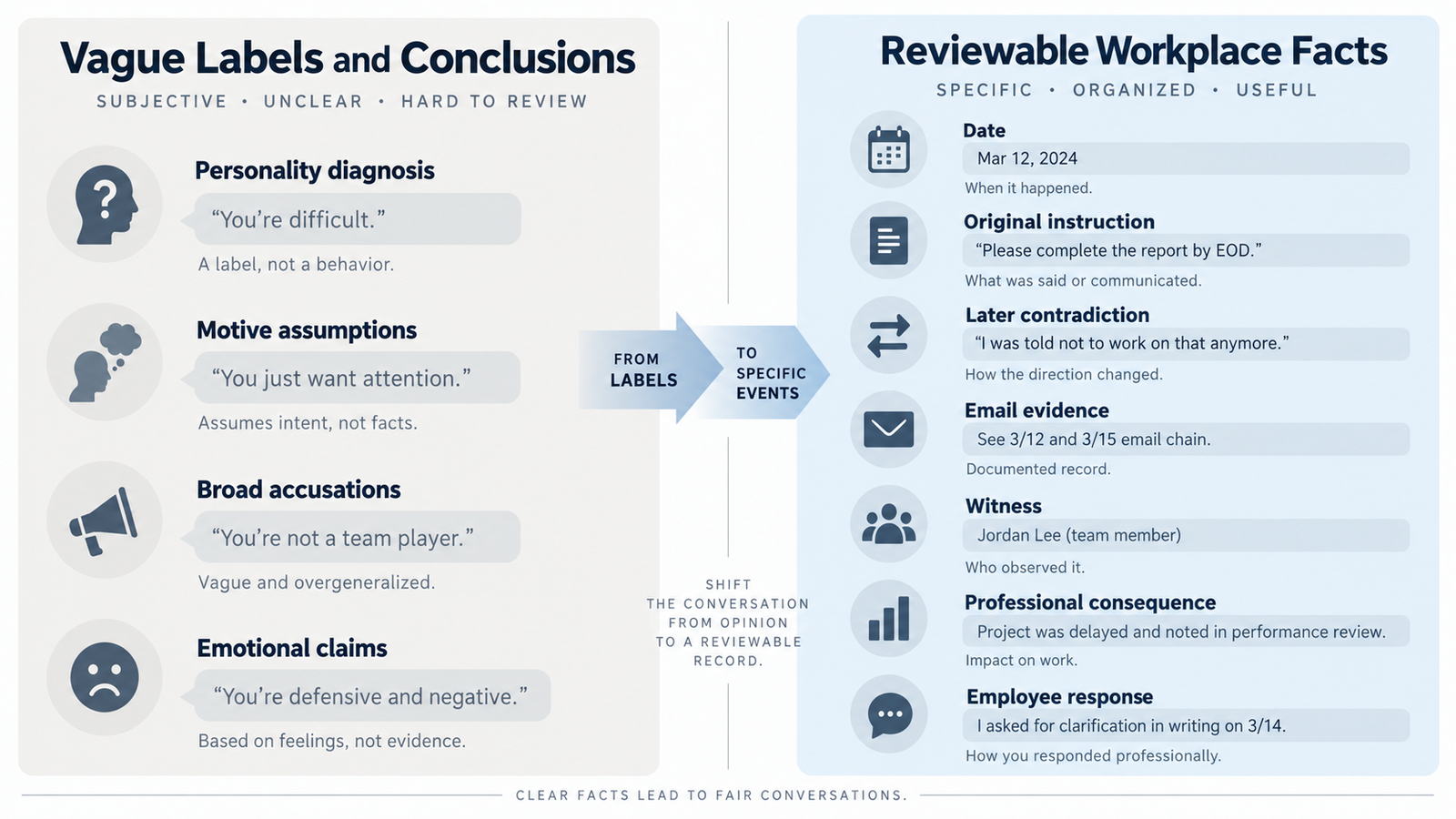
If you are trying to learn how to report workplace gaslighting to HR, the strongest approach is usually not to begin with, “My boss is gaslighting me.” Start with the behavior HR can review: specific dates, what was originally said or agreed, what was later denied or changed, supporting records, witnesses where relevant, and the effect on your work.
Think of the goal this way:
Do not ask HR to believe your interpretation first. Give them enough factual information to examine the pattern themselves.
Why Saying “My Boss Is Gaslighting Me” May Not Be Enough
The word gaslighting communicates something important to the person experiencing it.
It may capture months of:
- instructions being denied;
- events being rewritten;
- deadlines changing and later being described as unchanged;
- criticism that contradicts previous feedback;
- being told that you misunderstood things you have in writing;
- being made to question your memory or judgment.
But HR still has to determine what actually happened.
Imagine receiving these two complaints.
Complaint A
“My manager is a narcissist who gaslights me constantly and is trying to destroy my confidence.”
Complaint B
“I am raising a repeated problem involving instructions being changed or denied and then used in performance criticism. I have identified four incidents over the last two months, including the original written instructions, later contradictory statements and the resulting impact on my work.”
The first complaint communicates distress.
The second gives HR something concrete to review.
You do not have to suppress the fact that you believe the pattern is gaslighting.
You simply do not want the label to carry the entire complaint.
Translate “Gaslighting” Into Behavior HR Can Review
A useful reporting skill is converting your interpretation into an observable event.
| Label or Conclusion | Facts HR Can Review |
|---|---|
| “My boss gaslights me.” | “The manager gave an instruction on September 3, denied giving it on September 8 and criticized me for following the original instruction.” |
| “She keeps rewriting history.” | “The written project plan listed Friday as the deadline. During Monday’s performance discussion, I was told the deadline had always been Wednesday.” |
| “He makes me look incompetent.” | “Two performance criticisms were based on information I had requested but had not been provided.” |
| “She wants me to fail.” | “My approval access was removed on May 6, and I was criticized on May 10 for not completing the approval.” |
| “He lies about everything.” | “I identified three occasions where his later account differed from the written record.” |
| “She is trying to make me doubt myself.” | “When I referred to the earlier written instruction, I was repeatedly told that I had misunderstood it despite the wording remaining unchanged.” |
Notice the difference.
The right-hand column does not require HR to agree with your theory about motive.
It gives them events they can compare against records.
This same principle applies to many gaslighting phrases at work. A phrase such as “I never said that” becomes much more meaningful when you can identify when the original instruction occurred, what evidence exists and what happened after it was denied.
Before Going to HR, Build a Short Chronology
You do not need to reconstruct every difficult interaction you have ever had with your manager.
Start with the clearest representative examples.
For each incident, record:
- date and approximate time;
- where the event occurred;
- who was involved;
- the original instruction, statement or event;
- what was later contradicted or denied;
- supporting evidence;
- witnesses if applicable;
- your response;
- professional impact;
- what happened next.
If you need help building the chronology first, use our guide on how to document workplace abuse calmly and clearly or the free workplace incident log.
Example
September 4: Manager emailed that the client proposal was due September 12.
September 8: During a team meeting, manager stated that the proposal had been due September 7 and said I had missed the deadline.
My response: I referred to the September 4 email.
Manager response: Manager stated that I had misunderstood the email and that September 12 referred to a later stage.
Evidence: September 4 email states, “Final client proposal due September 12.”
Impact: The alleged missed deadline was referenced in subsequent written performance feedback.
That is considerably easier for HR to investigate than:
“My boss constantly changes reality.”
Select the Strongest Examples — Not Every Annoying Interaction
When you have lived through months of confusing behavior, everything can feel connected.
You may arrive at HR with:
- 80 screenshots;
- dozens of emails;
- six months of diary entries;
- multiple stories about unrelated disagreements;
- every rude comment you remember.
More material is not automatically a stronger complaint.
Start with incidents that most clearly demonstrate the pattern.
Strong Examples Often Have:
- a clear original event or instruction;
- a later contradiction or denial;
- supporting documentation;
- a measurable professional consequence;
- repetition across more than one incident.
You can tell HR that additional records exist if needed.
But a concise chronology makes it easier for the person receiving the complaint to understand what you are asking them to examine.
The Seven-Part Facts-First HR Report
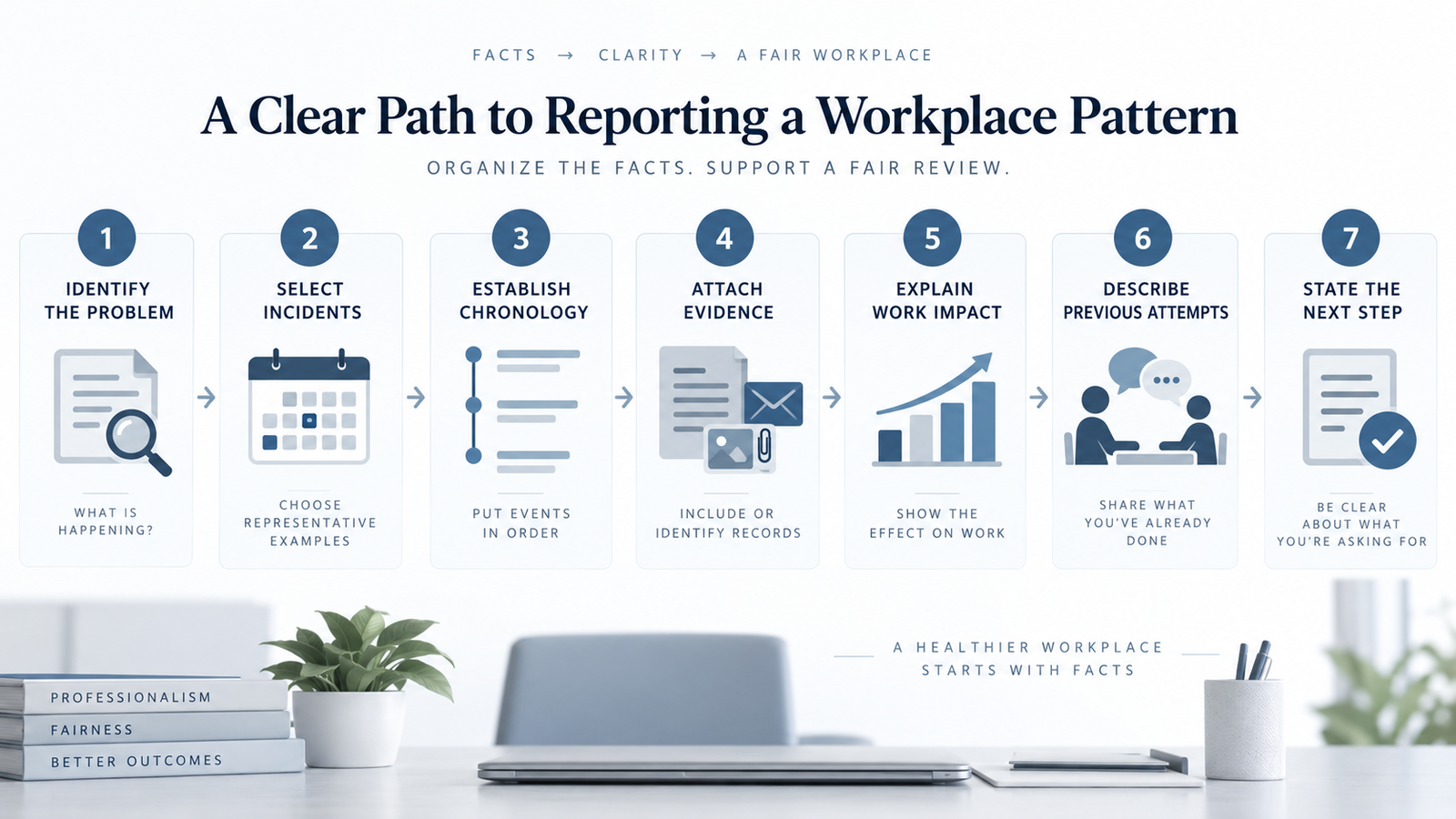
You can structure a written report or HR conversation around seven components.
1. State the Workplace Problem
Begin with the behavior.
For example:
“I would like to raise a repeated issue involving verbal and written instructions being contradicted later and then used as the basis for criticism of my performance.”
You may add:
“The pattern feels consistent with workplace gaslighting, but I would like the underlying incidents reviewed on their facts.”
That is very different from demanding that HR immediately accept a psychological label.
2. Give the Time Period
For example:
“The examples below occurred between May and August.”
This immediately gives the complaint boundaries.
3. Give Representative Incidents
For each incident, provide:
- date;
- what happened;
- what record exists;
- what later changed or was denied.
4. Identify Supporting Evidence
Do not simply write:
“I have proof.”
Identify the record.
For example:
“The original deadline appears in the May 6 project email.”
5. Explain the Professional Impact
This part is critical.
Explain what happened to your work because of the pattern.
Examples include:
- negative performance feedback;
- discipline;
- missed deadlines;
- rework;
- reduced responsibilities;
- loss of client contact;
- damage to your professional reputation;
- difficulty knowing which instructions to follow.
6. Explain What You Already Tried
For example:
“I attempted to reduce confusion by confirming instructions in writing after meetings on June 3 and June 17.”
If important conversations have been verbal, a follow-up email after a difficult verbal conversation can sometimes clarify expectations before escalation becomes necessary.
7. State What You Are Asking HR to Do
Do not make HR guess what outcome you need.
Depending on the circumstances, you might ask for:
- review of the incidents;
- clarification of reporting lines or decision authority;
- an investigation under the relevant policy;
- clear written expectations;
- a different communication process;
- support in preventing further incidents;
- information about the formal grievance procedure.
You do not necessarily need to demand punishment for another employee.
Your request can focus on addressing the conduct and protecting the work process.
What Evidence Should You Bring to HR?
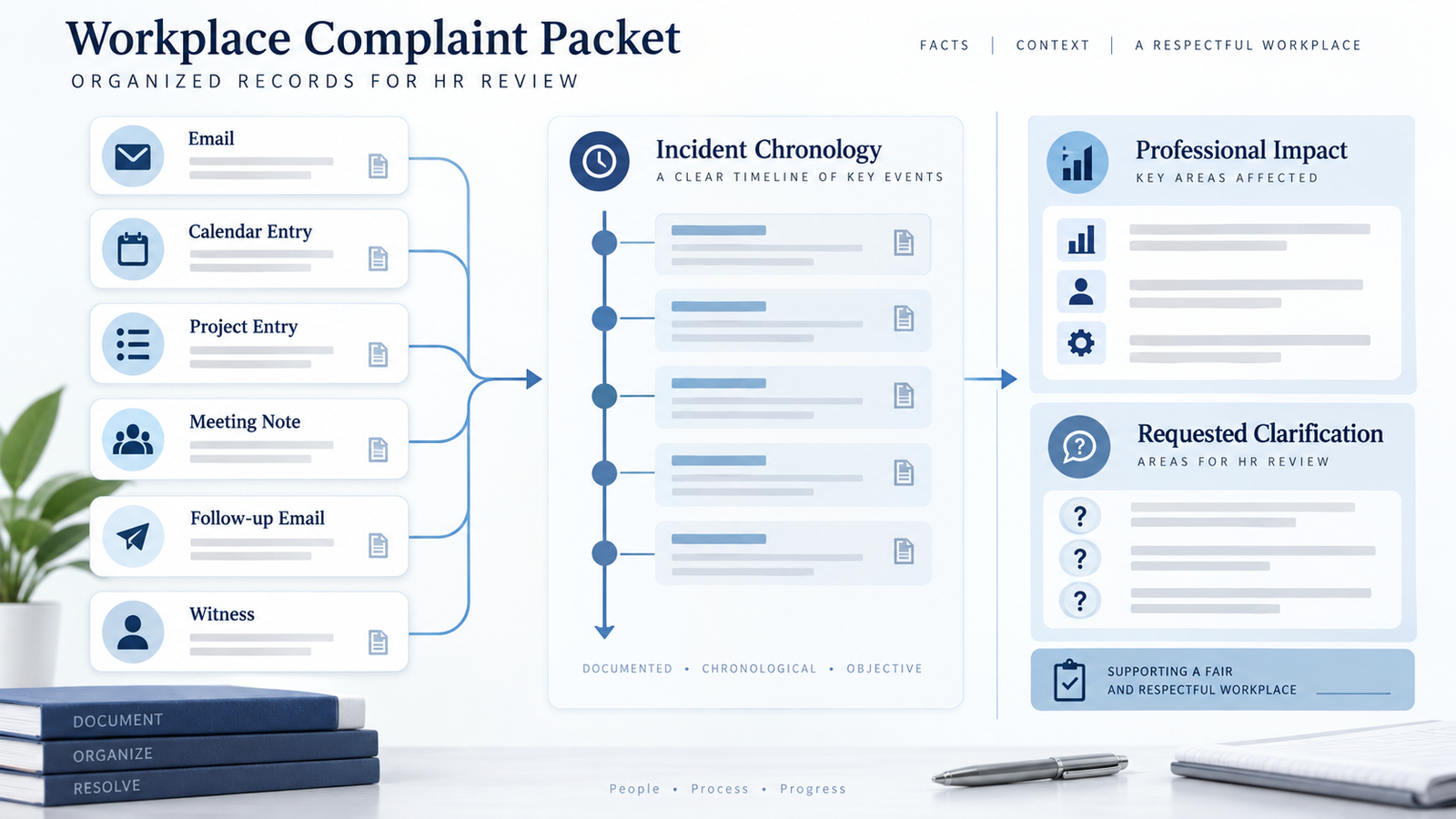
Your evidence should support the incidents you are actually reporting.
Useful records may include:
- emails;
- workplace messages;
- project-management entries;
- calendar records;
- performance reviews;
- written instructions;
- meeting notes;
- neutral follow-up emails;
- witness names;
- your contemporaneous incident log.
A simple evidence index can help:
| Incident | Date | Supporting Record | What It Shows |
|---|---|---|---|
| Deadline dispute | May 6 | Project email | Original deadline was Friday |
| Deadline denied | May 10 | Meeting notes | Manager stated deadline had always been Wednesday |
| Clarification | May 10 | Follow-up email | Employee requested confirmation |
| Performance consequence | May 18 | Written feedback | Missed deadline cited as performance issue |
The purpose is not to overwhelm HR with documents.
It is to connect each allegation to something reviewable.
Also remember that evidence collection has limits. Do not improperly access confidential files, remove company data you are not entitled to take or secretly record conversations without checking applicable law and workplace policy.
Explain Professional Impact, Not Just Emotional Harm
Gaslighting can be emotionally destabilizing.
You may feel anxious, confused, embarrassed or exhausted.
Those effects are real and may be relevant.
But when reporting to HR, also explain what happened to the work.
For example:
Emotional impact:
“The repeated contradictions have made me anxious about verbal instructions.”
Professional impact:
“Because verbal instructions have later been denied, I now spend additional time seeking written confirmation before completing routine tasks. Two disputed instructions have also been referenced in performance criticism.”
The second statement shows why this is an organizational problem, not simply an interpersonal disagreement.
How to Report Changing Instructions
Changing instructions are one of the easiest gaslighting-related patterns to describe factually.
Use a structure such as:
- What was the original instruction?
- When and how was it given?
- What did you do because of that instruction?
- What was later said?
- What record exists?
- What consequence followed?
Example
“On July 3, my manager instructed me during the project call to send the report directly to the client. I followed that instruction on July 4. On July 5, I was told that I should never have sent the report without manager approval. I sent a follow-up email asking whether the approval process had changed. The original July 3 meeting notes and my July 5 follow-up are available.”
You do not have to conclude:
“My manager deliberately set me up.”
Let HR evaluate the sequence.
How to Report Denial of Previous Conversations
If someone repeatedly says:
“I never said that.”
avoid turning the HR discussion into an argument about whose memory is superior.
Instead report:
“On August 6, I understood the instruction to be X. I sent a written summary at 2:14 p.m. confirming X. I did not receive a correction. On August 12, I was told that the instruction had always been Y.”
This is especially helpful where a written follow-up exists.
If no written record exists, you can still report the incident accurately:
“This was a verbal conversation in the manager’s office at approximately 11 a.m. I wrote a contemporaneous incident note later that day. There were no witnesses.”
A lack of witnesses does not mean you should invent supporting evidence.
How to Report Blame-Shifting That Overlaps With Gaslighting
Sometimes the disputed reality concerns responsibility.
You may be told you failed to complete something you did not have authority to complete.
Or a manager may later claim that a decision was yours when they approved it.
Report the responsibility chain.
For example:
“The project process required director approval before client submission. I requested approval at 9:15 a.m. on September 4. Approval arrived at 5:05 p.m., after the client’s 4 p.m. deadline. On September 5, I was told that I had personally caused the missed deadline by failing to send the document.”
The issue may overlap with blame-shifting at work, but again, the chronology is more useful to HR than the terminology.
A Sample Email to HR About Workplace Gaslighting
You do not have to use the word gaslighting in the subject line.
Subject: Request to Discuss Repeated Instruction and Performance Concerns
Hi [HR Name],
I would like to raise a repeated workplace issue involving instructions being changed or denied and then referenced in criticism of my performance.
I have documented four representative incidents between June and September. In each case, I recorded the original instruction, the later contradictory statement, any supporting records and the effect on my work.
For example:
- On June 4, I received a written deadline of June 12. On June 9, I was told the deadline had always been June 7 and was criticized for missing it. The June 4 email is available.
- On July 15, I was instructed during a meeting to send the revised proposal directly to the client. On July 17, I was criticized for sending it without approval. I sent a written clarification request immediately afterward.
- On August 8, I was told that there had been long-standing concerns about my project communication. My previous written review from June described my communication as meeting expectations. I requested specific examples of the new concern.
The repeated contradictions are making it difficult to determine which instructions and expectations I am expected to follow, and two of these incidents have now been referenced in performance discussions.
I would appreciate guidance on the appropriate process for having these incidents reviewed and for establishing clear written expectations going forward.
I can provide the chronology and relevant records.
Regards,
[Name]
Notice what is missing.
The email does not call the manager evil.
It does not diagnose narcissism.
It does not say HR must agree that gaslighting occurred.
It describes an investigable workplace problem.
Should You Actually Use the Word “Gaslighting” With HR?
You can.
The word is not forbidden.
The question is how much work you expect the label to do.
A useful formulation is:
“I have experienced a repeated pattern that I understand as workplace gaslighting. Rather than relying on that label, I have documented the specific incidents I would like reviewed.”
That communicates your experience while keeping the report grounded.
You might avoid making the label central if:
- your workplace treats the term as informal or psychological language;
- you are making a formal grievance under a policy with different terminology;
- the behavior is better described through specific policy violations;
- you do not want the discussion diverted into debating the definition of gaslighting.
The objective is not to win a vocabulary argument.
The objective is to have the conduct examined.
Check the Workplace Policy Before Reporting
Before sending a formal complaint, review any available policies relating to:
- bullying;
- harassment;
- grievances;
- employee conduct;
- ethics;
- retaliation;
- whistleblowing where relevant;
- formal complaints.
Look for:
- who should receive the complaint;
- whether informal resolution is expected first;
- what information should be included;
- whether there are reporting deadlines;
- what happens after a complaint is submitted.
General ACAS guidance advises employees raising formal grievances to check the organization’s procedure and put the problem, relevant evidence and the requested outcome in writing. Review ACAS guidance on raising a formal grievance.
Informal Conversation or Formal Complaint?
Not every problem has to begin with a formal grievance.
Some situations may be suitable for an informal conversation with:
- your manager;
- another manager;
- HR;
- a union representative;
- another designated workplace contact.
But a formal route may be more appropriate when:
- the behavior is serious;
- informal attempts have failed;
- the person involved has significant power over you;
- performance or disciplinary consequences are developing;
- you fear retaliation;
- workplace policy requires formal reporting;
- the conduct may involve discrimination, harassment or another legally protected issue.
ACAS distinguishes between informal resolution and formal grievance processes and notes that serious complaints may require formal handling. See ACAS guidance on raising a workplace problem.
What Should You Ask HR to Do?
A complaint is often stronger when it includes a realistic requested next step.
You might ask HR to:
- review the documented incidents;
- explain which workplace policy applies;
- clarify instructions and decision authority;
- establish a written communication process;
- investigate contradictions affecting performance records;
- correct inaccurate records where appropriate;
- explain how future concerns should be reported;
- take steps to prevent recurrence.
Try to distinguish the outcome you actually need from punishment you want imposed on someone else.
For example:
More practical:
“I would like the four incidents reviewed and written clarification of the approval process going forward.”
Less useful:
“I want my manager fired immediately.”
There may be situations where serious discipline is ultimately appropriate, but investigation and disciplinary decisions normally belong to the organization.
What If HR Says It Is Just a Communication Problem?
Do not immediately abandon the conversation.
Ask what process can resolve the communication problem they have identified.
For example:
“If this is being treated as a communication issue, I would like to agree on a process that prevents instructions from being disputed later. Could deadlines, approvals and significant task changes be confirmed through the project system going forward?”
You can also ask:
- Will the disputed performance criticism be reviewed?
- Can written expectations be established?
- Who should I contact if the issue repeats?
- Will HR keep a record that I raised the concern?
The label HR chooses is not always the most important outcome.
If concrete protections and clearer processes are put in place, those changes may be useful regardless of terminology.
What If HR Asks, “Why Didn’t You Raise This Earlier?”
You do not need a dramatic explanation.
Answer truthfully.
For example:
“At first, I thought the incidents were ordinary misunderstandings. I became concerned when the same pattern repeated and began affecting performance feedback.”
Or:
“I initially tried to resolve the confusion directly by confirming instructions in writing. I am raising it now because that has not resolved the problem.”
Workplace gaslighting can take time to recognize precisely because individual incidents may initially appear minor or explainable.
What If HR Wants Evidence You Do Not Have?
Do not create it.
Do not exaggerate.
Do not turn assumptions into facts.
Say what exists and what does not.
For example:
“The June 4 instruction is documented by email. The July 15 instruction was verbal, and I wrote an incident note later that day. Two coworkers attended the meeting.”
Or:
“There were no witnesses to the conversation, but I sent a follow-up email immediately afterward summarizing my understanding.”
The absence of perfect evidence does not mean you cannot report your experience.
It simply means the evidence available for different incidents may vary.
What If HR Does Not Agree That It Is Gaslighting?
Do not make agreement on the label the only measure of whether reporting was worthwhile.
Ask:
- Did HR review the underlying incidents?
- Were inaccurate records corrected?
- Were expectations clarified?
- Was the behavior addressed?
- Was a reporting process established?
- Did treatment improve or worsen afterward?
You may believe the behavior is gaslighting even if HR describes it as communication failure, poor management, inconsistent instruction or inappropriate conduct.
The practical question is whether the workplace problem is being addressed.
Document What Happens After You Report
Your records should not necessarily stop when HR becomes involved.
Document:
- when you reported the concern;
- who received it;
- what process was explained;
- what action was promised;
- meetings held afterward;
- any written outcome;
- changes to duties, access or treatment;
- whether the original behavior stops or continues.
Do not assume that every negative event afterward is retaliation.
Preserve the chronology and let the facts show what changed.
When Gaslighting May Overlap With Harassment or Discrimination
Workplace gaslighting is not automatically unlawful harassment.
A manager can behave unfairly, manipulatively or badly without necessarily violating anti-discrimination law.
However, additional legal issues may arise when the conduct is connected to:
- race;
- religion;
- sex or pregnancy;
- disability;
- age;
- national origin;
- another protected characteristic under applicable law;
- reporting discrimination or harassment;
- participating in a protected complaint or investigation.
For U.S. readers, the EEOC’s workplace harassment guidance recommends checking the employer’s anti-harassment policy and following its reporting options where legally relevant harassment may be involved.
Other countries use different legal frameworks, definitions and deadlines.
If the potential consequences are serious, use qualified advice applicable to your jurisdiction rather than assuming that the word gaslighting itself determines your legal rights.
A Facts-First Checklist Before Reporting Workplace Gaslighting to HR
- Can I describe the concern without relying on the word gaslighting?
- Have I identified the clearest three to five incidents?
- Do I know the date or approximate time period for each?
- Have I separated what happened from what I think the person’s motive was?
- Have I identified relevant evidence?
- Have I recorded witnesses accurately without pressuring them?
- Can I explain the effect on my work?
- Have I included previous attempts to resolve the problem?
- Have I reviewed the relevant workplace policy?
- Do I know whether I am raising the issue informally or formally?
- Can I state what I want HR to review or clarify?
- Have I removed unnecessary insults, diagnoses and speculation?
If you can answer those questions clearly, your report is likely much easier for another person to understand.
Frequently Asked Questions
How do I report workplace gaslighting to HR?
Describe specific incidents rather than relying on the word gaslighting alone. Provide dates, the original instruction or event, what was later denied or changed, available evidence, witnesses, your response and the professional impact. Explain the repeated pattern and state what you would like HR to review or address.
Should I tell HR my boss is gaslighting me?
You can use the term, but support it immediately with concrete examples. A useful formulation is: “I believe there is a repeated gaslighting pattern, and I have documented the specific incidents I would like reviewed.” This keeps the complaint focused on behavior rather than a debate about terminology.
What evidence do I need to report gaslighting at work?
Relevant evidence can include emails, messages, project records, calendar entries, performance feedback, written instructions, follow-up emails, incident notes and witness information. Not every incident will have documentary evidence, and you should not obtain records improperly simply to strengthen the complaint.
What are good examples of workplace gaslighting to give HR?
Strong examples include written instructions later being denied, deadlines being rewritten after the fact, performance criticism contradicting documented feedback, responsibility being reassigned retrospectively, or repeated claims that documented conversations never occurred. The strongest examples connect the contradiction to a professional consequence.
What if HR says gaslighting is not a workplace policy term?
Ask HR to review the underlying behaviors instead. Describe the repeated contradictions, denied instructions, changing expectations, inaccurate performance claims or other specific conduct and ask which workplace policy or process applies.
Can workplace gaslighting be harassment?
It can overlap with harassment, but gaslighting by itself is not automatically unlawful harassment. Legal definitions depend on the jurisdiction and circumstances. Conduct linked to protected characteristics or protected activity may raise additional legal issues.
Should I make a formal grievance about gaslighting?
That depends on the seriousness of the behavior, workplace policy, whether informal resolution has worked and the consequences you are experiencing. Review your grievance or bullying policy and consider professional advice if the situation involves discipline, discrimination, retaliation or significant employment consequences.
What if workplace gaslighting has no witnesses?
You can still report what you personally experienced. Clearly identify which incidents had no witnesses and provide any contemporaneous notes, messages, calendar records or follow-up emails that exist. Do not invent corroboration simply because an incident happened privately.
Conclusion: Give HR Something It Can Actually Review
Workplace gaslighting can make you feel as though you need to prove your entire reality at once.
You do not.
Start smaller.
Choose the clearest incidents.
Show:
- what happened;
- what was originally said or recorded;
- what later changed or was denied;
- what evidence exists;
- who witnessed it;
- how you responded;
- what happened to your work afterward.
You can say that you believe the pattern is gaslighting.
But let the facts carry the weight.
HR may disagree with your terminology.
It should still be possible to examine contradictory instructions, disputed performance claims, shifting expectations and other concrete workplace conduct.
Your goal is not to make someone accept a label.
Your goal is to make the workplace problem clear enough to review.
Chapter 4: Protect Yourself With Clarity, Not Chaos
Reporting to HR is only one part of protecting yourself when workplace reality keeps shifting.
You may also need to document incidents, preserve evidence carefully, confirm verbal conversations, establish communication boundaries, monitor what happens after you complain and decide what to do if the situation does not improve.
Reclaim Your Power brings those pieces together.
Chapter 4, Crisis First Aid: Protecting Yourself Right Now, focuses on documentation, boundaries, support systems and immediate protection strategies while you are still inside the workplace dynamic. The accompanying workbook helps you turn scattered incidents into a clearer chronology and action plan.
Explore Reclaim Your Power and the complete workplace protection workbook.
You do not need the perfect label before you protect yourself.
You need enough clarity to explain what happened, what changed and what you need next.
Ready to Reclaim Your Power?
Get the 376-page digital edition with 7 chapters, 22 practical tools, reusable forms, an optional 30-entry journal, and references.
Buy Now — $4.99
Leave a Reply