
Deciding to leave a difficult workplace is one thing. Telling your manager you are resigning—and then working through the final days—is another.
Perhaps your manager takes criticism personally. Perhaps you have already raised concerns and do not trust the response. You may be worried about your final pay, how your departure will be described, whether a future employer will contact this manager, or what will happen once you hand in your notice.
In that situation, resigning professionally does not mean pretending the workplace was healthy. It means handling the parts of the departure you can control: what you communicate, how you confirm dates, what you hand over, which records you keep appropriately, and when you seek advice instead of improvising.
This guide explains how to resign from a toxic job professionally, with a practical sequence, resignation letter and email examples, scripts for difficult conversations, a notice-period plan, and steps to protect your future reputation. It also explains when a standard short resignation letter may not be enough—especially where serious employment or legal concerns are involved.
What Does It Mean to Resign From a Toxic Job Professionally?
A professional resignation is not an endorsement of your employer. It is a controlled, accurate way to end the working relationship. Your manager might disagree with the decision, ask uncomfortable questions, attempt to negotiate, or react poorly. The aim is not to manage their feelings or obtain their approval.
The aim is to communicate a decision clearly, comply with applicable requirements where possible, maintain a useful record, and avoid unnecessary new problems during the exit.
For readers still deciding whether to leave, the separate stay-or-leave decision framework examines the cost of remaining and realistic repair options. If you are comparing a transfer, formal report, and resignation, see Transfer, Report, or Resign? This article starts once resignation is being seriously prepared or has become the selected next step.
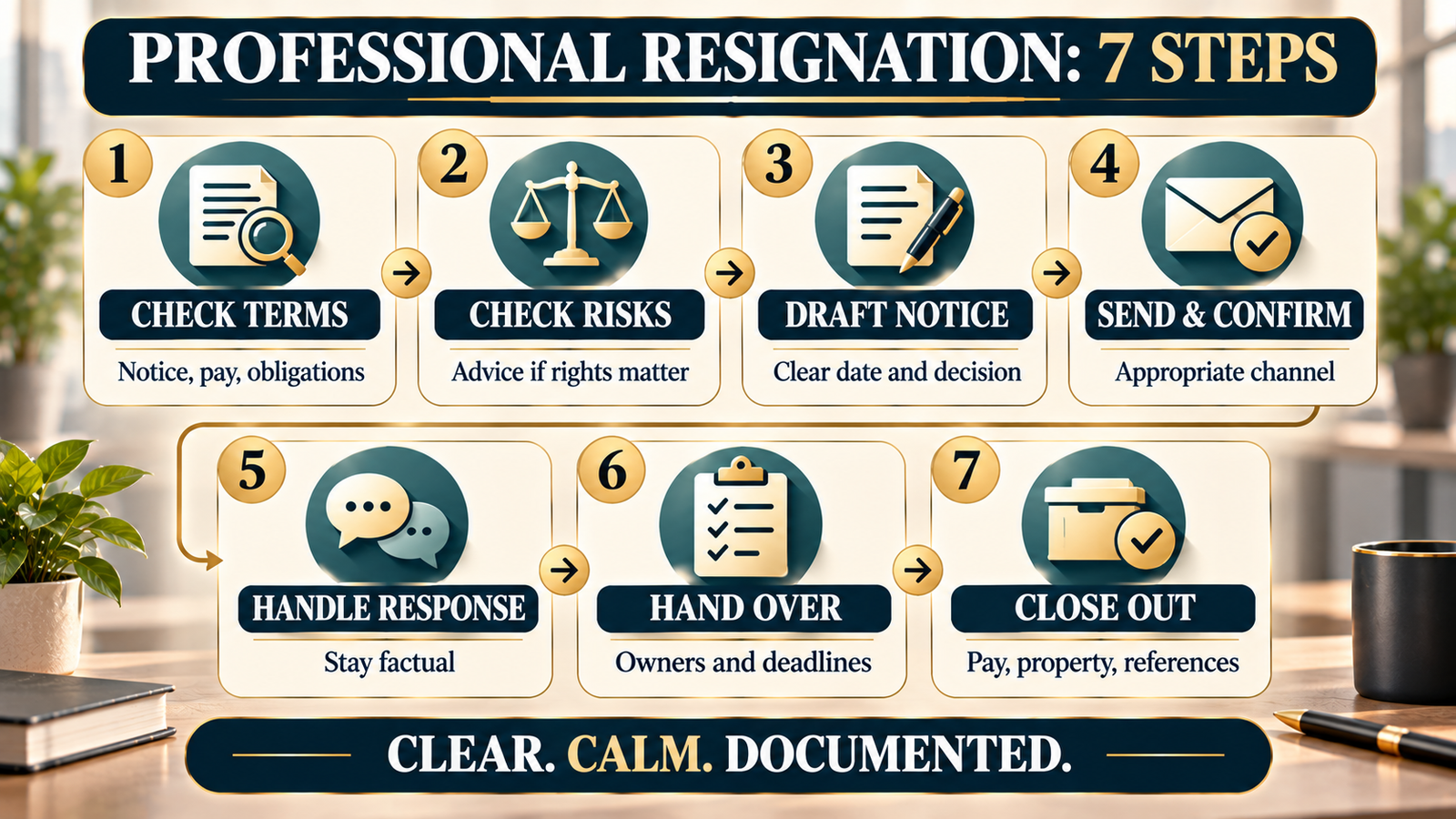
The Professional Resignation Process: Seven Practical Steps
Think of resignation as a process with several decisions rather than one dramatic conversation. Your circumstances may call for a different order, particularly where safety, health, or legal issues need prompt attention.
| Stage | What to do | What to avoid |
|---|---|---|
| 1. Verify the basics | Review your notice terms, proposed final date, pay, and important employment conditions. | Assuming a universal notice period. |
| 2. Check serious exceptions | Consider qualified advice if serious breaches, discrimination, retaliation, or a pending agreement may matter. | Using a generic resignation template for a high-stakes legal situation. |
| 3. Draft your message | State the decision, notice, and proposed last date in factual language. | Turning the letter into an unstructured argument. |
| 4. Notify the right person | Follow the appropriate manager, HR, or contractual process and request confirmation. | Relying only on an informal conversation when written confirmation is needed. |
| 5. Manage the response | Answer necessary logistics; set reasonable limits on arguments and pressure. | Negotiating emotionally in the moment. |
| 6. Hand over the work | Document live responsibilities and agreed priorities using approved systems. | Copying confidential information or promising an impossible completion plan. |
| 7. Complete the departure | Check final pay, equipment return, benefits, references, and personal contact details. | Leaving all administrative questions until after account access ends. |
Step 1: Review Your Contract, Notice Period, and Final Pay Before Giving Notice
Before choosing a final date, find the documents that govern the relationship: your contract or employment agreement, written terms, relevant handbook provisions, and any recent amendments. Do not assume the resignation rules from a previous job apply here.
Check the notice requirement
Notice can depend on your jurisdiction, employment status, contract, and sometimes a collective agreement. In the UK, ACAS guidance on how to resign explains the importance of checking the relevant process and notice requirements. Rules elsewhere can differ materially. In some circumstances an employer and employee can agree a different end date; ask for the agreement in writing.
Check what may change financially
Review salary through the final date, unpaid expenses, unused leave, earned commission or bonuses, benefits, loans or advances, and any deductions that may apply. Do not assume every item will be paid in the same way as a normal month. ACAS’s pre-resignation guidance highlights that final pay can differ because of leave and other contractual matters.
If another job is lined up, verify it
Check the next employer’s written offer, start date, essential conditions, and any remaining checks before you plan your transition around it. A verbal expression of interest and a completed job offer are not the same thing. Leave enough time to understand when one employment relationship ends and the next begins.
Look for restrictions and special processes
Some roles have additional requirements concerning confidentiality, client relationships, regulated responsibilities, access to sensitive information, company equipment, or post-employment restrictions. Do not guess whether they are enforceable. Seek local advice when their meaning could materially affect your next job.
Step 2: Decide Whether a Standard Resignation Letter Is Appropriate
For an ordinary career move, a short resignation letter can reduce ambiguity. It usually needs no dramatic explanation. But the standard template is not a safe substitute for legal advice in every situation.
When a short neutral letter often makes sense
If you have made a voluntary career decision, understand your notice obligations, and do not need to preserve a specific legal account of why you are leaving, a factual letter may be enough. It can say you are resigning, give the notice period, and identify your intended last working day.
When you should pause before choosing the wording
If you believe you are being forced to resign because of a serious breach of employment obligations, discrimination, harassment, retaliation for protected conduct, whistleblowing, or serious safety concerns, the wording and timing may affect your position. In the UK, ACAS advises obtaining legal advice before resigning when constructive-dismissal issues may be involved. That UK legal framework does not automatically apply elsewhere.
An angry letter is not a legal strategy. Neither is a bland letter that omits facts whose inclusion may matter to a particular legal position. If the circumstances are serious, get advice suited to where you work before using any template in this article.
Step 3: Write a Professional Resignation Email or Letter
For a routine resignation, clarity is more important than elegance. The recipient should be able to identify the decision, date, and practical next step without searching through paragraphs of frustration.
Simple professional resignation email template
Subject: Resignation — [Your Name]
Dear [Manager or HR Name],
I am writing to formally resign from my position as [Job Title]. In accordance with my applicable notice period, my proposed final working day is [Date].
Please confirm receipt of this notice and the arrangements for my final date, handover, and outstanding employment matters. I will continue to manage my responsibilities professionally during the transition.
Regards,
[Your Name]
You can adapt the tone, but keep the essential facts consistent. If your contract specifies who must receive notice or how it must be delivered, follow that procedure.
Short resignation letter when you do not want to discuss your reasons
Dear [Name],
Please accept this letter as my resignation from the position of [Job Title]. My intended last working day, subject to the notice requirements that apply to my employment, is [Date].
Please let me know the next administrative steps and how you would like my work handed over.
Sincerely,
[Your Name]
A truthful, concise letter is not evasive. It communicates the employment decision without turning one document into a history of every difficult interaction.
What if you are resigning because of unresolved serious concerns?
Do not automatically copy the neutral wording above. In some situations, a factual account of the reasons for resignation can matter. Speak with a qualified union adviser, employment lawyer, or appropriate local service about how best to record the reasons, what notice is appropriate, and whether a grievance, agency complaint, or other step may be relevant. Keep legal concerns separate from labels such as “narcissistic manager” or “toxic personality.”
What not to put into a routine resignation letter
- personal attacks or speculative diagnoses;
- unverified allegations presented as proven facts;
- threats intended to force an apology;
- confidential client or employee information;
- a long rebuttal to every past performance conversation;
- claims about legal rights you have not checked.
If you need a factual workplace complaint or an appeal, use the relevant process and get advice where appropriate instead of relying on an emotional resignation narrative to accomplish every objective at once.
Step 4: How to Tell a Difficult Boss You Are Resigning
You do not need a dramatic speech. When a direct conversation is appropriate, make the central message brief: you are resigning, the intended last date is in the written notice, and you want to coordinate the handover.
What to say in the meeting
“I’ve decided to resign from my role. I’ve sent the formal notice with my proposed last working day. I’d like to coordinate priorities and handover arrangements so the transition is clear.”
Then stop. You do not have to immediately fill silence with explanations. If the manager asks why, decide how much to share based on the circumstances and whether any serious rights-related issues call for a different approach.
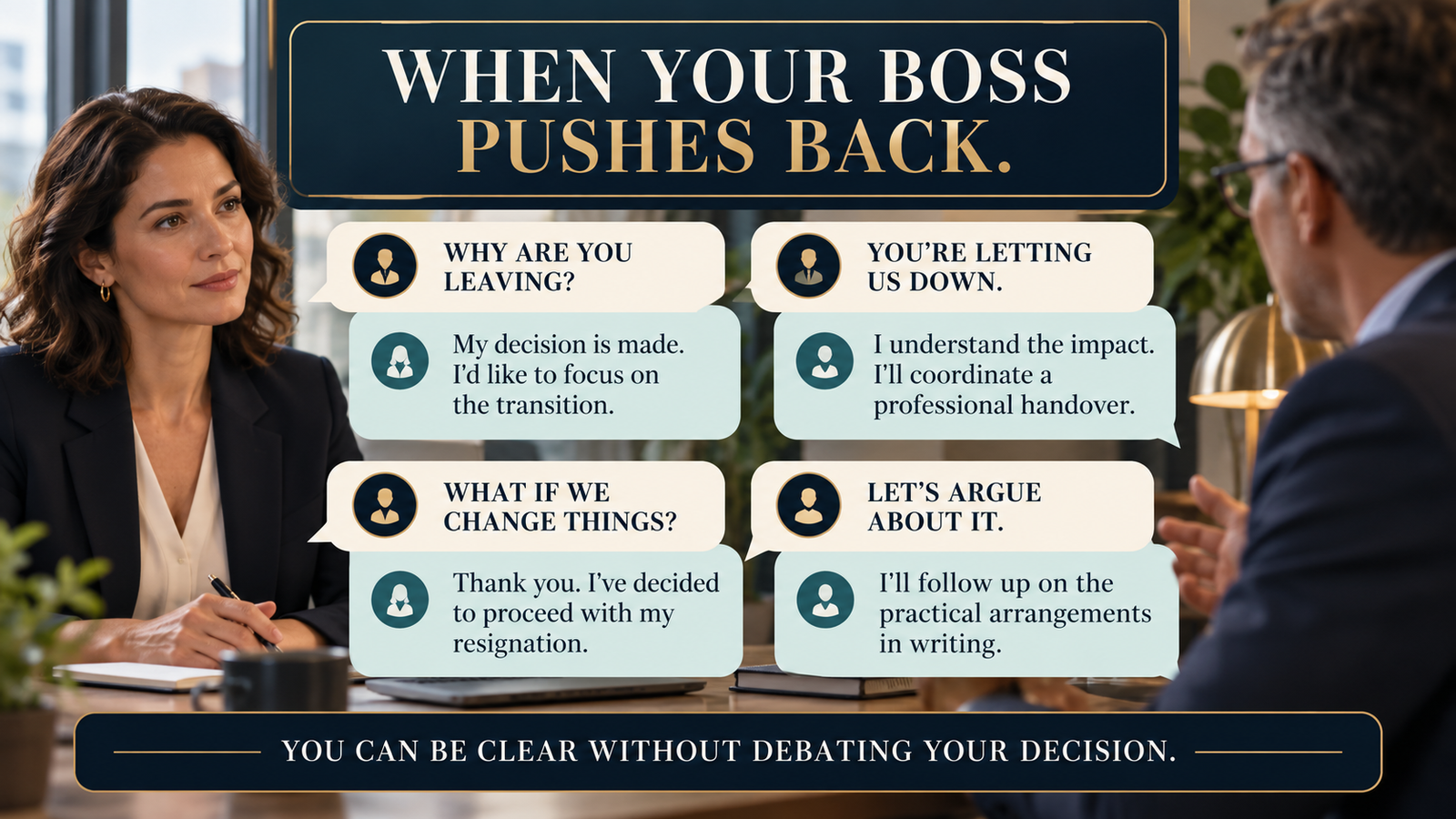
When the boss demands a detailed explanation
“I’ve considered the decision carefully. I want to focus this conversation on the practical transition and final working arrangements.”
When the manager says you are disloyal
“I understand this may be difficult for the team. My decision is made, and I intend to support a professional handover within the arrangements we agree.”
When the manager promises that everything will change
“Thank you for explaining that. I’ve made my decision based on my circumstances, and I’m proceeding with the resignation.”
You can consider a genuine counteroffer if you want to, but you do not owe an immediate decision just because the manager becomes persuasive. If serious workplace issues have already persisted through failed repair attempts, assess whether proposed changes are specific, credible, and enough for your needs.
When the manager reacts with anger or intimidation
You can end an unproductive conversation and move necessary matters to an appropriate written or HR channel. For example: “I don’t think this discussion is productive now. I’ll coordinate the remaining arrangements in writing.” If you have an immediate safety concern, prioritize appropriate support rather than trying to complete an ordinary resignation conversation.
For recurring problems with work-related pressure or changing demands, the site’s guide to professional boundaries with a manipulative boss offers more examples of short, work-focused language.
Can You Resign by Email Instead of Speaking to Your Manager?
Email may be a sensible way to create a clear written record, especially if in-person discussions have become difficult. Whether it meets your formal notice obligations depends on your terms and local rules. Some organizations want notice delivered to a specific person, address, or system.
If a conversation would be unhelpful or unsafe, ask an appropriate HR or advisory contact about the process and send the required notice through a suitable channel. Written confirmation of receipt can reduce later disputes about dates or notice. In the UK, ACAS explains that written notice can be helpful even in situations where it is not strictly required. Read its guidance.
Confirmation email after a verbal resignation
Subject: Confirmation of resignation and notice
Following our conversation today, I am confirming that I have resigned from my position as [Job Title]. My proposed final working day is [Date], subject to the applicable notice arrangements.
Please confirm receipt and let me know the agreed handover and final-pay process.
For additional examples of documenting important workplace discussions neutrally, see how to write a follow-up email after a difficult verbal conversation.
Step 5: Handle the Notice Period Without Creating New Problems
For some people the notice period is routine. For others, especially when trust with a manager has broken down, it becomes the most stressful part of leaving. Your goal is to carry out legitimate responsibilities, document agreed changes, and complete the departure under applicable employment terms.
Agree the practical priorities
If there is more work than can reasonably be completed, ask the manager to prioritize what should be delivered, documented, transferred, or paused before your final day. A workable transition does not require promising that every outstanding project will be finished.
“Given my final working date, I can complete the client summary and prepare a handover for the remaining tasks. Which work should take priority?”
Keep communication factual
Summarize material changes in deadlines, handover ownership, or access arrangements through approved work channels. Keep the messages proportionate; there is no need to copy all senior leadership on every routine question.
Do not take company information
Leaving does not create permission to download client lists, proprietary files, personnel records, private messages, or restricted company information. If you need to preserve evidence related to a serious concern, obtain appropriate advice about lawful handling rather than forwarding internal archives to yourself. The site has a separate guide on preserving workplace evidence without violating policy or privacy.
Know when your situation needs extra help
If the employer changes your duties, threatens discipline, questions your final date, proposes a settlement, or begins a serious investigation, review the terms and seek suitable advice. Do not assume that resigning automatically ends every employment process, contractual responsibility, or filing deadline.
Step 6: Create a Handover That Protects Your Professional Reputation
A handover is an operational document for the people who will continue the work. It is not a defense brief, a farewell manifesto, or evidence that you alone held the team together. Keep it structured enough that someone else can locate the current status and next action.
| Handover field | What to record | Example |
|---|---|---|
| Project or responsibility | Name of the recurring duty or current project | Monthly supplier reconciliation |
| Current status | What is done and what remains | September closed; October invoices awaiting approval |
| Next action | The practical next step | Request sign-off from finance |
| Due date | Known deadline, clearly labeled | November 5 |
| New owner | Person designated by management, if known | To be assigned by team lead |
| Approved location | Where authorized colleagues find the work | Company project system / finance folder |
| Open risk | A factual dependency or unresolved issue | Supplier confirmation pending |
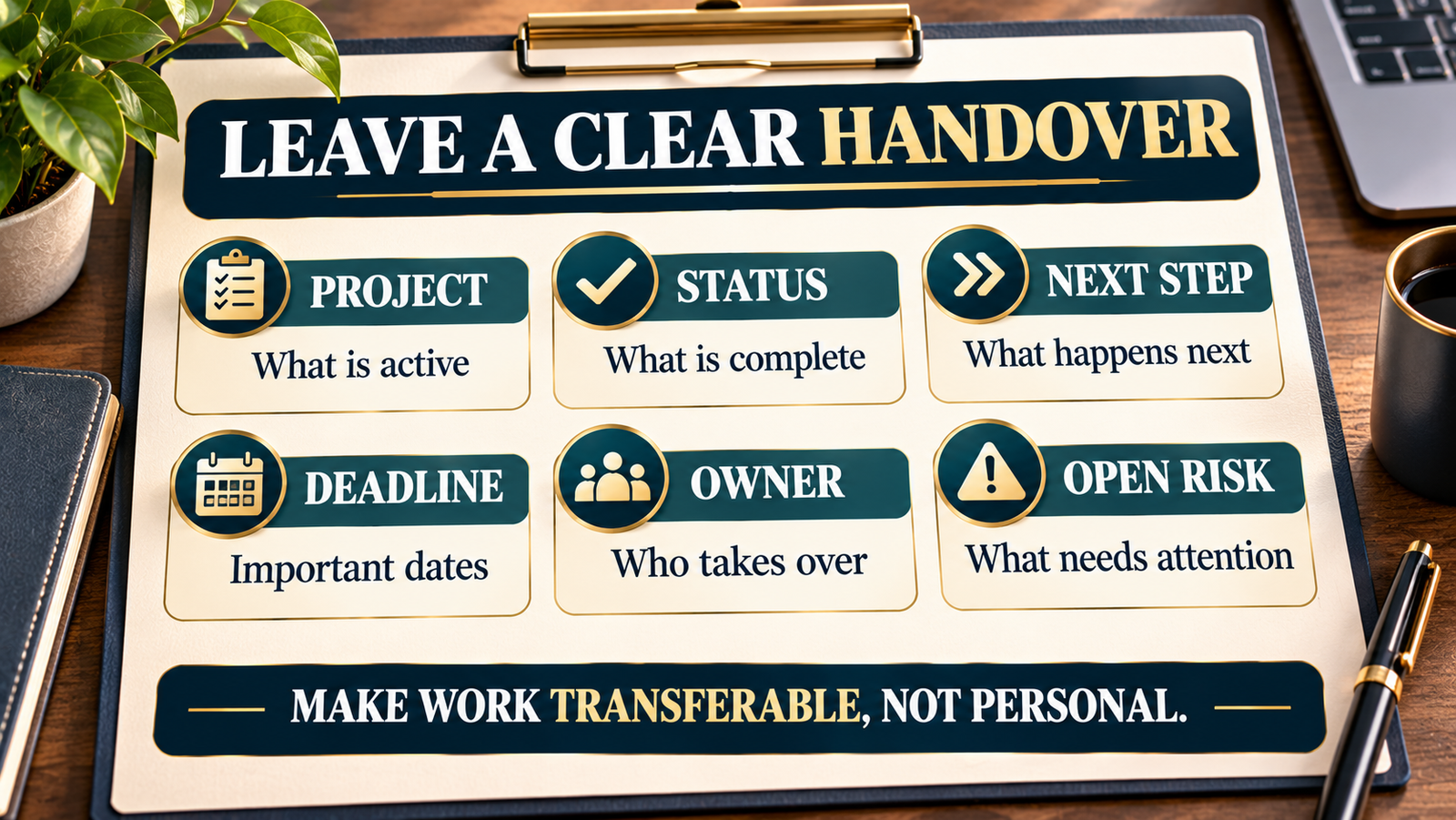
Use approved internal systems for handover material. Never place passwords in plain-text handover notes; direct colleagues to authorized access-management procedures. The record should make clear what is completed, what is not, and who will decide remaining priorities.
Handover completion email
Subject: Handover status — [Role/Project]
As part of the transition, I have updated the handover document in [approved location]. It lists current project status, outstanding items, relevant deadlines, and the remaining decisions that need an assigned owner.
Please let me know if there are specific priority gaps to address within my remaining working time.
How to Manage an Exit Interview at a Toxic Workplace
An exit interview may be offered as a feedback opportunity. Whether participation is required or optional depends on employer policy and local circumstances. Before agreeing to a sensitive discussion, understand who will receive the feedback, how it will be recorded, and whether the interview is intended to be confidential.
The fact that you are leaving does not obligate you to make an emotionally detailed speech. On the other hand, “be professional” does not mean concealing serious workplace concerns when there is a valid reason to report them. Decide what the interview should accomplish.
If you want to give limited operational feedback
“One challenge was that priorities changed frequently without a corresponding update to deadlines or capacity. More consistent written prioritization would improve the role.”
If you want to discuss conduct or possible misconduct
Be factual and distinguish what you observed from what you assume about motive. If the issue is serious, consider whether a separate formal process or independent advice is more suitable than a casual exit interview. A statement about a manager’s personality is usually less useful than specific events, records, and consequences.
If you do not want to give detailed feedback
“I appreciate the invitation. I would prefer to keep my feedback limited to transition arrangements and role processes.”
Do not presume an exit interview is legally privileged or strictly confidential. Your live HR complaint confidentiality guide explains why sharing and privacy expectations deserve specific questions.
What If Your Boss Says You Cannot Resign?
Do not turn an employment-process disagreement into a shouting match. In many legal systems, an employer cannot simply refuse a valid resignation, but formal requirements and consequences differ. For example, UK GOV.UK guidance explains that employers cannot refuse a resignation while employees must still follow applicable processes. That should not be treated as a universal rule for every type of employment worldwide.
Ask in writing what aspect is disputed: the effective notice date, the length of notice, the recipient, the contractual process, or another condition. Keep a copy of your lawful correspondence. If the employer threatens improper action or disputes fundamental rights, obtain advice for your location rather than guessing.
Simple reply to a disputed final date
“Thank you for your response. Please confirm the specific contractual or policy provision you believe changes the notice calculation, so we can clarify the correct final employment date.”
What If You Are Asked to Leave Immediately?
Some employers may release employees from active duties sooner than expected, agree an earlier end date, place them on garden leave, or use other arrangements permitted under local rules and contracts. Those options can affect pay, benefits, access, and the formal end of employment.
Do not assume that being told to stop attending work is the same as your employment ending that day. Ask HR to confirm the actual employment end date, whether you will be paid, what happens to leave and benefits, and how company property should be returned. Where the arrangement is disputed or consequential, seek qualified advice.
Can You Resign From a Toxic Job Without Working Notice?
Sometimes people cannot safely or reasonably continue attending work; other times they simply prefer not to work notice. Those circumstances are not equivalent. An employer may agree an alternative date, but leaving without the required notice can also have contractual or legal consequences.
In the UK, ACAS explains that insufficient notice can create contractual issues, while serious employer breaches can raise different questions. The correct answer in another jurisdiction may be different.
If the workplace involves serious threats, harassment, significant health effects, or potential legal rights, seek suitable help and do not let a general internet template determine what is required. If you are simply requesting a shorter notice period, propose a specific arrangement and ask for written agreement.
How to Protect Your References and Career Record When You Resign
One manager’s opinion does not have to be the only account of your work. Before or during the transition, identify people with direct, legitimate knowledge of your performance: former supervisors, project leads, senior collaborators, or other appropriate professional contacts.
Ask prospective referees for permission before listing them. Find out the employer’s official employment-verification policy and which details it normally confirms. You may be able to obtain your role title, employment dates, and other ordinary personnel records through appropriate processes.
Keep your own accurate, non-confidential list of achievements, responsibilities, and results. Do not make up references, misrepresent your reason for leaving, or take restricted work materials. For a deeper treatment, see how to protect references after leaving a difficult manager.
Requesting a professional reference
“I valued our work together on [project]. I’m moving on from my current role and wanted to ask whether you’d feel comfortable serving as a professional reference based on the work we did together. I can send a summary of the relevant responsibilities if helpful.”
If a recruiter asks to contact your current manager
“My current employer is not yet my preferred reference contact. I can provide other professional referees who have directly supervised or worked closely with me, along with the usual employment-verification information.”
Be transparent about any employer policy or background check that legitimately requires a particular contact. Do not promise a new employer that a check can be skipped when it cannot.
What to Say to Coworkers When You Leave
Not everyone needs the full history of the workplace conflict. A simple message can acknowledge the relationship without putting colleagues in the middle of a dispute.
“I’ve decided to move on, and my last working day is [Date]. I’ve appreciated working with you on [specific project or area]. I hope we can stay in touch professionally.”
Coordinate the timing of any wider announcement with the appropriate person. If coworkers ask for personal details, you can answer at the level you are comfortable with. Avoid recruiting teammates to validate your experience, sharing confidential information, or sending a company-wide accusation on the way out. If reputation attacks are already part of the story, see workplace smear campaigns and calm damage control.
How to Explain Leaving a Toxic Job in Your Next Interview
A future interviewer usually wants to understand your career reasoning and whether you can move into the new job constructively. You should answer truthfully without turning the discussion into a long case against your former manager.
| Situation | Professional explanation | What it communicates |
|---|---|---|
| You wanted clearer responsibilities | “I was looking for a role with clearer ownership and more consistent priorities.” | What conditions help you perform well. |
| Growth had stalled | “My scope had become limited, and I wanted to pursue work where I could develop further.” | Career direction. |
| The management relationship was difficult | “The role was no longer the right fit for the working environment and direction I was looking for. I’m focused on opportunities where I can contribute through [specific strengths].” | Honesty without unnecessary personal criticism. |
| You resigned before securing another job | “I made a considered decision to leave and used the transition to search for positions aligned with [role or priority].” | A factual account of your timeline. |
| You are asked directly about a disciplinary matter | Answer the specific question accurately; seek advice if there is an active dispute or legal concern. | Credibility and honesty. |
Choose wording that is true for your circumstances. Do not use “I left for career growth” if that would materially misrepresent what happened, especially if an interviewer asks a direct factual question. Aim for an answer that is brief, accurate, and oriented toward the work you want to do next.
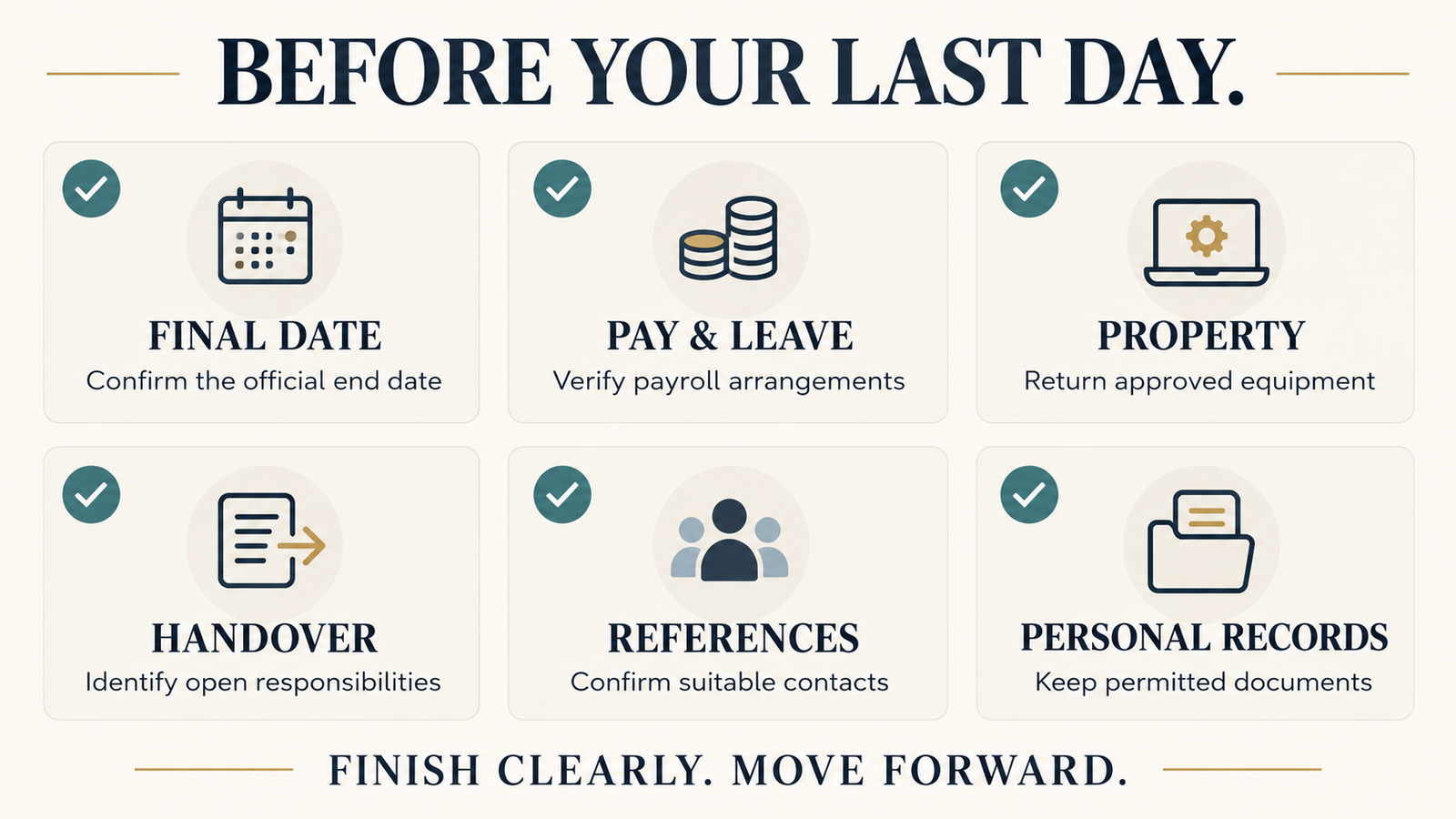
The Final-Day Checklist: What to Confirm Before Access Ends
Administrative details can become surprisingly stressful if left until the final hour. Use a written checklist and the designated HR or payroll channels.
- Confirm the official final employment date and whether you are expected to work through it.
- Confirm when and how final wages, leave payments, reimbursable expenses, or other outstanding amounts will be handled under the applicable terms.
- Check benefits, retirement or pension information, and any required tax or employment documents.
- Return badges, keys, equipment, cards, and other company property using the approved process; request confirmation where appropriate.
- Complete agreed handover tasks and identify unresolved items without overstating completion.
- Remove personal accounts from work devices in accordance with policy, without deleting business information or disrupting access.
- Confirm which email, address, or contact details HR should use for post-employment correspondence.
- Keep lawful personal copies of your resignation and administrative confirmation.
- Thank appropriate colleagues personally if you wish, without making a public statement about the conflict.
Three Realistic Resignation Scenarios
Scenario A: The manager is difficult, but there is no current legal dispute
An employee has accepted a new role, checked the applicable notice, and wants to leave without another tense discussion. The employee sends a short resignation email, asks for receipt confirmation, and prepares a useful handover. If asked why, the employee explains that they are moving to a different career opportunity. The goal is clear administration and minimal unnecessary conflict.
Scenario B: The employee reported bullying and is worried about retaliation
A worker has a pending complaint and receives a significant negative performance change. Resignation timing might affect evidence, employer procedures, or legal options. Instead of relying on a generic neutral letter, the employee organizes a factual chronology and consults an appropriate adviser about the implications before making an irreversible decision. The site’s retaliation-after-an-HR-complaint guide explains why adverse changes must be evaluated against relevant legal protections, not assumed from timing alone.
Scenario C: A sudden departure is being discussed
A manager tells an employee not to return after receiving notice. Rather than assume the contract has ended immediately, the employee requests written confirmation of the actual end date, pay, benefits, notice arrangements, and equipment-return process. If there is a dispute, the employee seeks appropriate advice. The practical lesson is that the final day at the workplace and the end of employment may not be identical.
When You Should Get Help Before Resigning
Consider timely support from an employment lawyer, union representative, government employment advice service, or other appropriately qualified professional when the situation involves dismissal threats, discrimination, protected retaliation, whistleblowing, unpaid pay, a serious contract breach, a settlement agreement, or potentially significant filing deadlines.
U.S. workers should not assume every complaint labeled “bullying” is legally protected activity. The EEOC’s retaliation guidance explains that protection depends on activity covered by relevant equal-employment-opportunity law and that legitimate nondiscriminatory decisions remain possible. Rules differ substantially in other countries.
Emotional wellbeing is a separate need: counselling or other appropriate professional support can help with the effects of a difficult workplace, even if a legal or organizational process is occurring. No single type of professional support replaces all the others.
Frequently Asked Questions About Resigning From a Toxic Job
How do I resign from a toxic job professionally?
Review the notice and employment terms that apply to you, consider whether serious legal issues require advice, give clear written notice through the appropriate channel, confirm your proposed final date, and prepare a realistic handover. Keep communication factual and protect your professional records without taking restricted company information.
What should I say when I resign from a toxic boss?
For a routine resignation, a brief statement is enough: “I’ve decided to resign. I’ve provided my notice and proposed final working date in writing, and I would like to coordinate the transition.” You do not need to debate every past interaction in the resignation meeting.
Should I mention a toxic work environment in my resignation letter?
Not necessarily for an ordinary voluntary departure. However, if you believe workplace misconduct or a serious contractual breach is the reason you are resigning, the content of the letter may matter. Seek qualified location-specific advice before deciding what to include or omit.
Can I resign by email?
Often a written email provides a useful record, but whether it satisfies formal requirements depends on your contract, workplace process, and location. Check the relevant terms, send it to the correct person or address, and request confirmation if needed.
How much notice should I give at a toxic job?
There is no universal amount. Review the applicable contract, legal rules, employment classification, and any collective arrangements. Seek advice before giving less notice than required or resigning immediately where legal consequences may arise.
What if my boss becomes angry when I resign?
Keep the decision and logistics separate from accusations. Repeat that your resignation has been submitted and that you will coordinate reasonable transition arrangements. If the discussion becomes intimidating or unsafe, end it and use an appropriate written or support channel.
Do I have to give a reason for leaving?
Requirements differ. In many routine situations a detailed reason is not required, but legal or formal-process considerations can change what is prudent to record. Do not make a major rights-related decision based only on a generic template.
Should I take part in an exit interview?
Check the workplace process and decide what you want to achieve. You can offer specific operational feedback without speculating about motives. If you are raising serious misconduct, consider a suitable formal or advisory process rather than assuming an exit interview is private or sufficient.
What if my employer refuses my resignation?
Ask what specific notice or procedural requirement the employer says is unmet. Employment law varies, but a valid resignation generally cannot simply be rejected in some jurisdictions, including under the UK guidance cited here. Get local advice if your status or final date is disputed.
Can I leave without working my notice?
You may be able to agree a shorter arrangement, and serious circumstances can raise exceptions under particular laws. Leaving without required notice can have consequences, so confirm the terms and seek appropriate advice before acting.
How do I protect my references after a toxic manager?
Identify credible alternative professional referees, understand formal employment-verification policy, keep accurate achievements you are authorized to retain, and ask permission before listing someone as a referee. See the site’s dedicated reference-protection guide for more.
What if I resign before finding another job?
Review savings, essential obligations, any benefits consequences, job-search prospects, and health or safety needs. If the situation allows, preparing financially can preserve flexibility. Resignation without a new offer is not automatically right or wrong.
Should I send a goodbye message to everyone?
It is optional. A brief professional note to people you worked with may be enough. Avoid circulating confidential information, blaming colleagues publicly, or trying to settle a workplace dispute through a broad farewell email.
Can a toxic employer give me a bad reference?
Reference practices and legal rules differ. Do not assume every unfavorable reference is unlawful. Keep an accurate employment record, understand company policy, and seek appropriate advice if you learn that a reference may be materially false, misleading, or retaliatory under applicable law.
What is the best resignation letter for a toxic workplace?
For a routine departure, a concise factual letter stating your decision, notice, and intended last day is usually a strong starting point. When serious contractual or legal claims may be involved, there is no single universally safe template; obtain appropriate advice about the wording.
Final Thoughts: Leaving Professionally Is About Protecting Your Next Step
A difficult workplace may not give you the ending you hoped for. The manager may never acknowledge what happened. An exit interview may not lead to change. A professional email may not produce a gracious response.
That does not make the practical details unimportant. Clear notice, a factual record, sensible handover, appropriate advice when needed, and trustworthy references all support the future you are trying to build. You can choose not to make your last conversation the place where every past disagreement must finally be resolved.
After you resign, the next stage is not simply leaving an organization. It is establishing what you want your future work life to look like: clearer standards, healthier boundaries, more reliable professional relationships, and confidence in your own contribution.
Chapter 5: Make the Resignation Part of a Smarter Exit Strategy
In Reclaim Your Power, Chapter 5, The Smart Exit Strategy, connects decisions about staying, reporting, transferring, or leaving with practical concerns such as finances, evidence, references, and career continuity. The guide also includes reusable planning tools to help readers approach professional transitions more systematically.
If you are still considering the decision, begin with Should I Stay or Leave My Toxic Job? If the decision is made, use the steps in this article to coordinate a careful departure, then continue with protecting references after leaving a difficult manager.
For a larger framework on workplace protection, exit planning, and rebuilding, explore the Reclaim Your Power guide and practical tools.
Educational disclaimer: This article is general information, not legal, financial, medical, mental-health, or individualized employment advice. Notice obligations, resignation processes, final pay, restrictive covenants, references, protected reporting, constructive-dismissal standards, and filing deadlines depend on jurisdiction and circumstances. The UK and U.S. resources cited are examples of jurisdiction-specific official guidance, not universally applicable rules. Seek appropriately qualified local help for serious workplace, legal, safety, or wellbeing concerns.
Ready to Reclaim Your Power?
Get the 376-page digital edition with 7 chapters, 22 practical tools, reusable forms, an optional 30-entry journal, and references.
Buy Now — $4.99
Leave a Reply