
Some mornings, you can still see the reasons you took the job: the work itself, the income, the skills you are building, or the career path you hoped it would open. On other mornings, you wonder how long you can keep working under the same conditions.
Perhaps a manager keeps changing expectations and then criticizing you for missing them. Perhaps you are excluded from information you need, a complaint has led nowhere, or you have begun spending more energy anticipating the next difficult interaction than doing your actual work.
So you ask the question that can feel almost impossible to answer: Should I stay or leave my toxic job?
The practical answer is to compare three things: what the workplace is costing you now, whether the conditions can realistically improve, and what you would need to leave with reasonable protection for your income, career, and wellbeing. Staying is not automatically weakness; leaving is not automatically the solution. Both decisions deserve evidence.
This guide offers a framework for making that decision without diagnosing your manager, minimizing harmful behavior, or treating one bad week as the whole story. It is especially useful when you know the workplace is affecting you but are not yet sure whether to try another change, prepare an exit, or leave as soon as reasonably possible.
First, What Is Making the Job Feel Toxic?
“Toxic workplace” is a useful everyday phrase, but it is not one universal legal or clinical diagnosis. It can describe very different problems: bullying, chronic overwork, unclear management, discriminatory treatment, poor boundaries, workplace conflict, or a role that no longer fits your life.
Before deciding to leave, write down the specific conditions behind the label. Are you facing inconsistent deadlines, repeated public criticism, exclusion from meetings, inappropriate comments, excessive hours, or a manager who will not address an identifiable problem? Has the situation become worse over time, or is there a clearly defined temporary cause?
This distinction matters because an unpleasant conversation does not automatically establish bullying, and legitimate performance feedback does not become abuse simply because it is difficult to hear. But a repeating pattern of intimidation, professional undermining, or misuse of power deserves more attention than an isolated disagreement. For a closer look at that distinction, see our guide to workplace bullying, gaslighting, and harassment.
Compare a Difficult Season With a Harmful Pattern
| Question | Potentially Temporary Problem | More Concerning Pattern |
|---|---|---|
| Expectations | A deadline changes and the new priority is explained. | Standards repeatedly change and earlier instructions are denied. |
| Feedback | Criticism identifies a specific problem and a way to improve. | Criticism repeatedly becomes public, personal, or detached from clear standards. |
| Workload | A busy period has an identifiable end and some capacity planning. | Unmanageable demands are treated as permanent and questioning them is punished. |
| Repair | Clarification makes the same issue less likely to recur. | Attempts to clarify lead to more blame, exclusion, or confusion. |
| Management response | A concern is heard, even if the answer is not what you hoped. | Significant concerns are repeatedly ignored or turned into character attacks. |
No row proves that a workplace is irreparable. The point is to understand what kind of problem you are deciding about.
Should I Leave My Toxic Job? Four Questions That Matter Most
Rather than counting “red flags” as if they were points in a quiz, consider four decision areas. They do not carry equal weight in every situation. A serious safety issue may outweigh a promising salary or career path; a small communication problem may be worth solving before giving up a valuable role.
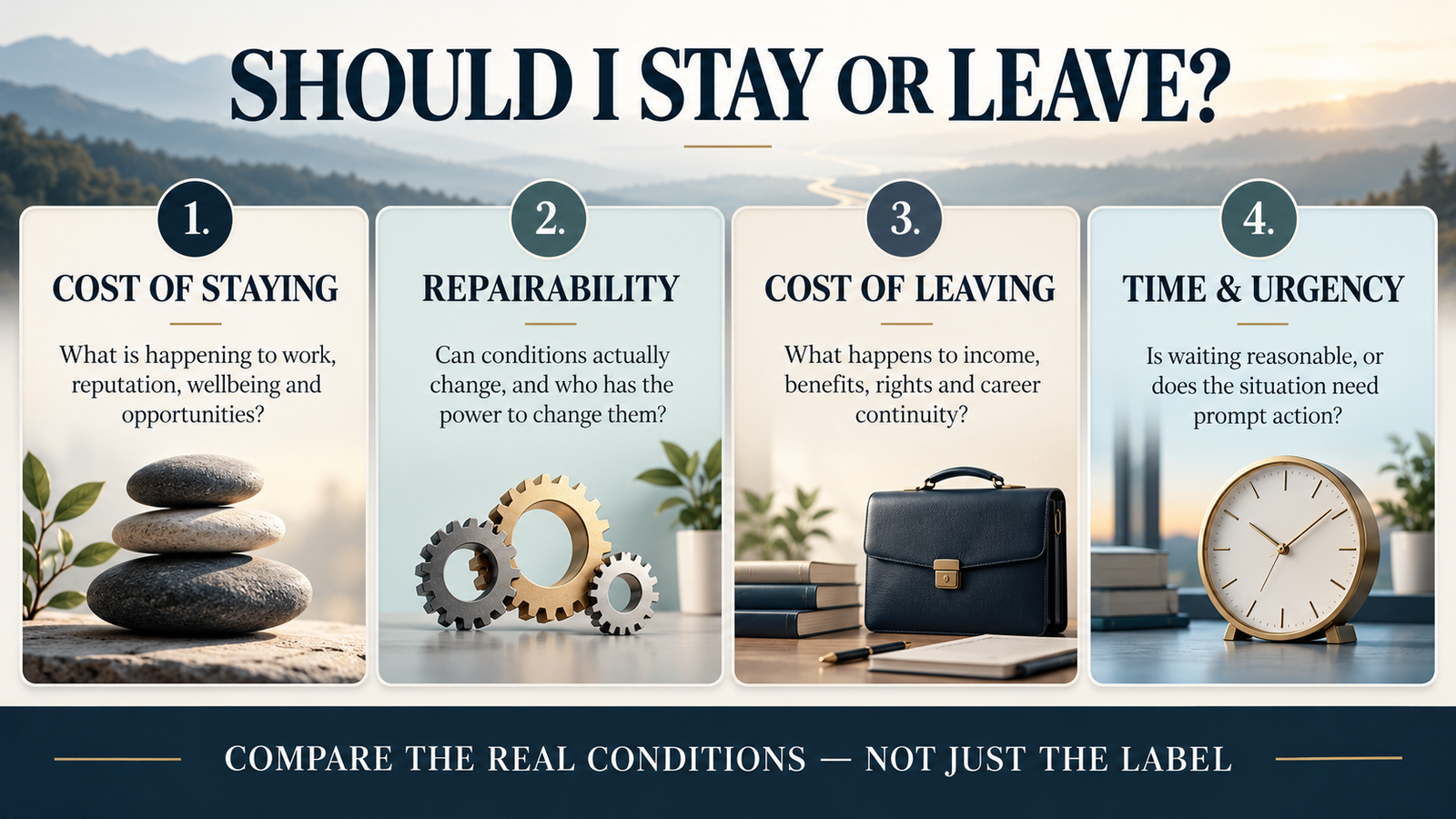
1. What Is Staying Costing You?
Include more than money. Consider work quality, professional reputation, confidence, relationships, access to opportunities, sleep, concentration, and time outside work. Ask whether the cost is stable, growing, or improving.
2. Is Meaningful Improvement Realistically Possible?
Who would need to act? Is that person willing and able to do it? Have earlier promises been followed by consistent changes? Would a different manager or role solve the problem, or is the same behavior tolerated across the organization?
3. What Would Leaving Cost Right Now?
Consider loss of earnings, benefits, contractual obligations, access to career opportunities, an unfinished job search, or possible legal consequences of resigning. These costs are real and should not be dismissed by someone telling you to “just quit.”
4. How Much More Time or Exposure Is Reasonable?
You do not owe an unhealthy situation an unlimited waiting period. Equally, you may choose a short, defined period to assess a credible workplace change while preparing alternatives. There is no universal deadline; the right horizon depends on severity, safety, and practical constraints.
When Staying May Still Be a Reasonable Choice
Staying can be a deliberate decision rather than passive endurance. It may make sense when the problem is clearly identifiable, your role still offers meaningful benefits, and there is a credible route to change.
For example, a new manager may have created confusion through poor handovers but responds constructively once expectations are documented. An exhausting project may have a firm completion date and management may be actively reallocating work. A conflict within one team may be resolved through a reporting change that preserves your responsibilities and career progression.
In these cases, staying becomes stronger when it is tied to specific conditions rather than the hope that the other person will eventually become nicer.
Five Conditions That Make Staying More Defensible
- You can name what needs to improve. For example, deadlines must be confirmed, public criticism must stop, or work must be reassigned to match capacity.
- Someone with authority is willing to act. Promises from a person who cannot change the process may not be enough.
- The change can be observed. Written expectations, normal meeting access, and predictable feedback are easier to evaluate than “the culture feels better.”
- The cost of waiting is acceptable. You are not putting yourself in a serious safety or health situation just to test another promise.
- You retain alternatives. Staying for now does not require stopping your external career planning.
If those conditions are absent, staying may still be financially necessary—but that is different from believing the workplace will improve. Recognizing the difference can help you build an exit plan rather than waiting without a strategy.
The Repair Test: What Would Have to Change for You to Stay?
Imagine that your manager asks, “What would resolve this?” Could you answer with two or three observable workplace changes? If you cannot, you may need to clarify the problem before making the decision.
A weak answer is: “I need everyone to stop being toxic.” A more useful answer is: “I need deadlines and priority changes confirmed in writing, access to the project meetings required for my role, and feedback tied to specific deliverables.”
The second version gives you something you can evaluate. It also helps you distinguish actual repair from a week of friendliness followed by the same behavior.
| Current Problem | Observable Improvement | Evidence to Look For |
|---|---|---|
| Deadlines keep changing | Material changes are communicated clearly. | Updated project records and consistent instructions. |
| Necessary information is withheld | You receive role-relevant updates and meeting access. | Invitations, shared notes, normal project communication. |
| Feedback becomes personal | Feedback concerns specific work and standards. | Examples, written expectations, private professional discussion. |
| Unmanageable workload | Priorities or resources are adjusted realistically. | Capacity decisions, revised scope, agreed deadlines. |
Ask yourself whether the workplace has demonstrated change consistently, not whether someone has said the right thing once. If you need help expressing a reasonable workload or communication limit, our guide on professional boundaries with a difficult manager provides practical examples.
When Leaving Deserves More Serious Consideration
Some signs suggest that another informal conversation may not address the actual problem. These include repeated humiliation, significant exclusion from work you need to perform, deteriorating or inaccurate performance records, credible threats, and punishment after reasonable questions or formal concerns.
Pay particular attention to what happens after you seek clarification or support. Is the behavior corrected? Does someone with authority investigate fairly? Or does the pattern continue while your professional position becomes worse?

When the Problem Is Larger Than One Person
A transfer may help when one reporting relationship is the problem. It is less promising when leaders throughout the organization normalize the same behavior, when complaint processes repeatedly fail, or when the same senior managers control both the old and prospective roles. The question becomes whether the environment can change enough to make staying worthwhile.
When Your Work and Career Are Being Eroded
Look for measurable changes: lost responsibilities, exclusion from decision-making, disputed performance claims, reduced development access, or serious reputation problems. These may have long-term consequences even if your pay remains unchanged.
When the Effects Extend Well Beyond Work
Persistent stress affecting sleep, concentration, daily functioning, or relationships deserves attention. The World Health Organization identifies bullying, excessive workloads, low job control, and poor organizational culture among risks to mental health at work. This is a reason to take the situation seriously and consider appropriate professional support, not a reason to diagnose yourself or another person. Read WHO’s guidance on mental health at work.
If you face an immediate threat, serious safety risk, or an acute health concern, prioritize appropriate immediate help rather than waiting for a self-imposed review date. You do not need to complete a checklist before addressing urgent harm.
What If the Job Is Good but Your Manager Is Not?
Do not confuse the organization, the role, and the manager. They are related, but they are not always the same problem. If you still value the work, colleagues, pay, and career path, a different reporting line or internal position might preserve those benefits without requiring you to tolerate the existing relationship indefinitely.
Before assuming a transfer is the answer, ask whether the prospective manager is independent, whether the original manager will still influence your reviews, and whether your existing record will follow you. Also check whether the move changes your pay, responsibilities, visibility, or promotion opportunities.
A transfer should change the conditions that made the role harmful—not simply move your desk. CIPD guidance acknowledges that a transfer may sometimes assist with difficult conflict when it is fair, necessary, feasible, and properly discussed. See CIPD’s workplace conflict guidance.
When the problem is mainly one manager, staying with a credible transfer path and leaving the organization can both remain options until you have enough information.
Should You Report the Workplace Before Leaving?
Reporting may be worthwhile when there is specific conduct the organization could investigate or correct: bullying, harassment, serious policy breaches, inaccurate disciplinary records, or significant exclusion from work. A report is more useful when you can explain what happened, what evidence exists, and what realistic workplace outcome you are requesting.
But reporting is not a guarantee of improvement. Nor must every person exhaust every informal process regardless of seriousness. ACAS says workers may consider a formal grievance when informal efforts have failed or when the issue is too serious for informal resolution. See ACAS guidance on workplace bullying concerns.
Try to separate two questions: “Is reporting the right way to address this conduct?” and “Is this still the right workplace for my career?” You may pursue an appropriate complaint process while also preparing alternatives. An unfavorable HR outcome is another piece of information, not necessarily an instruction to resign immediately. For that situation, see what to do when HR sides with your manager.
Staying for Now Is Different From Choosing to Stay Indefinitely
Perhaps you need your current income, a replacement role has not materialized, or family obligations make a sudden gap in employment difficult. That can be a practical reason to remain employed while making a plan.
Try phrasing the decision accurately: “I am staying for now while I build alternatives,” rather than “I guess I have to put up with this forever.” The first statement gives you an action. The second can make an already difficult situation feel permanent.
During that period, you can maintain professional communication, meet legitimate duties, protect your work record, apply for external roles, and consider the support available through your workplace, a union, or an appropriate adviser. You do not need to announce your career planning to everyone at work.
For example, if your manager changes an important deadline verbally, a neutral confirmation may help: “Confirming today’s update: the client draft is now due Thursday, and the compliance report moves to Monday. Please let me know if I misunderstood.” Our guide to follow-up emails after workplace conversations offers more examples.
Before You Resign: Your Exit-Readiness Checklist
Deciding that a workplace is not right for you and deciding that you are ready to resign are related but separate decisions. The more preparation is possible, the more choices you may retain.

Income and Financial Obligations
Review how long you could reasonably manage without your current income, what benefits or paid leave may change, and what commitments cannot be postponed. Do not use an arbitrary savings target from the internet: the right amount depends on your expenses, available support, and likelihood of new employment.
Employment Terms and Legal Questions
Read your contract, notice requirements, and policies. If dismissal, discrimination, whistleblowing, retaliation, unpaid wages, serious contractual issues, or a proposed settlement may be involved, consider location-specific professional advice before a resignation that could affect your options. ACAS warns that leaving because of a serious employer breach can raise complex constructive-dismissal questions under UK law; that framework does not automatically apply elsewhere. Read ACAS’s resignation considerations.
Career Evidence and References
Update your resume and record legitimate achievements, measurable results, skills, and projects you can describe without revealing confidential information. Consider which professional contacts can accurately speak about your work. Do not copy restricted company records or client data to personal accounts in the name of preparing for an exit.
Next-Role Readiness
Know the type of role you want next, what working conditions matter to you, and which interview questions could reveal a better—or worse—fit. An external job search is preparation, not a promise to quit at once.
Wellbeing and Practical Support
If the workplace is affecting your ability to function, consider appropriate health or counselling support alongside career planning. A workplace or legal process and personal recovery support solve different problems; you may need both.
Leaving Without Another Job: How to Think About the Trade-Off
Some people can arrange a new position first; others face conditions that make waiting difficult. Neither situation has a universal answer. Leaving without another role can reduce exposure to a harmful environment, but it may also create financial insecurity, benefit changes, and pressure to accept the next offer too quickly.
Ask what resources and constraints are specific to you: ongoing expenses, dependents, access to healthcare or benefits, local hiring conditions, possible contractual consequences, and the severity of the workplace situation. If your employment status or legal rights are involved, obtain qualified advice instead of relying on a general article.
It can also help to identify a minimum viable next step. That might be requesting a safe adjustment at work, taking permitted leave, having a conversation with a trusted adviser, starting applications, or setting a concrete job-search review date. You need not choose between resigning tomorrow and doing nothing.
A Stay-or-Leave Comparison Table You Can Actually Use
This is not a legal test or numerical score. Use it to organize which evidence matters to your situation.
| Decision Factor | Reasons Staying May Make Sense | Reasons Exit Planning May Matter More |
|---|---|---|
| Repairability | Specific problems are being addressed through visible changes. | Promises repeat while the same harm continues. |
| Leadership response | Appropriate leaders listen, investigate, or correct material issues. | Serious concerns are dismissed, reversed, or punished. |
| Work and reputation | Your responsibilities and record remain accurate and workable. | Exclusion, inaccurate claims, or shrinking opportunities persist. |
| Wellbeing | The situation is manageable with real improvements and support. | The impact is significant or worsening despite reasonable measures. |
| Career value | The role still offers meaningful learning or advancement. | Stagnation or reputational risk outweighs realistic future benefit. |
| Practical alternatives | A viable internal move or genuine short-term repair is available. | Internal changes cannot address the underlying conditions. |
| Financial readiness | Continued income is necessary while alternatives develop. | A transition is feasible and further waiting offers little benefit. |
Notice that financial necessity can support remaining employed for now even when the workplace is unlikely to improve. That is not inconsistency; it means the employment decision and the long-term career decision have different timelines.
Try a Defined Review Period—When It Is Safe to Do So
Indefinite waiting can become its own trap. If the situation is not urgent and credible repair is possible, consider a short review window that matches the workplace process. For example, you might review progress over the next few weeks after a manager agrees to specific changes. This is an illustrative planning tool, not a required waiting period.

- Define the change. Write down two or three observable improvements you would need to see.
- Identify the responsible person. Who has authority to make those improvements?
- Set a realistic check-in point. Choose a date suitable for the issue, its severity, and the employer’s stated process.
- Keep a factual record. Note important decisions, significant incidents, and whether the promised improvements occurred.
- Maintain options. Continue appropriate career preparation and seek support if necessary.
- Review the evidence. Did conditions improve consistently, stay the same, or worsen?
If the situation worsens, you do not have to wait until the end of the planned review period to reassess. Serious threats, safety issues, or substantial health effects deserve prompt attention.
Three Examples: Different Problems, Different Decisions
Example 1: A Demanding Role With a Manager Who Is Willing to Repair
A professional joins a growing team and receives conflicting priorities during a major launch. After raising the issue, the manager clarifies ownership, makes deadlines visible, and meets regularly to review capacity. The work remains demanding, but the confusion begins to decrease.
Possible next step: Staying for a defined review period may be reasonable while watching whether the improvements last. The fact that a job is stressful does not automatically mean it must be abandoned.
Example 2: One Harmful Reporting Relationship in an Otherwise Workable Company
An employee enjoys the work and has strong relationships elsewhere in the business, but the direct manager repeatedly humiliates them and controls access to key projects. Another department offers an independent reporting line without a loss of pay or career prospects.
Possible next step: Examine the transfer carefully, including whether the current manager can still influence evaluations and whether any inaccurate records need attention. An internal move could preserve more benefits than leaving the company entirely.
Example 3: The Harmful Pattern Is Supported Across Leadership
An employee documents repeated exclusion and changing performance standards. Internal attempts produce no meaningful change, senior leaders defend the conduct, and the employee’s professional opportunities continue to narrow.
Possible next step: Structured exit preparation and appropriate external advice may offer more than another informal conversation. The employee does not need to resign impulsively, but indefinite waiting is no longer the only alternative.
These examples are illustrative, not predictions. Similar facts can lead to different decisions when safety, finances, employment rights, and available opportunities differ.
What If You Are Afraid Leaving Means the Bully Wins?
It is understandable to resent the idea that someone else’s behavior could influence your career plans. But your next job should not have to serve as a verdict on another person’s character.
Staying solely to prove that you cannot be pushed out can keep your career organized around the conflict. Leaving solely to escape a difficult week can create a different set of problems. Neither choice needs to become a test of courage.
A more useful question is: Which decision gives me the strongest realistic future from the position I am in now? That may involve staying long enough to secure another role, making an internal change, pursuing an appropriate complaint, or leaving sooner when circumstances demand it.
Professional Scripts for Staying, Reviewing, or Leaving
When You Want to Give the Workplace One Clear Chance to Improve
“I’d like to make sure the current arrangement is workable. The main issues are changing deadlines and missing project information. Could we agree how updates will be recorded and review whether that process is working after the next project cycle?”
When You Need to Clarify an Internal Opportunity
“I’m interested in the position and would like to understand the reporting line, responsibilities, performance review process, and whether the move would affect my pay or progression.”
When You Need Time Before a Major Employment Decision
“Thank you for explaining the proposal. Because it would affect my role and employment terms, I’d like to review the details in writing before responding.”
When You Decide to Resign Professionally
“Please accept this as formal notice of my resignation from my position as [role], with my final working day proposed as [date], subject to the applicable notice requirements. I will coordinate an appropriate handover of my current responsibilities.”
If your reasons for resignation may have legal consequences, take location-specific advice before sending wording that could affect your position. A resignation letter is not necessarily the right place to settle the entire workplace dispute.
What Not to Do While Making the Decision
- Do not base the whole decision on a personality diagnosis or one bad interaction.
- Do not assume that another promise of change is the same as demonstrated improvement.
- Do not stop performing legitimate duties because you have decided the workplace is unfair.
- Do not download confidential files, client information, or restricted records to protect yourself.
- Do not assume you must report, transfer, or resign in a fixed order regardless of risk.
- Do not accept a new job without evaluating its conditions simply because you want to escape the current one.
- Do not let the desire to prove a point replace financial, legal, or career planning.
If you need an accurate record of significant events before deciding, use our workplace incident log and workplace documentation guide. They focus on actions, dates, evidence, and professional impact rather than guessing about motive.
Chapter 5: Turn the Decision Into an Exit-Readiness Plan
The Smart Exit Strategy in Reclaim Your Power is not built around telling everyone to resign. It is about choosing among staying, reporting, transferring, and leaving while protecting finances, professional records, references, and career continuity.
That is also why exit readiness is useful even if you ultimately stay. Better documentation, clearer career goals, suitable references, and knowledge of your options can make you less dependent on one workplace’s approval.
If you decide to search externally, our guide to distinguishing a difficult manager from a harmful pattern can help you develop clearer questions for the next role. Avoid carrying one manager’s behavior forward as a prediction about every future employer.
Frequently Asked Questions
Should I leave my toxic job?
Consider what the workplace is costing you, whether material improvements are realistically possible, and what leaving would mean for your finances, rights, and career. If the pattern is serious or repeatedly unchanged, exit planning may deserve greater priority. The label “toxic” alone cannot decide the answer.
How do I know when it is time to quit a toxic job?
Warning signs include continuing harmful conduct, failed repair attempts, worsening professional impact, significant exclusion, or an environment that cannot realistically change. Assess urgency and available support alongside income and career considerations.
Is it better to stay until I find another job?
Finding another job first can protect income and provide more choices. But it is not always feasible or appropriate when serious safety, health, or legal concerns are present. There is no universal rule.
Should I report my boss before leaving?
Reporting may help when there is conduct an employer can investigate or correct. It is not automatically the best choice in every case, and legal consequences can depend on where you work and the nature of the complaint. Seek suitable advice for serious employment issues.
Can an internal transfer solve a toxic workplace?
Sometimes, especially when the problem is localized to a team or manager and the destination offers genuinely different conditions. It is less likely to help when the same leadership or culture controls both roles.
What if my job pays well but I am unhappy?
Include income in your assessment, but also consider work quality, career growth, responsibilities, relationships, and wellbeing. A high salary is a real benefit; it is not the only factor that matters.
What if I cannot afford to resign?
You may decide to remain employed for now while reducing harm and building options. Consider appropriate workplace support, structured communication, external applications, legitimate career records, and a review date rather than treating today’s constraint as permanent.
What if I am afraid the next job will be just as bad?
Use the previous experience to ask better questions about management, feedback, priorities, boundaries, turnover, and working expectations. You cannot guarantee a perfect employer, but you can investigate conditions before accepting an offer.
Is leaving a toxic job a failure?
No career decision needs to be judged as victory or failure based solely on whether you stayed. The useful standard is whether the choice reasonably protects your interests and future options under your circumstances.
Can I prepare to leave while still working?
Yes. Career exploration, resume updates, professional networking, and assessing finances are preparation rather than resignation. Respect confidentiality and your employment obligations while doing so.
Should I resign immediately after an HR complaint goes badly?
Not automatically. Clarify what HR decided, review internal options and relevant employment terms, and obtain qualified advice if significant legal rights may be involved. Serious immediate risks may require a different response.
How long should I give a toxic workplace to improve?
There is no universal waiting period. If it is safe to do so, identify observable improvements and a realistic review point suited to the employer’s process. Do not let an arbitrary deadline delay action on serious harm.
Final Thoughts: You Do Not Need Perfect Certainty to Make a Careful Decision
A difficult job decision can feel as if you must establish, beyond all doubt, whether your workplace deserves to be called toxic. You do not. You need a sufficiently clear picture of what is happening, what is likely to change, and what each realistic option would cost.
If there is credible repair, you may choose to stay and test it. If only one part of the organization is harmful, a transfer may deserve investigation. If a workplace process can address specific conduct, reporting may be appropriate. And if the pattern persists while your career or wellbeing deteriorates, preparing to leave can become the more practical direction.
Do not ask only, “Can I endure another month here?” Ask, “What would another month achieve, and what will I do if nothing changes?”
That question makes the decision less about fear or pride and more about protecting the future you are working toward.
Build a Career Decision You Can Stand Behind
Reclaim Your Power connects the full journey: recognizing harmful workplace patterns, protecting yourself while they are active, assessing the damage, and choosing a strategic next step. Chapter 5 focuses specifically on the decision to stay, report, transfer, or leave, with attention to finances, references, and career continuity.
If you need a more structured way to work through that decision, explore the Reclaim Your Power guide and workbook. You can also review the seven-chapter structure and practical tools before deciding whether it fits your situation.
Educational and professional-support disclaimer: This article provides general information, not individualized legal, financial, medical, mental-health, or employment advice. “Toxic workplace” is a descriptive term, not one universal legal finding. Resignation, notice, discrimination, harassment, retaliation, and constructive-dismissal rules vary by jurisdiction, contract, and facts. Serious safety concerns and significant health effects require appropriate timely support. Seek qualified local advice before decisions involving important legal rights or employment consequences.
Ready to Reclaim Your Power?
Get the 376-page digital edition with 7 chapters, 22 practical tools, reusable forms, an optional 30-entry journal, and references.
Buy Now — $4.99
Leave a Reply