
You have decided to leave a difficult manager behind. You have updated your résumé, started applying for jobs and finally found an opportunity that feels promising.
Then the recruiter asks: “Can we speak to your previous manager?”
Suddenly, the job search feels less like a fresh start. You remember the arguments about changing expectations, the performance criticism you disputed, or the way your manager spoke about people who left. You wonder whether one person could influence how your next employer sees you.
If you are worried about references after leaving a toxic boss, begin by building a reference plan—not by assuming your former manager will sabotage you. Check your employer’s reference policy, identify other people who directly know your work, ask their permission, organize a truthful record of your achievements and decide how you will explain the departure professionally. If an actual reference later appears inaccurate or retaliatory, address the specific facts and seek appropriate advice.
Your former manager may have been the person who supervised your daily work. That does not mean they are the only person who can describe your professional contribution. And a prospective employer’s requirements may be more flexible than you expect—although some employers and regulated roles have specific verification requirements.
This guide explains how to protect your references before you leave, what to say to recruiters afterward, when a neutral HR reference is useful, how to handle a request for your last manager and what to do if a reference appears misleading. The goal is to protect your future without inventing a story, recruiting people to attack your manager or treating every negative comment as unlawful.
What Does It Mean to Protect Your References After Leaving a Difficult Manager?
Protecting your references does not mean hiding your employment history or preventing a prospective employer from carrying out legitimate checks. It means preparing accurate, relevant sources that can speak to your professional work without leaving the entire process dependent on one strained relationship.
There are several parts to that preparation:
- Understand what kind of reference the employer wants.
- Find out who is authorized to give an official reference for your previous organization.
- Identify people who personally know your work.
- Ask them whether they are comfortable speaking about your contribution.
- Prepare your own factual record of responsibilities and achievements.
- Respond calmly if a hiring team requests someone you cannot confidently nominate.
The key distinction is between an official employment check and a professional assessment of your work. They may come from different people and serve different purposes.
Employment Verification vs. Professional Recommendation
One common source of unnecessary anxiety is assuming every employer reference involves a long conversation with your most recent boss.
In reality, a company may request basic verification, a detailed performance reference, a character reference or a combination.
| Reference Type | What It May Cover | Possible Source |
|---|---|---|
| Employment verification | Dates employed, job title and other factual employment details the employer is permitted to confirm. | HR, payroll or an authorized verification provider. |
| Professional work reference | Skills, results, responsibilities, work style and examples of performance. | Former manager, project lead, cross-functional supervisor or another eligible professional contact. |
| Professional character reference | Reliability, teamwork, judgment and professional strengths, based on direct knowledge. | Mentor, colleague, professional contact or other permitted referee. |
| Regulated or required checks | Specified employment or conduct information required for a particular role or regulatory regime. | Sources and processes prescribed by the hiring employer and applicable rules. |
UK ACAS guidance distinguishes basic factual work references from detailed work references, while the U.S. Department of Labor’s CareerOneStop describes employment, professional, academic and personal references. The categories and rules differ by employer and location. Read ACAS guidance on reference content and CareerOneStop’s reference guidance.
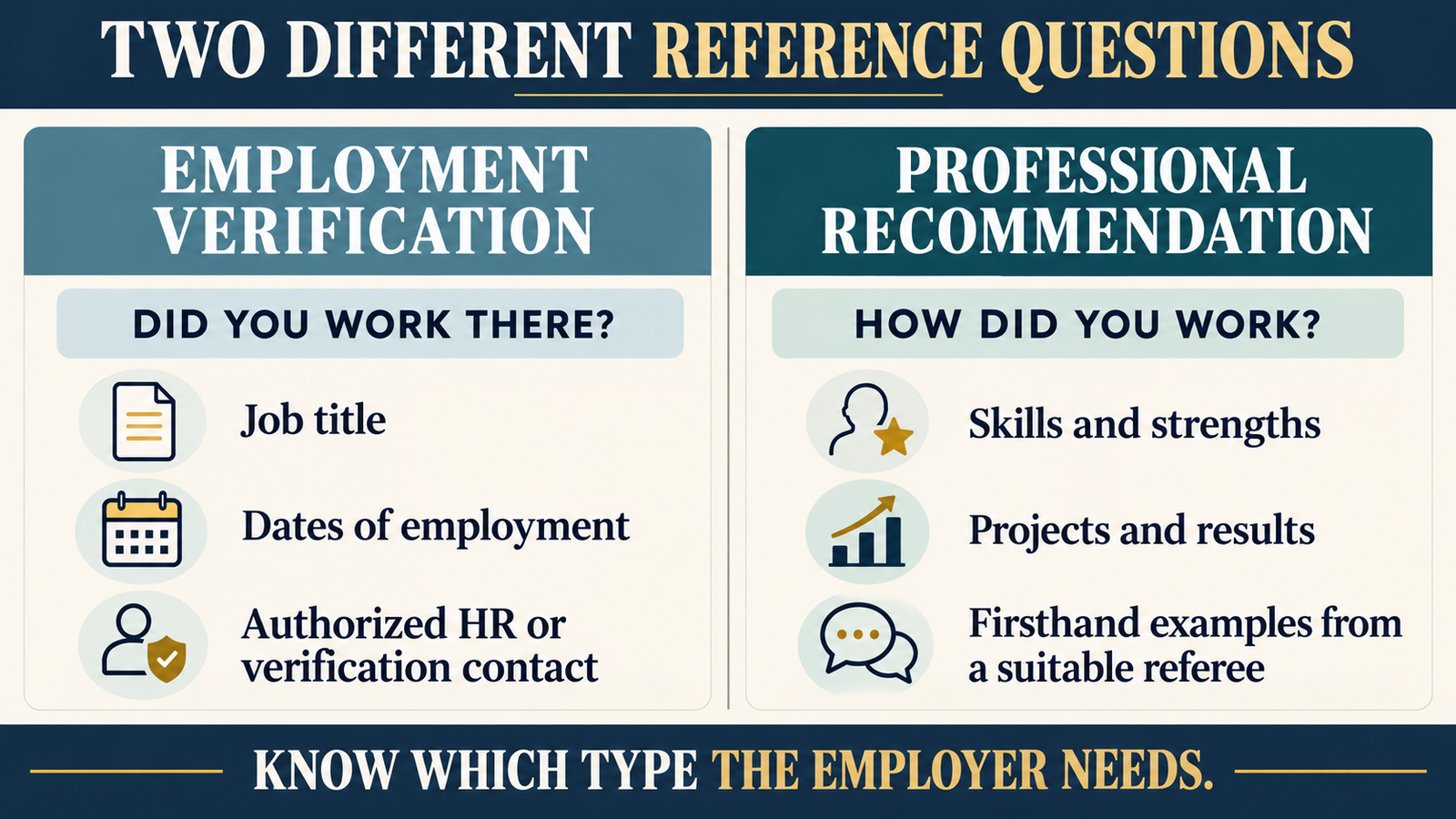
Ask the hiring employer which type it needs before assuming a difficult former manager must be your main referee.
First, Check Your Former Employer’s Reference Policy
Before leaving—or as soon as you can afterward—check whether your employer has a policy on references.
Useful questions include:
- Are official references issued by HR only?
- Does the company provide factual references or detailed performance references?
- Can a former supervisor provide a personal professional recommendation in addition to official verification?
- Is there an approved verification contact or service?
- Does a settlement or departure agreement address references?
- Are there particular rules for regulated roles?
An organization may restrict who speaks on its behalf. ACAS notes that employer reference policies can limit both the information supplied and who may issue the reference. In the UK an employer generally is not required to provide a reference, subject to important exceptions such as certain regulated roles or contractual commitments. Other jurisdictions have their own rules. See ACAS guidance on when an employer must give a reference.
Knowing the policy gives you an accurate answer when a recruiter asks where to send the request.
Build a Credible Reference Network Before You Need It
If you have one strained relationship at work, your entire career does not have to be judged through that relationship alone.
Think about people who have directly seen your work:
- a previous manager with whom you worked successfully;
- a project lead who reviewed your contributions;
- a senior colleague who collaborated with you closely;
- a manager in another department who knows your work;
- a client or partner, where professional confidentiality and company policy permit it;
- a professional mentor who can discuss relevant work;
- a supervisor from an earlier employer.
Do not choose references only because they like you. Choose people who can answer concrete questions about the role you want.
For instance, a senior coworker who saw you manage deadlines, coordinate a project and resolve client issues may be more useful than an executive who barely knows your name.
CareerOneStop recommends choosing people who know your work, asking permission first, confirming their preferred contact method and sharing information about your target role. Review its reference preparation guidance.
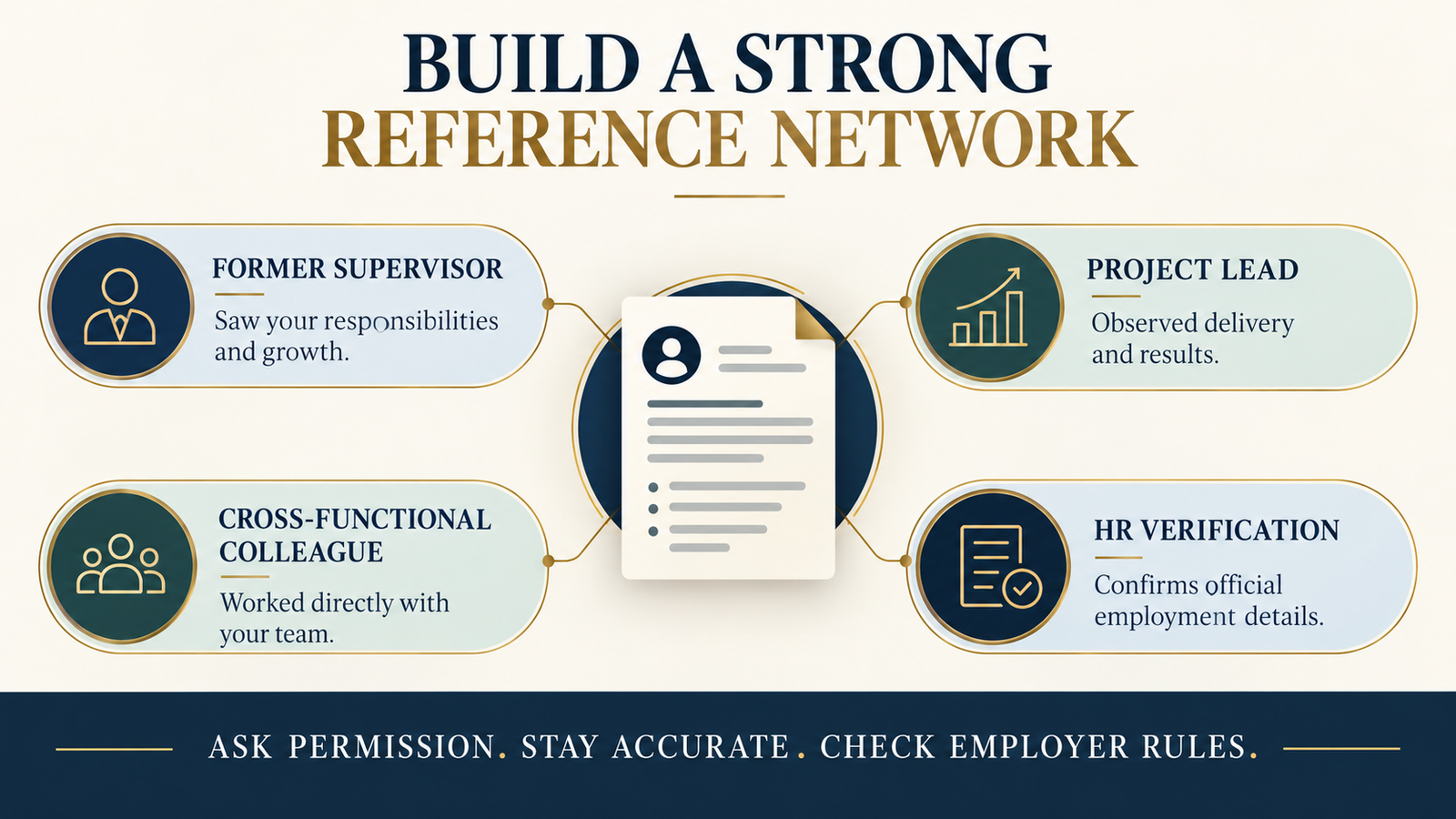
A Simple Reference Shortlist
| Potential Referee | What They Can Honestly Confirm | Check Before Listing |
|---|---|---|
| Previous direct manager | Responsibilities, performance and professional growth during an earlier role. | Are they comfortable and available to speak? |
| Cross-functional project lead | Collaboration, delivery and results on a specific project. | Did they work with you closely enough? |
| Senior teammate | Technical work, reliability and day-to-day teamwork. | Will the hiring employer accept a peer reference? |
| HR verification contact | Formal employment details permitted by company policy. | Is this the authorized route for official verification? |
Having several options does not mean every employer will accept all of them. Your job is to create a credible shortlist and then match it to what the hiring team requests.
How to Ask Someone to Be Your Reference
Ask directly, privately and without turning the request into a conversation about everything your former manager did wrong.
A professional request could look like this:
“Hello [Name], I appreciated working with you on [project or role]. I’m applying for [type of position] and wondered whether you would feel comfortable serving as a professional reference. You have firsthand experience of my work on [specific responsibility]. I can send an updated résumé and a short description of the role. Please feel free to say no if the timing or request does not work for you.”
This respects the person’s choice and makes the request easy to assess.
If they agree, ask how they prefer to be contacted and whether they want advance notice before each employer reaches out.
What to Share With a Willing Referee
- your current résumé;
- the role or field you are targeting;
- the dates or projects you worked on together;
- two or three accurate accomplishments they personally observed;
- the hiring employer’s likely timeline.
You can help someone remember relevant work. You should not script false praise, exaggerate their authority or ask them to deny legitimate concerns.
Ask HR About a Neutral Employment Reference
If a particular manager relationship has deteriorated, a neutral factual reference may be useful for confirming employment history without inviting a broad personal assessment.
Depending on policy, HR might confirm:
- the dates you worked there;
- your role or roles;
- other permitted factual employment details.
A neutral reference is not guaranteed. It may be the company’s normal policy, or you may be able to request it. Some employers must provide information beyond basic verification for particular positions or under specific laws.
Try asking:
“Could you please confirm the company’s policy for employment references and the appropriate contact for future employment-verification requests? I would like to give recruiters the correct official details.”
That question is practical. You do not have to accuse the manager of planning to sabotage you.
Can You Ask for Reference Wording as Part of an Exit Agreement?
Sometimes departure or settlement discussions include agreed reference wording or verification procedures. Whether that is possible or enforceable depends on the employer, the agreement and the law. It may be sensible to obtain independent advice before signing a document that affects your rights.
Do not treat an informal verbal promise that “we will give you a good reference” as equivalent to a written and applicable agreement.
Protect Your Work Record Without Taking Confidential Material
A strong professional reference becomes easier when you can describe your actual work clearly. That does not require copying entire workplace systems before you leave.
Prepare a truthful career summary using information you may properly retain or describe, such as:
- your role and general responsibilities;
- skills you developed;
- publicly discussable project outcomes;
- qualifications and certifications;
- awards or recognition you are authorized to disclose;
- performance achievements you can support appropriately;
- published work or portfolio examples you have permission to use.
Be careful with client records, financial reports, proprietary designs, private employee data and restricted internal communications. Access to those materials during employment does not automatically authorize personal copies or public portfolio use afterward.
If your manager took credit for work or disputed contributions, our guide to protecting your professional credit provides a more detailed framework for keeping work history accurate.
The goal is a clear, lawful record—not a secret archive of company data.
What If the Recruiter Asks for Your Most Recent Manager?
This is often the moment a difficult workplace relationship feels most threatening.
Do not invent a reference or pretend that a peer was your line manager. Ask what the employer actually needs.
For example:
“I can provide official employment verification through the company’s HR process. For a detailed professional reference, I can offer a previous supervisor and a project lead who worked closely with me. Would that combination meet your requirements?”
If you are still employed and have not disclosed your job search, you can also ask:
“I haven’t informed my current employer that I’m exploring opportunities. Could you confirm when you would need to contact them, and whether you can use my other references first?”
UK ACAS guidance recommends obtaining an applicant’s permission before contacting a current employer and explains the risks of premature reference requests. The specific obligations may differ where you are applying. See ACAS guidance on reference timing.
Some organizations, regulated positions and background-check processes may insist on a particular source. If so, do not misrepresent your history. Ask which alternatives or verification arrangements are acceptable.
How to Explain Why You Left Without Attacking Your Former Boss
You do not have to pretend a difficult experience was wonderful. You also do not have to spend the interview diagnosing your former manager.
Recruiters are usually trying to understand your career direction, judgment and whether the new role is a suitable match.
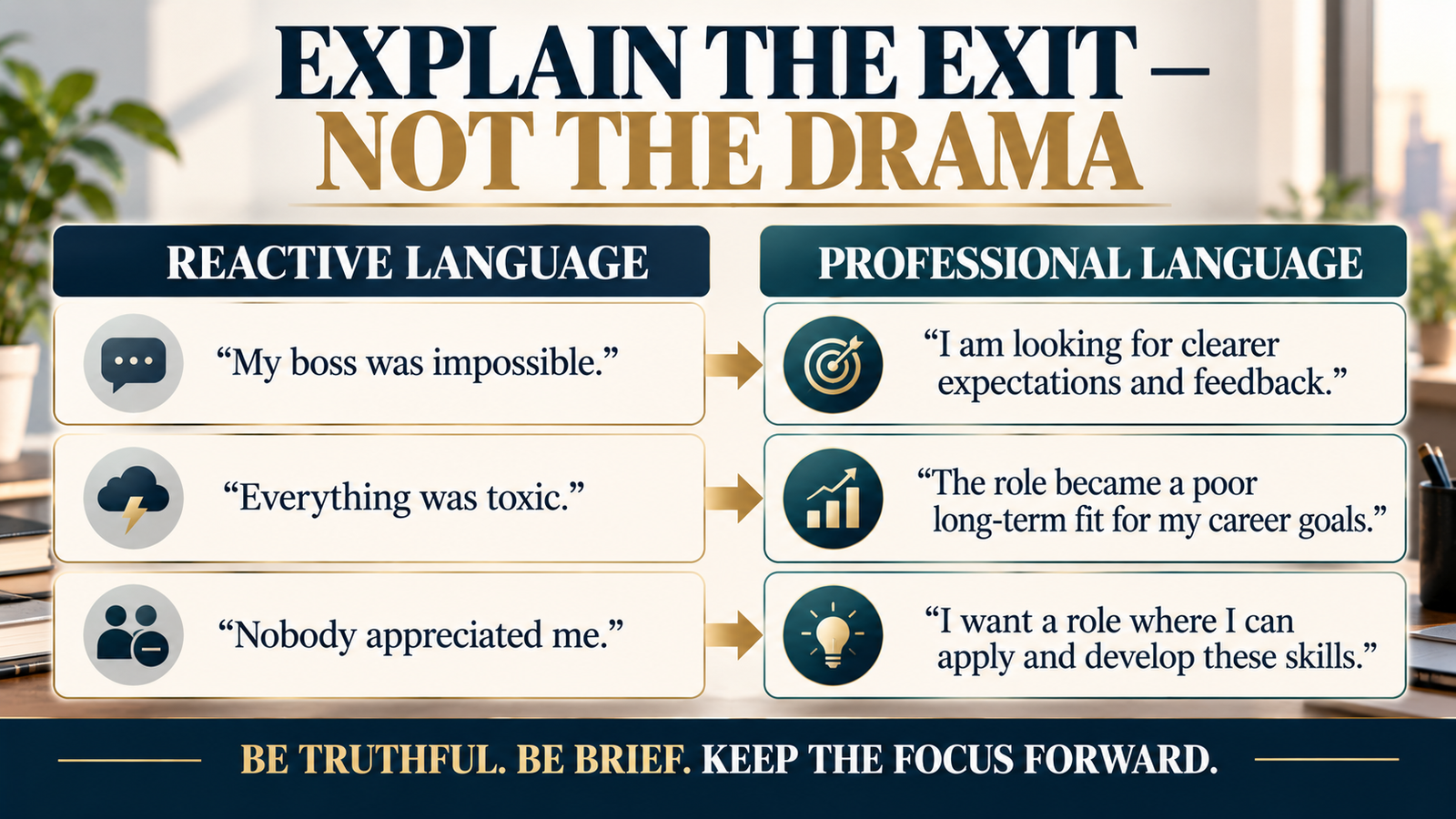
| Situation | Clear Professional Explanation |
|---|---|
| You wanted clearer expectations | “I am looking for a role with more clearly defined priorities and a feedback process that supports good delivery.” |
| The role changed substantially | “The responsibilities evolved away from the work I want to build my career around, so I began looking for a better match.” |
| The management relationship was difficult | “The management approach and my working style were not a strong long-term fit. I am focused on finding a team with clear expectations and constructive communication.” |
| You have a genuine performance issue to explain | “There was a performance concern involving [specific issue]. I addressed [what you did], learned [relevant lesson], and can explain how I work differently now.” |
| You left after an unresolved formal concern | “There were unresolved workplace issues, and I chose to move forward professionally. I can explain my responsibilities and results, and I have references who can speak directly to that work.” |
Use only wording that is true in your circumstances. These are examples, not scripts for concealing a material fact if the employer asks a legitimate and lawful question that requires a direct answer.
A two-minute account of every workplace conflict rarely helps a hiring discussion. Give the relevant answer, then return to what you can contribute to the new job.
What If You Have No Supportive Manager From That Job?
First separate two questions: Who can verify that I worked there? and Who can accurately describe how I work?
HR or an approved verification service may cover the first. A former supervisor from another organization, a credible project lead or an eligible colleague might cover the second, subject to the new employer’s requirements.
ACAS suggests that people who cannot obtain the usual reference can ask whether the recruiting employer will accept someone else they worked with, a different employer or an appropriate character reference. It also suggests requesting a basic work reference if detailed references are not supplied. See ACAS alternatives when a reference is unavailable.
A limited reference history does not mean you should manufacture one. Explain the situation briefly and offer honest alternatives.
What If Your Former Boss Gives a Negative Reference?
Start with the distinction between an unfavorable assessment and an unfair one.
A supervisor may honestly believe that an employee needed improvement in a particular area. An accurate reference does not become illegal merely because the employee dislikes it. A false, misleading, discriminatory or legally retaliatory reference raises different questions.
ACAS states that in the UK a work reference should be fair and accurate, and it explains routes for challenging a misleading or discriminatory reference. Read ACAS guidance on bad references.
Do Not Assume a Rejection Proves a Bad Reference
A job offer may fall through for many reasons: qualifications, budget, role changes, background checks or another candidate. Try to establish what actually happened before accusing someone.
Ask the Hiring Employer What Concern Arose
If a recruiter indicates that reference information caused concern, you might say:
“Thank you for letting me know. Could you clarify which employment details or performance concerns you need me to address? I would appreciate the opportunity to correct any factual misunderstanding and provide supporting information or another appropriate reference.”
Seek Clarification or Correction Through the Right Route
Where appropriate, request correction of specific inaccuracies through HR or the authorized reference provider. Preserve the correspondence and any evidence you are lawfully entitled to use.
Do not assume you have an automatic right to obtain the reference itself. In some jurisdictions confidential-reference rules can restrict access, even where other personal-data rights exist.
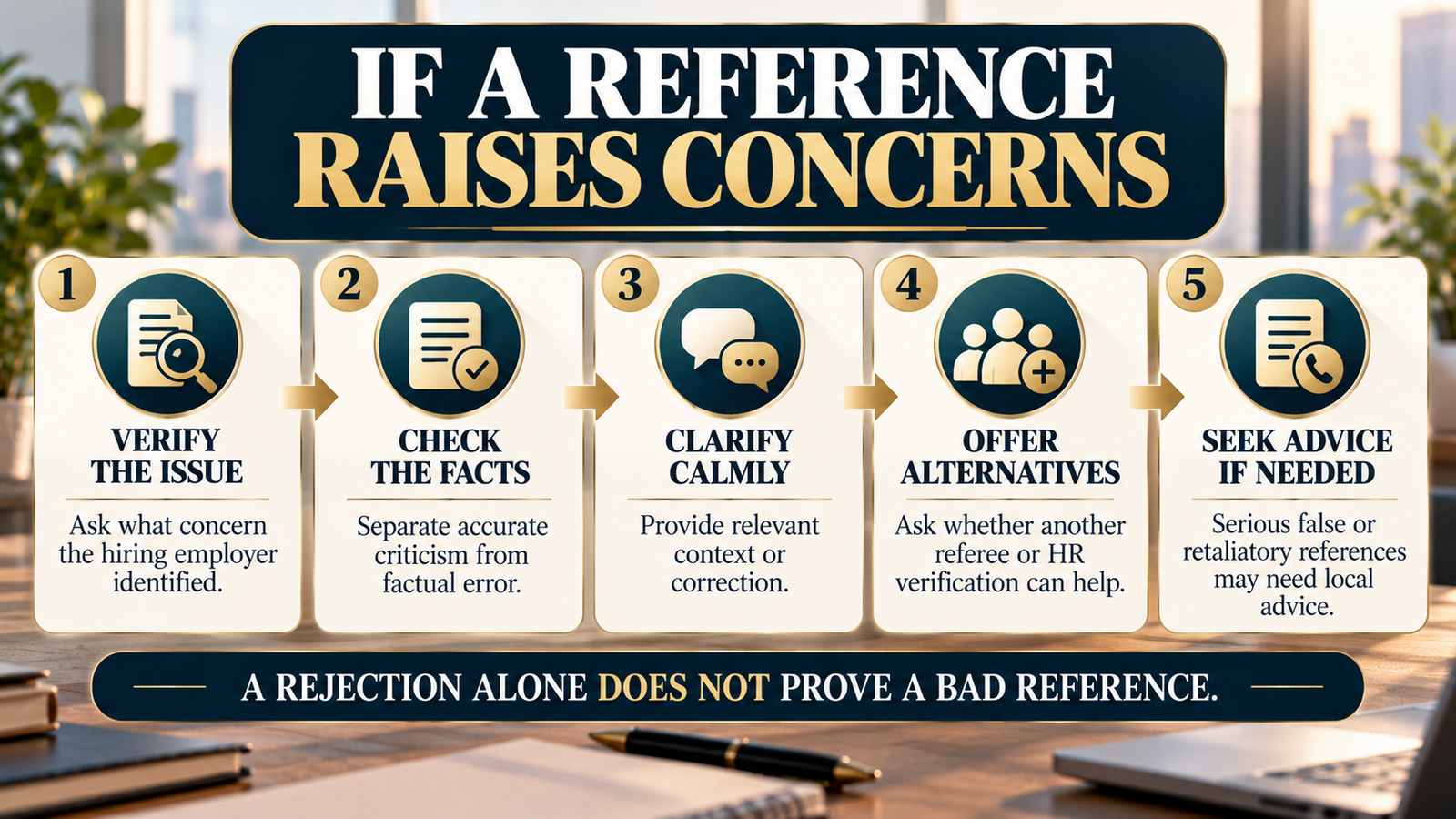
If the problem affects a job offer, your income or potentially protected employment rights, get qualified local advice promptly. Rules and filing deadlines vary.
Could a Bad Reference Be Retaliation After an HR Complaint?
Sometimes, but the legal basis matters.
Under U.S. federal equal-employment-opportunity law, the EEOC explains that anti-retaliation protections can extend to former employees. Its guidance specifically addresses unjustified negative references linked to protected EEO complaints. It also distinguishes those cases from truthful negative references supported by legitimate performance evidence. See EEOC enforcement guidance on post-employment retaliation.
An internal complaint that a manager is difficult or rude is not automatically the same as legally protected opposition to discrimination under U.S. federal EEO law. Other laws may apply to protected safety reporting, whistleblowing, wage concerns, or other activity, depending on the jurisdiction.
The practical first step is still factual: what was said, who said it, when, what was inaccurate, what the hiring employer actually relied on, and which rights may be involved.
For the broader framework, see our guide to possible retaliation after an HR complaint.
What If Your Previous Performance Record Includes Disputed Criticism?
A difficult manager may have recorded concerns you believe omit important context. The safest approach is not to erase the criticism from your own story or attack the manager’s motives without evidence.
Instead, separate:
- the performance expectation;
- the documented event;
- your response or clarification;
- the outcome;
- what you can accurately say you achieved.
If you are still employed, use appropriate performance-review, grievance or correction procedures where meaningful. After leaving, review any available policy for correcting factual mistakes.
For a practical way to confirm difficult discussions in writing, read our guide to professional follow-up emails. For documenting repeated material concerns, see the workplace incident log.
Not every negative performance record is false. Correct what can be shown to be wrong; acknowledge genuine areas for improvement.
Protect Your References Before, During and After Leaving
| Before Leaving | During Recruitment | After a Reference Problem |
|---|---|---|
| Check employer policy and who issues references. | Ask what kind of references are required. | Confirm what the hiring employer is concerned about. |
| Request permission from credible professional referees. | Share appropriate referee contact details only with permission. | Separate facts from speculation about what was said. |
| Organize lawful achievement summaries. | Explain your departure briefly and truthfully. | Request correction of identifiable inaccuracies where appropriate. |
| Clarify the HR verification contact. | Ask about timing before current-employer contact. | Offer another suitable reference or factual verification if accepted. |
| Review any major disputed employment record. | Keep the focus on your skills and the new role. | Seek qualified advice when serious legal or employment consequences arise. |
You may not be able to complete every step before departure. Use this as a flexible checklist, not a requirement to remain in an unsafe or unworkable situation indefinitely.
A Realistic Example: Leaving a Manager Who Questioned Your Work
Consider a fictional project coordinator who spent two years at a company. During the final six months, the coordinator and their manager disagreed repeatedly about deadlines and responsibility for delayed approvals. Their relationship became strained, and the manager’s final assessment was mixed.
The coordinator wants a new role but is worried that a prospective employer will contact that manager.
What Would Help?
- Check the official policy. The company may use HR for employment verification.
- Identify direct observers. A former team lead and another department’s project owner may be able to discuss real work.
- Ask permission. Both contacts should decide independently whether they are comfortable serving as references.
- Prepare specific results. The coordinator can describe legitimate project contributions and lessons from the disputed deadlines.
- Answer the recruiter clearly. Explain which source can verify employment and which referees can discuss performance.
This does not guarantee a job offer. It creates a clearer, more credible process than either pretending the manager never existed or assuming they will ruin everything.
Professional Scripts for Common Reference Questions
“Why Didn’t You List Your Last Manager?”
“I chose references who can speak directly to the responsibilities most relevant to this position. Official employment verification is available through my previous employer’s approved process. If you specifically require my last manager, please let me know what information you need so we can discuss the appropriate route.”
“Did You Leave on Good Terms?”
“There were differences about management and expectations toward the end. I remained focused on my responsibilities and have reflected on what working conditions help me perform well. I can provide people who worked closely with me and can discuss my contribution.”
“We Require a Supervisor Reference.”
“I can provide a supervisor from an earlier role who has firsthand knowledge of my work, alongside verification of my most recent employment. Would those meet the requirement, or does your process specifically require the last direct manager?”
“A Reference Raised a Concern.”
“I appreciate the opportunity to address it. Could you share the factual issue you need clarified? I would like to respond accurately and can provide relevant employment information or another appropriate referee.”
Adapt each script to the truth. Do not use them to misstate reporting lines, dates, performance, employment status or the circumstances of a departure.
How to Avoid Making a Difficult Manager the Center of Every Interview
A difficult past relationship can occupy so much mental space that it becomes the central story you tell about your career.
Hiring managers usually need to understand something more practical:
- What can you do?
- What have you delivered?
- How do you work with others?
- What did you learn?
- Why does this position make sense now?
Prepare truthful examples that answer those questions. Do not use the interview to campaign against your former manager or ask the recruiter to take sides in an old disagreement.
If your professional reputation was affected by workplace rumors, our workplace smear campaign guide covers calm correction of material misinformation. That is different from reference planning, but the two topics can overlap.
Should You Collect LinkedIn Recommendations or Written Testimonials?
Written recommendations can be useful as supplementary professional evidence when they come from people who genuinely know your work and have consented to share their views.
They may help communicate:
- what type of work you performed;
- which skills others observed;
- specific professional strengths;
- the context in which you collaborated.
But an online recommendation is not necessarily a substitute for official employment verification or a reference check. Avoid pressuring coworkers to publish endorsements, disclosing private project information or writing fictional testimonials in another person’s name.
What About Contacting Former Colleagues After You Leave?
Keep professional relationships professional.
It is reasonable to thank a colleague for working with you, reconnect about their career or ask whether they would be comfortable serving as a reference in the future.
It is not helpful to ask them to join a dispute with your manager or circulate a hostile account of why you left.
A simple message is enough:
“I appreciated collaborating with you on [project]. I’m moving into a new stage of my career and would like to stay in touch. Thank you for the work we did together.”
Professional goodwill should be built on actual working relationships, not an obligation to choose sides.
When to Get Employment or Legal Advice
General reference-planning guidance may not be sufficient when:
- a conditional job offer is withdrawn after a reference;
- a former employer appears to have provided materially false information;
- a reference may involve unlawful discrimination or protected retaliation;
- your departure was part of a settlement or legal dispute;
- a regulated role has mandatory reference requirements;
- the issue involves confidential information or important filing deadlines.
In the UK, ACAS explains that fair and accurate negative references can be lawful but misleading, inaccurate or discriminatory references may be challengeable, with applicable time limits and procedures. In the U.S., EEOC protection against retaliation depends on legally protected activity and relevant facts. Rules elsewhere may be different. ACAS: if you get a bad reference; EEOC: retaliation questions and answers.
Qualified advice can help you distinguish a disappointing reference from a specific issue for which legal remedies may exist.
Frequently Asked Questions
Can my former boss give me a bad reference?
Rules vary. In the UK an employer can give an unfavorable reference if it is fair, accurate and not misleading. U.S. rules depend on applicable laws and facts; false negative references given because of protected EEO activity can raise retaliation issues. Negative information is not automatically unlawful.
Do I have to use my most recent boss as a reference?
Not necessarily. Some hiring employers accept former supervisors, project leaders or other appropriate referees, sometimes alongside official employment verification. Others have stricter policies. Ask what is required and never misrepresent a referee’s relationship to you.
Can HR give a reference instead of my manager?
Often HR can provide factual employment verification, depending on the employer’s policy. Confirm who is authorized and what details they supply; do not assume they will provide a personalized recommendation.
What if my former manager refuses to be a reference?
Ask the hiring employer whether it will accept other professional referees or basic verification. A refusal does not necessarily establish wrongdoing, particularly where the employer uses a restrictive reference policy.
Should I explain that my former boss was toxic?
Usually a concise, truthful explanation focused on working conditions, career direction and lessons learned is more useful than a broad personality label. Answer relevant questions honestly and bring the discussion back to your skills and future role.
Can I use a coworker as a professional reference?
Sometimes. A coworker who directly knows your work may give a credible account of collaboration or technical contribution, but some employers require supervisors or official verification. Ask the hiring team before listing them.
Can I ask a reference what they plan to say?
You can ask whether they feel comfortable speaking positively and accurately about work they observed. You can share your résumé and target job description. Do not pressure the person to offer false praise or conceal facts they are required to disclose.
What if a job offer is withdrawn after a reference check?
Ask the employer whether it can explain the concern and whether you can correct a factual error or provide another suitable reference. If the reference appears materially inaccurate, discriminatory or retaliatory, seek location-specific advice promptly.
Can I see what my former employer said about me?
Access rights differ by law, jurisdiction and confidentiality arrangements. Even in places with personal-data access rights, confidential references may receive special treatment. Ask the relevant organization about its process and seek local advice where necessary.
Can a negative reference after an HR complaint be retaliation?
It can be, depending on the nature of the complaint, the action and the applicable law. The U.S. EEOC explicitly recognizes certain retaliatory references against former employees who engaged in protected EEO activity; it also distinguishes honest negative assessments from retaliation.
Should I ask for an agreed reference before resigning?
It may be worth discussing when a departure agreement or settlement is involved, but agreed wording is not automatic and may be inappropriate for some regulated roles. Obtain advice about important legal or contractual terms before signing.
How many references should I prepare?
Prepare enough credible options to meet the employers and roles you are targeting. Ask permission, maintain up-to-date contact details and match each referee to the skills or work they directly observed. Quality and relevance matter more than building a large list.
Is a LinkedIn recommendation enough?
It may support your professional reputation, but it will not necessarily satisfy formal employment or supervisor-reference requirements. Treat public recommendations as supplementary information.
How do I protect future opportunities if I left on bad terms?
Verify the official reference policy, identify other credible sources, prepare a factual achievement record, explain the departure professionally and respond to concrete concerns rather than assuming the worst. Seek qualified advice if a material falsehood or protected legal issue emerges.
Conclusion: One Difficult Manager Is Not Your Entire Career Record
A difficult departure can make the next reference request feel much bigger than it is.
You may not control how your former manager remembers your working relationship. You may not control every question a hiring employer asks. And you cannot guarantee that every referee will describe your work exactly as you would.
But you can build an accurate professional record around more than one perspective.
Find out who is authorized to verify employment. Ask people who actually observed your work whether they can serve as references. Give them truthful context. Protect confidential material. Explain your departure without a character attack. And, if a real problem appears, address the facts rather than trying to anticipate every possible criticism.
Your objective is not to erase a difficult workplace from your history. It is to prevent one strained relationship from becoming the only account of what you contributed.
If you are still deciding how and when to leave, read Should I Stay or Leave My Toxic Job?. If you are rebuilding your professional story after a difficult environment, our guide to screening your next workplace can help you evaluate the management conditions you want next.
Build Your Next Chapter on a Stronger Professional Record
Chapter 5 of Reclaim Your Power, The Smart Exit Strategy, covers the larger decision of staying, reporting, transferring or leaving while protecting finances, references and career continuity.
Reference planning is one part of that process. It works alongside accurate documentation, professional boundaries, career preparation and realistic decisions about what comes next.
If this article speaks to a larger experience of workplace manipulation or harmful leadership, explore Reclaim Your Power and the complete seven-chapter guide and workbook.
Employment-law and professional disclaimer: This article provides general educational information only, not legal, employment, financial or mental-health advice. Reference policies, data-access rights, discrimination laws, retaliation protections, regulated-sector requirements, contract terms and legal deadlines vary by jurisdiction. Not every negative reference is improper, and not every strained manager relationship gives rise to a legal claim. Obtain qualified location-specific advice for serious disputes, revoked offers, confidential records, settlement terms or possible legal violations.
Ready to Reclaim Your Power?
Get the 376-page digital edition with 7 chapters, 22 practical tools, reusable forms, an optional 30-entry journal, and references.
Buy Now — $4.99
Leave a Reply