
After leaving a harmful workplace, the next job offer can create two emotions at the same time.
Relief:
“I finally have a chance to start again.”
And fear:
“What if I walk straight into the same kind of workplace?”
That fear can make people move in two opposite directions.
Some ignore warning signs because they desperately want the new opportunity to work.
Others become so alert that every imperfect interview answer, rushed recruiter or demanding job description begins to look like proof of another toxic workplace.
Neither extreme helps.
You cannot guarantee that a workplace will be healthy before you join it.
Interviews are curated. Job descriptions are incomplete. Managers may present their best version of themselves. Employee reviews can be biased in either direction.
But you can reduce uncertainty.
The goal is not to develop a magical ability to detect a “toxic company” in thirty minutes.
The goal is to collect signals from several places:
- the job description;
- the recruitment process;
- the hiring manager;
- potential coworkers;
- employee turnover;
- publicly available workplace information;
- the questions you ask;
- the written offer.
Then ask whether those signals tell a reasonably consistent story.
This guide explains toxic workplace red flags to watch for during an interview, questions that reveal how a manager actually operates, how to research company culture before accepting an offer, and how to make a careful decision without treating every imperfection as danger.
First: You Cannot Prove a Workplace Is Toxic From One Interview
This is the most important limitation in the entire article.
An awkward interviewer may simply be inexperienced.
A role may be open because the previous employee was promoted.
A manager may stumble over a culture question because nobody has ever asked it that way.
A company may have several terrible employee reviews and thousands of satisfied employees who never wrote one.
Likewise, an impressive interview does not guarantee a healthy workplace.
The safest approach is to evaluate patterns rather than search for one decisive clue.
Current Glassdoor guidance on researching workplace culture makes a similar distinction: recurring themes across multiple detailed reviews are more informative than one extreme review, and interview signals should be combined with other research rather than treated as conclusive on their own.
See Glassdoor’s current guidance on evaluating company culture.
Think like a researcher.
One signal creates a question.
Several consistent signals create a pattern worth taking more seriously.
The Interview Is Not Only an Audition for You
Many candidates enter interviews thinking:
“How do I convince them to hire me?”
That is only half the process.
CIPD notes that interviews also give candidates an opportunity to understand the responsibilities of the role, ask about the organization and decide whether they would want the job if it were offered.
See CIPD guidance on candidate selection and interviews.
A better mindset is:
“I want them to understand whether I can do the job, and I want to understand what doing this job will actually require from me.”
That shift matters.
You stop seeing every employer question as a test you must survive.
You start paying attention to the system you may be joining.
Toxic Workplace Red Flags to Watch During the Interview
None of the following signs automatically proves that a workplace is toxic.
Each one is better treated as a reason to ask another question.
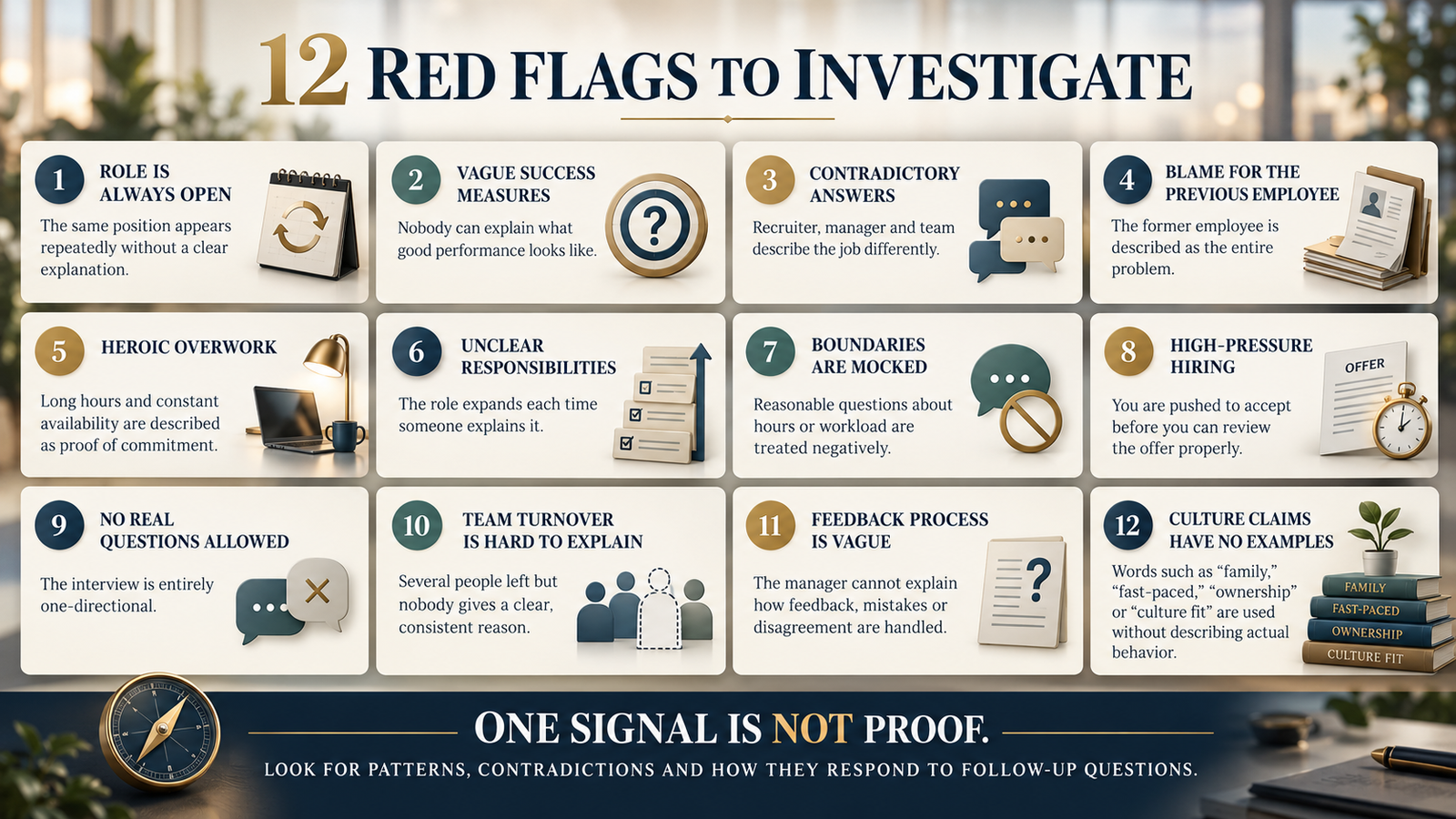
1. Nobody Can Explain What Success Looks Like
Ask:
“What would make you say after six months that the person in this role is performing really well?”
A useful answer might identify:
- specific responsibilities;
- measurable outcomes;
- quality standards;
- important relationships;
- reasonable learning milestones.
A vague answer may sound like:
“We just need someone who really takes ownership.”
That phrase is not automatically concerning.
Ask what ownership means.
“What would ownership look like in this role in practice?”
If expectations remain impossible to define even after follow-up questions, you may be entering a role where performance standards are highly subjective.
That matters because unclear success measures can later turn into:
“You should have known.”
Clear expectations do not eliminate bad management.
But complete inability to define success is useful information.
2. The Role Changes Every Time Someone Describes It
The recruiter says the job is primarily client management.
The manager says it is half sales.
A future teammate says most of the week is spent on operations.
The job description says none of those things clearly.
Some role evolution is normal.
But major contradictions deserve clarification.
Ask:
“I have heard the role described slightly differently during the process. Could we clarify the main responsibilities and roughly how the person’s time is expected to be divided?”
Do not assume somebody is lying.
Find out whether the organization itself understands the role.
3. The Previous Employee Is Blamed for Everything
Ask why the position is available.
You may hear:
“The previous person was not a good fit.”
That by itself tells you almost nothing.
Follow up professionally:
“What did the team learn from that experience about what the next person needs to succeed?”
Listen carefully to how the manager answers.
A manager may reasonably explain:
- missing technical skills;
- performance requirements;
- a role redesign;
- a mutual mismatch.
A more concerning pattern is when the former employee is described almost entirely through character attacks:
“They were lazy.”
“They couldn’t handle pressure.”
“They had attitude problems.”
while the manager shows no curiosity about whether the role, workload, expectations or management contributed.
Glassdoor’s current interview guidance similarly recommends paying attention to managers who respond to problems primarily through blame instead of explaining how they addressed the problem. See Glassdoor’s manager-screening guidance.
4. Long Hours Are Treated as a Personality Test
A demanding job is not automatically a toxic job.
Some roles have:
- busy seasons;
- incident response;
- client deadlines;
- launch periods;
- on-call responsibilities.
The useful question is whether the workload is described honestly and operationally.
For example:
“Quarter-end is usually our busiest period. The team may work late several days during those two weeks, and we plan capacity around it.”
is very different from:
“People who succeed here don’t really watch the clock.”
or:
“We’re looking for someone hungry enough to do whatever it takes.”
Ask:
“What does a genuinely busy week look like for this team?”
Then ask:
“How often does that happen?”
You are not trying to prove that nobody ever works late.
You are trying to understand whether exceptional workload is actually exceptional.
5. Reasonable Boundary Questions Make the Interviewer Defensive
Consider asking:
“How does the team normally handle work that arrives outside regular working hours?”
A manager may have strict availability requirements.
That does not automatically make the workplace unhealthy if those expectations are legitimate, clearly communicated and appropriate for the role.
The signal is how the question is handled.
Do they explain the expectation?
Or do they turn your question into a judgment about commitment?
“You seem very focused on hours.”
or:
“Maybe this environment isn’t for someone who needs that much structure.”
Before joining, you want important expectations exposed—not discovered after you have signed.
6. “We’re a Family” Comes With Blurred Expectations
The phrase:
“We’re like a family here.”
is not itself proof of anything.
Some teams use it casually to describe closeness.
The more useful question is what comes next.
Does “family” mean:
- people support one another;
- colleagues collaborate;
- relationships are warm?
Or does it appear alongside:
- pressure to prioritize work over personal commitments;
- guilt about taking leave;
- expectations of unpaid availability;
- loyalty to individuals rather than professional standards;
- poor boundaries?
Do not reject a company because somebody used one phrase.
Translate slogans into operating behavior.
7. “Culture Fit” Is Important but Nobody Can Define It
Another phrase worth examining is:
“We’re very protective of our culture fit.”
Ask:
“What behaviors are most important to the team when you talk about culture?”
CIPD cautions employers that subjective requirements around “cultural fit” or “person-organisation fit” can increase bias when they simply mean selecting people who resemble the existing workforce.
The issue is not that values do not matter.
The issue is whether “fit” means clear professional behaviors or an undefined expectation that everybody think, socialize and behave the same way.
8. The Interview Process Is Repeatedly Disorganized or Disrespectful
One rescheduled interview is not a workplace diagnosis.
Emergencies happen.
Recruiters get sick.
Managers have urgent meetings.
Look for repeated patterns:
- multiple last-minute cancellations;
- interviewers who have not read your CV;
- different people giving incompatible information;
- long unexplained silence followed by urgent demands;
- repeated lateness without acknowledgement;
- unexpected assessments that were never mentioned;
- major changes to the role midway through hiring.
ACAS and CIPD both recommend prepared and structured recruitment processes, while CIPD notes that the candidate experience itself matters during selection. See ACAS interview guidance.
The hiring process is not a perfect miniature of employment.
But it is one of the few actual interactions you can observe before joining.
9. You Are Pressured to Accept Immediately
Sometimes an employer genuinely needs someone quickly.
Urgency alone is not evidence of toxicity.
But be cautious when you are discouraged from doing basic due diligence.
Examples include:
“We need your answer in the next hour.”
when no genuine deadline had previously been mentioned.
Or:
“There is really nothing to think about.”
when you ask to review the written offer.
A reasonable candidate should normally want to understand:
- compensation;
- job title;
- manager;
- location;
- working arrangement;
- start date;
- benefits;
- responsibilities;
- important employment terms.
A good opportunity should survive reasonable questions.
10. Nobody Wants You to Meet the Team
Not every hiring process includes future coworkers.
Sometimes confidentiality, scheduling or company size makes that unrealistic.
But if the job is highly collaborative, meeting even one potential teammate can provide useful information.
Ask:
“Would it be possible to speak briefly with someone currently doing similar work so I can understand the team’s workflow?”
If that is impossible, ask the manager:
“How long have the current members of the team been working together?”
Then:
“Where have people who previously held this role typically moved next?”
You are looking for context, not conducting an investigation.
11. Nobody Can Explain How Mistakes Are Handled
Every employee eventually makes a mistake.
This question can be revealing:
“What happens when someone on the team makes a significant mistake?”
A thoughtful manager may explain:
- how the problem is contained;
- how responsibility is reviewed;
- how the employee receives feedback;
- how systems are improved;
- when escalation becomes necessary.
A concerning answer may glorify humiliation:
“They only make that mistake once.”
Or focus almost entirely on blame:
“People here know there are consequences if they embarrass me.”
The exact wording matters less than the management philosophy underneath it.
12. The Manager Cannot Describe How Disagreement Works
Ask:
“Can you give me an example of a disagreement within the team and how it was resolved?”
You are not looking for a workplace without conflict.
That workplace does not exist.
You are looking for evidence that disagreement can happen without becoming personal warfare.
A healthy answer may involve:
- different technical opinions;
- a priority conflict;
- a discussion;
- data or evidence;
- a decision;
- people continuing to work together afterward.
If the answer suggests that disagreement with the manager itself is unacceptable, pay attention.
13. Turnover Is High but Nobody Can Explain Why
Turnover deserves investigation, not automatic judgment.
People leave because:
- they are promoted;
- the company is growing;
- roles are restructured;
- contracts end;
- people relocate;
- another employer pays more;
- the workplace is genuinely difficult.
Indeed’s current candidate guidance specifically recommends asking why the role is open and notes that significant turnover can be useful information when assessing an employer. See Indeed’s guidance on questions for a hiring manager.
Ask:
“How long was the previous person in this role?”
Then:
“What happened to them afterward?”
A promotion is very different from a sequence of six employees leaving the same manager within a year.
14. Compensation, Flexibility or Role Terms Keep Moving
You applied for a hybrid role.
During the final interview, it becomes:
“Hybrid after probation.”
At offer stage, it becomes:
“Mostly office-based depending on manager approval.”
Or salary, title, reporting line or major responsibilities keep changing.
Sometimes legitimate business circumstances change.
The problem is not change itself.
The issue is whether major changes are explained clearly and reflected in the written offer.
Before signing, resolve material contradictions.
15. Every Problem Is Described as an Employee Attitude Problem
Listen to how leaders discuss:
- turnover;
- missed deadlines;
- previous employees;
- team conflict;
- customer problems;
- failed projects.
Healthy leaders do not have to blame themselves for everything.
But strong management usually recognizes systems as well as individuals.
A pattern such as:
“People today just don’t want to work.”
combined with high turnover, unclear expectations and heavy workload may tell you more than the sentence alone.
Ask Questions That Are Hard to Answer With Corporate Slogans
Asking:
“What is your culture like?”
often produces:
“Collaborative, innovative and fast-paced.”
Almost every company can say that.
Instead, ask for events, examples and decisions.
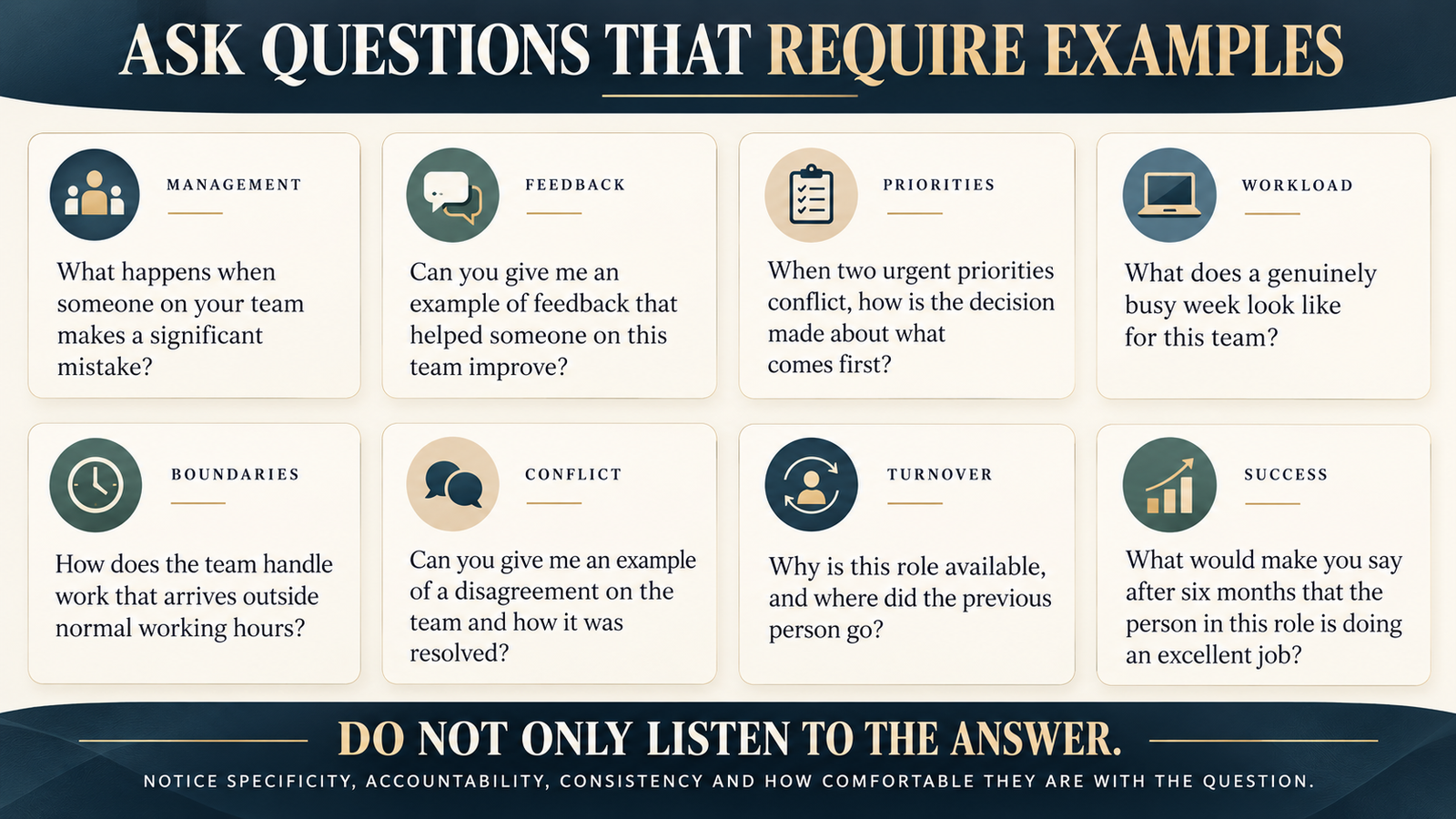
Ask About the Manager, Not Their Management Philosophy
Compare these questions.
Easy Question
“How would you describe your management style?”
You may hear:
“I’m collaborative but I give people autonomy.”
That sounds good.
It tells you very little.
Better Question
“Can you give me an example of how you handled a situation where someone on your team strongly disagreed with your decision?”
Now the manager has to describe behavior.
Listen for:
- whether disagreement was permitted;
- whether evidence mattered;
- whether the employee was respected;
- whether the manager can describe their own part in the conflict.
Ask How Feedback Actually Happens
Try:
“How frequently do you normally give feedback to the person in this role?”
Then:
“Can you give me an example of feedback that helped someone on the team improve?”
You are looking for a process.
Does feedback happen through:
- regular one-to-ones;
- project reviews;
- written performance goals;
- annual reviews only;
- only when something goes wrong?
A company does not need your preferred feedback style.
You simply need to know what you are joining.
Ask What Happens When Priorities Conflict
This is one of the strongest questions for detecting whether “fast-paced” actually means “permanently chaotic.”
“If two senior stakeholders both have urgent requests and there is not enough capacity for both, how is priority normally decided?”
A workable system may involve:
- manager prioritization;
- published priorities;
- capacity planning;
- negotiating deadlines.
A concerning system may effectively be:
“Everything is urgent. Good people figure it out.”
That answer tells you something important about how impossible workload may be transferred onto employees.
Ask What Happened to the Previous Person
This should not sound accusatory.
Try:
“Is this a new role or am I replacing someone?”
If replacing:
“Where did the previous person move next?”
You may learn that they:
- were promoted;
- changed departments;
- relocated;
- left the organization;
- were terminated;
- were one of several people who recently held the job.
None of those answers automatically proves anything.
It gives you another piece of the workplace history.
Watch How They Respond to Your Questions
The content of an answer matters.
So does the response to being asked.
Notice whether reasonable questions produce:
- specific answers;
- thoughtful uncertainty;
- examples;
- willingness to clarify.
Compare that with:
- mockery;
- visible irritation;
- defensiveness;
- pressure to stop asking;
- repeated slogans instead of answers.
A good manager does not have to love every question.
But how someone responds when you seek clarity can be useful preview information.
Do Not Confuse Charisma With Healthy Leadership
A confident, warm and persuasive interviewer can still be a poor manager.
An awkward interviewer can still be an excellent one.
Do not over-weight charm.
Evaluate:
- clarity;
- accountability;
- consistency;
- respect;
- expectations;
- how disagreement is handled;
- whether answers match what others told you.
The point is not:
“Did I like this person?”
It is:
“What evidence did this conversation give me about how this person manages work and people?”
Research the Workplace Before You Accept the Offer
The interview gives you only part of the picture.
Use legitimate public and professional information to test what you heard.
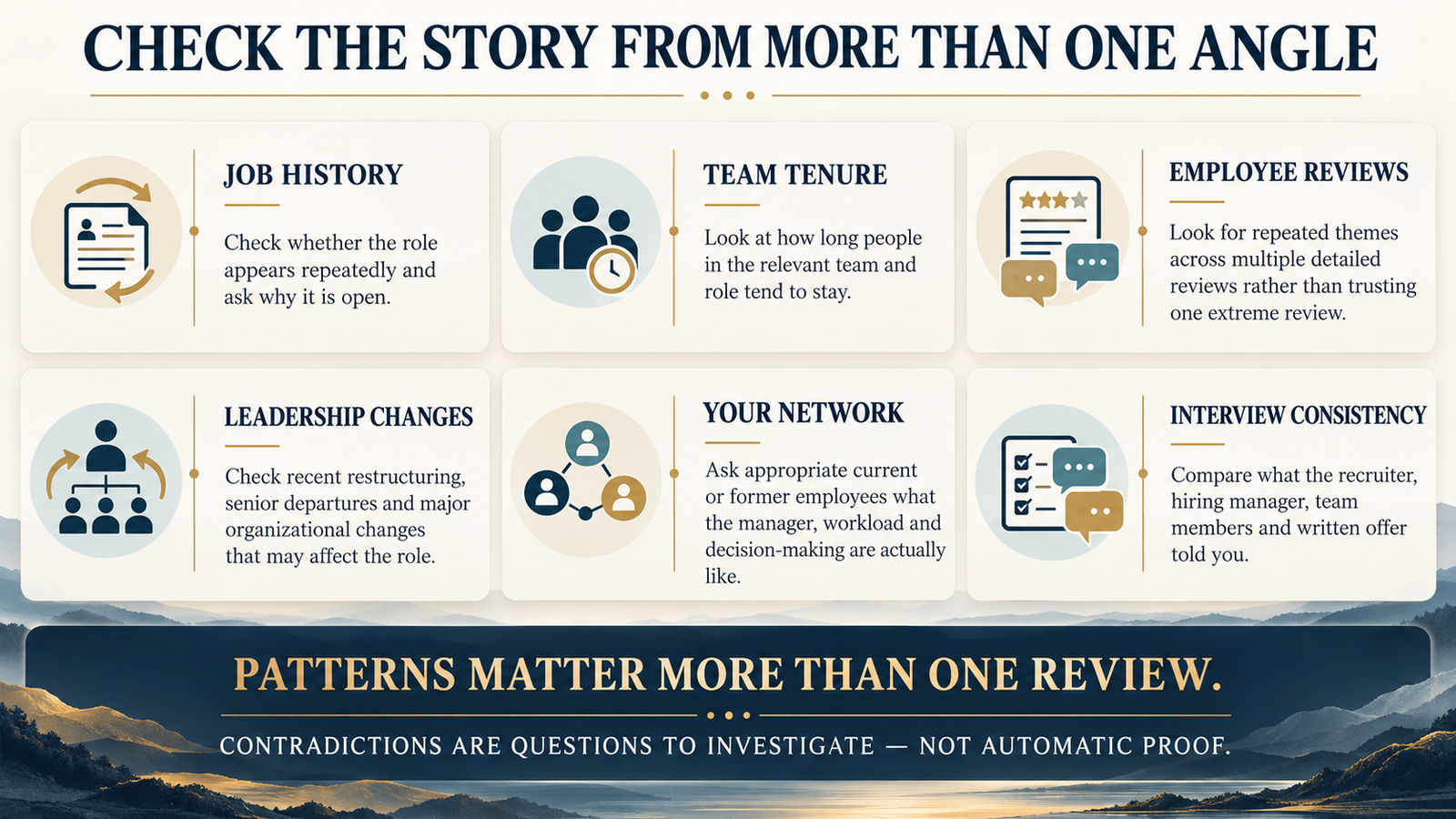
1. Look at the History of the Role
Search the position and company.
Ask yourself:
- Has this exact role been advertised repeatedly?
- Has the team expanded significantly?
- Is the job new?
- Is the role being redesigned?
A repeated vacancy can indicate turnover.
It can also indicate growth.
Ask rather than assume.
2. Look at Team Tenure
Public professional profiles can sometimes help you understand whether people tend to remain in the relevant department.
Do not invade anyone’s privacy.
You are looking at ordinary professional information people intentionally make public.
A team where:
- most people joined in the last six months;
- several people recently left;
- the same role changes hands repeatedly;
may deserve another question.
But context matters.
The company may have opened a new department or completed a restructuring.
3. Read Employee Reviews Like Evidence, Not Verdicts
Do not make a major career decision because one anonymous reviewer wrote:
“Worst company ever.”
Also do not dismiss reviews because:
“Every company has unhappy employees.”
Look for patterns.
Repeated mentions of the same specific issue deserve more attention than broad emotional judgments.
For example:
- the same department repeatedly mentioning micromanagement;
- several reviewers describing frequent manager turnover;
- repeated concerns about after-hours work;
- multiple detailed accounts of unclear promotion criteria.
Also check the dates.
A company may have changed leadership significantly since reviews from three years ago.
Glassdoor’s current company-culture guidance likewise recommends examining recurring themes across multiple reviews rather than relying on star ratings or isolated accounts. See Glassdoor’s culture-research guidance.
4. Ask Your Professional Network
If you legitimately know someone who works or previously worked there, a short professional conversation may help.
Instead of:
“Is the company toxic?”
ask:
- “How would you describe decision-making?”
- “How was your manager?”
- “How realistic was the workload?”
- “Why did you eventually leave?”
- “What surprised you after joining?”
- “What type of person tends to do well there?”
Again, one person’s experience is one data point.
5. Compare the Recruiter, Manager and Team Stories
You are looking for reasonable consistency.
| Topic | Recruiter Says | Manager Says | Team Says | Question to Resolve |
|---|---|---|---|---|
| Hybrid work | 3 remote days | Depends on workload | Usually office 4 days | What arrangement applies to this role in practice? |
| Working hours | Normal business hours | Flexible | Frequent evening messages | What after-hours availability is actually expected? |
| Role scope | Client management | Client + sales | Mostly operations | What are the top three responsibilities? |
| Growth | Strong promotion culture | Depends on performance | Few people have been promoted recently | What were the last two internal promotions from this team? |
Contradiction does not automatically equal deception.
It does mean the issue should be clarified before you rely on it.
Be Careful With the Phrase “Fast-Paced Environment”
“Fast-paced” can describe a healthy workplace.
Some people genuinely enjoy:
- rapid decisions;
- multiple projects;
- short deadlines;
- frequent change.
The phrase becomes less useful when it hides chronic operational problems.
Ask what fast-paced actually means.
“What tends to make the pace intense—volume, client deadlines, changing priorities or team capacity?”
Then:
“How does the manager decide what should be deprioritized when capacity is full?”
If the answer is:
“Nothing gets deprioritized.”
you have learned something much more valuable than the original phrase.
Do Not Overreact to Direct or Demanding Managers
A demanding manager is not automatically a toxic manager.
Some excellent managers:
- set high standards;
- give direct feedback;
- expect deadlines to be met;
- challenge weak work;
- require accountability.
The difference appears in how those standards operate.
Ask whether:
- expectations are understandable;
- standards remain reasonably stable;
- feedback relates to the work;
- mistakes can be corrected;
- the manager can acknowledge their own errors;
- reasonable questions are permitted.
Our existing guide to a narcissistic boss vs. a difficult boss explores this distinction in detail.
Ask Yourself Whether the Job Description Contains Hidden Warning Signs
Job descriptions often contain generic phrases that are harmless by themselves.
Look at how several phrases interact.
| Phrase | Could Simply Mean | Useful Follow-Up |
|---|---|---|
| “Fast-paced” | High-volume or rapidly changing work | “How often do priorities change, and who decides what gets deprioritized?” |
| “Self-starter” | Autonomy | “What onboarding and manager support does the role receive?” |
| “Wear many hats” | Varied responsibilities in a small team | “What are the three responsibilities that take most of the person’s time?” |
| “High ownership” | Decision-making responsibility | “What decisions can this role make independently?” |
| “Resilient” | Ability to handle demanding situations | “What tends to make this role particularly challenging?” |
| “Flexible” | Adaptability | “What kinds of schedule or priority changes happen most often?” |
Do not treat buzzwords as secret codes.
Use them as prompts for better questions.
Notice Whether the Employer Is Also Evaluating Fairly
A healthy workplace is not guaranteed by a structured interview.
But a thoughtful hiring process is generally a better signal than an arbitrary one.
ACAS recommends consistent interview questions where possible, while CIPD notes that structured interviews use predefined questions and consistent assessment criteria to make selection more objective and fair. See ACAS interview guidance.
Positive signals may include:
- interviewers understand the role;
- the process is explained;
- questions relate to the actual job;
- you know what happens next;
- reasonable adjustments are handled professionally;
- major assessments are disclosed in advance;
- you have an opportunity to ask questions.
This is not a purity test.
It is another part of the pattern.
Green Flags Matter Too
Future-proofing your career should not turn into hunting only for danger.
Look actively for positive evidence.
1. The Manager Can Admit the Job Has Challenges
“Our biggest issue right now is that priorities can change quickly when clients escalate, and we are working on improving capacity planning.”
That answer is more useful than:
“Everything is amazing here.”
2. Expectations Are Specific
You understand:
- what you own;
- what you do not own;
- who you report to;
- how success is measured.
3. The Manager Can Describe Development
They can tell you how people have:
- learned;
- taken on bigger responsibilities;
- moved internally;
- been promoted.
4. People Can Discuss Mistakes Without Drama
Mistakes are neither ignored nor treated as personal betrayal.
5. Different Interviewers Tell Compatible Stories
The wording may differ.
The fundamentals do not.
6. Questions Are Welcome
The employer understands that accepting a job is a serious decision for you too.
What If You Previously Experienced Workplace Abuse?
A previous harmful workplace can change how you interpret the next hiring process.
You may notice yourself thinking:
“My old manager used that phrase too.”
or:
“This interviewer reminds me of my old boss.”
Those reactions can contain useful information.
They can also be influenced by what you recently experienced.
You do not need to ignore your instinct.
Convert it into a question.
Instead of:
“They remind me of my toxic boss, so I should decline.”
try:
“What exactly triggered my concern, and what information could test it?”
Was it:
- vague expectations?
- blame?
- boundary language?
- contradictory instructions?
- pressure?
- simply a similar personality style?
This helps you use experience without allowing the last workplace to make every future decision for you.
Our article on why workplace abuse can be hard to recognize while it is happening explains why patterns often become clearer only after several incidents are viewed together.
Do Not Make “No Red Flags” Your Standard
No employer will answer every question perfectly.
No manager will have flawless systems.
No employee-review page will be entirely positive.
No recruitment process will be perfectly smooth.
You are not searching for:
“A workplace where nothing bad can ever happen.”
You are looking for:
- clarity;
- reasonable accountability;
- enough consistency;
- workable boundaries;
- respectful disagreement;
- systems that can correct problems when they happen.
A healthy workplace is not a conflict-free workplace.
It is a workplace with enough capacity for repair.
What If You Need the Job?
Sometimes you cannot screen jobs as if you have unlimited alternatives.
You may need income.
Your current contract may be ending.
You may have been unemployed for months.
A possible red flag does not automatically mean:
“Reject the offer.”
Instead, ask:
- What risk did I identify?
- How serious is it?
- Can I clarify it before accepting?
- Can I protect myself if I take the role?
- What alternatives do I realistically have?
Career decisions happen under real constraints.
The goal is informed choice, not perfection.
Do Not Accept a Job Mainly to Escape Your Current One
This is especially important after a toxic workplace.
The first acceptable offer can feel extraordinary simply because it is an exit.
Try to evaluate the new employer separately from the old one.
Do not ask only:
“Is this better than where I am?”
Ask:
“Would I consider this a good opportunity if I were not desperate to leave my current job?”
The difference can prevent one escape from becoming the next problem.
The Final Pre-Offer Workplace Red-Flag Check
Before accepting, stop collecting impressions and summarize what you actually know.
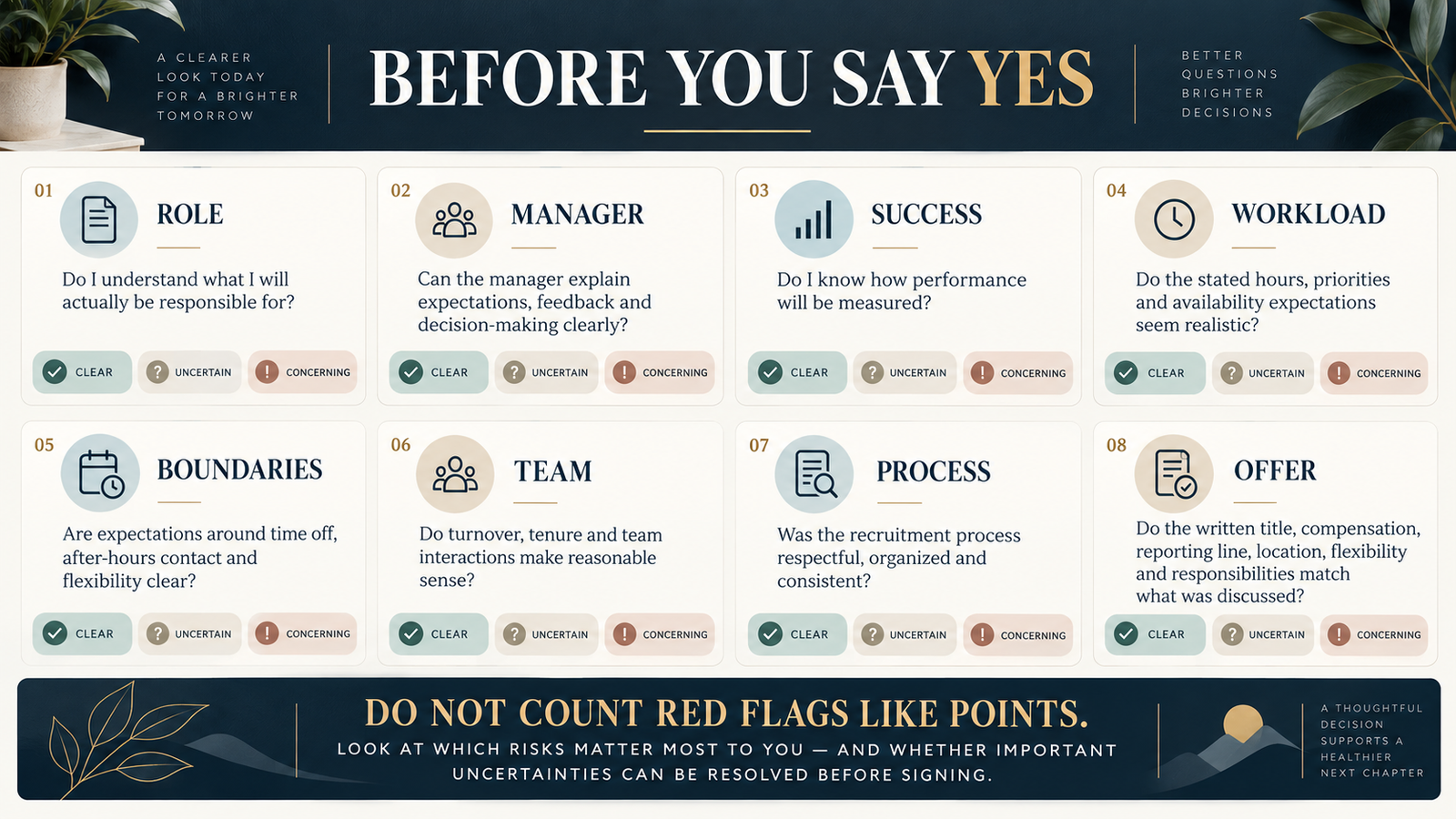
| Area | Clear | Uncertain | Concerning |
|---|---|---|---|
| Role | I understand the main responsibilities. | Some responsibilities remain vague. | Different people describe fundamentally different jobs. |
| Manager | Expectations and management practices were explainable. | I need more information. | Blame, control or hostility repeatedly appeared in answers. |
| Success | Performance standards are reasonably clear. | Measures are broad. | Nobody can explain what success means. |
| Workload | Busy periods and prioritization make sense. | Actual workload remains unclear. | Chronic overwork is glorified or everything is always urgent. |
| Boundaries | Availability expectations are understandable. | Some ambiguity remains. | Reasonable boundary questions are treated as lack of commitment. |
| Team | Tenure and turnover have understandable explanations. | I have limited team information. | Repeated turnover combines with blame and evasive explanations. |
| Hiring process | Generally respectful and organized. | Some ordinary friction occurred. | Repeated disrespect, contradictions or pressure appeared. |
| Offer | Written terms match important discussions. | A few items require clarification. | Important terms changed unexpectedly or remain unclear. |
Do not turn this into:
“Three red flags means reject.”
Risk is not arithmetic.
A single major issue can matter more than five minor uncertainties.
And several uncertainties may disappear after one good follow-up conversation.
Questions to Ask After You Receive the Offer
You can still clarify important points before accepting.
Reporting Line
“Can you confirm who this role reports to and whether that is expected to change?”
Hybrid Arrangement
“Can you confirm the normal on-site and remote-work expectations for this role?”
Role Scope
“Before I accept, could we confirm the three main areas of responsibility we discussed?”
Working Hours
“Are there regular on-call, evening or weekend requirements that are part of this role?”
Performance
“When would the first formal performance review normally occur?”
Important verbal promises should not remain mysterious simply because you now have an offer.
What About an Unpaid Interview Task?
Practical assessments can be legitimate recruitment tools.
A short task may help an employer evaluate whether you can perform relevant work.
But scope matters.
ACAS guidance for UK employers notes that unpaid work trials should genuinely be for recruitment purposes and remain reasonable in duration; where work extends beyond genuine assessment or creates actual value for the employer, minimum-wage issues may arise under UK law.
See ACAS guidance on interview work trials.
Laws differ by jurisdiction.
From a candidate perspective, ask:
- How long should the task take?
- What skill is it testing?
- Will the output be used commercially?
- Who will evaluate it?
A realistic assessment is different from producing days of free client work.
What If the Reviews Are Terrible but the Interview Is Excellent?
Do more research.
Ask:
- Are the reviews current?
- Do they concern your department?
- Do several detailed reviews identify the same problem?
- Has leadership changed?
- Was there a major restructuring?
- Can you ask the hiring manager professionally about a relevant issue?
You do not need to confront the manager with:
“Why does everybody online say this company is toxic?”
You can ask the underlying question:
“I noticed the organization has gone through significant change recently. How has that affected this team and its workload?”
You are testing reality, not prosecuting the employer.
What If the Reviews Are Excellent but Something Feels Wrong?
Do not force yourself to ignore the concern.
Identify it.
Maybe:
- the manager repeatedly interrupted teammates;
- the role remained vague;
- the interviewer mocked work-life boundaries;
- your offer changed substantially;
- answers about turnover were contradictory.
Now investigate that specific concern.
Positive reviews do not invalidate information you directly observed.
Likewise, your discomfort does not automatically prove what it means.
Convert instinct into a testable question.
How to Decline an Offer When the Risk No Longer Feels Worth It
You do not need to accuse the company of being toxic.
A simple professional decline is enough.
“Thank you very much for the offer and for the time the team invested throughout the interview process. After careful consideration, I have decided not to move forward with the position. I appreciate the opportunity and wish the team well.”
You do not owe an employer a diagnosis of its workplace culture.
Your job is to make the career decision.
Chapter 7: Future-Proofing Does Not Mean Becoming Suspicious of Every Workplace
Chapter 7 of Reclaim Your Power is not about teaching you that every future manager is dangerous.
It is about improving your filters.
A harmful workplace may have taught you useful lessons about:
- which boundaries matter to you;
- which management styles help you perform;
- which behaviors you previously rationalized;
- which questions you wish you had asked sooner;
- which career conditions are now non-negotiable.
The goal is not hypervigilance.
The goal is discernment.
Your previous experience should become information—not a prison you carry into every interview.
The live Reclaim Your Power workbook includes a Future Workplace Red-Flag Map and a Career Confidence Rebuild Plan specifically for this stage. See the complete Chapter 7 and workbook structure.
Create Your Own Future Workplace Red-Flag Map
A generic internet list is useful.
Your personal history is more specific.
Divide a page into four sections.
1. Behaviors I Will Investigate Earlier
For example:
- moving expectations;
- public humiliation;
- manager blame;
- poor boundaries;
- extreme turnover.
2. Conditions I Need to Perform Well
For example:
- clear priorities;
- regular feedback;
- reasonable autonomy;
- predictable availability expectations;
- access to the information needed for the job.
3. Questions I Will Ask Before Accepting
Turn past problems into future interview questions.
If your old workplace constantly changed priorities:
“How does this team handle competing urgent requests?”
If feedback appeared only when something went wrong:
“How does the manager normally give feedback?”
4. Deal-Breakers
Keep this list short.
Not every preference is a deal-breaker.
Examples might include:
- a compensation threshold;
- a specific travel requirement;
- permanent overnight availability;
- a working arrangement incompatible with your circumstances;
- a manager behavior you know you cannot work under again.
This turns recovery into a better future selection system.
Frequently Asked Questions
What are the biggest toxic workplace red flags during an interview?
Useful warning signs include repeated contradictions about the role, inability to explain success measures, unexplained high turnover, chronic overwork being treated as commitment, hostility toward reasonable boundary questions, repeated blame of former employees, unclear feedback processes, and pressure to accept without adequate time to review the offer. No single sign automatically proves a workplace is toxic.
How can I tell whether a boss will be toxic during an interview?
You cannot know with certainty from one interview. Ask behavioral questions about mistakes, disagreement, feedback, workload and priorities. Pay attention to accountability, specificity, respect and consistency rather than trying to diagnose the manager’s personality.
What questions reveal a toxic workplace?
Useful questions include: “What happens when someone makes a significant mistake?”, “How are conflicting priorities handled?”, “Why is this role open?”, “How does the manager normally give feedback?”, “What does a busy week look like?” and “Can you give me an example of a disagreement on the team and how it was resolved?”
Is high employee turnover always a red flag?
No. Turnover can result from growth, promotion, restructuring, relocation and many other factors. It becomes more concerning when the same role repeatedly turns over and the employer cannot give a clear or consistent explanation.
Is “we are a family” a workplace red flag?
Not by itself. Some teams use the phrase simply to describe close relationships. Investigate what it means in practice. Concern increases if “family” is used to justify weak boundaries, unpaid availability, guilt about leave or personal loyalty over professional standards.
Is “fast-paced environment” a red flag?
Not automatically. Ask what creates the pace, how often priorities change and what happens when workload exceeds capacity. A fast-moving workplace can be well managed; permanent unmanaged urgency is different.
Should I trust company reviews online?
Use them as one source rather than a verdict. Look for repeated, specific themes across multiple recent reviews and compare them with information from interviews, public professional profiles and your network.
What if the company has bad reviews but I liked the manager?
Investigate the discrepancy. Check whether the reviews concern your department, whether leadership has changed and whether several recent reviews describe the same issue. A good manager can exist in a troubled organization, and a polished manager can exist in a difficult team.
What if I cannot meet the team before accepting?
Ask the manager about team size, tenure, turnover, collaboration and where previous employees moved. Not every recruitment process can include future coworkers, so absence of a team meeting is not automatically a warning sign.
Should I ask why the previous employee left?
Yes, professionally. Ask whether the role is new or a replacement and where the previous employee moved next. The answer can provide useful context about turnover, promotion and role stability.
What are good signs in a job interview?
Positive signals include clear responsibilities, realistic success measures, managers who can discuss challenges honestly, consistent answers across interviewers, specific examples of feedback and development, respectful handling of questions, and written offer terms that match the discussion.
Is a disorganized interview process proof of a toxic workplace?
No. Individual scheduling problems happen. Pay more attention to repeated disrespect, major contradictions, unexplained delays followed by unreasonable pressure, or a process where nobody seems to understand the role.
What if I need the job despite some red flags?
Evaluate the seriousness of each concern, clarify what you can before accepting and consider what protections or alternatives you would have after joining. Career decisions happen under financial and practical constraints, so the goal is informed choice rather than finding a perfect employer.
How can I avoid another toxic workplace after leaving one?
Use the previous experience to define clearer non-negotiables, ask more specific interview questions, research the manager and team appropriately, compare information from several sources, clarify working expectations before accepting and pay attention to patterns rather than isolated impressions.
Should I decline an offer if I see several red flags?
Several consistent red flags should prompt deeper investigation. Whether to decline depends on their seriousness, whether important uncertainties can be resolved, your alternatives and which risks matter most to you. Do not reduce the decision to a numerical red-flag count.
Final Thoughts: Do Not Look for a Perfect Workplace — Look for Evidence That Problems Can Be Repaired
Your next employer will have problems.
There will be pressure.
Someone will communicate badly.
A project will become chaotic.
You will disagree with your manager at some point.
The goal is not to find a company where nothing uncomfortable ever happens.
Look for something more realistic.
Can expectations be explained?
Can mistakes be discussed without humiliation?
Can priorities be clarified?
Can employees ask reasonable questions?
Can managers describe their own responsibility?
Can disagreement occur without professional punishment?
Do different people tell reasonably compatible stories about the job?
Does the written offer match the opportunity you believe you are accepting?
And when you discover something uncertain:
Can you ask about it without the entire relationship becoming defensive?
That last question matters.
A healthy workplace does not need to be perfect.
It needs enough honesty, structure and accountability to repair ordinary problems before they become destructive patterns.
If your last workplace taught you how harmful unclear expectations and repeated manipulation can become, use that knowledge differently now.
Do not use it only to recognize danger after six months.
Use it to ask better questions before Day One.
Turn What Happened Before Into Better Filters for What Comes Next
The final stage of Reclaim Your Power is not simply leaving a toxic workplace behind.
It is building a career that is harder to destabilize in the same way again.
Chapter 7 focuses on future-proofing through:
- workplace red flags;
- stronger professional boundaries;
- better interview filters;
- career confidence;
- clearer non-negotiables.
The accompanying workbook includes a Future Workplace Red-Flag Map and a Career Confidence Rebuild Plan so the lessons from the previous workplace can become a practical screening system rather than permanent fear.
Explore Reclaim Your Power and the complete seven-chapter recovery guide and workbook.
Career and employment disclaimer: This article provides general educational information only and is not legal, employment, financial, medical or mental-health advice. “Toxic workplace” is an informal descriptive term rather than one universal legal category. No interview question, employee review, hiring behavior or warning sign can reliably prove how an employer or manager will behave after you join. Recruitment laws and employment rights also vary by jurisdiction. Use multiple information sources, your own circumstances and appropriately qualified professional advice where necessary before making important career decisions.
Ready to Reclaim Your Power?
Get the 376-page digital edition with 7 chapters, 22 practical tools, reusable forms, an optional 30-entry journal, and references.
Buy Now — $4.99
Leave a Reply