
You reported a workplace problem to HR.
Then something changed.
Your manager became unusually formal.
You were removed from a meeting you had attended for months.
A new performance concern appeared.
Your workload changed.
An opportunity disappeared.
Or coworkers suddenly seemed to know a negative version of the complaint that you never told them.
It is understandable to ask:
“Is this retaliation after my HR complaint?”
The answer cannot usually be determined from timing alone.
A negative event that happens after an HR complaint is not automatically retaliation. Employers can continue managing performance, changing business priorities, restructuring roles and addressing legitimate misconduct after someone raises a concern.
At the same time, certain changes after a complaint can deserve careful attention—especially when they materially affect your work, opportunities, professional reputation or employment position.
The practical response is not to label every uncomfortable interaction retaliation.
It is to build a clear before-and-after record.
Ask:
- What did I report?
- When did I report it?
- Who knew about the complaint?
- What changed afterward?
- Who made the decision?
- What reason was given?
- How does that reason compare with the existing record?
- What professional impact followed?
This guide explains warning signs of possible retaliation after an HR complaint, what does and does not prove retaliation, how to document post-complaint changes, how to communicate professionally, and when internal or external advice may be appropriate.
Important Employment-Law Note: “Retaliation” Has a Legal Meaning
People often use the word retaliation to mean:
“Something negative happened after I complained.”
Employment law can use the term more narrowly.
For example, under the U.S. federal EEO laws enforced by the Equal Employment Opportunity Commission, a retaliation claim generally involves three elements:
- the employee engaged in protected activity;
- the employer took a materially adverse action;
- there is a legally sufficient connection between the protected activity and the action.
EEOC retaliation guidance explains that protected EEO activity can include participating in an EEO process or reasonably opposing unlawful employment discrimination.
This means an internal complaint saying:
“My manager is rude and unfair.”
is not automatically the same, legally, as a complaint saying:
“I believe I am being treated differently because of my disability.”
Other laws may protect other activities, including certain wage complaints, safety complaints, whistleblowing, leave rights, union or concerted activity and other workplace rights, depending on where you work.
In the UK, discrimination law commonly uses the term victimisation for detrimental treatment because a person carried out a protected act under the Equality Act. ACAS explains victimisation here.
This article therefore uses possible retaliation carefully.
It does not determine whether a specific workplace event is legally retaliatory.
Retaliation After an HR Complaint: The Practical Test
Before deciding that your employer is retaliating, slow the situation down.
Use four questions.
1. What Did You Report?
Was your complaint about:
- discrimination;
- harassment connected to a protected characteristic;
- a workplace safety concern;
- wages or pay;
- whistleblowing;
- protected leave;
- union or concerted activity;
- another legally protected workplace right;
- a general bullying, management or personality problem?
The answer can affect which legal protections may apply.
2. What Actually Changed?
Identify the concrete workplace action.
Do not write:
“Everything became hostile.”
Write:
“Two weeks after the complaint, I was removed from the weekly client meeting I had attended for the previous seven months.”
3. When Did It Change?
Chronology can matter.
A workplace change occurring soon after a complaint may deserve attention, particularly when combined with other evidence.
But timing by itself does not establish motive.
4. What Reason Was Given?
Ask what the employer says caused the decision.
Was it:
- poor performance;
- business restructuring;
- a client request;
- attendance;
- misconduct;
- role redesign;
- budget changes;
- something else?
Then compare the stated reason with the record.
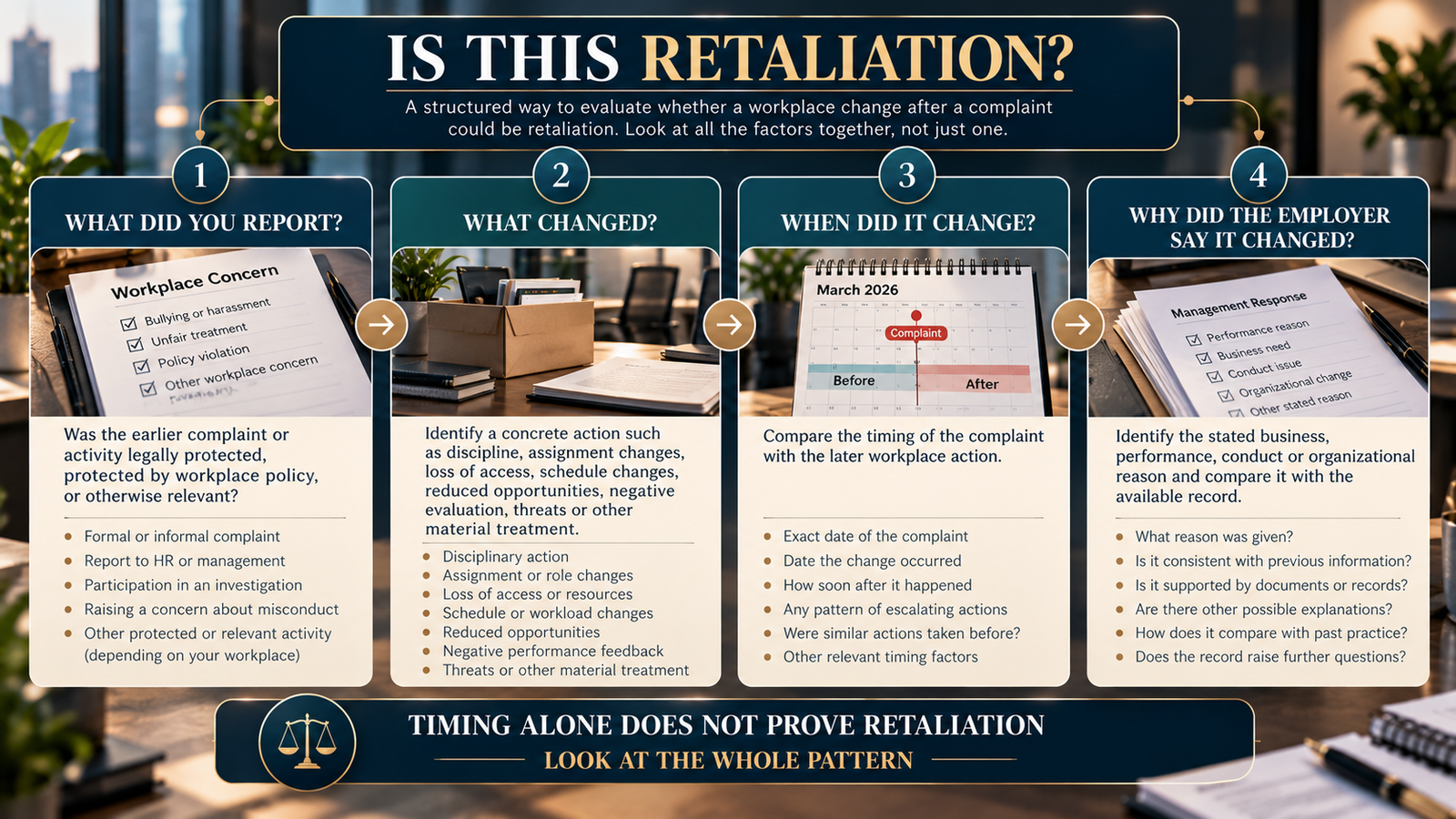
The goal is not to assume that the employer’s explanation is false.
The goal is to preserve enough information to evaluate it accurately.
Not Every Negative Event After an HR Complaint Is Retaliation
This distinction protects your credibility.
After a complaint, you may naturally become more alert to how your manager behaves.
You notice shorter emails.
You notice that a meeting felt colder.
You notice that your manager now documents more conversations.
Some changes may simply reflect the fact that the working relationship has become more formal.
Likewise, an employer can still:
- give legitimate performance feedback;
- investigate genuine misconduct;
- enforce attendance rules;
- restructure a team;
- change priorities;
- make business decisions unrelated to the complaint.
EEOC guidance specifically notes that engaging in protected EEO activity does not immunize an employee from discipline or discharge for legitimate, non-retaliatory reasons.
A useful question is:
“Would this action likely have occurred for the same documented reason if I had not made the complaint?”
You may not know the answer immediately.
That is why chronology, evidence and comparison matter.
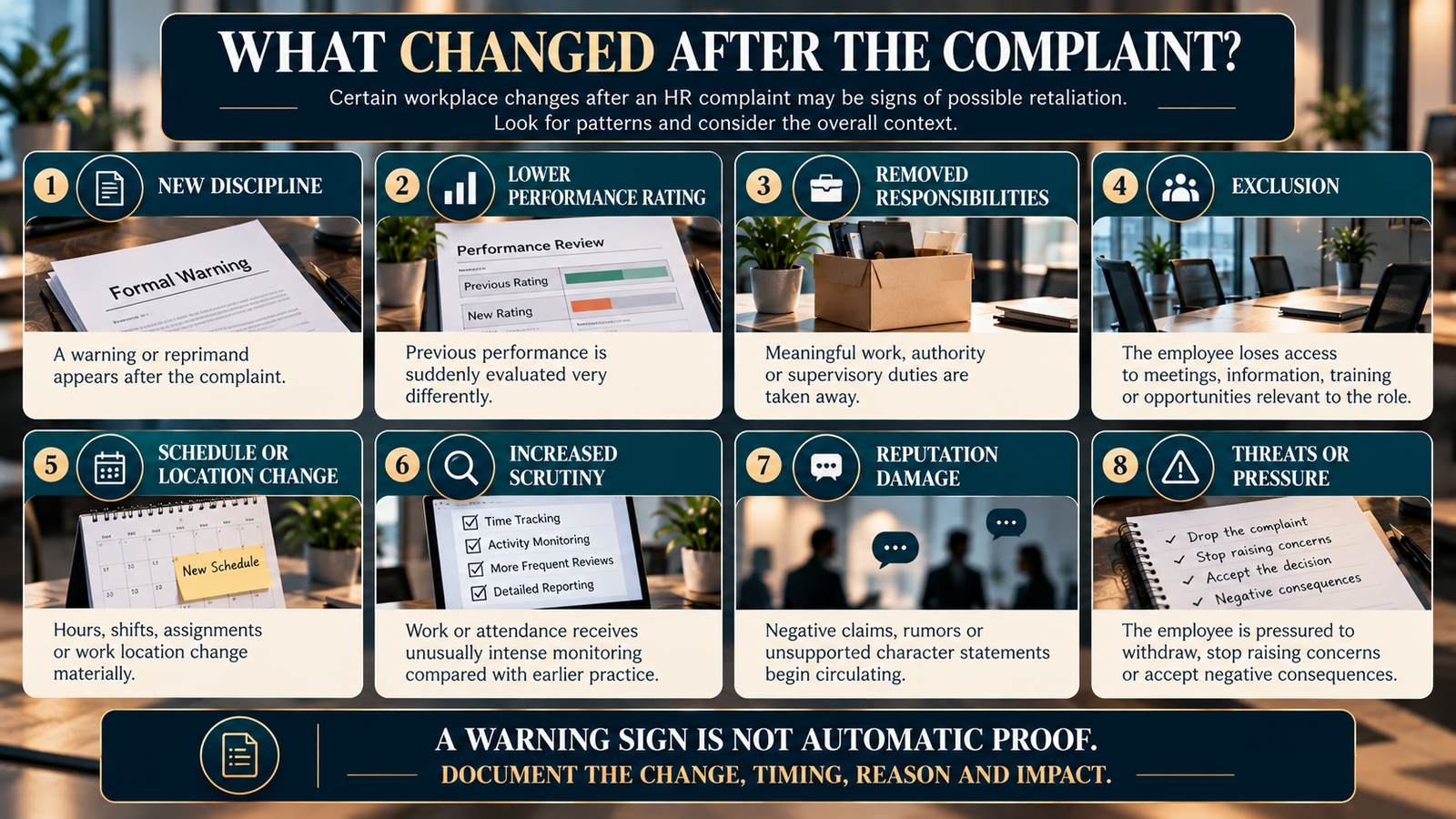
12 Warning Signs to Watch After an HR Complaint
No single item on this list automatically proves retaliation.
The point is to identify material changes worth documenting.
1. A Sudden Written Warning Appears
You receive discipline shortly after the complaint.
Do not assume the warning is retaliatory.
Ask:
- What conduct is being cited?
- When did it occur?
- What policy or standard applies?
- Was this issue raised before the complaint?
- What evidence supports the warning?
2. Your Performance Rating Changes Sharply
A previously stable or positive record suddenly becomes significantly worse.
Look at:
- previous evaluations;
- specific examples in the new review;
- whether expectations changed;
- whether the new criticism is documented;
- when the concerns supposedly began.
3. Important Responsibilities Are Removed
You lose:
- project ownership;
- supervisory responsibilities;
- client-facing work;
- decision-making authority;
- high-visibility assignments.
Ask why the change was made and whether it applies only to you or reflects a broader restructuring.
4. You Are Excluded From Meetings or Information
Exclusion can matter when it affects your ability to perform or advance.
Our guide to silent treatment and strategic exclusion at work explains why it is useful to distinguish social distance from exclusion that materially affects your job.
5. Your Schedule, Shift or Work Location Changes
A change may be ordinary business management.
But document:
- the previous arrangement;
- the new arrangement;
- the date of the complaint;
- the date of the change;
- the stated reason;
- the practical effect.
6. Scrutiny Suddenly Intensifies
Your work, attendance, break times, messages or minor mistakes receive unusual attention.
Again, compare.
Was this level of monitoring normal before the complaint?
Are similarly situated employees being monitored the same way?
The EEOC identifies unjustified increased scrutiny as one example that can be relevant to retaliation depending on context.
7. Training or Advancement Opportunities Disappear
You stop receiving:
- training;
- mentorship;
- high-visibility work;
- promotion consideration;
- professional development access.
Record the opportunity and why you reasonably expected to be considered.
8. Negative Stories About You Begin Circulating
You begin hearing that you are:
- difficult;
- untrustworthy;
- not a team player;
- disloyal;
- overly emotional;
- trying to get management in trouble.
If the narrative becomes repeated and materially affects your reputation, see our guide to workplace smear campaigns.
9. Your Complaint Becomes a Character Problem
You reported a specific workplace issue.
The conversation shifts to:
“Your attitude is the real problem.”
That does not automatically mean retaliation.
Your conduct may genuinely require discussion.
But keep the original complaint and the new criticism separate.
If the pattern becomes denial, attack and role reversal, compare it with DARVO at work.
10. You Are Pressured to Withdraw or Stop Raising the Concern
Examples may include:
- pressure to withdraw the complaint;
- statements that you are damaging your career by continuing;
- threats tied to participating in an investigation;
- pressure not to provide information as a witness.
Take explicit threats seriously and preserve the exact wording where possible.
11. Coworkers or Witnesses Are Treated Differently
In some legal frameworks, retaliation protection can extend to people who participate in protected complaint processes or support someone else’s protected complaint.
If a witness tells you their treatment changed, do not coach them or build a coordinated account.
They should maintain their own factual record.
12. An Opportunity Is Withdrawn Without the Previous Explanation Making Sense
You were previously:
- being considered for promotion;
- assigned an important project;
- scheduled for training;
- given leadership responsibility.
After the complaint, the opportunity disappears.
Ask what changed.
Document the answer.
What Matters More Than a “Warning Sign”?
The warning sign itself is only one part of the picture.
Look at four dimensions:
| Question | What to Examine |
|---|---|
| Timing | How close was the workplace action to the complaint or participation in the process? |
| Decision-maker knowledge | Did the person making or influencing the decision know about the complaint? |
| Consistency | Does the explanation fit previous practice, policies and treatment of comparable employees? |
| Evidence | What records support the employer’s explanation and what records support your concern? |
The EEOC notes that evidence relevant to retaliation can include suspicious timing, statements revealing retaliatory intent, comparative evidence and evidence suggesting that the employer’s stated reason is false.
But none of those points should be evaluated in isolation.
Timing Matters — But Timing Alone Is Not Enough
Suppose you complain to HR on September 1.
On September 3, your manager gives you a written warning.
The close timing may naturally raise a question.
But imagine the employer has emails from August showing that:
- the performance concern had already been documented;
- a meeting had already been scheduled;
- the warning process had begun before the complaint.
The chronology looks different.
Now imagine there was no previous performance concern, your reviews were positive and the manager wrote after the complaint:
“If they want to involve HR, we should start documenting everything we can use against them.”
That chronology looks different too.
The point is not that one example automatically proves a legal case.
It is that context changes the meaning of timing.
Build a Before-and-After Timeline
One of the strongest practical tools after an HR complaint is a simple chronology.
Divide it into two periods:
Before the Complaint
Record relevant baseline information such as:
- your responsibilities;
- normal meeting access;
- performance feedback;
- schedule;
- project ownership;
- training opportunities;
- reporting structure.
After the Complaint
Record material changes:
- date;
- decision;
- who made it;
- reason given;
- supporting record;
- professional impact.
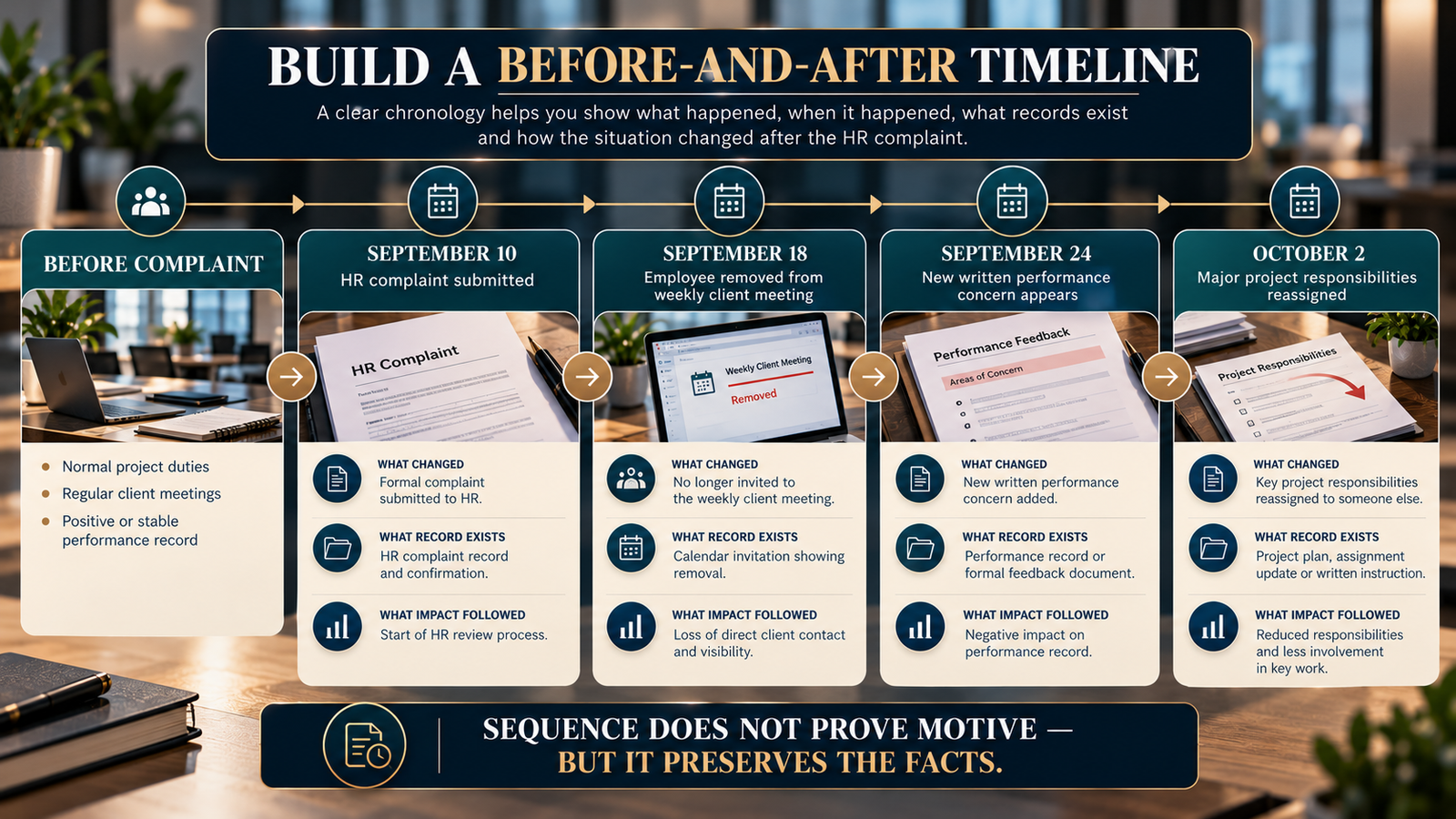
This does not mean building a case out of every small event.
It means preserving a baseline so you can explain what actually changed.
If you need a structured format, use the workplace incident log or our guide to documenting workplace abuse calmly and clearly.
Keep the Original Complaint and New Performance Issues Separate
This is one of the most important safeguards in a retaliation situation.
Suppose you originally reported:
“My manager repeatedly changes deadlines and later says I missed them.”
Two weeks later, you receive feedback that your client emails are too slow.
Do not immediately merge them into one story.
Track A: The Original Complaint
- What did you report?
- What evidence supported it?
- What did HR do?
- What outcome was reached?
Track B: The New Performance Concern
- What specific concern is being raised?
- When did it begin?
- What examples support it?
- What standard applies?
- What improvement is expected?
Two things can theoretically be true at the same time:
- you may have raised a legitimate workplace concern;
- your employer may also have a legitimate performance concern.
Separating the tracks makes both issues easier to evaluate.
Ask for the Reason Behind Material Changes
You do not need to begin with:
“This is retaliation.”
Start with clarification.
When a Responsibility Is Removed
“I noticed that the client account has been reassigned. Could you please clarify the reason for the change and whether this affects my role going forward?”
When a Performance Concern Appears
“I would like to address the concern accurately. Could you provide the specific examples, dates and performance standard being applied?”
When You Are Excluded From a Meeting
“I noticed I am no longer included in the weekly project meeting. Since the decisions affect my assigned work, could you clarify the new communication process?”
When Your Schedule Changes
“Could you confirm the reason for the schedule change and whether it is temporary or permanent?”
These questions preserve information without forcing an immediate conclusion about motive.
Use Follow-Up Emails for Important Verbal Explanations
If a material workplace change is explained verbally, a short confirmation may be useful.
“Thank you for discussing the role change today. My understanding is that the client account was reassigned because the team is being reorganized and that the change is not related to my performance. Please let me know if I have misunderstood.”
That email does two useful things:
- records the employer’s stated reason;
- gives the recipient a chance to correct a misunderstanding.
For more examples, use our guide to a follow-up email after a difficult verbal conversation.
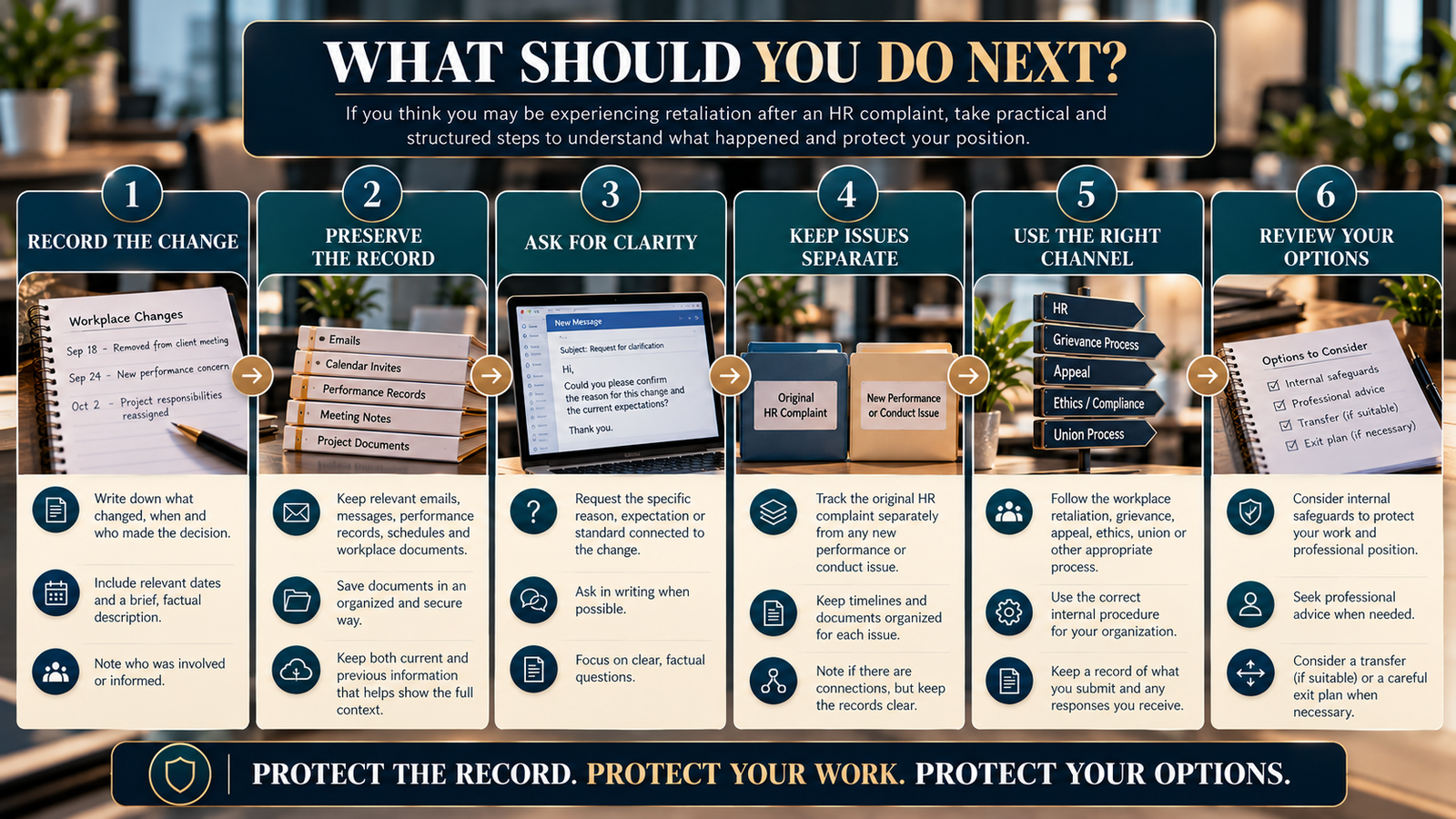
What to Do If You Suspect Retaliation After an HR Complaint
Step 1: Record the Material Change
Write down:
- what changed;
- when;
- who made the decision;
- what reason was given;
- what professional impact followed.
Step 2: Preserve Relevant Records
Relevant records may include:
- HR complaint correspondence;
- performance evaluations;
- meeting invitations;
- project assignments;
- schedules;
- disciplinary documents;
- emails or workplace messages explaining the change;
- records showing your previous duties or performance.
Preserve records appropriately. Our guide to collecting workplace evidence safely explains why you should not respond by forwarding or downloading every confidential record you can access.
Step 3: Ask for Clarification
Where appropriate, ask for the reason behind the action.
You are trying to understand the employer’s position, not trap someone into making a statement.
Step 4: Keep Doing Your Job Carefully
Continue legitimate responsibilities.
Follow reasonable policies.
Meet deadlines where possible.
Ask for clarity when instructions are unclear.
A complaint is not a shield from ordinary accountability.
Step 5: Report New Concerns Through the Appropriate Channel
If you believe post-complaint treatment needs review, use the employer’s designated process.
You might write:
“I would like to report several material workplace changes that occurred after the complaint I raised on September 10. I am not assuming the reason for the changes, but I would like them reviewed because of the timing and professional impact. I have listed the dates, decisions and available records below.”
Step 6: Protect Your Career Options
Continue protecting:
- your work record;
- achievements;
- professional relationships;
- references where appropriate;
- resume;
- financial options;
- future job-search readiness.
What If HR Says the Change Is Not Retaliation?
Ask what HR actually decided.
For example:
- Did HR conclude the action was unrelated to the complaint?
- Did HR find a legitimate business reason?
- Did HR say there was insufficient evidence of a connection?
- Did HR decide your original complaint was not legally protected?
- Did HR decide no policy violation occurred?
These are different conclusions.
If the outcome is unfavorable, do not immediately re-argue everything.
Review the finding, policy and evidence first.
Our dedicated article on what to do when HR sides with your manager explains how to separate findings from assumptions, review evidence and assess appeal options.
What If Your Boss Suddenly Becomes Extremely Formal?
Formality by itself is not retaliation.
Your boss may begin:
- documenting instructions;
- sending written summaries;
- using formal meeting agendas;
- copying HR on important communications;
- avoiding casual conversation.
That may feel uncomfortable.
It may also create clearer work records.
You can respond with the same professional discipline:
- be concise;
- answer legitimate questions;
- confirm important instructions;
- avoid emotional escalation;
- keep the work moving.
Our Gray Rock Method at Work guide explains why low-reactivity communication should still remain complete and professional rather than becoming stonewalling.
What If You Are Suddenly Being Watched More Closely?
Increased scrutiny is one area where context matters enormously.
Ask:
- Did a real performance issue trigger the monitoring?
- Was the monitoring planned before the complaint?
- Does the same standard apply to comparable employees?
- What exactly is being monitored?
- Is the scrutiny affecting your opportunities or formal record?
A useful note might say:
“Before September 10, weekly project updates were required. Beginning September 18, I was instructed to provide updates three times per day. I asked whether this applied to the team or only to my role. My manager confirmed that the requirement applied only to me because of concerns about responsiveness.”
That preserves the facts.
You can later evaluate whether the explanation is supported.
What If Coworkers Become Distant After the Complaint?
Social distance by itself may be difficult to interpret.
Coworkers may feel uncomfortable because an investigation is underway.
They may have been instructed not to discuss the complaint.
They may simply want to avoid involvement.
Focus on whether professional communication changes.
Ask:
- Am I still receiving information I need?
- Am I still included in relevant meetings?
- Are people refusing legitimate work communication?
- Has the exclusion affected my ability to do my job?
If the conduct becomes repeated information withholding or strategic isolation, compare it with silent treatment and strategic exclusion at work.
What If Negative Stories Start Spreading?
A complaint can sometimes be followed by a narrative such as:
“They cannot handle feedback.”
or:
“They are trying to get the manager fired.”
Do not respond by launching a counter-rumor campaign.
Identify material misinformation.
For example:
“I understand there is a concern that I refused the new project assignment. I would like to clarify that I accepted the assignment on October 3 and asked for confirmation of the revised deadline. The project message records that exchange.”
If the pattern becomes repeated reputation damage, see Workplace Smear Campaigns: Signs, Risks, and Calm Damage Control.
What If Your Manager Says You Are Retaliating Against Them?
This can happen when roles reverse after a complaint.
Your manager might say:
“You reported me because I gave you legitimate feedback.”
or:
“You are trying to damage my reputation.”
Do not get trapped in a debate about motives.
Return to the original facts:
“My complaint concerns the three incidents described in the chronology and the records attached. I am willing to discuss any legitimate performance concern separately.”
If the interaction becomes repeated denial, attack and reversal, our guide to DARVO at work provides a useful pattern-recognition framework.
Should You Use the Word “Retaliation” With HR?
You can.
But you do not need the label to come before the facts.
Compare:
Less Useful
“My manager is obviously retaliating against me.”
More Useful
“I am concerned about possible retaliation because three material changes occurred after my September 10 complaint: I was removed from the client account on September 18, received a new written warning on September 24 and lost access to the weekly project meeting on September 27. I would like the changes and the reasons for them reviewed.”
The second version tells HR what needs examination.
When Should You Consider External Employment Advice?
Qualified advice may be particularly important when:
- you are terminated or threatened with termination;
- you receive significant discipline;
- you believe discrimination or harassment law is involved;
- you participated in an EEO or other legally protected process;
- you made a protected whistleblowing or safety complaint;
- you face a substantial pay, schedule or role change;
- you are being pressured to withdraw a legally protected complaint;
- there are important filing deadlines;
- you are unsure how to preserve sensitive evidence lawfully.
Employment laws, deadlines and definitions vary significantly by country, state, province and type of claim.
Do not rely on a general workplace article to determine whether you have a legal case.
Do Not Quit Impulsively Because You Suspect Retaliation
There are situations where leaving quickly may be necessary.
But in many cases, a careful decision is safer than resigning during the most stressful week of the dispute.
Before making a major decision, consider:
- financial position;
- available internal options;
- transfer possibilities;
- employment contract;
- notice requirements;
- health and safety;
- reference strategy;
- job market;
- documentation;
- professional advice where appropriate.
Chapter 5 of Reclaim Your Power focuses on the difference between an impulsive exit and a strategic one.
A Simple Post-Complaint Retaliation Log
| Field | What to Record |
|---|---|
| Original complaint date | When the concern was raised and through which channel. |
| Who knew | People known to have received or participated in the complaint process. |
| Later workplace action | The specific change, discipline, reassignment, exclusion or other event. |
| Action date | When the later event occurred. |
| Decision-maker | Who made or communicated the decision. |
| Reason given | The stated business, performance, conduct or other reason. |
| Evidence | Emails, schedules, reviews, meeting records or other relevant records. |
| Professional impact | Effect on duties, pay, reputation, access, opportunities or employment status. |
| Your response | Clarification requested, HR report, appeal or other professional step. |
Keep this factual.
Do not write:
“They are finally showing their true colors.”
Write:
“October 2: removed from the client account. Manager stated the change was due to restructuring. I had managed the account since February. Two other account owners remained in place.”
Chapter 4: Protect Yourself While You Assess What Changed
Chapter 4 of Reclaim Your Power focuses on immediate professional protection.
After an HR complaint, that can mean:
- maintaining a factual chronology;
- preserving relevant evidence;
- confirming important decisions;
- keeping legitimate work visible;
- maintaining professional communication;
- protecting your reputation;
- separating assumptions from reviewable facts.
The point is not to treat every manager interaction as evidence.
The point is to make material events easier to understand if you later need to explain them.
Chapter 5: Know When the Question Changes From “Is This Retaliation?” to “Is This Workplace Still Workable?”
You may eventually reach a point where the central question is no longer:
“How do I make HR agree with me?”
It becomes:
“Can I continue working here effectively, safely and professionally under the conditions that now exist?”
Your options may include:
- continuing with stronger safeguards;
- using a grievance or appeal process;
- requesting transfer where appropriate;
- seeking union or representative support;
- obtaining independent employment advice;
- beginning a careful job search;
- preparing a strategic exit.
An exit strategy does not have to begin with resignation.
It can begin with protecting your options.
Frequently Asked Questions
What is retaliation after an HR complaint?
In everyday workplace language, retaliation usually means negative treatment that occurs because someone raised a complaint or participated in a workplace process. The legal definition depends on the law involved. Under U.S. federal EEO law, for example, legal retaliation generally requires protected activity, a materially adverse action and the required causal connection between them.
Is every negative action after an HR complaint retaliation?
No. Employers may continue legitimate performance management, discipline, restructuring and other business decisions after an employee complains. The issue is whether a materially adverse action occurred because of legally protected activity or whether another policy or law prohibits the response.
How soon after a complaint can retaliation happen?
There is no universal time period. Close timing may be relevant evidence, but timing alone does not prove retaliation. Other evidence, including decision-maker knowledge, stated reasons, comparative treatment and records, can matter.
Can a bad performance review after an HR complaint be retaliation?
It can be relevant depending on the facts, but a negative evaluation is not automatically retaliatory. Review when the performance concern began, what examples support it, what standards apply and whether the employer can identify a legitimate reason for the evaluation.
Can exclusion from meetings be retaliation?
Potentially, depending on the circumstances and applicable law. Exclusion becomes particularly important when the meeting contributes to professional development, is necessary for job performance or materially affects the employee’s opportunities.
Is increased scrutiny after a complaint retaliation?
It can be relevant depending on the context. Compare the level of scrutiny before and after the complaint, whether comparable employees are treated similarly and whether there is a legitimate reason for the monitoring.
Can my employer discipline me after I make an HR complaint?
Yes, employers can generally continue legitimate discipline for genuine non-retaliatory reasons. Making a complaint does not protect an employee from normal accountability. Whether a particular disciplinary action is retaliatory depends on the facts and applicable law.
What should I document after an HR complaint?
Record material changes such as responsibilities, performance ratings, discipline, meeting access, schedules, promotion opportunities, threats or reputation-related events. Include dates, decision-makers, reasons given, supporting records and professional impact.
Should I tell HR I think I am being retaliated against?
You can raise the concern, but it is usually stronger to explain the specific post-complaint changes first. Identify the dates, workplace decisions, stated reasons and professional impact, then ask for the pattern to be reviewed.
What if HR says my boss has a legitimate performance concern?
Keep the issues separate. Ask for specific examples and standards regarding performance while continuing to preserve the original complaint and any post-complaint chronology.
What if HR sides with my manager?
Understand exactly what HR decided before responding. Ask for the outcome in writing where possible, compare the decision with your evidence and workplace policy, and review any appeal or further reporting process. See What to Do When HR Sides With Your Manager.
Can retaliation include rumors or reputation damage?
Depending on the facts and law involved, reputation-related actions may be relevant. If negative stories or false claims become repeated and materially affect your work, document specific examples rather than trying to confront every rumor.
Should I resign if I believe I am being retaliated against?
There is no universal answer. Consider the severity of the situation, available internal processes, financial position, safety, contract terms, job alternatives and professional advice where appropriate. An immediate resignation can have consequences, so make the decision carefully unless urgent circumstances require otherwise.
When should I talk to an employment lawyer or adviser?
Consider qualified advice when there is termination, significant discipline, discrimination, harassment, whistleblowing, protected activity, substantial changes to pay or duties, important filing deadlines, or uncertainty about your legal rights or evidence obligations.
Final Thoughts: Document the Change Before You Decide What It Means
Retaliation after an HR complaint can be difficult to evaluate because timing naturally affects how you interpret everything that follows.
Your manager becomes colder.
You receive criticism.
Your responsibilities change.
You lose an opportunity.
You begin wondering whether the complaint made everything worse.
Sometimes the concern is justified.
Sometimes the workplace change has a legitimate explanation.
Sometimes the answer cannot be known immediately.
The strongest first step is the same in each situation:
Preserve the facts before deciding the motive.
Record what you complained about.
Record who knew.
Record what changed.
Record when it changed.
Record the reason given.
Record the professional impact.
Keep legitimate performance issues separate.
Continue doing your work carefully.
Use appropriate internal processes.
And protect your future options while the situation becomes clearer.
If you need to rebuild the chronology, start with How to Document Workplace Abuse, the Workplace Incident Log and How to Collect Evidence of Workplace Bullying Safely.
If HR has already reached an unfavorable decision, continue with What to Do When HR Sides With Your Manager.
Protect the Complaint — and Protect the Career Around It
Chapter 4 of Reclaim Your Power focuses on protecting yourself while a difficult workplace situation is still happening.
Chapter 5 focuses on what comes next when staying, transferring, escalating or leaving becomes a real decision.
The broader goal is not to spend your entire career proving what one manager intended.
It is to protect your work, reputation, evidence, options and confidence while you decide what the next professional step should be.
If retaliation concerns are part of a wider pattern of workplace manipulation, bullying or toxic leadership, explore Reclaim Your Power and the complete seven-chapter workplace recovery system.
Employment-law disclaimer: This article provides general educational information and is not legal advice. The legal meaning of retaliation, reprisal, victimisation, protected activity, adverse action, whistleblowing and other employment protections varies by jurisdiction, statute, employer type and facts. An internal HR complaint does not automatically create every form of legal anti-retaliation protection. Filing deadlines can also apply. Seek appropriately qualified employment or legal advice for your location when your situation involves dismissal, discrimination, harassment, protected whistleblowing, significant discipline, pay or role changes, or other serious employment consequences.
Ready to Reclaim Your Power?
Get the 376-page digital edition with 7 chapters, 22 practical tools, reusable forms, an optional 30-entry journal, and references.
Buy Now — $4.99
Leave a Reply