
You want to report workplace bullying, harassment, or another serious concern to HR. But before you describe what happened, one question stops you:
“Will my manager find out I was the person who complained?”
It is a reasonable question. You may still have to work with the person involved. You may be worried about coworkers learning details, witnesses being approached, or a private conversation turning into a formal investigation before you feel ready.
HR can often limit who sees a workplace complaint, but it usually cannot promise absolute secrecy. Some information may have to be shared to understand what happened, give the person accused a fair opportunity to respond, interview witnesses, or meet legal obligations. That does not give everyone in the organization a right to know.
The useful question is not only, “Is this confidential?” It is: “Who will be told what, at which stage, for what reason, and what choices do I have before I share sensitive details?”
This guide explains what HR complaint confidentiality means, how it differs from anonymity, why the accused person may learn about allegations, what might happen to witness statements, and the questions worth asking before you report.
Can HR Keep a Workplace Complaint Confidential?
Usually, HR can take steps to keep a complaint confidential to the extent reasonably possible. But HR generally cannot guarantee that no one else will learn about the complaint.
Consider an employee reporting that a manager repeatedly humiliated them during team meetings. HR may need to:
- review the complaint with the person assigned to investigate;
- tell the manager enough about the alleged incidents to obtain a response;
- interview people who attended the meetings;
- review relevant emails, calendars, and meeting records;
- share necessary findings with someone authorized to decide what happens next.
Those steps are different from forwarding the employee’s entire complaint to the whole department or discussing it casually with colleagues.
The U.S. Equal Employment Opportunity Commission (EEOC) has long explained that an employer should protect harassment-complaint information to the extent possible, while recognizing that effective investigations can require limited disclosure. Read EEOC guidance on harassment complaint procedures and confidentiality.
Similarly, UK ACAS guidance says workplace investigations should usually be treated confidentially, both to protect the people involved and to support a fair process. See ACAS guidance on preparing an investigation.
The principle is controlled, necessary disclosure rather than unrestricted secrecy.
Confidential, Anonymous, Private, and Off the Record: What Is the Difference?
These words sound interchangeable when you are worried about being identified. They are not.
| Term | What It Means in Practice |
|---|---|
| Confidential complaint | The employer limits access and disclosure according to its process, but some people may still need information. |
| Anonymous report | The reporting channel may allow information without identifying the reporter to the recipient. The circumstances may still make identity guessable. |
| Private conversation | A conversation is held discreetly; that alone does not mean HR can promise no further action. |
| “Off the record” | An informal phrase, not a universal legal shield. Do not assume it prevents documentation, escalation, or lawful disclosure. |
| Need-to-know access | Information is shared with people whose role in handling the issue makes access necessary. |
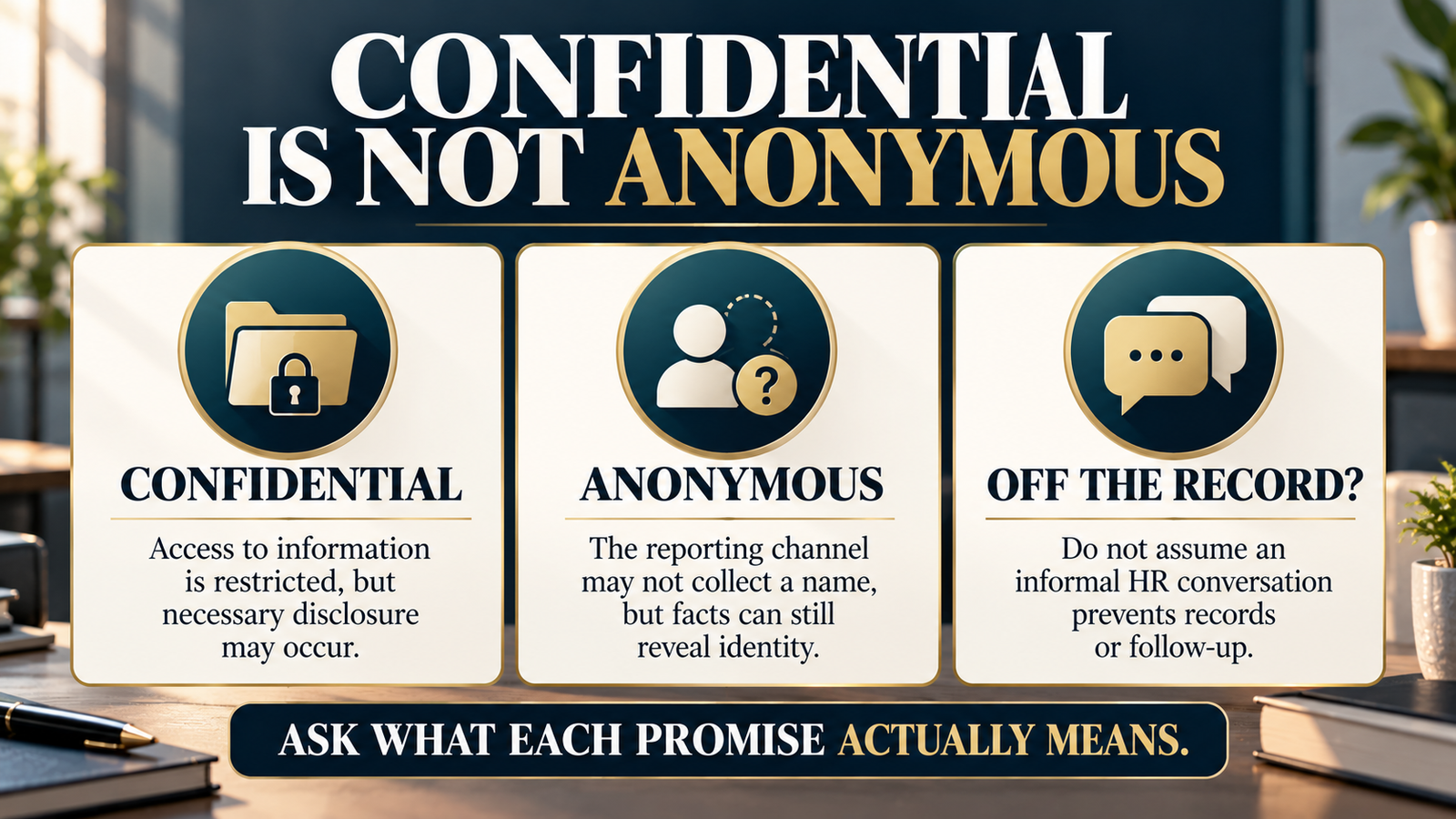
Suppose you tell HR, “I want this kept confidential.” HR might agree to restrict circulation while still explaining that the manager may need to hear the substance of the allegations.
Suppose you instead ask, “Can I submit this anonymously?” HR may explain whether an ethics line or another channel accepts anonymous reports, whether you can receive updates, and what information an investigation would still require.
Before relying on any label, ask the person receiving the report what it actually commits them to do.
Who Might Learn About Your HR Complaint?
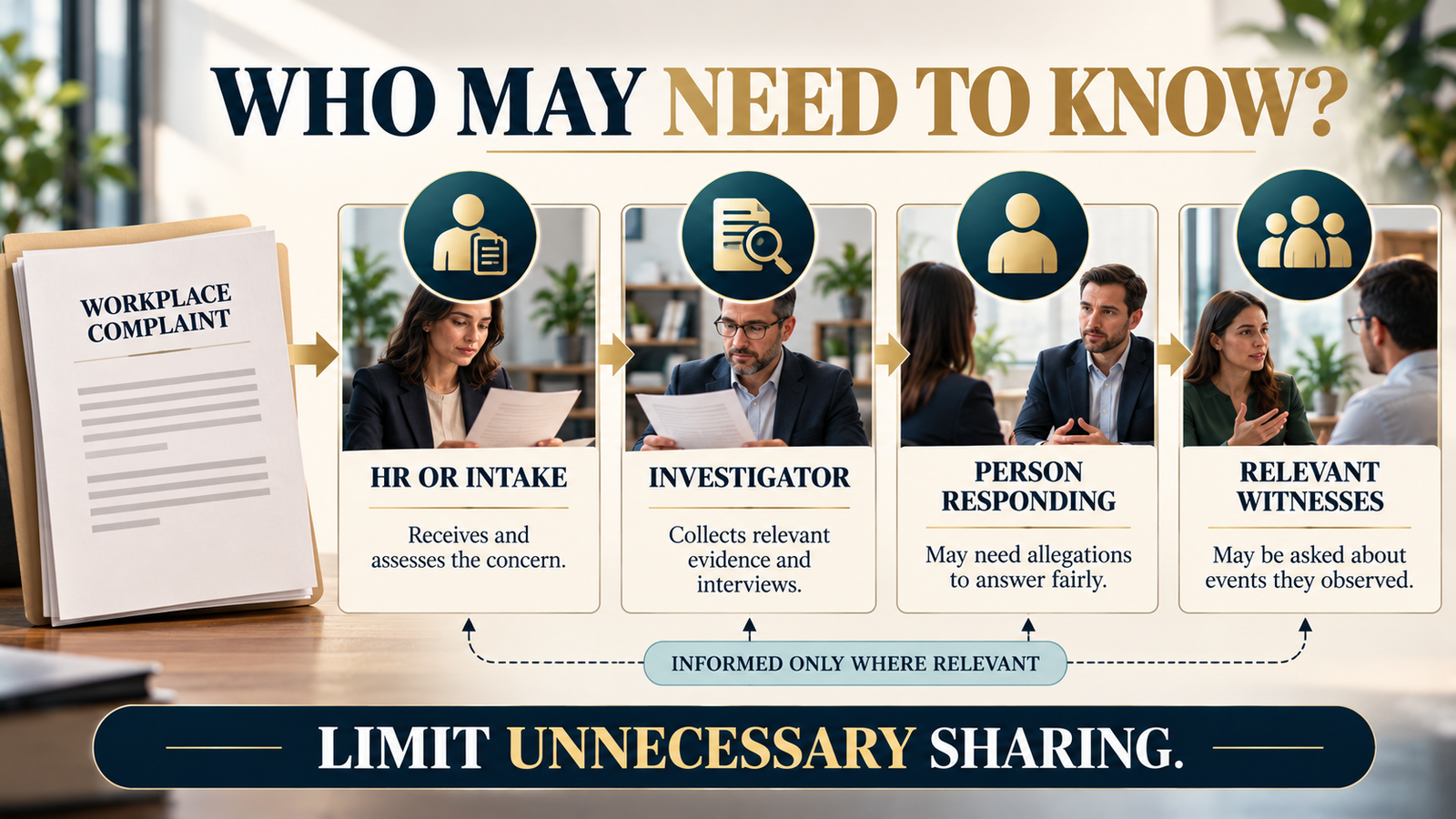
The answer depends on what you report and which process the employer follows. Common possibilities include:
- HR or employee relations: receiving, assessing, or coordinating the complaint;
- an investigator: collecting relevant facts and interviewing people;
- a designated manager or decision-maker: deciding what action, if any, should follow;
- the person accused: receiving sufficient information to respond fairly to relevant allegations;
- witnesses: being asked about events they may have seen, without necessarily receiving your whole complaint;
- legal, compliance, safety, or another specialist function: where the subject or applicable obligations require it.
That is not a list of people who must always be told. It is a reason to ask the employer to explain its actual process.
For example, if the alleged incident occurred in a small meeting with only two employees present, the accused person may infer who raised the concern even if HR does not directly announce the name.
One of the most practical questions is:
“Who will have access to my written complaint and supporting documents, and what information might be shared with the person I am reporting?”
Ask separately whether your direct manager will be informed if the complaint concerns somebody else.
Will HR Tell Your Boss You Reported Them?
It is possible, and in some investigations it may be necessary for your boss to learn about the allegations. You should not plan around a promise that the person accused will never discover a complaint exists.
A fair fact-finding process may require a specific response to the conduct alleged. If the manager is accused of changing a deadline on a particular project, HR may need to identify the project, meeting, and relevant records. Those facts may point toward the employee who experienced the incident.
But there is a difference between sharing enough to investigate and circulating unnecessary personal information.
Before making the report, ask:
“At what stage would my manager be contacted? Would they receive my full complaint, a summary of allegations, or specific questions? How will you decide what details are necessary?”
If your concern involves someone with influence over your assignments or performance record, also ask what process exists for raising concerns about subsequent changes to your work.
For more on the wider sequence once you report, read what happens after you report a toxic boss to HR.
Can You Speak to HR Without Making a Formal Complaint?
You may be able to ask general questions or discuss options before submitting a formal grievance. But an informal conversation does not automatically prevent HR from acting.
An employee might say:
“I want to understand the complaint process, but I am not ready to submit names and incidents today.”
That is a clearer starting point than:
“Promise me this conversation stays between us no matter what.”
In some situations, HR may identify an issue serious enough to assess or escalate under law, policy, or an employer’s duties even when the employee asks for no action. The U.S. EEOC’s employer guidance specifically acknowledges conflicts between a request for secrecy and the employer’s duty to prevent or correct harassment.
Before describing identifiable allegations, consider asking:
- “Can you explain the process without opening a formal case yet?”
- “What kinds of information would trigger a duty to escalate or investigate?”
- “Will this preliminary conversation be recorded, and who can access those notes?”
- “What are my options if I am not ready to provide identifying details?”
Do not assume the answers will be the same for bullying, discrimination, harassment, safety, or other concerns.
Can You Make an Anonymous Workplace Complaint?
Some employers offer anonymous hotlines or reporting portals; others require an identified complainant for particular grievance processes.
Anonymous reporting can have practical limitations:
- the investigator may not be able to ask follow-up questions;
- the report may lack enough detail to establish what happened;
- the employee may have difficulty receiving updates;
- the nature of the incident may make identity apparent even without a name;
- other witnesses or records may still need to be examined.
Neither anonymity nor identification automatically determines whether a concern will be taken seriously. That depends on evidence, policy, legal requirements, and what the organization can investigate.
Be especially careful not to confuse an employer’s anonymous ethics line with a government reporting process. Different bodies have different requirements, and protections attached to specialized whistleblowing channels should not be generalized to every HR complaint.
Ask: “Does this channel permit anonymous reporting? Can investigators ask me questions afterward? What happens if the facts identify me anyway?”
What About Witnesses and Their Statements?
Witnesses may be contacted because they saw or heard relevant events. Their names and statements may sometimes form part of the evidence used to reach a fair decision.
ACAS guidance explains that investigators should consider confidentiality when gathering witness information, but statements may need to be provided to the employee under investigation if further action is taken. It also describes circumstances where identifying information may be removed or where access to third-party information may be restricted. Read ACAS guidance about witnesses and sharing statements.
If a coworker is concerned about being identified, they can ask the investigator what protection may be available. They should not be promised complete anonymity without checking the applicable process.
Do not coordinate accounts, suggest wording for other witnesses, or pressure coworkers to support a conclusion. A factual statement from someone with firsthand knowledge is more useful than a rehearsed statement.
Questions to Ask About Witnesses
- “Will witnesses be told who made the report?”
- “What is said to a witness before their interview?”
- “Who will receive their statement?”
- “Could the statement be shared with the person accused?”
- “Can identifying details be limited when appropriate?”
What Happens to Your Complaint, Notes, and Evidence?
Confidentiality is not only about conversations. A workplace complaint may create records including emails, investigation notes, evidence indexes, witness statements, meeting summaries, findings, and decisions.
Ask how those records will be handled.
| Question | Why It Matters |
|---|---|
| Who has access to the case file? | Clarifies which functions or decision-makers can see the material. |
| Where are records stored? | Helps you understand whether access and retention are controlled. |
| What will be shared with witnesses or the respondent? | Clarifies the likely extent of disclosure during fact-finding. |
| Will unrelated personal details be limited? | Helps reduce unnecessary exposure of private information. |
| How long are records kept? | Connects the process with workplace policy and data-protection obligations. |
| What information about the outcome can I receive? | Sets realistic expectations about privacy for other employees. |
In the UK, data-protection rules may apply to employment records, but rights of access and disclosure are not simply a universal right to see every unredacted document about another person. ACAS describes redaction and third-party privacy considerations in investigation records. See the discussion of information-sharing limits.
If evidence contains client data, medical details, private messages, or confidential business information, ask how relevant material should be submitted. Having workplace access to a document does not always mean you can transfer it into personal storage.
Our guide to preserving workplace bullying evidence without violating policy or privacy covers that distinction in greater detail.
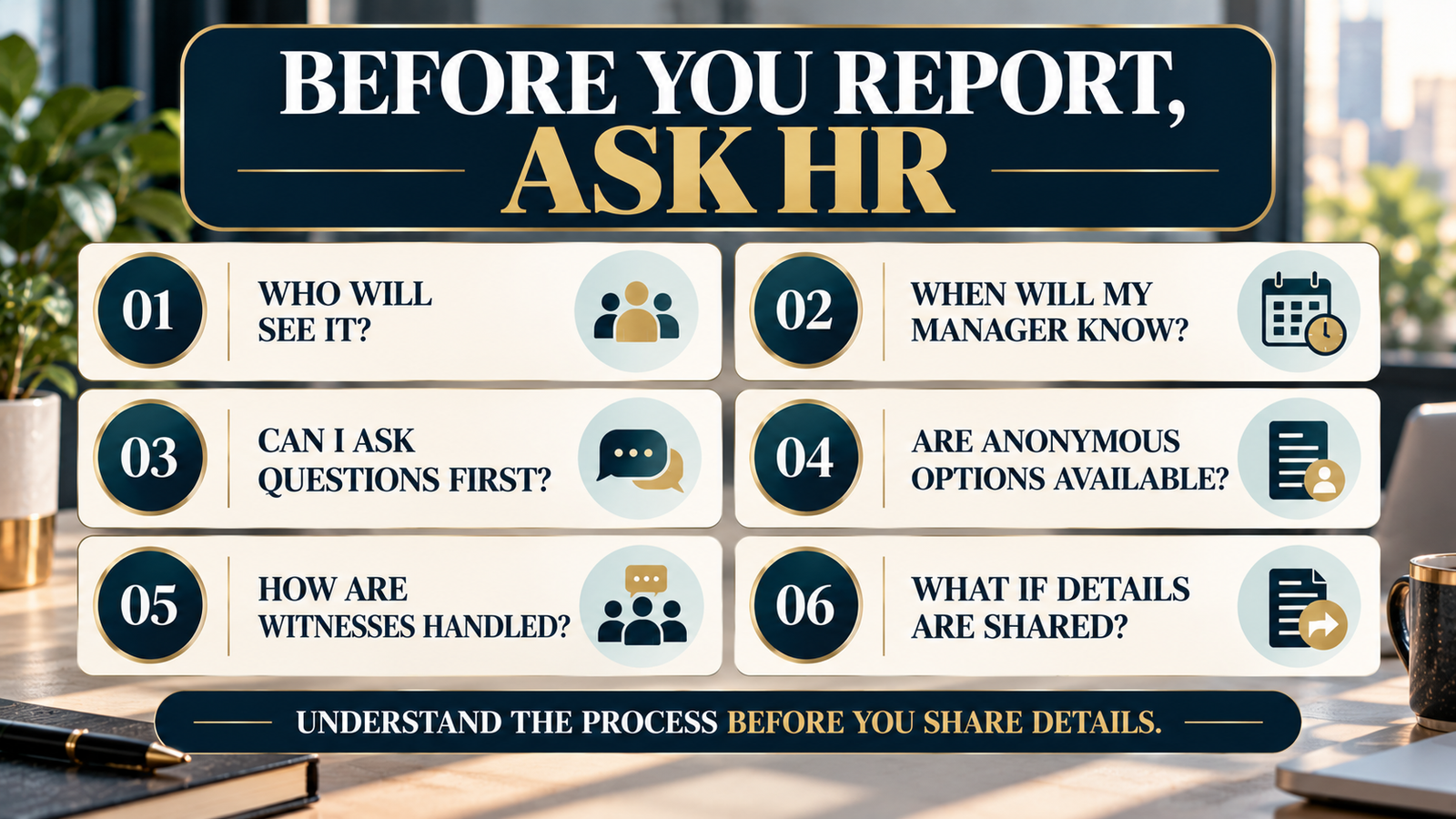
12 Questions to Ask HR Before Reporting
You do not need to ask all twelve in one long email. Choose the questions most relevant to your situation and the employer’s policy.
- What process will apply? “Is this treated as an informal concern, formal grievance, harassment complaint, or another procedure?”
- Can I ask preliminary questions first? “Can I understand my options without submitting identifiable allegations today?”
- What confidentiality can you offer? “What exactly does confidential mean under this procedure?”
- Who may learn that I reported? “Which people or departments could be told, and why?”
- When will the person involved be contacted? “Will they see my full report or only the allegations they need to answer?”
- Can an anonymous report be made? “If so, what are the limits on investigating it or keeping me unidentifiable?”
- How are witnesses handled? “Who can see their statements, and what privacy limits apply?”
- How will my records be stored? “Who can access complaint notes, emails, and attachments?”
- What happens if you believe action is required? “Could the employer proceed even if I later ask not to continue?”
- How are workplace changes reviewed? “Where should I report significant changes in my assignments, evaluations, or treatment?”
- What will I be told afterward? “Which findings or next steps can be shared with me, and what may remain private?”
- What if confidentiality is breached? “Who should I contact if complaint information is circulated beyond the people handling it?”
If you are already scheduled for an HR meeting, our article on preparing for an HR meeting about workplace bullying focuses on organizing incidents, questions, evidence, and the outcome you are requesting.
A Simple Email Asking About Confidentiality Before You Report
Use a neutral process question rather than asking HR for an impossible promise.
Subject: Question About Workplace Complaint Process and Confidentiality
Hello [HR Contact],
Before I decide how to raise a workplace concern, I would like to understand the reporting process and how information is handled.
Could you please clarify who may have access to a complaint, when information may be shared with the people involved, and whether a preliminary conversation can take place before a formal complaint is submitted?
I would also appreciate guidance on whether the organization accepts anonymous reports, how witnesses are handled, and where I should direct any concerns about inappropriate disclosure or changes in workplace treatment.
Thank you for explaining the process.
[Name]
This email asks about policy; it does not assume that HR has agreed to keep a later report secret.
Remember that sending questions to HR may itself create an ordinary workplace record. If the issue is especially serious or legal deadlines may apply, seek qualified advice for your location rather than delaying action indefinitely to obtain a confidentiality assurance.
What If You Need to Report Something Serious but Fear Exposure?
Some concerns should be evaluated promptly, even when you are worried about being identified. Examples may involve significant harassment, discrimination, threats, safety, or serious workplace consequences.
The goal is to balance your need for discretion with the reality that an employer may need to take action.
You can ask:
“I am concerned that the person involved may influence my work if they learn about this report. What safeguards can you consider during the process, and who should I contact if my working conditions materially change?”
Possible arrangements depend on policy and circumstances. They might involve an alternative reporting contact, an impartial investigator, temporary changes to communication arrangements, or review of employment decisions affecting the people involved. No specific measure is automatic or guaranteed.
If you are deciding whether to raise concerns internally or obtain outside advice first, see our guide to choosing between HR, a union representative, an employment lawyer, or a therapist.
What If HR Says, “Don’t Tell Anyone About This Investigation”?
Organizations may reasonably ask participants not to discuss sensitive investigation details broadly. The purpose may be to protect privacy, avoid rumor, and prevent witness accounts from being influenced.
But a request for confidentiality should not automatically be interpreted as a ban on all appropriate support or advice.
For example, ACAS explains that someone involved in an investigation should be able to discuss it with their trade-union or workplace representative where applicable. Rights and permissible restrictions vary by location and process.
If you are uncertain, ask:
“I understand the need for discretion. Could you clarify what information I should not share, and whether I may discuss the matter with my union representative or a qualified adviser?”
Do not assume every employment-related conversation is legally privileged. HR confidentiality, professional ethical confidentiality, and legal professional privilege are different concepts and depend on the circumstances.
What If Your Coworkers Find Out?
Sometimes information spreads because people make assumptions. Sometimes the facts of the case make the reporting employee obvious. In other cases, information may actually have been disclosed unnecessarily.
Do not treat every rumor as proof that HR leaked your report.
Start with what you can establish:
- What was said or shared?
- Who told you about it?
- Was the information accurate or speculative?
- Did it include private details that should not have been circulated?
- Has there been a material effect on your work?
If sensitive details appear to have been shared inappropriately, ask HR or the appropriate privacy contact to review the disclosure under policy and applicable law.
A calm message might be:
“I have been informed that details of my workplace concern were discussed outside the people handling the case. Could you clarify who was authorized to receive the information and review whether any disclosure occurred outside the relevant process?”
Keep the focus on the facts rather than countering the rumor with more rumor.
Can HR Keep the Outcome Confidential From You?
You may receive an explanation of the outcome or what happens next without being told every detail of a coworker’s disciplinary or personnel record.
For example, HR might explain that the investigation has concluded and that relevant action or workplace arrangements will follow, while limiting specific personnel information about the person accused.
This can feel unsatisfying, especially when you made the complaint. But one person’s need to understand an outcome does not necessarily create unrestricted access to someone else’s employment records.
Ask what information you will receive under the applicable policy:
“Will I receive the findings that relate to my concern, an explanation of any workplace arrangements affecting me, and information about the review or appeal process?”
If the process concludes against you or you believe important evidence was missed, see what to do when HR sides with your manager.
Confidentiality Is Not the Same as Protection From Retaliation
Even carefully restricted disclosure cannot guarantee that the working relationship will feel unchanged afterward.
Your manager might become more formal. Coworkers might be interviewed. A schedule or reporting arrangement might change for legitimate operational reasons. These changes are not automatically unlawful retaliation.
Nevertheless, document significant events that affect your role or professional position, such as new discipline, materially changed responsibilities, reduced meeting access, threats, or lost opportunities.
In the United States, federal EEO retaliation protections apply to qualifying protected activity and must not be generalized to every complaint about a rude or difficult manager. Other employment laws may protect other types of reports. The EEOC also explains that protected activity does not exempt an employee from legitimate performance rules. See EEOC retaliation guidance.
For a detailed way to evaluate post-complaint events, read retaliation after an HR complaint: warning signs and practical next steps.
UK and US Confidentiality Rules: Important Differences
There is no single worldwide HR confidentiality rule. Even within a country, the answer depends on whether the concern involves a general grievance, alleged discrimination, an external agency, whistleblowing, public employment, or another specialized process.
United Kingdom: ACAS, Grievances, and Data Protection
ACAS recommends confidential handling of bullying and discrimination complaints and investigations. It also recognizes fair-process disclosure, relevant witness statements, third-party privacy, and the possibility of removing identifying details from documents where appropriate.
UK GDPR and related data-protection rules can affect the handling and access to employee information, but they do not mean every complaint can be kept wholly secret or that every party automatically receives an unredacted case file. Employment-specific advice may be necessary.
United States: Internal Complaints and EEOC Charges
EEOC guidance recommends limiting harassment-complaint information to what is necessary for an effective response, while recognizing that the accused and witnesses may need relevant information.
A separate process applies to contacting the EEOC itself. According to the EEOC, information from an initial contact is handled confidentially before a charge is filed, while filing a charge generally involves notification to the employer. See the EEOC’s explanation of confidentiality during its charge process.
That EEOC process should not be confused with an internal conversation with your employer’s HR department.
Elsewhere
Other countries have different privacy, employee-relations, whistleblower, harassment, and reporting rules. Do not copy a UK or US confidentiality promise into another jurisdiction without checking local law and the actual workplace policy.
Before You Share the Complaint: A Practical Privacy Checklist
- Read the relevant grievance, harassment, whistleblowing, or ethics policy.
- Identify the reporting contact and whether anyone involved has a conflict of interest.
- Ask who can access your report and how the accused person may be informed.
- Ask what happens if you want advice before submitting a formal complaint.
- Check whether an anonymous reporting channel exists and its limits.
- Identify the strongest incidents rather than sharing unrelated private information.
- Ask how witnesses and their statements will be handled.
- Submit evidence only through appropriate channels and in a manner consistent with law and policy.
- Ask what happens if inappropriate disclosure or material workplace changes occur.
- Consider union, employment-law, or other qualified advice when legal rights, serious risk, or deadlines may matter.
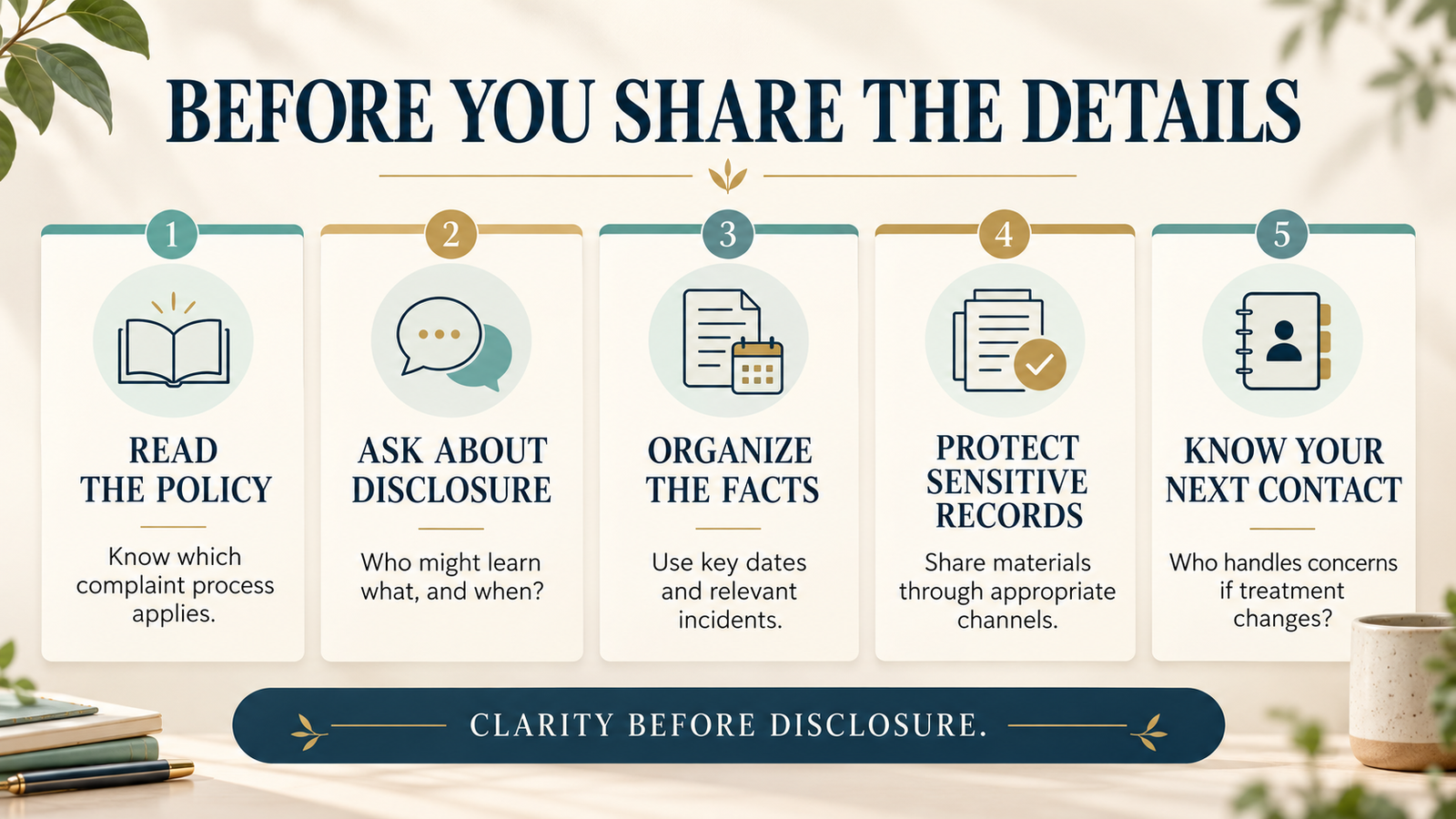
Our workplace incident log can help organize the chronology. The objective is not to prepare the biggest possible dossier; it is to give the person handling the concern relevant, accurate facts.
Frequently Asked Questions
Can HR promise to keep my complaint confidential?
HR may promise to limit access and share information only as needed, but complete secrecy is usually not a realistic guarantee when allegations must be investigated or answered. Ask what the organization’s promise means in practice.
Will my boss know I complained to HR?
Possibly. The manager may need to know the relevant allegations in order to respond, and the facts may identify the complainant even when their name is withheld. Ask when and how the manager will be informed.
Can I ask HR a question without opening an investigation?
You can ask whether a preliminary process conversation is available. But a serious concern disclosed informally may still require action. Ask what HR must record or escalate before revealing sensitive details.
Can I report workplace bullying anonymously?
Some employers offer anonymous reporting channels. They may limit follow-up or investigation, and the details of an incident can still make someone identifiable. Check the specific channel’s rules.
Does HR have to tell the person accused who complained?
There is no universal rule. The person accused may need enough information to respond fairly, but what must be shared depends on policy, the type of case, and applicable law. Identity may also be inferred from the facts.
Can HR share my written statement?
A written statement may be reviewed by authorized investigators and decision-makers, and relevant parts or related evidence may need to be shared with someone responding to allegations. Ask whether the full statement or a summary may be disclosed.
Are witness statements confidential?
They should be handled carefully, but confidentiality is not always absolute. Fair procedure or applicable law may require relevant evidence to be disclosed, with privacy safeguards or redactions where appropriate.
Can HR tell other managers about my complaint?
Potentially, if a manager has a legitimate role in investigating, deciding, or implementing workplace measures. That does not justify unnecessary general circulation. Ask which roles will have access.
Can I tell my union representative or a lawyer about the complaint?
Appropriate advice or representation may be available, and applicable laws and policies affect how confidentiality instructions operate. Ask for clarification rather than assuming a blanket discussion ban. Privilege and professional confidentiality differ from HR confidentiality.
Can HR tell me what happened to the person I reported?
HR may explain findings and workplace steps relevant to you while restricting another employee’s private disciplinary information. Ask what outcome details and appeal information the policy permits.
What if HR reveals my complaint without a good reason?
Establish what was shared, who received it, and the apparent effect. Raise the concern with the appropriate HR, privacy, or independent reporting contact, and seek professional advice if significant rights or consequences may be involved.
Is my complaint legally protected against retaliation?
It depends on what was reported and the law that applies. A complaint about unlawful discrimination may have particular protections, while a general complaint about unfair management does not automatically trigger the same legal framework. Other laws may apply to other kinds of reports.
Can confidentiality stop rumors at work?
Careful handling can reduce unnecessary disclosure, but cannot guarantee that coworkers will not speculate or infer who reported. Document confirmed disclosures rather than treating every rumor as proof of an HR leak.
What if I do not want HR to take action yet?
Explain your concern and ask what options are available, but understand that an employer may have responsibilities to assess or address certain reported issues even when you prefer no formal action.
Does the EEOC keep discrimination complaints confidential?
Initial contact with the EEOC and a filed charge are different stages. The EEOC says it handles initial contacts confidentially, while an employer is generally notified after a charge is filed. This is different from confidentiality inside an employer’s HR department.
Final Thoughts: Ask Who Needs to Know, Not Just Whether HR Can Keep a Secret
Reporting a serious workplace problem can require a difficult trade-off: you want the employer to address the conduct, but you may be concerned about the information needed to do that fairly.
There is no value in a promise of perfect secrecy that the process cannot keep. There is real value in clear answers about who receives information, how allegations are presented, how witnesses are treated, how records are stored, and what to do if the handling is inappropriate.
Before reporting, ask:
“What must be shared to handle this concern, what can remain restricted, and how will I be informed as the process moves forward?”
You do not need to diagnose a manager or prove a motive to ask those questions. You need to understand the process and make an informed decision about what information to provide.
If you have not organized your evidence yet, begin with how to document workplace abuse. If you want to know what the wider investigation may involve, continue with what happens after reporting a toxic boss to HR.
Protect Your Information and Your Options
Chapter 4 of Reclaim Your Power focuses on immediate workplace protection: understanding the pattern, organizing facts, setting boundaries, preserving appropriate records, and making decisions without turning every interaction into a confrontation.
Confidentiality is one part of that larger strategy. Knowing who may receive a complaint, what the process can promise, and when you may need outside support helps you prepare for the next step without relying on unrealistic assurances.
Explore Reclaim Your Power and its complete workplace recovery guide and workbook.
Employment-law and privacy disclaimer: This article provides general educational information, not legal, employment, union, mental-health, or data-protection advice. There is no single worldwide rule governing confidentiality, anonymity, witness statements, access to records, protected reporting, or retaliation. Requirements vary by jurisdiction, employer, type of complaint, and applicable process. Serious discrimination, harassment, whistleblowing, safety, dismissal, privacy, or legal-deadline concerns may warrant prompt advice from a qualified professional in your location.
Ready to Reclaim Your Power?
Get the 376-page digital edition with 7 chapters, 22 practical tools, reusable forms, an optional 30-entry journal, and references.
Buy Now — $4.99
Leave a Reply