
An HR meeting about workplace bullying can feel harder than the bullying itself to explain.
You may have months of incidents in your head, dozens of messages, a few strong examples, and a growing fear that once the meeting starts you will either say too much, forget something important, or become so focused on proving the pattern that the practical workplace problem gets lost.
The best preparation is not to build the most dramatic case possible. It is to make the situation easy to understand, easy to verify, and easy to act on.
Go into the meeting ready to answer five questions:
- What happened?
- When did it happen?
- What supports your account?
- How did it affect your work?
- What do you want HR to review or do next?
This guide shows you how to prepare your timeline, evidence, talking points, questions and follow-up so that the meeting stays focused on the workplace conduct rather than becoming a debate about personalities.
If you are still trying to work out whether the problem is bullying, gaslighting, harassment or another workplace pattern, start with our guide to workplace bullying, gaslighting and harassment.
What Kind of HR Meeting Are You Preparing For?
Before preparing what you will say, understand why the meeting is happening.
An HR meeting about workplace bullying might be:
- an informal conversation after you raised a concern;
- an initial intake meeting;
- part of a formal grievance;
- an investigation meeting where HR is gathering facts;
- a follow-up meeting to clarify evidence;
- a meeting about workplace arrangements while a complaint is reviewed;
- a meeting to discuss an outcome.
The distinction matters because the purpose, preparation and procedural rights can differ.
Read the invitation carefully. If it is unclear, ask before the meeting:
“Could you please confirm the purpose of the meeting, who will attend, and whether there is anything you would like me to prepare or bring?”
That one question can prevent a lot of unnecessary uncertainty.
ACAS guidance for workplace grievance and investigation processes also emphasizes that workers should be told the reason for relevant meetings and given reasonable time to prepare. See ACAS guidance on investigation meetings.
Review the Workplace Policy Before You Walk In
Your employer may already have a written process covering bullying, harassment, respectful conduct, grievances, investigations or employee complaints.
Look for:
- who complaints should be raised with;
- what happens when the manager is the person being complained about;
- whether informal resolution is expected first;
- how a formal grievance is submitted;
- who investigates complaints;
- whether you can bring a colleague, union representative or other permitted companion;
- how evidence and witnesses are handled;
- how outcomes are communicated;
- whether there is an appeal or review process;
- any time limits.
Do not assume an online article describes the exact process your employer must follow. Your workplace policy and the law that applies where you work matter.
For example, ACAS states that UK workers have a legal right to be accompanied at grievance meetings, while investigation meetings can be different. Other jurisdictions use different rules. See ACAS guidance on grievance meetings.
The Best HR Meeting Preparation Framework
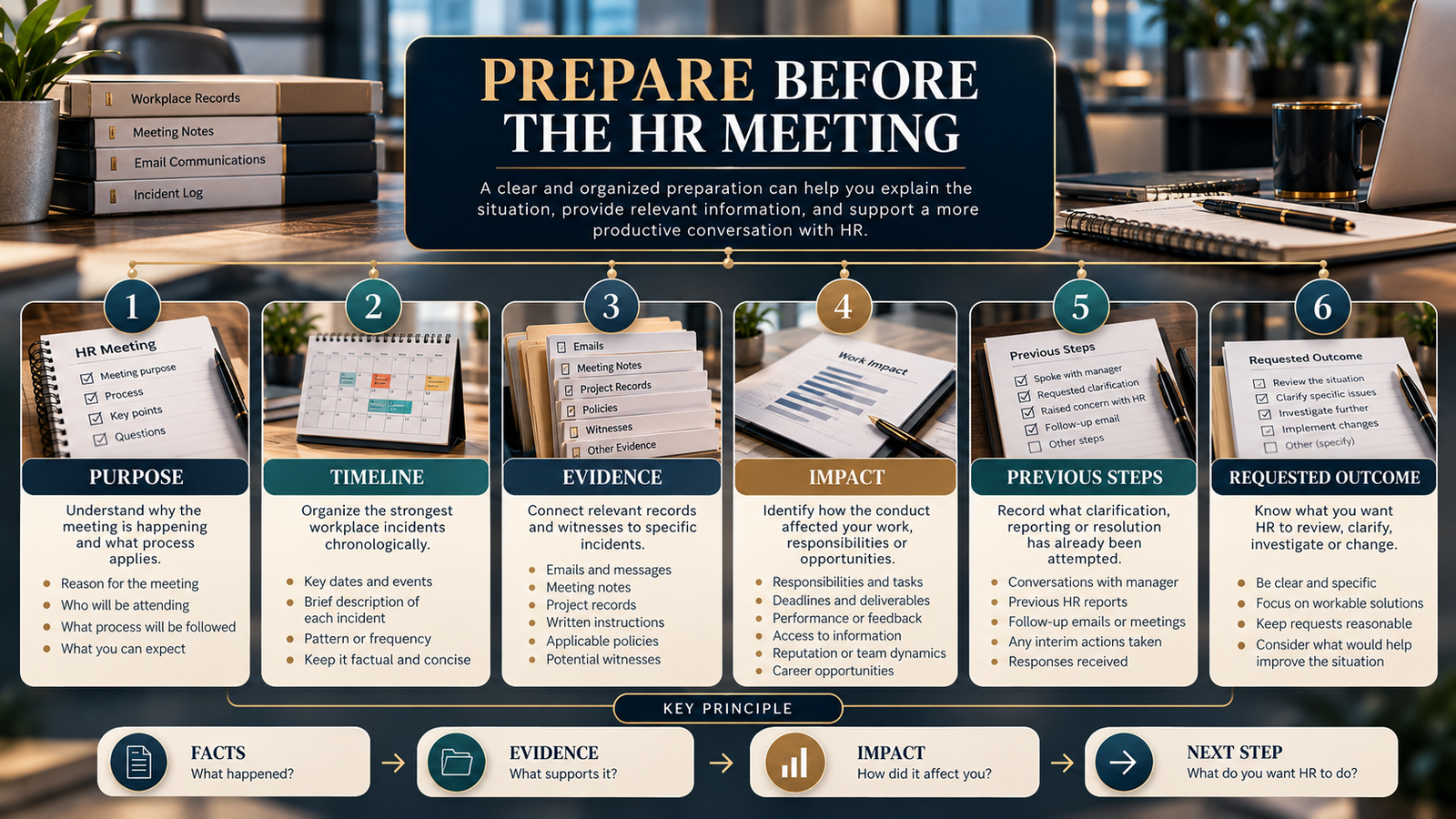
You do not need a 50-page narrative.
Prepare the meeting around six things:
| Prepare | What It Should Answer | Common Mistake |
|---|---|---|
| Purpose | Why are you meeting HR? | Walking in without knowing whether the meeting is informal, investigative or formal. |
| Timeline | What happened and in what order? | Jumping between incidents until the pattern becomes difficult to follow. |
| Evidence | What records or witnesses support the key events? | Providing a large unsorted folder of screenshots. |
| Impact | How has the conduct affected your work? | Describing only the other person’s personality or motives. |
| Previous steps | What have you already tried? | Leaving out attempts to clarify, report or resolve the issue. |
| Requested outcome | What do you want HR to review, clarify or change? | Expecting HR to guess what a workable resolution looks like. |
This structure mirrors the way strong workplace documentation already works: facts first, context second, evidence third, impact fourth, next step last.
If you need to build the underlying record first, use our guide on how to document workplace abuse calmly and clearly.
Prepare a One-Page Meeting Brief
A one-page brief is not necessarily something you have to hand to HR. It is a tool for keeping yourself focused.
Use six short headings:
- Concern: What repeated workplace behavior are you asking HR to review?
- Key incidents: Which three to five examples best demonstrate it?
- Evidence: What supports those incidents?
- Professional impact: What happened to your work, responsibilities, reputation or opportunities?
- Previous attempts: What clarification or resolution have you already tried?
- Requested next step: What do you want HR to do?
If the conversation becomes emotional or moves off topic, this sheet gives you somewhere to return.
Build a Short, Factual Timeline
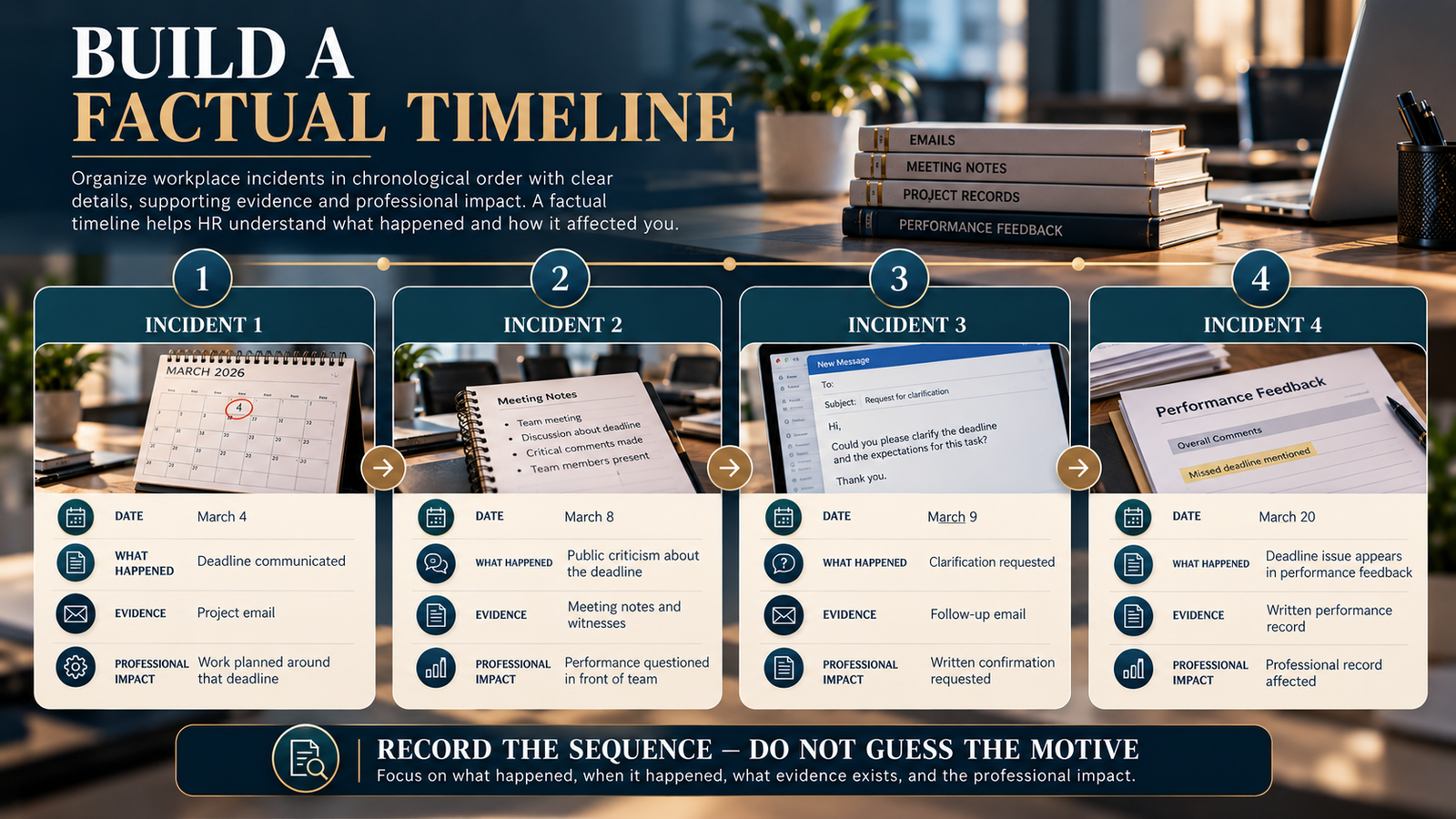
A chronology helps another person understand events in the order they actually happened.
For each significant incident, record:
- date and approximate time;
- location or communication channel;
- people directly involved;
- witnesses with firsthand knowledge;
- relevant context;
- what was said, written, done, changed or withheld;
- what evidence exists;
- your response;
- professional impact;
- what happened afterward.
ACAS recommends keeping a record of bullying concerns that includes what happened, dates and times, evidence and witnesses, while noting that many bullying incidents occur without witnesses. See ACAS guidance on keeping a bullying record.
For a reusable structure, see our workplace incident log.
Weak Timeline Entry
“My boss humiliated me again because they are threatened by me.”
Stronger Timeline Entry
“March 8, weekly project meeting: my manager stated that I had missed the March 7 client deadline. The project email sent March 4 lists March 12 as the deadline. Six team members were present. I referred to the March 4 email and asked whether the deadline had changed. The alleged missed deadline was later mentioned in written performance feedback.”
The stronger version does not require HR to agree with your theory about motive. It gives them an event, a record, witnesses and a consequence.
Select Three to Five Representative Incidents
You may have dozens of examples.
Start with the incidents that make the pattern easiest to see.
A strong example usually has several of these features:
- you can describe the conduct clearly;
- the date or approximate period can be established;
- there is a relevant record;
- a witness has firsthand knowledge;
- similar behavior occurred more than once;
- there was a clear professional consequence.
You can tell HR that additional incidents exist if they need them.
This is not about hiding information. It is about giving the meeting a clear starting point.
Organize the Evidence So HR Can Actually Use It
Evidence becomes more useful when it is connected to an incident.
Relevant records might include:
- emails;
- workplace messages;
- calendar invitations;
- meeting notes;
- project-management history;
- written instructions;
- performance feedback;
- previous reports;
- relevant policy documents;
- your contemporaneous notes.
Do not simply hand over a folder called “proof.”
Create a short evidence index:
| Incident | Date | Evidence | What It Helps Establish |
|---|---|---|---|
| Deadline changed | March 4 | Project email | The deadline originally communicated. |
| Public criticism | March 8 | Meeting notes | What was said about the deadline. |
| Clarification requested | March 9 | Follow-up email | That you asked which deadline applied. |
| Performance impact | March 20 | Written feedback | That the disputed deadline later affected your performance record. |
Our detailed guide on preserving workplace evidence explains the difference between preserving relevant records and collecting information in ways that could create privacy, confidentiality or policy problems.
Do Not Create a Second Problem While Collecting Evidence
Relevant does not automatically mean you are allowed to copy it.
Workplace records can contain:
- client information;
- personal data about employees;
- confidential business information;
- financial information;
- trade secrets;
- restricted internal communications.
Your ability to access a document for your job does not automatically give you permission to forward it to a personal email account or download it to a personal device.
Likewise, do not secretly record conversations without checking applicable law and workplace policy.
The goal is to preserve clarity, not create a second workplace issue.
What to Say to HR: Facts First, Labels Second
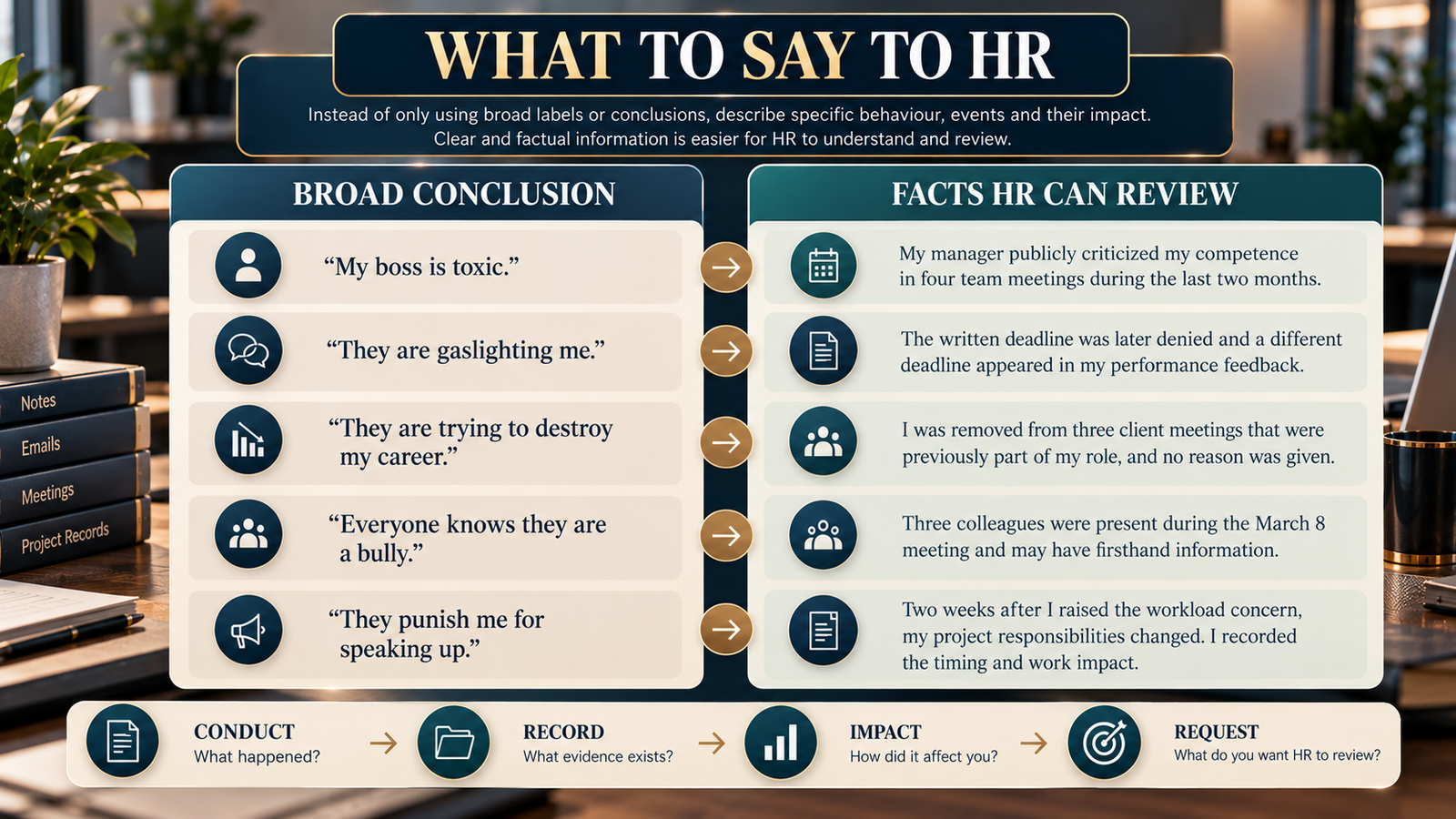
You can tell HR that you believe you are experiencing workplace bullying.
But support that conclusion with behavior HR can review.
| Less Useful | More Useful |
|---|---|
| “My boss is toxic.” | “My manager has publicly criticized my competence in four team meetings during the last two months.” |
| “They are gaslighting me.” | “The written deadline was later denied and a different deadline was used in my performance feedback.” |
| “They are trying to destroy my career.” | “I was removed from three client meetings that were previously part of my role, and no reason was given for the change.” |
| “Everyone knows they are a bully.” | “Three colleagues were present during the March 8 meeting and may have firsthand information about what was said.” |
| “They punish me for speaking up.” | “Two weeks after I raised the workload concern, my project responsibilities changed. I am documenting the timing and work impact.” |
The right-hand column does not require HR to agree with your interpretation first.
It gives them something to assess.
This same principle is central to our guide on reporting workplace gaslighting to HR using facts rather than labels.
Explain the Pattern, Not Just the Worst Incident
Bullying concerns are often about repetition, power and cumulative impact.
Do not assume HR will automatically connect separate events.
You might say:
“The incidents are different, but the pattern is consistent. Important instructions change or are withheld, and I am later criticized for the resulting problem.”
Or:
“The pattern I am concerned about is repeated public criticism followed by exclusion from information I need to perform my role.”
Then support that pattern with two or three representative incidents.
Explain the Professional Impact
Do not make the meeting only about how the behavior made you feel.
Your emotional experience matters, but HR may also need to understand what happened to the work.
Examples of professional impact include:
- missed or withheld information;
- delayed work;
- rework;
- unclear responsibilities;
- inaccurate performance criticism;
- loss of meetings or projects;
- loss of client access;
- damage to professional reputation;
- reduced opportunities;
- difficulty performing your assigned responsibilities.
A useful explanation might be:
“The public criticism has been difficult personally. The work-related concern is that I am also being excluded from project information and then questioned about delays caused by information I did not receive.”
Be Honest About Your Own Mistakes
You do not have to present yourself as flawless for a bullying concern to be legitimate.
If you contributed to part of a problem, acknowledge it accurately.
For example:
“I accept that I should have followed up on the approval earlier. My concern is that the approval still had not been provided by the original deadline and I was later held entirely responsible for the delay.”
This separates your actual responsibility from the part you believe has been inaccurately assigned to you.
If responsibility is repeatedly being redirected after problems occur, compare the pattern with our guide to blame-shifting at work.
Decide What You Want HR to Do
HR may ask:
“What outcome are you seeking?”
Do not wait until that moment to think about it.
Your answer might include:
- reviewing the incidents under the relevant policy;
- starting a formal investigation;
- clarifying reporting responsibilities;
- requiring important instructions or expectations to be documented;
- correcting an inaccurate performance record;
- ending a specific behavior;
- establishing a safer communication process;
- changing a reporting arrangement where appropriate;
- explaining the formal grievance process.
You do not necessarily need to demand a particular punishment.
A practical request might be:
“I would like the incidents reviewed and I would like future deadlines, material changes and performance expectations confirmed clearly so the same disputes do not continue.”
Prepare a 60-Second Opening Statement
You do not need a speech.
You need an anchor.
For example:
“I am here because I want to raise a repeated workplace bullying concern. I have prepared a short timeline of the strongest incidents, the records connected to them and the impact on my work. I would like to explain the pattern and understand what process HR will use to review it.”
Then move to your strongest example.
A short opening is easier to deliver than trying to explain six months of events in the first five minutes.
Professional Scripts for Difficult Moments in the Meeting
| Situation | Grounded Response |
|---|---|
| HR asks whether you could have misunderstood. | “That is possible for the verbal part. That is why I followed up in writing. This is the message I sent afterward.” |
| You do not remember exact wording. | “I do not remember the wording precisely enough to quote it. I can explain the substance and the note I made afterward.” |
| The conversation moves to your personality. | “I am happy to address any specific concern about my conduct. For the complaint I raised, I would like to return to the incidents and evidence.” |
| You need time before answering. | “I want to give you an accurate answer. Let me check my notes before I respond.” |
| You become emotional. | “I need a moment. This is difficult to discuss, but I would like to continue.” |
| HR calls it a communication problem. | “If that is how the issue is being treated, can we agree on a clearer process for deadlines, responsibilities and performance feedback?” |
| HR raises a separate performance concern. | “I am happy to address that separately. Can we identify the specific example and expected standard, and then return to the concern I raised?” |
Prepare for Questions HR May Ask
Questions are not automatically proof that HR disbelieves you.
They may need to establish:
- when the behavior started;
- how often it happened;
- who was involved;
- who witnessed it;
- what exactly was said or done;
- whether you raised the issue previously;
- what you did in response;
- what evidence exists;
- how the behavior affected the work;
- what resolution you are asking for.
Answer what you know.
If you are uncertain, say so.
Accuracy is more credible than artificial certainty.
What If You Become Emotional?
Discussing repeated workplace mistreatment can be difficult.
Becoming emotional does not automatically make your account unreliable.
You can pause.
You can look at your timeline.
You can ask for a moment.
You can continue when you are ready.
Before the meeting, write down the three things you most need HR to understand. If the discussion becomes overwhelming, return to those three points.
What If You Have No Witnesses?
Do not assume the incident is meaningless because nobody else was in the room.
ACAS notes that many bullying incidents happen out of sight of others. Its guidance specifically says the absence of witnesses should not stop someone reporting bullying.
Be precise about what can be checked.
For example:
“There were no witnesses to the conversation. I sent a follow-up email immediately afterward confirming my understanding of what had been discussed.”
Do not pressure coworkers to become witnesses to events they did not directly observe.
Prepare Questions to Ask HR
Do not leave the meeting unsure what happens next if HR has not explained it.
Useful questions include:
- “What process is being followed?”
- “Is this an informal conversation, investigation meeting or formal grievance meeting?”
- “Is there any additional information you need from me?”
- “Will relevant witnesses be contacted?”
- “Who will handle the next stage?”
- “What happens after this meeting?”
- “When should I expect an update?”
- “Who should I contact if another significant incident occurs?”
- “How should I report material changes while this is being reviewed?”
- “Is there an appeal or review process if I disagree with the eventual outcome?”
Some questions may not have immediate answers.
Your goal is to understand the process, not force HR to predict the result.
Can You Bring Someone With You?
That depends on the type of meeting, workplace policy, jurisdiction and applicable law.
Do not assume every HR meeting carries the same accompaniment rights.
For example, UK ACAS guidance distinguishes grievance meetings from some investigation meetings. In a grievance procedure, a worker can have a statutory right to be accompanied in qualifying meetings, while a disciplinary investigation meeting does not carry the same automatic legal right, though allowing accompaniment may be good practice. See ACAS guidance for the distinction.
Check your own workplace process and ask HR in advance.
Take Notes During the Meeting
If the meeting format permits it, record the important points.
Note:
- who attended;
- what HR said the meeting was for;
- important questions asked;
- important answers you gave;
- documents discussed;
- additional information HR requested;
- actions HR said it would take;
- anything you agreed to provide;
- expected follow-up.
You do not need a word-for-word transcript.
Focus on facts, decisions, requests and next steps.
ACAS guidance on formal grievance meetings also recommends keeping a confidential record of what was said, evidence gathered and decisions or actions taken. See ACAS grievance meeting guidance.
What Not to Do in the HR Meeting
Some understandable reactions can make the workplace issue harder to review.
Try to avoid:
- turning the meeting into a diagnosis of your manager;
- guessing motives and presenting those guesses as facts;
- saying “everyone agrees” when you cannot establish that;
- exaggerating how often something happened;
- inventing precise quotes you do not remember;
- coaching witnesses;
- mixing every unrelated grievance into the same complaint;
- interrupting every difficult question because it feels challenging;
- threatening HR, your manager or coworkers;
- making legal conclusions you cannot support;
- improperly taking confidential company records;
- secretly recording without first checking law and policy.
The objective is not to make the other person sound as bad as possible.
It is to make the workplace problem understandable.
What If HR Calls It a Personality Conflict?
You may believe you are experiencing bullying while HR describes the issue as conflict, management style or communication difficulty.
You do not need to abandon the facts.
Ask what practical workplace change follows from that view.
For example:
“If the issue is being treated as a communication problem, can we establish a process where material changes to deadlines and responsibilities are confirmed in writing?”
Or:
“Can future performance concerns include a specific example and the standard I am expected to meet?”
You may not get the label you expected.
You may still be able to obtain a useful workplace safeguard.
If clearer limits are needed, see how to set boundaries with a manipulative boss professionally.
What If HR Starts Asking About Your Performance?
Do not automatically assume the complaint has been turned against you.
Two things can be true:
- you may have a legitimate bullying concern;
- your employer may also have legitimate questions about part of your performance.
Keep the tracks separate.
Track A: Your Bullying Concern
- What happened?
- When?
- What supports it?
- What was the professional impact?
Track B: Performance
- What specific concern is being raised?
- What example supports it?
- What standard applies?
- When was that standard communicated?
- What improvement is expected?
You can acknowledge a genuine performance issue without allowing it to erase the original concern.
What If the Bullying Includes Gaslighting?
If the problem includes repeated denial of instructions, contradictions or rewritten accounts of what was agreed, show the underlying sequence.
For example:
“The written instruction and the later performance account are different. I have brought the original message and the later feedback so the sequence can be reviewed.”
HR does not need to agree with the word gaslighting before it can compare the records.
If this is the main issue, see our detailed guide on how to report workplace gaslighting to HR with facts.
What If the Conduct May Also Be Harassment or Discrimination?
Workplace bullying and unlawful harassment are not automatically the same thing.
In the United States, federal harassment law generally concerns unwelcome conduct linked to protected characteristics, and the legal threshold depends on the facts and context. The EEOC advises employers to use prompt, impartial and thorough investigation processes for harassment complaints. See the EEOC workplace harassment fact sheet.
If your complaint involves discrimination, protected activity, harassment, whistleblowing, safety, dismissal or another serious employment issue, seek guidance relevant to your jurisdiction instead of relying only on general workplace-bullying terminology.
What If You Are Worried About Retaliation?
It is reasonable to pay attention to what changes after you raise a concern.
But do not automatically classify every uncomfortable interaction as retaliation.
Document material developments such as:
- significant changes in duties;
- new disciplinary action;
- new or materially different performance criticism;
- loss of necessary access;
- removal from important meetings;
- substantial schedule changes;
- withdrawal of professional opportunities;
- new threats concerning employment.
Record dates, context and professional impact.
The legal meaning of retaliation depends on the type of complaint, protected activity, jurisdiction and facts.
For the broader post-reporting process, read what happens after you report a toxic boss to HR.
What to Do Immediately After the HR Meeting
Do not rely only on memory once the meeting ends.
As soon as reasonably practical, record:
- who attended;
- what was discussed;
- what evidence was requested;
- what information you agreed to provide;
- what HR said would happen next;
- any deadlines;
- any changes to your responsibilities or communication;
- the date of any follow-up meeting.
If important next steps were agreed verbally, consider a concise follow-up email:
“Thank you for meeting with me today. My understanding is that I will provide the additional project records we discussed, HR will review the incidents and relevant information, and I should expect an update regarding the next step. Please let me know if I have misunderstood anything.”
For more examples, use our guide to writing a follow-up email after a difficult workplace conversation.
Continue Your Incident Log After the Meeting
Your documentation should not necessarily stop once HR is involved.
Record significant developments if:
- the behavior stops;
- the behavior continues;
- your duties change;
- new performance concerns appear;
- you lose access or opportunities;
- another incident occurs;
- HR requests additional information.
Do not document every cold look or uncomfortable conversation.
Document events that materially affect the complaint, your work, your reputation or your employment position.
The workplace incident log can help keep the post-meeting chronology separate from your emotional reflections.
A 24-Hour HR Meeting Preparation Checklist
| Before the Meeting | During the Meeting | After the Meeting |
|---|---|---|
| Confirm the purpose. | Listen to how HR frames the meeting. | Write down what happened. |
| Review the policy. | Use specific incidents and dates. | Record the next steps. |
| Prepare a one-page brief. | Separate facts from assumptions. | Provide requested information. |
| Select three to five strong incidents. | Be honest about uncertainty. | Confirm material decisions in writing. |
| Organize relevant evidence. | Take useful notes. | Continue documenting significant developments. |
| Write down your requested outcome. | Ask what happens next. | Review whether the process is progressing as explained. |
| Prepare your questions. | Pause if you need time. | Protect your work and professional reputation. |
When an HR Meeting Is Not Enough
An HR meeting can be an important step, but some situations require additional support.
Consider appropriate professional advice when the issue involves:
- possible discrimination;
- legally protected retaliation;
- termination or threatened termination;
- formal disciplinary action;
- whistleblowing;
- serious safety concerns;
- significant contractual disputes;
- questions about sensitive or confidential evidence.
Employment law and procedure vary by jurisdiction.
A general article cannot determine whether a specific situation creates a legal claim.
Chapter 1: Recognize the Pattern Before You Explain It
Preparing for HR becomes easier when you can separate the workplace behavior from the label you have been using to make sense of it.
You might be dealing with:
- repeated humiliation;
- exclusion;
- changing expectations;
- blame-shifting;
- gaslighting;
- credit stealing;
- harassment;
- discrimination;
- ordinary management conflict.
You do not need to diagnose the person behind the behavior.
You need to describe what happened clearly enough that another person can review it.
That is why understanding the distinction between workplace bullying, gaslighting and harassment can help before you enter the meeting.
Chapter 4: Protect Yourself During the HR Process
Preparation is part of workplace protection.
So is what happens after the meeting.
You may need to:
- keep important instructions clear;
- maintain factual documentation;
- preserve relevant evidence appropriately;
- protect your work and credit;
- maintain professional relationships;
- set practical boundaries;
- watch for meaningful changes after the complaint.
If the situation is already affecting your work or reputation, read how to protect your work, credit and professional reputation.
Frequently Asked Questions
How do I prepare for an HR meeting about workplace bullying?
Understand the purpose of the meeting, review the relevant policy, prepare a short chronology, select your strongest incidents, organize the evidence connected to them, explain the professional impact, decide what you want HR to review or change, and prepare questions about the process and next steps.
What should I bring to an HR meeting about bullying?
Bring relevant records connected to the incidents you plan to discuss. Depending on the situation, these may include emails, messages, meeting notes, calendar records, project documents, written instructions, performance feedback, your incident log and the names of relevant witnesses.
Should I bring every screenshot I have?
Usually, no. Start with the records that support your strongest examples and organize them so HR can see why each one matters. Keep additional material available if it becomes relevant.
What should I say to HR about workplace bullying?
Describe the specific conduct, dates, context, witnesses, evidence and professional impact. You can say that you believe the pattern constitutes bullying, but support that conclusion with observable examples.
Should I call my boss a bully or narcissist?
You can explain the label you believe describes the pattern, but workplace concerns are easier to assess when the underlying conduct is specific. Focus on what the person said, did, changed, withheld or decided rather than trying to prove a personality diagnosis.
How many incidents should I prepare?
There is no fixed number. Three to five strong representative incidents can be a useful starting point when they clearly show the conduct, chronology, evidence and professional impact. Additional incidents can remain available if HR needs them.
What if I have no written evidence?
You can still explain what you personally experienced. Be clear about what you remember, what you cannot verify independently, whether anyone witnessed the incident and whether you created contemporaneous notes or follow-up communication.
What if I cry or become emotional?
You can pause and return to your notes. Becoming emotional does not prevent you from continuing to provide a factual account. Preparing your three most important points beforehand can help you regain your place.
Can I bring someone to the meeting?
It depends on the type of meeting, workplace policy, jurisdiction and applicable law. Check your employer’s procedure and ask HR in advance rather than assuming every meeting has the same accompaniment rules.
Can I secretly record the HR meeting?
Do not assume covert recording is permitted. Recording laws and workplace rules vary and can raise privacy, trust and employment issues. Check the relevant rules or obtain qualified advice before recording.
What if HR says it is just a personality conflict?
Return to the work impact. Ask what practical changes can address the incidents you documented, such as clearer responsibilities, written expectations, specific performance standards or a more reliable communication process.
What if HR raises concerns about my performance?
Treat the performance concern as a separate track. Ask for the specific example, evidence, standard and expected improvement. You can engage with legitimate performance feedback without abandoning the bullying concern you raised.
What if HR does not believe me?
Focus on what can be reviewed. Ask what evidence was considered, whether additional information is needed and what process comes next. If the eventual outcome goes against you, review the decision and any appeal or review process before deciding what to do next.
What should I do after the meeting?
Record who attended, what was discussed, what evidence HR requested, what actions were described and any deadlines. Confirm important next steps in writing when appropriate and continue documenting significant developments.
Conclusion: Your Goal Is Clarity, Not a Perfect Performance
You do not need to walk into an HR meeting with a flawless speech.
You do not need to prove every motive.
You do not need to remember every sentence exactly.
You need enough structure that another person can understand the workplace problem.
Know what the meeting is about.
Know which incidents matter most.
Know what evidence supports them.
Know how the behavior affected your work.
Know what you want HR to review.
Know which questions you need answered before you leave.
Use dates instead of generalizations.
Use records instead of arguments about memory where records exist.
Separate what you know from what you believe.
Acknowledge your own mistakes where they are real.
Do not guess at motives.
Do not coach witnesses.
Do not turn the meeting into a character trial.
The practical goal is simple:
Make the workplace problem clear enough to review, and make the next step clear enough to follow.
If you still need to organize the record, start with the workplace incident log, how to document workplace abuse and how to preserve workplace evidence.
If you have already reported the problem and are wondering what happens next, read what happens after you report a toxic boss to HR.
Prepare for the Meeting — and Protect What Comes After It
An HR meeting can put a workplace problem into a more formal process, but the meeting itself may be only one stage of a larger decision.
You may still need to document what happens next, protect your professional reputation, reset boundaries, assess whether the workplace is becoming more workable and decide what options remain if it does not.
Reclaim Your Power brings those pieces together through a seven-chapter workplace recovery framework covering recognition, manipulation patterns, damage assessment, immediate protection, exit strategy, recovery and career confidence.
If this HR meeting is part of a much larger workplace situation, explore Reclaim Your Power and the complete workplace recovery workbook.
Educational disclaimer: This article provides general educational information and is not legal advice. Workplace bullying policies, grievance procedures, accompaniment rights, confidentiality rules, retaliation protections and employment laws vary by workplace and jurisdiction. Terms such as bullying, gaslighting, toxic and narcissistic are descriptive and do not establish a diagnosis or legal finding. Seek appropriately qualified advice when your situation involves serious employment, discrimination, harassment, retaliation, safety, contractual or legal concerns.
Ready to Reclaim Your Power?
Get the 376-page digital edition with 7 chapters, 22 practical tools, reusable forms, an optional 30-entry journal, and references.
Buy Now — $4.99
Leave a Reply