
Workplace bullying can create several different problems at the same time.
You may need the behavior to stop.
You may need someone beside you in an HR meeting.
You may need to understand whether your legal rights are involved.
And you may need help recovering from the stress the situation has created.
Those are not the same problem.
That is why the question:
“Who should I contact about workplace bullying?”
does not have one universal answer.
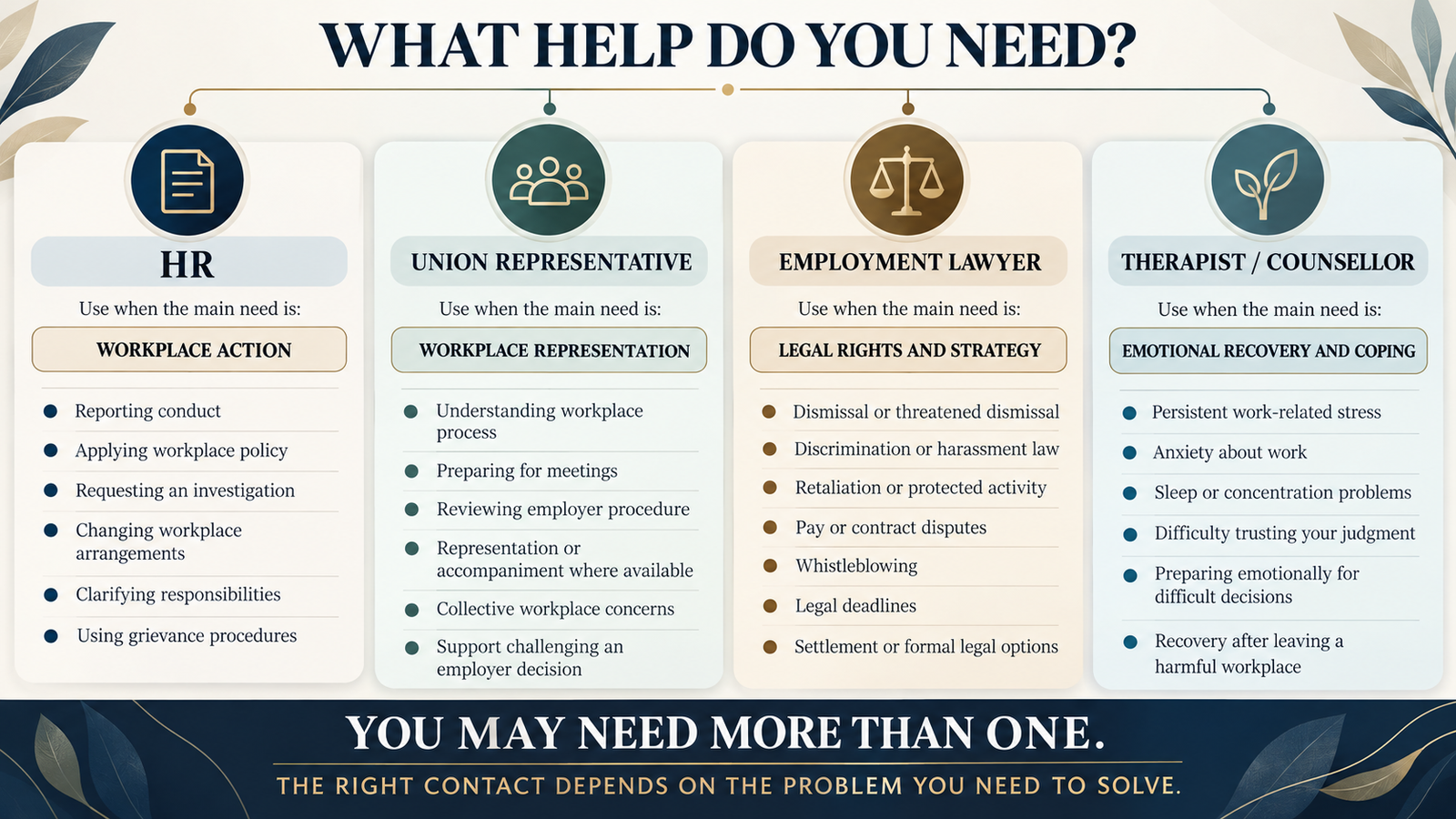
HR can address internal workplace processes, policies and complaints.
A union representative may help a member understand procedures, prepare for meetings and obtain workplace representation.
An employment lawyer or qualified employment adviser can explain legal rights, deadlines, risks and formal options.
A therapist or counsellor can help with emotional impact, stress, self-trust, coping and recovery.
Sometimes you need only one of them.
Sometimes the safest and most effective approach involves two or three at different stages.
This guide explains what each option is actually for, when to contact them, what they cannot do for you, and how to decide which type of support fits the problem you are facing right now.
The Quick Answer: Match the Professional to the Problem
| If You Need… | Consider Speaking To… | Main Purpose |
|---|---|---|
| A workplace complaint investigated or addressed internally | HR or management | Workplace policy, investigation, grievance, reporting arrangements and organizational action. |
| Help navigating employer procedures or representation as a member | Trade union representative | Workplace advice, representation, meeting preparation and collective support. |
| Advice about legal rights, deadlines, termination, retaliation or other serious employment consequences | Employment lawyer or qualified employment adviser | Legal assessment, legal risk, deadlines and available formal options. |
| Help with stress, anxiety, self-trust, coping or recovery | Therapist, counsellor or appropriate mental-health professional | Emotional support, coping skills, perspective and recovery. |
This is not a rigid sequence.
You do not always have to speak to HR first.
You do not always need a lawyer before raising a workplace concern.
And talking with a therapist does not mean the workplace issue is “all in your head.”
The right contact depends on what you need from the conversation.
First Ask: What Problem Am I Trying to Solve?
Before contacting anyone, finish this sentence:
“I need help with…”
Your answer might be:
- stopping repeated workplace behavior;
- understanding the employer’s bullying policy;
- preparing for an HR meeting;
- having someone represent or accompany you;
- challenging an inaccurate disciplinary action;
- understanding whether discrimination law is involved;
- protecting yourself after retaliation;
- deciding whether to sign a settlement agreement;
- coping with severe workplace stress;
- rebuilding confidence after leaving the job.
The professional you choose should match that problem.
This sounds simple, but confusion here causes a lot of disappointment.
Someone may go to HR expecting personal advocacy.
Someone else may ask a therapist whether they have a legal retaliation claim.
Another person may hire a lawyer when their immediate problem is that nobody at work has yet been asked to correct a simple reporting-line dispute.
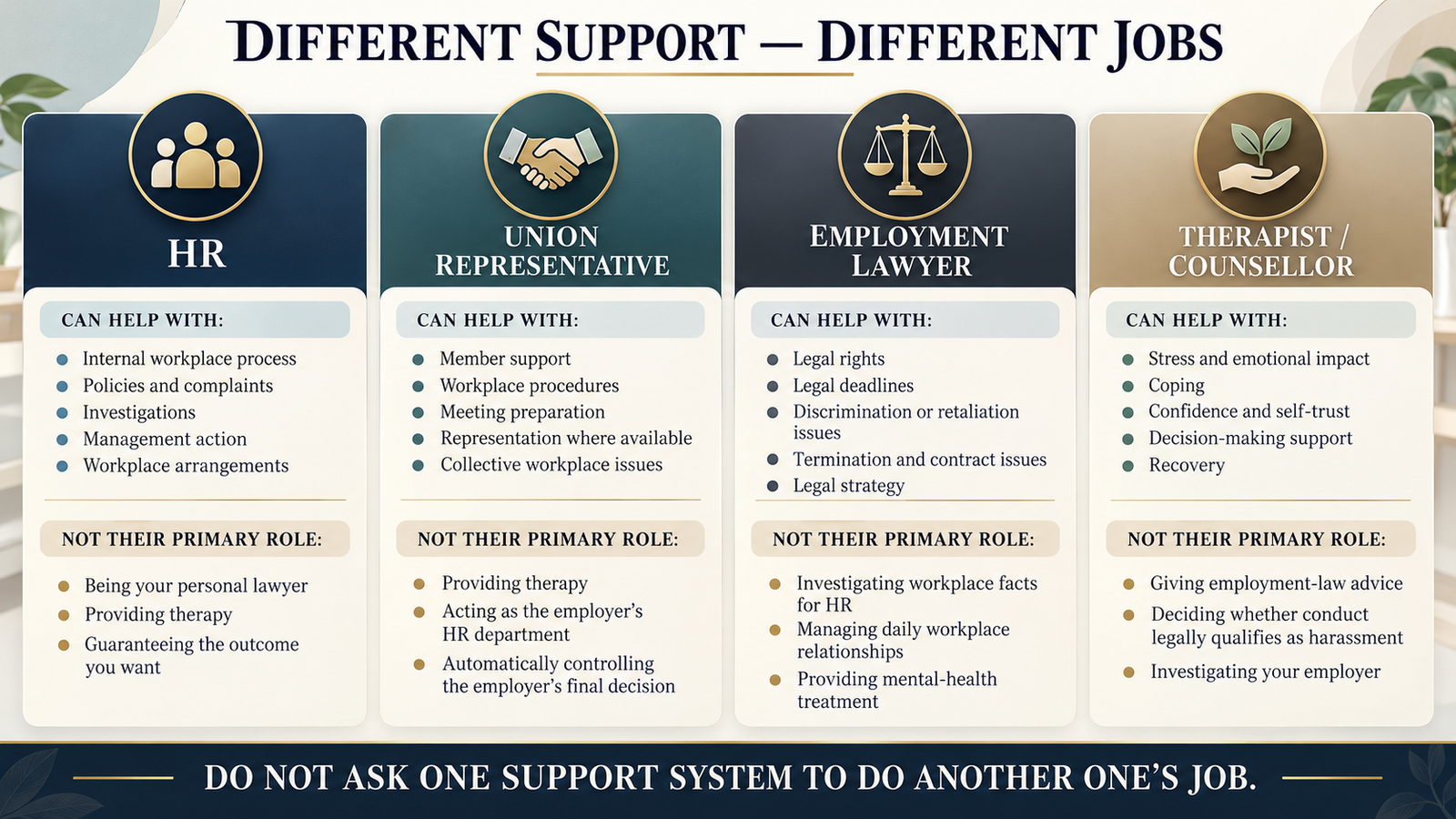
Different support systems have different jobs.
Do Not Ask One Support System to Do Another One’s Job
A useful way to think about workplace support is this:
| Support | What It Can Help With | What It Does Not Automatically Provide |
|---|---|---|
| HR | Internal policies, complaints, investigations, workplace arrangements and employer action. | Personal legal representation or therapy. |
| Union representative | Member representation, process advice, meeting support and workplace advocacy. | Control over the employer’s final decision or mental-health treatment. |
| Employment lawyer | Legal rights, deadlines, legal strategy, contracts and serious employment consequences. | Daily workplace management or emotional treatment. |
| Therapist or counsellor | Emotional impact, coping, perspective, confidence and recovery. | Legal conclusions, HR investigations or workplace-policy decisions. |
When to Speak to HR About Workplace Bullying
HR may be the right contact when you need the organization itself to respond.
That can include:
- reporting repeated workplace bullying;
- asking which policy applies;
- raising a formal grievance;
- requesting an investigation;
- reporting harassment or discrimination;
- raising concerns about retaliation;
- asking for reporting-line or communication changes;
- clarifying what happens after a complaint.
ACAS advises workers who believe they are being bullied to consider workplace reporting options and notes that if the manager is the person involved, another manager or HR may be an appropriate contact depending on the organization’s policy. See ACAS guidance on workplace bullying.
In the United States, EEOC guidance similarly recommends checking the employer’s anti-harassment policy and following the available reporting options where potentially unlawful harassment is involved. See EEOC guidance on workplace harassment reporting.
What HR Can Realistically Do
Depending on the organization and facts, HR may be able to:
- explain the workplace policy;
- receive a complaint;
- identify the appropriate reporting process;
- arrange or conduct an investigation;
- interview relevant people;
- review workplace records;
- coordinate corrective action;
- clarify reporting arrangements;
- recommend management changes;
- document an outcome;
- explain appeal or follow-up procedures.
What HR can tell you about confidential disciplinary action may be limited.
You may therefore report a manager and never be given every detail of what happened to that manager afterward.
This does not automatically mean nothing happened.
What HR Is Not
HR is part of the employer’s organizational structure.
It is not your personal lawyer.
It is not your therapist.
And its role is not necessarily to provide whichever outcome you personally prefer.
This does not mean:
“HR is always against employees.”
That claim is too simplistic.
It means you should approach HR understanding its role.
Bring a workplace problem that HR can assess:
- specific conduct;
- dates;
- available evidence;
- witnesses where relevant;
- professional impact;
- the workplace outcome you are requesting.
If your evidence is scattered, start with how to document workplace abuse calmly and clearly and the workplace incident log.
When HR Is Probably the Best First Step
HR may be a reasonable first contact when:
- the problem clearly falls under an internal workplace policy;
- you need the employer to investigate;
- the manager is the person causing the problem and another reporting channel is needed;
- an informal approach has failed;
- the behavior is too serious for informal resolution;
- you need clarification on a grievance or complaint procedure.
A simple opening can be:
“I would like to raise a repeated workplace conduct concern. I have prepared a short chronology of the main incidents, the relevant records and the professional impact. Could you explain which workplace process applies and what information you need from me?”
When to Speak to a Union Representative
If you are a union member, a union representative can be useful much earlier than many employees realize.
You do not necessarily need to wait until:
- you are disciplined;
- HR rejects your complaint;
- your employment is threatened.
A representative may be able to help you understand:
- your employer’s procedures;
- relevant collective agreements;
- how to frame a workplace complaint;
- what documentation is useful;
- what to expect in a meeting;
- whether representation or accompaniment is available;
- whether similar issues affect other members.
ACAS specifically lists trade-union representatives as a possible source of support for workers experiencing bullying and as people who may support workers in relevant workplace meetings. See ACAS bullying guidance.
Why a Union Can Be Particularly Useful Before a Formal Meeting
A union representative already understands that workplace processes have structure.
Before a meeting, they may help you distinguish:
- the facts from assumptions;
- the central complaint from unrelated frustrations;
- a grievance issue from a performance-management issue;
- the questions worth asking;
- the records worth bringing.
This can be especially useful if you feel intimidated by the process.
Depending on workplace rules and applicable law, representation or accompaniment rights vary.
Do not assume the same rules apply in every country, employer or meeting.
Ask the union what support is available under your membership and workplace arrangements.
What to Ask a Union Representative
You might ask:
- “Which workplace policy applies to this situation?”
- “Does the pattern I documented fit an issue the union can support?”
- “What should I prepare before speaking to HR?”
- “Can a representative attend the meeting with me?”
- “Are there deadlines I should know about?”
- “Does the collective agreement contain anything relevant?”
- “What should I do if discipline starts after I raise the concern?”
Do not assume the union can guarantee an outcome.
The value often lies in experienced representation, process knowledge and another set of eyes on the situation.
When a Union May Not Be Enough
A union representative can provide strong workplace support without being your personal employment lawyer or therapist.
You may need additional help if the situation involves:
- complex discrimination law;
- significant legal deadlines;
- dismissal;
- a proposed settlement agreement;
- serious whistleblowing issues;
- a major contractual dispute;
- significant emotional or health effects.
The union itself may sometimes have legal services or refer members to specialist advisers.
Ask rather than assume.
When to Speak to an Employment Lawyer
You do not necessarily need a lawyer because a coworker was rude or your manager handled one conversation badly.
Legal advice becomes more important when the problem may involve legal rights, legal deadlines or significant employment consequences.
Consider obtaining location-specific employment advice when the situation involves:
- termination or threatened termination;
- demotion or significant loss of pay;
- possible unlawful discrimination;
- potentially unlawful harassment;
- retaliation following legally protected activity;
- whistleblowing;
- significant contractual disputes;
- major changes to employment terms;
- a settlement or severance agreement;
- possible constructive dismissal or forced resignation issues;
- government, court or tribunal filing deadlines.
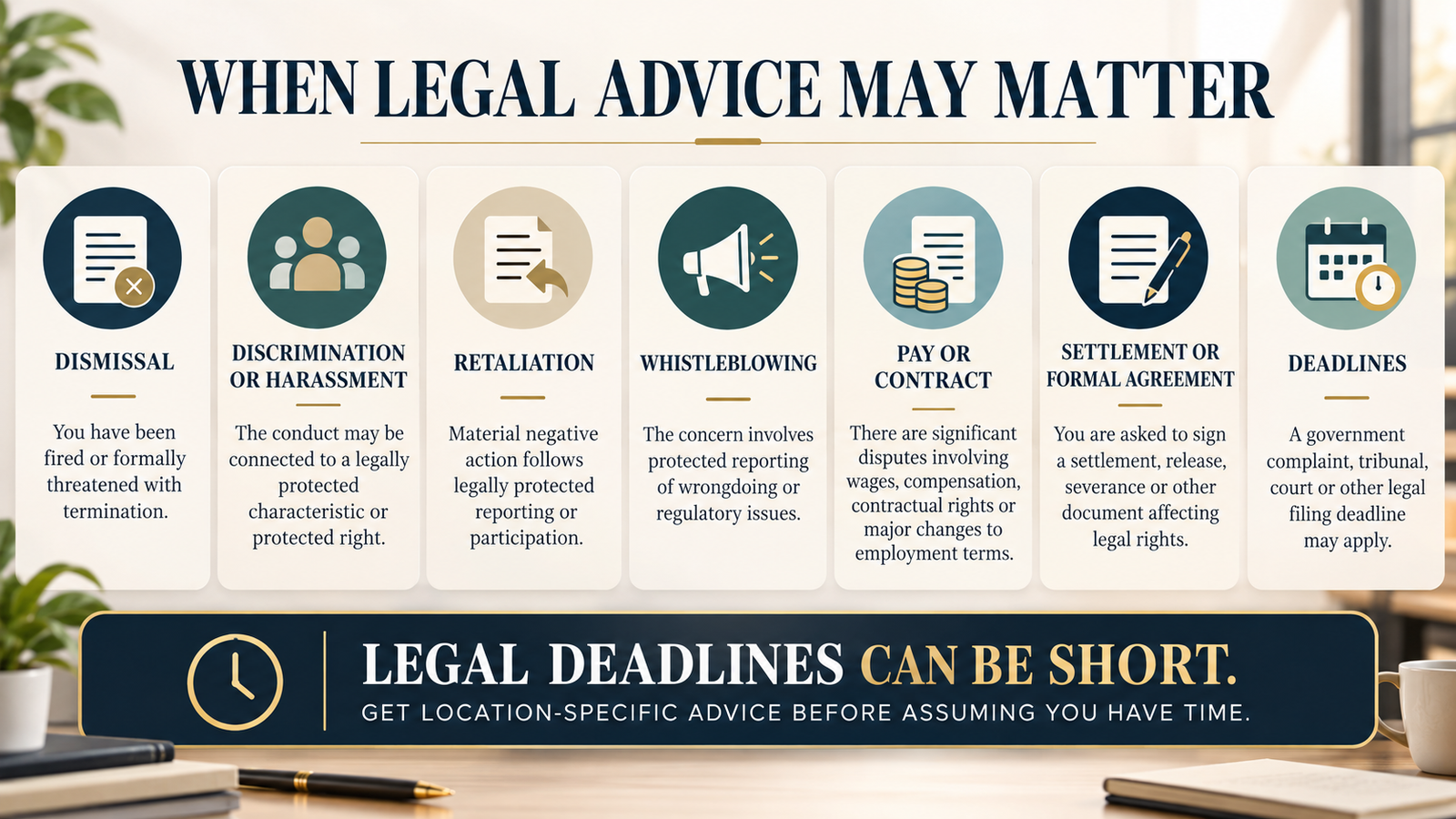
The central reason not to delay legal advice in serious cases is that some rights have deadlines.
For example, the U.S. EEOC states that discrimination charges generally must be filed within 180 days, with the period extended to 300 days in certain jurisdictions. Different rules apply in some cases, including the federal sector. See EEOC filing guidance.
Other countries use completely different systems and deadlines.
This is why internet articles should not be used to calculate your individual filing deadline.
What an Employment Lawyer Can Help You Understand
A qualified lawyer familiar with the law where you work may help you assess questions such as:
- Does this conduct potentially involve a legal right rather than only workplace policy?
- What legal deadlines apply?
- Does the documentation support the concern?
- What are the risks of resigning?
- What should I know before signing an agreement?
- Does a retaliation or discrimination framework apply?
- Should I use an internal process first?
- What government or tribunal process exists?
- What evidence should be preserved lawfully?
This is particularly important before making irreversible decisions.
Speak to a Lawyer Before You Resign If Legal Consequences May Matter
Resigning can feel like the fastest way to escape a harmful workplace.
But resignation can affect legal, contractual and financial options.
ACAS cautions that resigning because of severe workplace bullying is a major step and should be considered carefully when constructive-dismissal issues may be relevant. See ACAS guidance.
If you believe you may be forced out, do not rely on a generic blog post to decide the legal consequences of resigning.
Get advice appropriate to your jurisdiction before acting where possible.
Do You Need a Lawyer Before Talking to HR?
Not always.
For many workplace concerns, the internal procedure is a reasonable first step.
But early legal advice may make sense when:
- termination is already being discussed;
- a serious disciplinary process is underway;
- discrimination or legally protected retaliation appears central;
- you have been asked to sign an agreement;
- there may be a short filing deadline;
- you are considering resigning because you believe the employer has seriously breached your rights.
The objective is not to threaten your employer with a lawyer.
It is to understand your position before making consequential decisions.
When to Speak to a Therapist or Counsellor
A workplace problem can require organizational action and emotional support at the same time.
Those needs do not cancel each other out.
WHO identifies poor working environments—including excessive workloads, low control, discrimination and job insecurity—as risks to mental health. :chatgpt-content-reference{index=”3″}
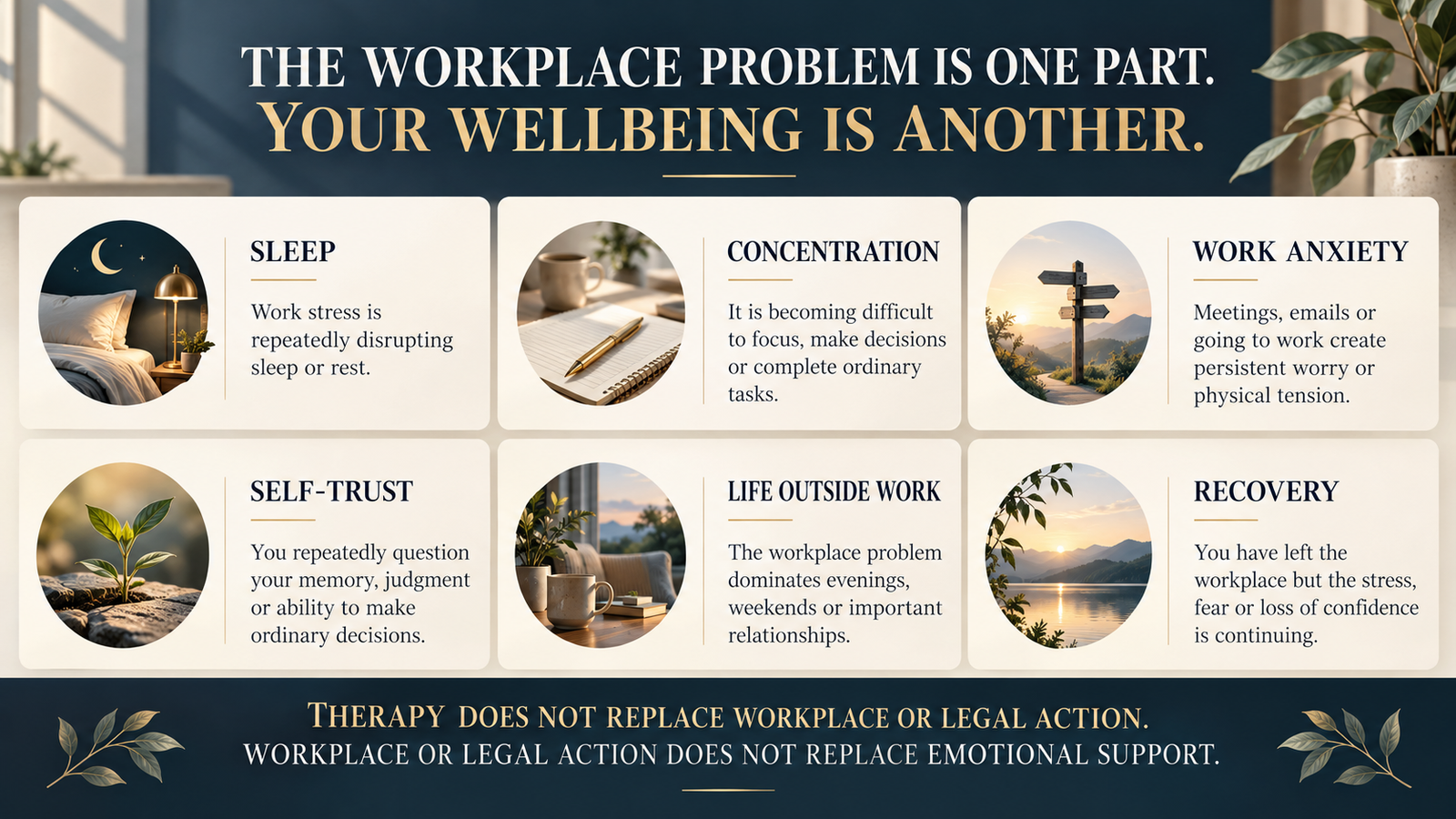
Consider appropriate mental-health support when the workplace situation is repeatedly affecting areas such as:
- sleep;
- concentration;
- ability to relax outside work;
- confidence in your judgment;
- anxiety before ordinary workplace interactions;
- relationships outside work;
- ability to make decisions;
- recovery after leaving the workplace.
The NHS also advises seeking appropriate support when work-related stress or burnout is affecting daily life or mental health. See NHS guidance on work-related stress.
What Therapy Can Help With
A therapist or counsellor may help you:
- process the emotional impact of what happened;
- separate workplace facts from fears that have built around them;
- manage stress responses;
- rebuild confidence in your own judgment;
- prepare emotionally for difficult meetings;
- think through boundaries and decisions;
- recover after leaving a harmful workplace;
- prevent one workplace experience from defining how you approach every future workplace.
Therapy does not require you to prove that the person involved is a narcissist, bully or gaslighter.
The focus can remain on your experience and what helps you function and recover.
What a Therapist Cannot Decide for You
A therapist is not normally the right professional to determine:
- whether a workplace policy was violated;
- whether HR conducted a fair investigation;
- whether you have a legal retaliation claim;
- whether an employment deadline applies;
- whether you should sign a settlement agreement;
- whether your employer legally owes you compensation.
A mental-health professional may help you think through how the workplace situation is affecting you.
Legal questions should go to appropriately qualified legal or employment advisers.
Workplace-policy questions generally belong with the relevant employer process, union or appropriate adviser.
What About an Employee Assistance Programme?
If your employer provides an Employee Assistance Programme, or EAP, it may offer confidential counselling or other support.
ACAS lists EAP and counselling support among resources employers may make available to workers involved in bullying or discrimination complaints. See ACAS guidance on supporting employees.
Before using an EAP, you can ask:
- who provides the service;
- what confidentiality rules apply;
- whether the employer receives only anonymous usage information or anything more;
- how many sessions are included;
- whether referrals to longer-term support are available.
Do not assume every EAP operates identically.
You May Need More Than One Kind of Support
One of the biggest mistakes is assuming you must choose only one path.
Example 1: Workplace Bullying With No Obvious Legal Issue
You may use:
- HR to report the conduct;
- a therapist to manage the emotional impact.
Example 2: Unionized Employee Facing a Formal Grievance
You may use:
- a union representative for workplace representation;
- HR for the employer’s grievance process.
Example 3: Discrimination Followed by Termination
You may need:
- HR for the internal record;
- a union representative if applicable;
- an employment lawyer or appropriate government employment body for rights and deadlines;
- a therapist if the experience is also affecting your wellbeing.
Example 4: HR Rejects Your Complaint
You might use:
- the employer’s appeal procedure;
- union representation where available;
- independent employment advice if serious rights are involved;
- therapy or counselling to help you make the next decision without the workplace consuming your entire life.
The support systems are complementary when they are solving different problems.
When to Contact HR First
Start with HR or an appropriate manager when:
- you want the employer to investigate;
- you want workplace conduct addressed;
- you need an internal grievance;
- you need clarification of workplace policy;
- you are asking for a workplace arrangement or safeguard.
If you are preparing to report, our guide to workplace bullying vs. gaslighting vs. harassment can help you describe the concern accurately.
When to Contact the Union First
Contact your union early when:
- you want help understanding the procedure before filing something;
- you are being called into a formal meeting;
- discipline is involved;
- a collective agreement may matter;
- you want representation or accompaniment where available;
- other employees appear to be experiencing the same workplace issue.
You can still contact HR afterward.
The union may help you prepare first.
When to Contact a Lawyer Earlier Rather Than Later
Consider earlier legal advice when:
- your job is at immediate risk;
- you have been dismissed;
- you are being asked to sign away rights;
- you believe protected discrimination or retaliation is involved;
- you made a serious whistleblowing report;
- you are considering resigning for legal reasons;
- a filing deadline may be running.
Legal deadlines are one reason not to wait indefinitely for an internal workplace process to solve everything.
When to Contact a Therapist Earlier Rather Than Later
You do not need to wait until the workplace situation becomes unbearable.
Consider support if you notice that the problem is repeatedly affecting your ability to function outside the actual incidents.
For example:
- you cannot switch off after work;
- you repeatedly replay conversations;
- you dread routine communications;
- sleep or concentration is being affected;
- you no longer trust ordinary decisions;
- the experience is affecting relationships outside work;
- you left the workplace but still feel stuck inside what happened.
A workplace process may decide what the employer should do.
It does not automatically repair the personal impact.
What to Prepare Before Contacting Any of Them
You do not need a courtroom-style case file.
A short structured summary is usually more useful.
Prepare:
- A one-paragraph summary: What is the central problem?
- A chronology: What are the most important incidents and dates?
- Relevant records: Which emails, messages, evaluations or documents matter?
- Professional impact: What has happened to your work, access, reputation, pay, responsibilities or employment position?
- Previous steps: What have you already tried?
- Your question: What do you need this person to help you understand or accomplish?
For workplace records, use our guides to documenting workplace abuse and collecting workplace evidence safely.
What to Bring to HR
Focus on:
- specific conduct;
- dates;
- relevant workplace records;
- witnesses where appropriate;
- professional impact;
- the workplace outcome you are seeking.
Do not rely entirely on:
“My boss is toxic.”
Translate the label into events.
What to Bring to a Union Representative
Bring:
- the meeting invitation;
- relevant policies;
- disciplinary or grievance documents;
- your short chronology;
- important evidence;
- the questions you have about the process.
Ask specifically what support the union can provide in your situation.
What to Bring to an Employment Lawyer
For an initial discussion, useful information may include:
- employment start date;
- job title;
- employment contract where relevant;
- important policies;
- key chronology;
- complaints made;
- employer responses;
- disciplinary or termination documents;
- relevant emails or records;
- the major outcome you are concerned about.
Do not send confidential company information indiscriminately.
If you are unsure what can lawfully or appropriately be shared, ask the lawyer how they want relevant records identified or provided.
What to Bring to Therapy
You do not need an evidence binder.
You can start with:
“Work has become difficult enough that it is affecting how I feel and function outside work. I want help understanding the impact and responding without losing confidence in myself.”
You can discuss:
- what happens at work;
- how you respond emotionally;
- what you are afraid may happen;
- how the experience affects your confidence;
- what decisions you are struggling with;
- what recovery would look like.
Therapy is not an HR deposition.
You do not need to turn every session into evidence collection.
A Simple Decision Guide
| Your Main Question | Useful First Contact |
|---|---|
| “How do I get my employer to address this?” | HR, management or formal workplace process. |
| “How do I navigate this meeting or grievance as a union member?” | Union representative. |
| “What are my legal rights and deadlines?” | Employment lawyer or qualified employment-law adviser. |
| “How do I cope with what this is doing to me?” | Therapist, counsellor, EAP or appropriate mental-health support. |
| “What happened, and how do I prove it clearly?” | Start with structured documentation; then choose the appropriate workplace, union or legal channel. |
| “Should I quit?” | Potentially more than one: legal advice if rights are involved, financial/career planning, union support where applicable, and emotional support if stress is driving the decision. |
What If HR Has Already Rejected Your Complaint?
Do not assume your only remaining options are:
“Accept it.”
or:
“Hire a lawyer immediately.”
First understand what HR actually decided.
Was the complaint:
- not substantiated;
- partly substantiated;
- unsupported by enough evidence;
- outside the policy;
- treated as a communication problem?
Then review:
- the appeal process;
- union support;
- missing evidence;
- legal issues;
- whether the workplace remains workable.
Our live guide on what to do when HR sides with your manager walks through that process in detail.
What If the Problem Is Bullying but Not Obviously Illegal?
This is common.
Workplace bullying is not automatically unlawful in every jurisdiction or situation.
That does not mean:
“Nothing can be done.”
The conduct may still violate:
- respectful-workplace policy;
- anti-bullying policy;
- conduct standards;
- grievance procedures;
- collective agreements;
- management expectations.
HR or management may still have a role.
A union may still have a role.
Therapy may still have a role.
A lawyer can advise whether any separate legal issues exist.
This distinction is explored further in Workplace Bullying vs. Gaslighting vs. Harassment.
What If the Bullying May Also Be Discrimination or Harassment?
Do not rely only on general bullying language if the conduct may involve a protected characteristic or another specific legal right.
Relevant issues can include treatment connected with:
- race;
- religion;
- sex;
- pregnancy;
- national origin;
- age;
- disability;
- other protected characteristics under applicable local law.
Legal definitions differ by jurisdiction.
For U.S. federal discrimination law, the EEOC states that filing deadlines can be 180 or 300 days depending on the circumstances and location. See EEOC filing information.
If legal discrimination or harassment may be involved, obtain location-specific information promptly.
What If You Are Worried About Retaliation?
Document measurable changes rather than every uncomfortable interaction.
Examples worth recording can include:
- new discipline;
- significant performance changes;
- removed responsibilities;
- loss of important access;
- schedule changes;
- withdrawn opportunities;
- employment threats.
A negative action after a complaint is not automatically unlawful retaliation.
Whether legal protection applies depends on the type of complaint and relevant law.
Where significant rights or employment consequences may be involved, a union representative or employment lawyer may help you understand the next step.
What If You Are Not a Union Member?
You can still consider:
- your manager or another manager;
- HR or employee relations;
- an internal ethics or grievance process;
- an employee representative where available;
- a government employment advisory body;
- independent employment advice;
- a lawyer when legal rights warrant it;
- EAP, counselling or therapy for emotional support.
Available resources vary greatly by country and workplace.
Do not assume a resource that exists in one jurisdiction exists in another.
What If Your Workplace Has No HR Department?
Smaller organizations may not have dedicated HR.
Check:
- who owns the relevant workplace policy;
- whether another manager can receive complaints;
- whether the owner or senior leader is the designated contact;
- whether an external HR provider is used;
- whether your union can assist;
- whether an external employment adviser is appropriate.
If the person at the top of the organization is also the person involved, external advice may become more important because the internal escalation path is limited.
When the Right Answer Is “More Than One”
Some workplace bullying situations have four separate layers:
- The conduct itself: What needs to stop?
- The workplace process: Who can investigate or act?
- The legal question: What rights, deadlines or risks exist?
- The personal impact: What do you need to recover and function?
No single professional necessarily covers all four.
For example:
HR may address the workplace without healing the emotional impact.
A therapist may help the emotional impact without changing the workplace.
A lawyer may explain legal rights without managing your daily relationship with your boss.
A union representative may support the workplace process without providing mental-health treatment.
Using the right person for the right problem is not overreacting.
It is good problem definition.
A Practical Support Plan
If you are overwhelmed and do not know where to start, use this order.
Step 1: Clarify What Happened
Create a short chronology.
Step 2: Identify the Immediate Risk
Ask whether the main issue is:
- ongoing workplace conduct;
- discipline or job loss;
- legal rights;
- emotional impact;
- some combination.
Step 3: Choose the First Appropriate Contact
Match the problem to HR, the union, legal advice or emotional support.
Step 4: Prepare the Conversation
Know what you want to ask.
Step 5: Add Another Type of Support if the Problem Expands
You do not have to predict every future need today.
Frequently Asked Questions
Who should I contact about workplace bullying?
It depends on what help you need. HR or management may address internal workplace conduct. A union representative can support members with procedures and representation. An employment lawyer can advise on legal rights and deadlines. A therapist or counsellor can help with emotional impact and recovery.
Should I go to HR about workplace bullying?
Consider HR when you need your employer to review or address the conduct, apply workplace policy, investigate a complaint or explain a grievance process. If your manager is involved, check whether the policy provides an alternative reporting route.
Should I contact my union before HR?
If you are a union member, contacting your representative before an important meeting or formal complaint can be useful. They may help you understand the procedure, prepare your documentation and explain what representation is available.
When should I contact an employment lawyer about workplace bullying?
Legal advice becomes especially important when the situation involves termination, discrimination, legally protected retaliation, whistleblowing, significant contractual or pay issues, a proposed settlement, or legal filing deadlines.
Do I need a lawyer before complaining to HR?
Not always. Many workplace complaints can begin through internal processes. Earlier legal advice may be valuable when serious legal rights, dismissal, settlement documents or short deadlines are involved.
Can a therapist help with workplace bullying?
A therapist or counsellor can help with stress, confidence, emotional impact, decision-making and recovery. They are generally not the person to determine whether your employer violated employment law or workplace policy.
Does going to therapy mean the workplace problem is psychological?
No. An external workplace problem can create real emotional strain. Seeking emotional support does not determine whether the workplace conduct was appropriate, inappropriate or unlawful.
Can HR provide therapy?
HR itself is not therapy, although an employer may offer an Employee Assistance Programme, counselling service or other mental-health resources.
Is HR on the employee’s side or the company’s side?
HR is part of the employer’s organizational structure. Its responsibilities can include policy compliance, workplace investigations, employee relations and organizational risk. Rather than assuming HR is automatically an advocate or adversary, approach it as an internal workplace process and present the concern clearly.
What can a union representative do about bullying?
Depending on the union and workplace, a representative may advise on procedures, help prepare a complaint, support or accompany a member in relevant meetings, review collective agreements and assist with workplace representation.
What if my union does not help?
Ask what services your membership provides and whether another union official or appeal route exists. Depending on the problem, HR, an employment adviser, lawyer or other appropriate professional may still be relevant.
What if workplace bullying is affecting my mental health?
Consider speaking with an appropriate healthcare or mental-health professional when work-related stress is persistently affecting sleep, concentration, daily functioning, relationships, confidence or recovery. Workplace action and emotional support can happen in parallel.
Should I quit before speaking to a lawyer?
If legal rights or serious employment consequences may be involved, consider obtaining location-specific advice before resigning where possible. Resignation can affect legal, contractual and financial options.
What evidence should I take to HR, a union or a lawyer?
A concise chronology, relevant emails or messages, performance records, workplace policies, meeting documents and evidence of professional impact may be useful. Preserve information lawfully and avoid taking confidential material you are not authorized to remove.
Can I speak to both a lawyer and a therapist?
Yes. They solve different problems. Legal advice can address rights and formal options while therapy addresses emotional impact, coping and recovery.
Final Thoughts: Choose Support by the Problem You Need Solved
Workplace bullying can make every problem feel like one enormous problem.
It helps to separate it.
If you need the employer to act:
Think HR or the appropriate workplace process.
If you need representation as a union member:
Think union representative.
If you need to understand legal rights, deadlines or serious employment consequences:
Think qualified employment-law advice.
If you need help with the emotional impact, coping or recovery:
Think therapy, counselling, EAP or another appropriate mental-health resource.
And when the situation affects several areas at once:
use more than one.
You do not need to force HR to become your therapist.
You do not need your therapist to decide your legal claim.
You do not need your lawyer to repair your confidence.
You do not need your union representative to solve every part of your life.
The clearer you are about the help you need, the easier it becomes to choose the right person to ask.
Build a Support System, Not Just a Complaint
The Resources section of Reclaim Your Power is built around the same principle.
Workplace recovery may involve different forms of support at different stages.
Chapter 4 focuses on protecting yourself while the problem is active.
Chapter 5 addresses strategic choices when staying, escalating or leaving becomes a real decision.
Chapter 6 turns toward recovery and rebuilding after prolonged workplace strain.
The objective is not simply to win an argument about whether someone was “toxic.”
It is to build enough clarity, support and professional protection to make the next decision from a stronger position.
If workplace bullying is part of a larger pattern of manipulation, gaslighting or toxic leadership, explore Reclaim Your Power and the complete workplace recovery guide and workbook.
Professional-support disclaimer: This article provides general educational information only. It is not legal, medical, mental-health, employment or union advice and does not create a professional relationship. Workplace rights, union representation rules, grievance procedures, discrimination protections and legal deadlines vary by jurisdiction and circumstances. Mental-health needs also differ between individuals. Use appropriately qualified professionals and official local resources for advice about your specific situation. If an urgent safety or medical concern exists, use the appropriate local emergency or professional service rather than relying on general online information.
Ready to Reclaim Your Power?
Get the 376-page digital edition with 7 chapters, 22 practical tools, reusable forms, an optional 30-entry journal, and references.
Buy Now — $4.99
Leave a Reply