
A toxic job can make every option feel wrong.
If you stay, you may worry that the situation will keep damaging your work, confidence or reputation.
If you report it, you may worry that nothing will change—or that the relationship will become even harder.
If you transfer, you may wonder whether the same problems will simply follow you into another team.
If you resign, you may lose income, benefits, leverage or career options before you are ready.
That is why the most useful question is usually not:
“Should I stay or quit my toxic job?”
It is:
“Which available next step is likely to reduce the most harm while protecting the most important options?”
For some people, that may be an internal transfer.
For others, it may be a formal report that gives the organization one realistic chance to address the problem.
And sometimes the pattern is so structural, persistent or professionally damaging that the smartest decision is to stop trying to repair the environment and begin planning a careful exit.
This guide is not designed to tell you that leaving is brave, staying is weak, reporting is always right, or transferring is always safe.
It gives you a decision framework.
You will look at:
- what is actually broken;
- whether the problem is local or structural;
- what you have already tried;
- what each option could realistically change;
- what each option could cost;
- how much damage is already occurring;
- what needs to be protected before you make an irreversible move.
The goal is not a perfect choice.
The goal is the least harmful realistic next step.
Start With a Better Question Than “Should I Quit?”
When a workplace becomes exhausting, resignation can begin to feel like the only decision that matters.
But “Should I quit?” is often too large a question to answer clearly while you are still inside the problem.
Break it down.
Ask:
- What exactly is making this job harmful?
- Where does that problem live?
- Can anything realistically change it?
- What has already been tried?
- What is staying currently costing me?
- What would leaving currently cost me?
The answers begin to distinguish between three very different situations.
Situation 1: The Role Is Still Good, but One Part of the Environment Is Not
A transfer may deserve serious consideration.
Situation 2: The Organization May Be Able to Correct the Problem
Reporting or another internal process may be worth trying.
Situation 3: The System Itself Is the Problem
Exit planning may become more realistic than another round of internal repair.
The Core Decision: What Actually Needs to Change?
Before choosing between transfer, report or resignation, identify the smallest change that would make the job meaningfully safer or more workable.
Would the problem improve if:
- you had a different manager?
- you moved to another team?
- responsibilities were clarified?
- a false performance record was corrected?
- the bullying stopped?
- the reporting line changed?
- leadership enforced the existing policy?
- you had better boundaries?
- you no longer worked for this organization at all?
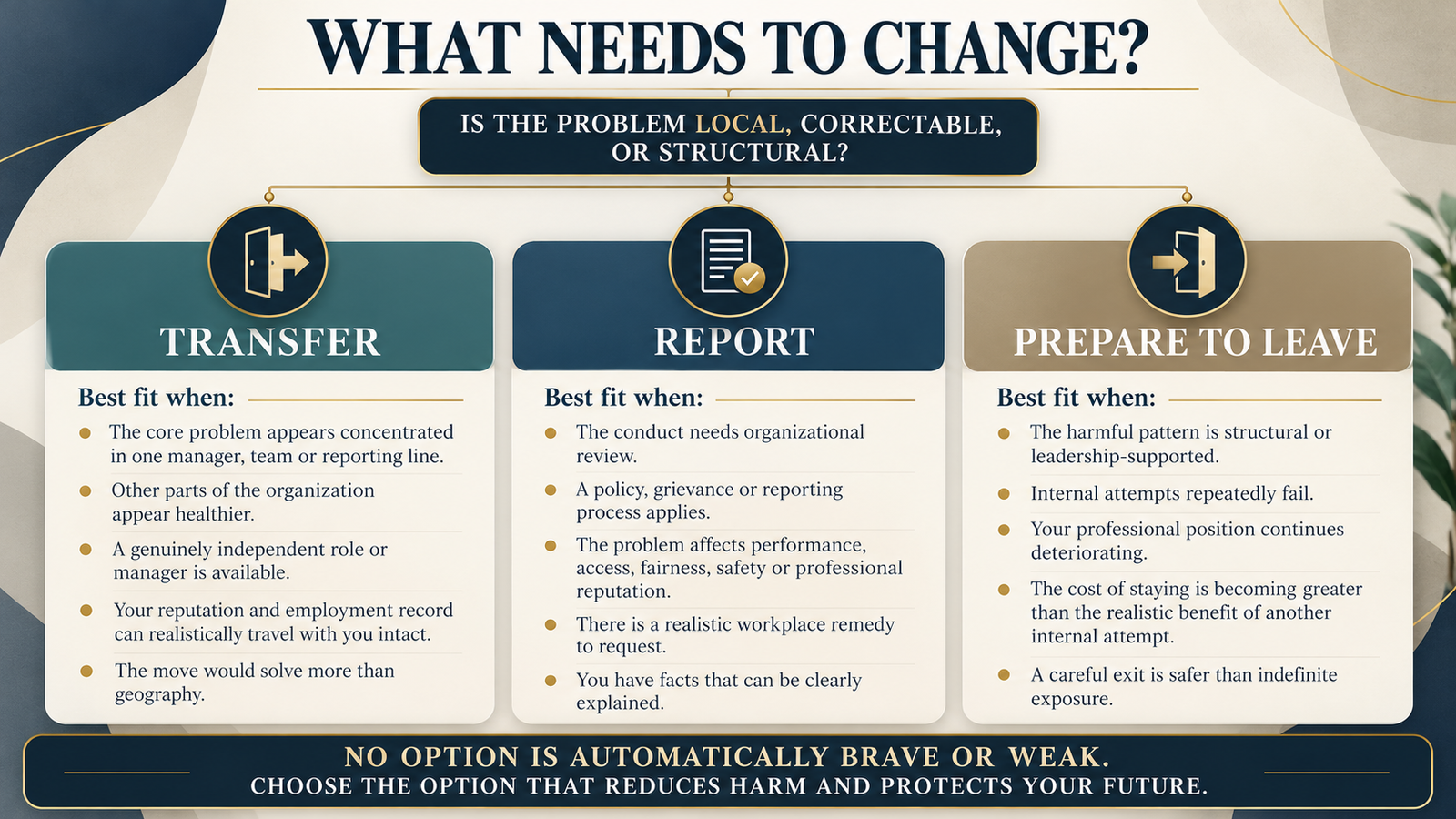
This question matters because each option changes something different.
| Option | What It Primarily Changes | What It May Not Change |
|---|---|---|
| Transfer | Your manager, team, reporting line, work environment or day-to-day relationships. | Organization-wide culture, senior leadership, company policies or an existing damaged record. |
| Report | Visibility of the problem and the possibility of organizational review or corrective action. | The underlying culture if leadership does not respond effectively. |
| Resign | Your future exposure to the workplace once employment ends. | The financial, career, legal and emotional consequences of leaving. |
The best option is therefore not simply the one that feels most decisive.
It is the one that actually addresses the source of the problem with an acceptable level of risk.
First Decide Whether the Problem Is Local or Structural
This distinction can completely change the decision.
A More Localized Problem Might Look Like:
- one manager behaving badly;
- one team with dysfunctional communication;
- a specific reporting relationship that has deteriorated;
- a conflict concentrated around one coworker;
- a problem that other departments do not appear to share.
A More Structural Problem Might Look Like:
- senior leadership rewards the behavior;
- multiple teams show the same pattern;
- HR repeatedly protects documented misconduct;
- performance systems are routinely weaponized;
- retaliation or exclusion follows reasonable concerns;
- high turnover is treated as normal;
- the organization depends on fear, favoritism or silence;
- your problem cannot realistically be separated from the wider culture.
A localized problem may be transferable.
A structural problem often travels with you.
When an Internal Transfer May Be the Least Harmful Option
An internal transfer can be attractive because it may allow you to preserve:
- income;
- benefits;
- organizational tenure;
- existing skills and institutional knowledge;
- some professional relationships;
- career momentum.
CIPD guidance on workplace conflict notes that moving an employee to another team or role can sometimes be considered where conflict is difficult to resolve, provided the move is fair, necessary, feasible and properly discussed with the employee. See CIPD guidance on workplace conflict.
But a transfer is only useful if it changes the conditions creating the problem.
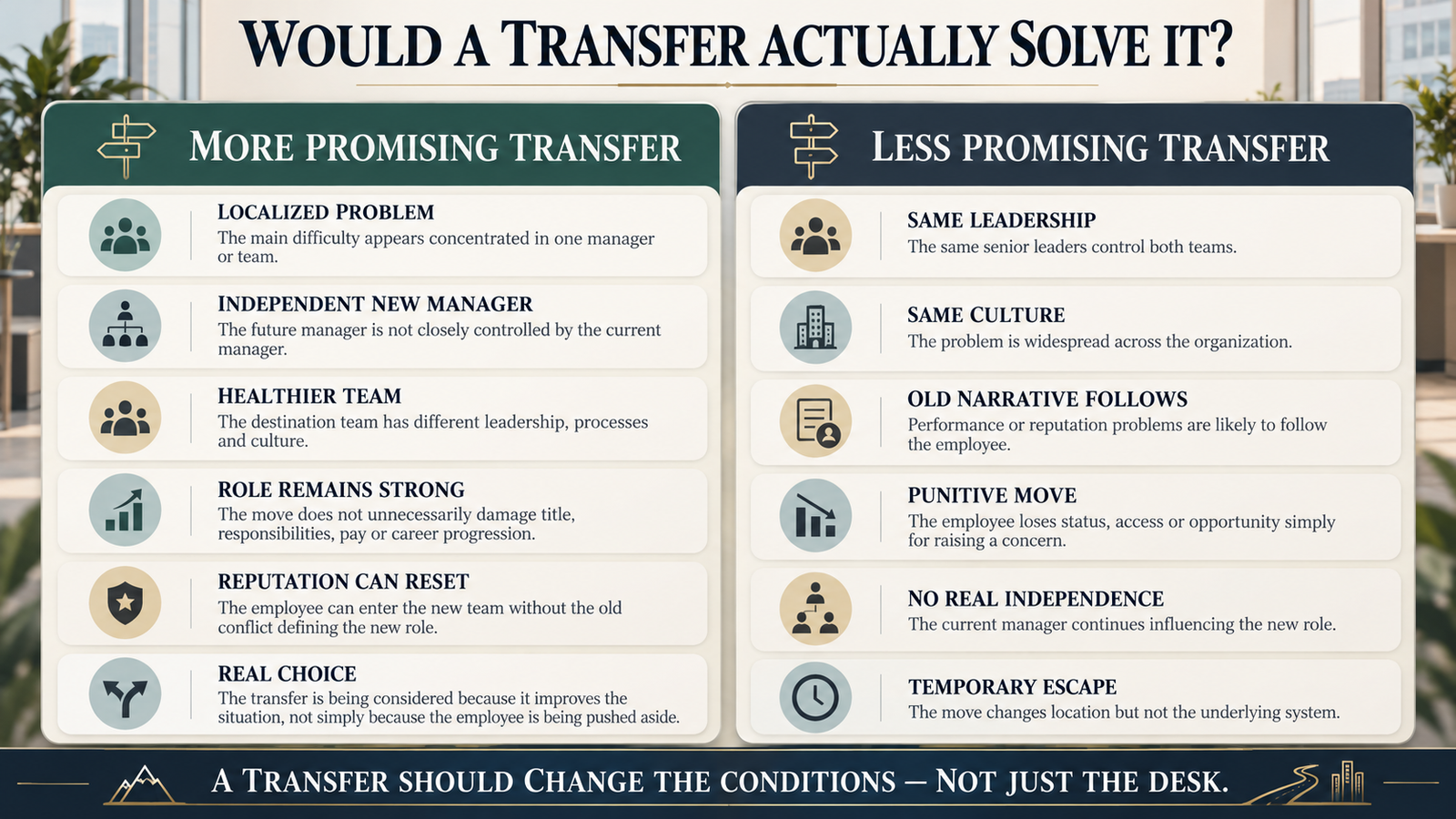
The Six-Part Transfer Test
1. Is the Problem Concentrated in One Team?
If most of the difficulty comes from one manager or team, a transfer may genuinely remove the source.
If the same behavior is reinforced by senior leadership, moving teams may only change the immediate messenger.
2. Is the New Manager Actually Independent?
Ask whether your current manager:
- influences the transfer decision;
- will continue reviewing your performance;
- works closely with the new manager;
- controls shared projects;
- has already shaped the story about you.
A new team is less protective if the same person still controls your career indirectly.
3. What Happens to Your Professional Record?
If your current record already contains disputed criticism, consider whether that record follows you.
A transfer does not automatically correct:
- an inaccurate review;
- disciplinary action;
- a false narrative about performance;
- damaged internal reputation.
Where important inaccuracies exist, consider whether they need clarification before or alongside the move.
4. Is the New Role Still a Good Career Move?
Do not allow a toxic manager to quietly push you into:
- a lower-level role;
- less meaningful work;
- reduced visibility;
- poorer promotion prospects;
- a role unrelated to your career direction.
A transfer can be strategic.
It can also become displacement disguised as a solution.
5. Does the Destination Team Look Healthier?
Before transferring, gather ordinary professional information:
- Who would manage you?
- How does the team communicate?
- Why is the role open?
- How long do people stay?
- What does success look like?
- How are mistakes handled?
- How much autonomy does the role have?
6. Are You Choosing the Transfer or Being Pushed Into It?
Those are different situations.
If you are being encouraged to move immediately after raising a concern, ask:
“Is this transfer being proposed as a resolution to my complaint, and will any aspect of my role, pay, responsibilities, reporting line or advancement opportunities change?”
Understand the terms before agreeing.
When a Transfer Is Probably Not Enough
Be cautious if:
- the same senior leadership controls both roles;
- HR itself is part of the problem;
- your current manager will still influence your evaluation;
- the workplace culture broadly rewards the harmful behavior;
- your reputation has already been damaged organization-wide;
- you are being moved instead of the underlying conduct being addressed;
- the new role significantly harms your career.
A different team cannot repair an organization that requires the same dysfunction everywhere.
When Reporting May Be Worth Trying Before You Leave
Reporting can make sense when the organization has something concrete it may be able to review or correct.
This may include:
- bullying;
- harassment;
- discrimination;
- retaliatory-looking changes;
- repeated performance-record inaccuracies;
- conflicting instructions;
- serious exclusion from necessary work;
- conduct that violates workplace policy.
ACAS advises workers experiencing bullying that a formal grievance may be appropriate when informal efforts have failed or the issue is too serious to resolve informally. See ACAS guidance on workplace bullying.
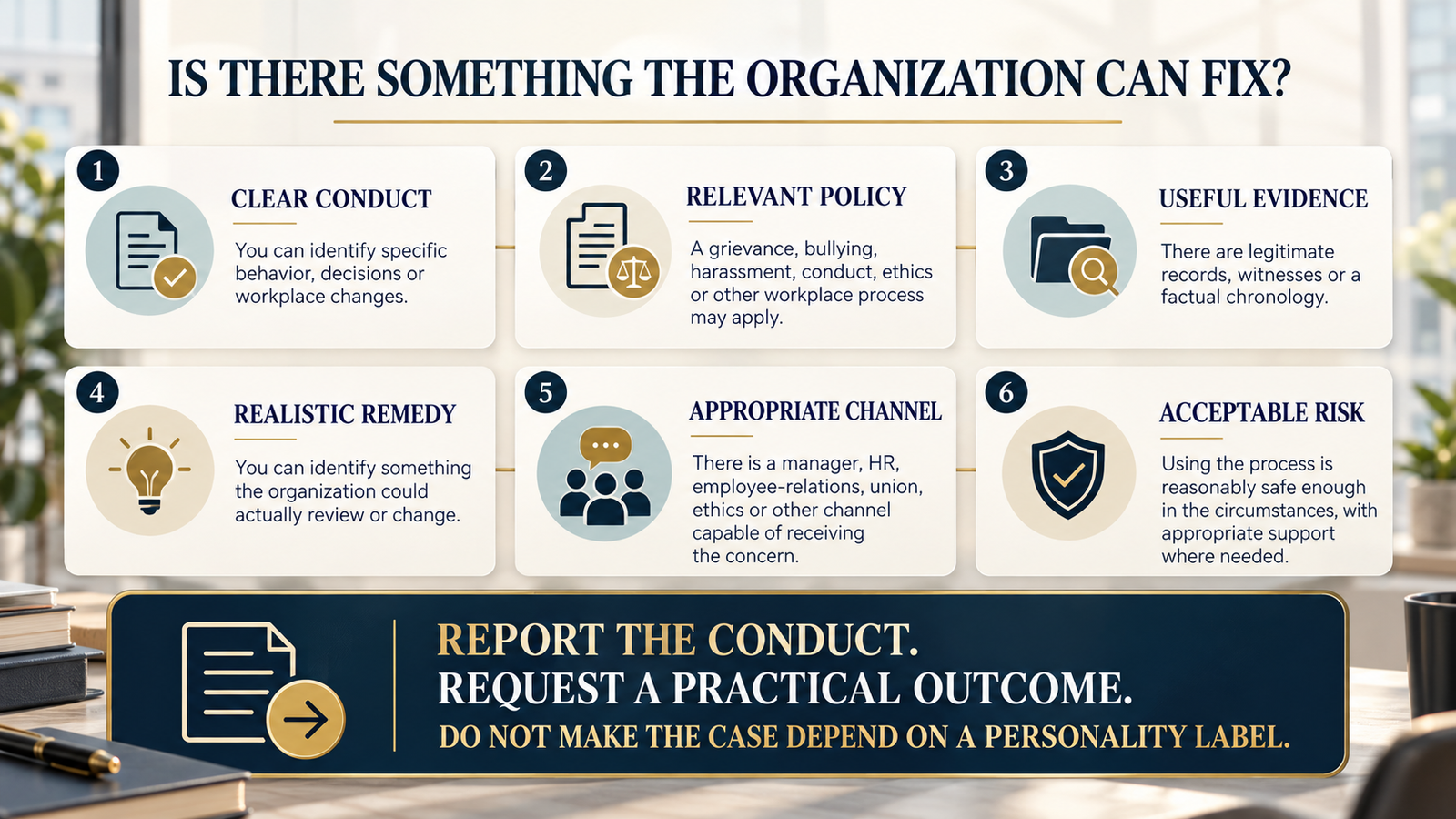
The Reporting Test: Is There a Realistic Workplace Remedy?
Before reporting, ask:
“What could the organization realistically do if it agreed that my concern was valid?”
Possible requests might include:
- reviewing documented incidents;
- investigating specific conduct;
- clarifying reporting responsibilities;
- correcting an inaccurate performance record;
- changing communication arrangements;
- reviewing retaliation concerns;
- establishing a different reporting line;
- explaining the grievance or appeal process.
A complaint becomes more actionable when it asks for something the organization can actually evaluate.
Instead of:
“My boss is toxic and needs to be removed.”
try:
“I would like these four incidents reviewed because the changing instructions have now resulted in two inaccurate performance concerns. I would also like written clarification of the approval and deadline process going forward.”
For a deeper reporting framework, see how to report a workplace concern to HR using facts rather than labels.
When Reporting May Be Less Likely to Solve the Core Problem
Reporting is not automatically the right answer simply because a formal process exists.
Its practical value may be lower when:
- the most senior leaders are directly involved;
- the organization has repeatedly ignored similar documented concerns;
- the workplace has no credible independent escalation route;
- previous reporting has materially worsened your position without correcting anything;
- the culture itself is the problem;
- the main issue is no longer correcting the workplace but leaving it safely.
This does not mean a report is pointless.
A report can still create a record, trigger a process or become relevant to later decisions.
But be clear about what you realistically expect it to change.
Do You Have to Report Before You Resign?
No universal rule says every person must exhaust every internal workplace process before leaving.
There may be good reasons to report first.
There may also be situations where another internal round is not worth the cost.
However, if legal rights may depend on what the employer knew, what opportunity it had to respond, or what happened before resignation, obtain location-specific advice rather than assuming the answer.
ACAS notes that where someone is considering resignation because of severe bullying and possible constructive dismissal, resignation is a major step and legal advice should be considered first. See ACAS guidance on constructive dismissal.
This is one reason exit strategy should begin before the resignation letter.
When Resignation Starts Becoming a Rational Option
Leaving becomes more reasonable when the evidence increasingly suggests that remaining is unlikely to produce enough benefit to justify the continuing cost.
Possible signals include:
- the harmful pattern continues despite reasonable attempts to resolve it;
- leadership supports or rewards the behavior;
- your responsibilities keep shrinking;
- your professional reputation is deteriorating;
- your performance record is becoming increasingly inaccurate;
- reasonable boundaries repeatedly trigger punishment or exclusion;
- the workplace no longer offers realistic development;
- you spend more energy surviving the environment than doing meaningful work;
- the situation is substantially affecting life outside work;
- a better external path is becoming available.
Your existing workplace-smear-campaign guide already captures an important Chapter 5 principle: an exit strategy does not necessarily mean resigning immediately; it can mean updating your resume, organizing professional evidence, building references and preparing options. :chatgpt-content-reference{index=”3″}
The Cost of Staying Is a Real Cost
People often evaluate resignation only through what they would lose by leaving.
That matters.
But staying also has a cost.
Consider whether the current environment is costing you:
- professional growth;
- accurate recognition;
- good references;
- confidence;
- energy outside work;
- ability to concentrate;
- access to useful projects;
- future earning potential;
- professional relationships.
WHO identifies psychosocial workplace risks including bullying, discrimination, exclusion, authoritarian supervision, unclear roles, low job control and poor organizational culture. See WHO guidance on mental health at work.
This does not mean every stressful job should be abandoned.
It means the cost of staying belongs in the decision alongside the cost of leaving.
Do Not Confuse “I Can Survive This” With “This Is Worth Staying For”
You may be capable of surviving another six months.
That does not automatically mean another six months is the best investment of your career.
Ask:
- What am I staying for?
- Is that benefit still real?
- What would need to improve?
- How likely is that improvement?
- What opportunity cost am I accepting by staying?
A strong decision is not only about endurance.
It is about direction.
Before You Resign: Protect the Options You Still Have
Resigning can be the correct decision and still be poorly executed.
Before giving notice, slow down long enough to review the practical consequences where circumstances allow.
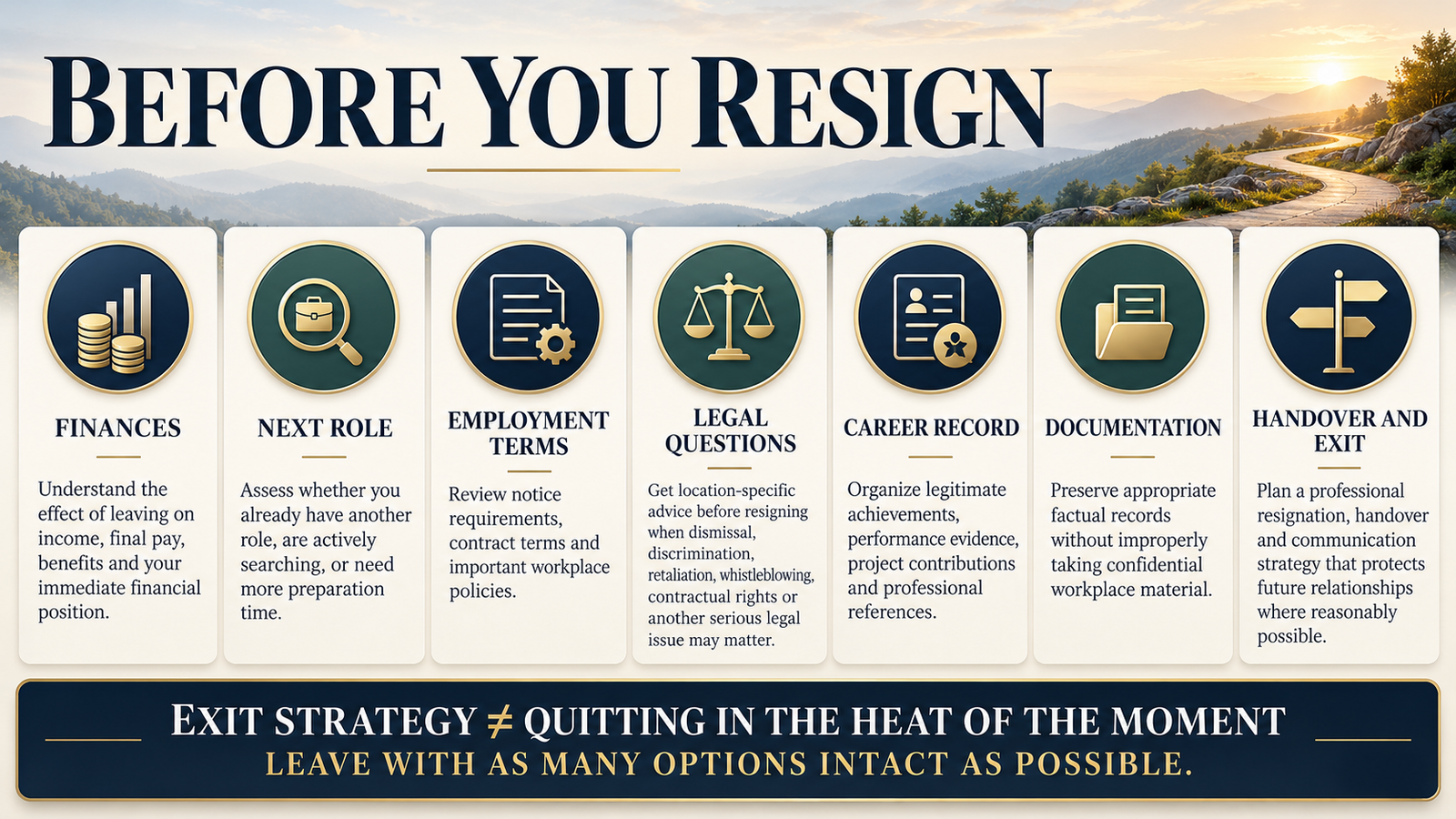
1. Review Your Financial Position
Understand what leaving may do to:
- salary;
- final pay;
- unused leave where applicable;
- bonuses or commissions;
- insurance or benefits;
- financial commitments;
- the amount of time you can reasonably job-search.
ACAS similarly advises people considering resignation because of a workplace problem to consider the effect on income and review their employment terms. See ACAS guidance on resignation.
The right financial threshold will differ between people.
The goal is simply to know the consequence before acting.
2. Review Your Contract and Notice Requirements
Check relevant terms concerning:
- notice period;
- final pay;
- company property;
- confidentiality;
- restrictive covenants where applicable;
- bonus or commission timing;
- handover responsibilities.
Do not assume the rules based on how a previous employer handled resignations.
3. Get Advice Before Resigning When Important Legal Issues May Exist
This is particularly important when the situation involves:
- possible discrimination;
- legally protected retaliation;
- whistleblowing;
- serious contractual breaches;
- unpaid wages;
- dismissal threats;
- settlement discussions;
- possible constructive-dismissal issues.
Employment law varies by jurisdiction and legal deadlines can be short.
Do not use a general blog article to calculate whether resigning helps or harms a specific legal claim.
4. Organize Your Professional Record
Before leaving, make sure you can reconstruct your real professional contribution using records you are legitimately entitled to retain or reference.
That may include:
- job description;
- non-confidential achievement summaries;
- performance feedback;
- awards or recognition;
- professional certifications;
- project names and results you can appropriately reference;
- contact details for suitable professional references.
Do not take confidential client files, internal databases, proprietary documents or restricted company material simply because it might be useful later.
For protecting your work record while still employed, see how to protect your work and professional credit.
5. Preserve Relevant Workplace Documentation Properly
If the workplace problem may matter later, organize your factual chronology before access to normal workplace systems ends.
But preserve evidence appropriately.
Your existing workplace incident log is designed for this purpose.
A useful record can identify:
- dates;
- people involved;
- what happened;
- available evidence;
- professional impact;
- what happened afterward.
The goal is not to download everything.
The goal is to preserve an accurate record.
6. Think About References Before You Leave
Your direct manager may not be the only person capable of speaking accurately about your work.
Consider appropriate professional relationships with:
- former managers;
- project leaders;
- senior colleagues;
- cross-functional partners;
- clients where appropriate;
- mentors.
Do not recruit coworkers into a campaign against your manager.
Simply maintain normal professional relationships with people who genuinely know your work.
7. Start the External Search Before You Need It
Exit strategy becomes easier when resignation is not the first step.
You can begin by:
- updating your resume;
- refreshing your portfolio;
- organizing achievements;
- reconnecting professionally;
- researching healthier employers;
- interviewing carefully;
- saving money where possible.
A job search does not force you to resign.
It creates optionality.
Do Not Resign Only to Prove a Point
A resignation letter is not usually the best place to deliver the final argument you wish your employer had understood.
A dramatic letter may feel satisfying for one evening.
It may also become part of your employment record.
Where a normal professional resignation is appropriate, concise communication may protect you better.
For example:
“Please accept this email as formal notice of my resignation from my position as [role], effective [date], in accordance with my notice period. I will support an orderly handover of my current responsibilities during that time.”
If specific legal reasons for leaving need to be recorded, seek appropriate advice before deciding how the resignation should be worded.
What If You Cannot Afford to Leave Yet?
Then resignation may not be today’s decision.
Your decision may be:
“How do I reduce harm while I create an exit?”
That could involve:
- stronger documentation;
- more structured communication;
- practical boundaries;
- reducing unnecessary personal disclosure;
- protecting your work and credit;
- looking for internal roles;
- building external job options;
- seeking professional support.
For operational workplace boundaries, see how to set boundaries with a manipulative boss professionally.
The goal is not to pretend the environment is healthy.
It is to survive the transition without surrendering every other priority.
What If Reporting Makes the Situation Worse?
First distinguish discomfort from material change.
Your manager may become more formal after a complaint.
That alone does not establish retaliation.
Pay closer attention to concrete changes such as:
- new discipline;
- significant loss of responsibilities;
- removal from necessary meetings;
- new performance claims;
- loss of opportunities;
- schedule or role changes;
- employment threats.
Document the change, timing, reason given and professional impact.
If legal retaliation may be involved, obtain location-specific advice rather than assuming that every negative event after a complaint is legally retaliatory.
What If HR Sides With Your Manager?
An unfavorable HR outcome does not automatically mean:
“I have to quit tomorrow.”
First understand what the outcome actually says.
Was the complaint:
- not substantiated?
- partly substantiated?
- outside the policy?
- unsupported by enough evidence?
- treated as a communication issue?
Then review:
- appeal options;
- transfer possibilities;
- what has changed since reporting;
- legal or union advice where appropriate;
- whether the workplace remains viable.
The important question becomes:
“Given what I now know about the organization, what is my best remaining option?”
What If the Toxic Boss Is Senior or Powerful?
Power changes the practical risk.
A senior leader may influence:
- HR;
- internal transfers;
- performance ratings;
- promotion;
- references;
- how other leaders perceive you.
This does not mean nothing can be done.
It means your decision framework should include the organization’s actual power structure.
Ask:
- Is there a genuinely independent reporting channel?
- Can a transfer remove their influence?
- Does senior leadership tolerate the behavior?
- What happened to other people who raised concerns?
- What options exist outside the organization?
Do not build your strategy around an imaginary organizational independence that does not actually exist.
What If the Job Is Good but the Manager Is Not?
This is the strongest case for seriously exploring a transfer.
Suppose:
- the company still offers good opportunities;
- other teams appear well managed;
- your skills are valued;
- the pay and benefits are strong;
- the main problem is one reporting relationship.
Leaving the entire organization may carry more cost than necessary.
But investigate the destination carefully.
Do not transfer based only on:
“Anywhere is better than here.”
Make sure the new role solves the relevant problem.
What If the Whole Organization Feels Toxic?
Internal movement becomes less promising when:
- the same behavior appears across teams;
- senior leaders normalize it;
- high turnover is routine;
- complaints disappear without meaningful review;
- favoritism or fear drives decisions;
- your professional values repeatedly conflict with the culture.
At that point, the decision may no longer be:
“Which team should I transfer to?”
It may be:
“How do I build enough financial and professional readiness to leave well?”
Use a Decision Matrix Instead of Deciding on the Worst Day
| Factor | Transfer | Report | Prepare to Leave |
|---|---|---|---|
| Problem is mainly one manager/team | Potentially strong option | May still help | May be unnecessary if a healthy internal role exists |
| Problem is organization-wide | Less likely to solve it | Value depends on independence of process | More important to evaluate |
| Clear policy issue exists | Possible parallel option | Potentially useful | Can still prepare while process runs |
| Reputation is already seriously damaged internally | May not fully reset it | May provide correction if process works | External reset may become more valuable |
| Job remains strong except for current environment | Worth exploring | Depends on conduct | Compare against internal opportunity |
| Repeated repair attempts have failed | Depends on whether destination is independent | Formal process may be next | Exit readiness should increase |
| Work is substantially affecting life outside work | Useful only if conditions truly change | Useful only if process can reduce exposure | Cost of continued staying deserves greater weight |
This table does not make the decision for you.
It stops one emotional moment from making the entire decision.
The Least Harmful Option Can Change Over Time
You do not have to make one permanent decision today.
For example:
Week 1: Document and clarify.
Week 2: Explore internal transfer options.
Week 3: Raise the formal concern.
Meanwhile: Update your resume and start looking externally.
After more information arrives, your decision may change.
Reporting may reveal that leadership is responsive.
A transfer opportunity may appear.
Or the organization’s response may confirm that leaving is the more rational choice.
Strategy should respond to evidence.
Chapter 5: The Smart Exit Strategy
Chapter 5 of Reclaim Your Power is built around one central distinction:
Leaving strategically is different from escaping impulsively.
A smart exit strategy can involve:
- understanding what has become unworkable;
- testing whether repair is realistic;
- protecting your professional record;
- preserving appropriate evidence;
- reviewing financial consequences;
- building external opportunities;
- protecting references;
- deciding when the cost of waiting exceeds the benefit.
The actual resignation may be one of the final steps.
Not the first.
The live Reclaim Your Power workbook includes an Exit Readiness Checklist alongside documentation, boundary and recovery tools designed for this exact transition. See what is included in Reclaim Your Power.
Frequently Asked Questions
Should I transfer or quit a toxic job?
A transfer may be worth considering when the problem appears concentrated in one manager, team or reporting relationship and the destination role is genuinely more independent and healthy. Leaving may become more realistic when the problem is structural, your reputation or career is continuing to deteriorate, or internal attempts repeatedly fail.
Should I report my toxic boss before quitting?
There is no universal requirement that everyone report before leaving. Reporting may be useful when a workplace process applies and there is a realistic remedy the organization could provide. If legal rights may depend on the sequence of events, obtain location-specific advice before making an irreversible decision.
Can transferring departments solve a toxic-boss problem?
Sometimes. A transfer is more promising when the problem is localized, the new manager is genuinely independent and the new team has healthier working conditions. It may help less when the same leadership, culture or damaged reputation follows you.
How do I know if the whole workplace is toxic?
Look for patterns across teams and leadership rather than one difficult relationship. Warning signs can include repeated tolerance of bullying, retaliation, favoritism, high turnover, fear-based management, weak complaint processes and the same problems appearing under multiple managers.
When is it time to leave a toxic job?
Consider leaving more seriously when the harmful pattern continues despite realistic attempts to improve it, your professional position keeps deteriorating, internal alternatives are not credible, and the continuing cost of staying outweighs the realistic benefits.
Should I quit without another job?
There is no universal answer. Consider finances, safety, employment terms, health and wellbeing, available support, job-market conditions and any legal implications. When circumstances allow, creating financial and career options before resigning generally gives you more control.
Should I resign immediately after workplace bullying?
Not automatically. Immediate departure can sometimes be necessary, but resignation can also have financial, contractual and legal consequences. If serious legal or employment issues may be involved, obtain appropriate advice before resigning where possible.
Can I report a workplace problem while looking for another job?
Yes. Internal reporting and external job preparation are not mutually exclusive. You can use a workplace process while also protecting your future options.
Is transferring instead of reporting cowardly?
No. A transfer is a career decision, not a moral test. If moving to another team removes the harmful conditions while preserving your employment and career, it may be a practical solution.
Is quitting a toxic job giving the bully what they want?
Your career decision does not need to be organized around defeating another person. The more useful question is whether remaining or leaving better protects your work, future opportunities, financial position and wellbeing.
What should I document before leaving a toxic job?
Maintain a factual chronology of significant incidents, relevant performance information, important workplace decisions and professional impact. Also organize legitimate records of your achievements and contributions. Do not improperly remove confidential or restricted workplace material.
What if I cannot afford to quit yet?
Focus on reducing harm while building options. Strengthen documentation, clarify expectations, protect your work, explore transfers, update your resume, build external opportunities and seek appropriate professional support.
Can I ask HR for a transfer instead of filing a complaint?
You can ask about transfer options, but understand whether the transfer resolves the underlying problem and whether it changes your title, duties, compensation, reporting relationship or career progression. Depending on the conduct involved, you may still decide that a formal concern needs to be recorded.
What if HR already rejected my complaint?
Review what HR actually decided, whether an appeal exists, whether a credible internal transfer remains possible and whether external advice is appropriate. An unfavorable HR outcome can also provide useful information about whether the organization remains workable.
What if staying is affecting my wellbeing?
Include that impact in the decision rather than evaluating the job only through salary. WHO recognizes bullying, exclusion, poor organizational culture, low job control and similar working conditions as psychosocial risks. Appropriate healthcare or mental-health support can also help you assess and manage the impact while you decide what to do.
Final Thoughts: Do Not Ask Which Option Looks Strongest — Ask Which One Protects You Best
Transfer.
Report.
Resign.
None of those words tells you whether the decision is good.
A transfer can be strategic—or it can move you sideways while the same problem follows.
A report can create accountability—or reveal that the system will not change.
A resignation can protect your future—or create unnecessary financial and career damage if made impulsively.
So do not choose the option that sounds strongest.
Choose based on what you know.
Ask:
- Where does the problem live?
- What would have to change?
- Which option can actually change it?
- What is the realistic risk of that option?
- What is staying already costing me?
- What do I need to protect before making the move?
If the problem is local and the organization still has healthy places to work, explore transfer.
If there is something concrete the organization may be able to correct, consider reporting.
If the system repeatedly shows that it cannot or will not become workable, begin building the safest exit you reasonably can.
And remember:
An exit strategy starts when you begin protecting your options—not when you finally hand in your resignation.
If you are still documenting the pattern, use the Workplace Incident Log and How to Document Workplace Abuse.
If the immediate issue is pressure from your manager, see How to Set Boundaries With a Manipulative Boss Professionally.
Make the Next Step Part of a Larger Exit Strategy
Reclaim Your Power does not treat leaving as a single dramatic event.
Chapter 4 focuses on protecting your work, boundaries, evidence and professional position while the problem is still active.
Chapter 5 helps you evaluate staying, transferring, reporting and leaving without allowing one difficult day to make the entire decision.
Chapter 6 focuses on recovery after prolonged workplace strain.
Chapter 7 helps you carry stronger boundaries, red-flag awareness and professional confidence into the next workplace.
The accompanying workbook includes an Exit Readiness Checklist along with pattern-recognition, documentation, boundary and career-recovery tools. Explore Reclaim Your Power and the complete workplace recovery guide and workbook.
Employment and professional-support disclaimer: This article provides general educational information only. It is not legal, financial, medical, mental-health, employment or career advice. Workplace policies, employment contracts, resignation requirements, discrimination protections, retaliation rules, constructive-dismissal standards and legal deadlines vary by jurisdiction and circumstances. Do not rely on a general article to determine the legal consequences of resigning, transferring or reporting a workplace concern. Seek appropriately qualified advice when serious employment, legal, financial, safety or wellbeing issues are involved.
Ready to Reclaim Your Power?
Get the 376-page digital edition with 7 chapters, 22 practical tools, reusable forms, an optional 30-entry journal, and references.
Buy Now — $4.99
Leave a Reply