
You finish a difficult workday and still need to research vacancies, update your resume, write applications, respond to recruiters, prepare for interviews, and decide whether a new employer would actually be better.
At the same time, you may not be ready to resign. You may need your income, benefits, professional relationships, or time to assess the job market before making a major change.
You can begin looking for a new job while remaining employed without abandoning your current responsibilities or rushing into the first available offer.
The challenge is making the search manageable.
That means knowing which jobs deserve your attention, keeping personal career planning separate from employer systems, arranging interviews responsibly, preparing credible references, and protecting enough energy to make thoughtful decisions.
It also means recognizing an important distinction: a new employer is not automatically a better employer simply because it offers an escape from your current situation.
This guide explains how to job search while working in a toxic environment, including practical applications, interview scheduling, recruiter conversations, weekly planning, references, offer evaluation, and the transition from receiving an offer to giving notice.
Can You Look for Another Job While Still Employed?
In many ordinary employment situations, people explore other opportunities while continuing in their current positions. Seeking career advancement, different responsibilities, or a healthier working environment is a normal reason to consider a change.
However, the rules that apply to particular employees can differ according to their location, contract, industry, professional obligations, and workplace policies.
For example, an employment agreement may contain rules about conflicts of interest, outside work, competing businesses, use of company equipment, or disclosure of confidential information.
Looking for another job does not automatically give you permission to disregard those obligations. Nor does it mean you must announce every possible career move before you know whether another opportunity exists.
Indeed’s 2026 guidance on finding a job while employed recommends separating personal applications from work resources, arranging interviews thoughtfully, and maintaining discretion in professional communications.
The useful principle is to keep your job search professional and consistent with the obligations that apply to your current role.
Why Job Searching in a Toxic Workplace Feels Different
Not every difficult workplace creates the same problem. A demanding role with clear expectations is different from a workplace where employees regularly face humiliation, shifting standards, exclusion, or threats.
When the environment is harmful, several challenges may appear at the same time.
You Have Less Energy After Work
It is harder to prepare a strong application when you have spent the day defending ordinary decisions, managing conflict, or trying to understand changing instructions.
You May Question Your Professional Value
Repeated criticism or undermining can make it more difficult to describe your achievements confidently. You may remember the conflict more readily than the useful work you completed.
You May Feel Pressure to Accept Anything
When the immediate priority is getting away from the current environment, a new offer can seem attractive before you have examined its management, workload, and employment terms.
Interview Scheduling May Be More Complicated
A manager with unpredictable expectations can make it difficult to arrange appointments. Your workday may not end at the same time every day, and you may need to plan around existing responsibilities.
You May Have Reference Concerns
If the working relationship with your current supervisor is strained, you may be unsure whether that person can provide an accurate or useful professional reference.
The answer to these challenges is not necessarily to work harder at job searching. It is to create a process that gives each task a defined purpose.
The Five-Stage Job Search Framework
Instead of treating the search as one enormous task, divide it into five stages.
| Stage | Main Question | Useful Outcome |
|---|---|---|
| 1. Target | What kind of role and working conditions am I actually seeking? | A focused list of suitable positions and important requirements. |
| 2. Prepare | How can I accurately demonstrate my experience? | An updated resume, professional profile, and examples of relevant work. |
| 3. Apply | Which openings are worth a thoughtful application? | Relevant submissions and an organized application record. |
| 4. Interview | How can I explain my background and evaluate the employer? | Prepared answers, workable scheduling, and information about the new role. |
| 5. Evaluate | Is the actual offer an improvement worth accepting? | A considered decision based on role, management, finances, and employment terms. |
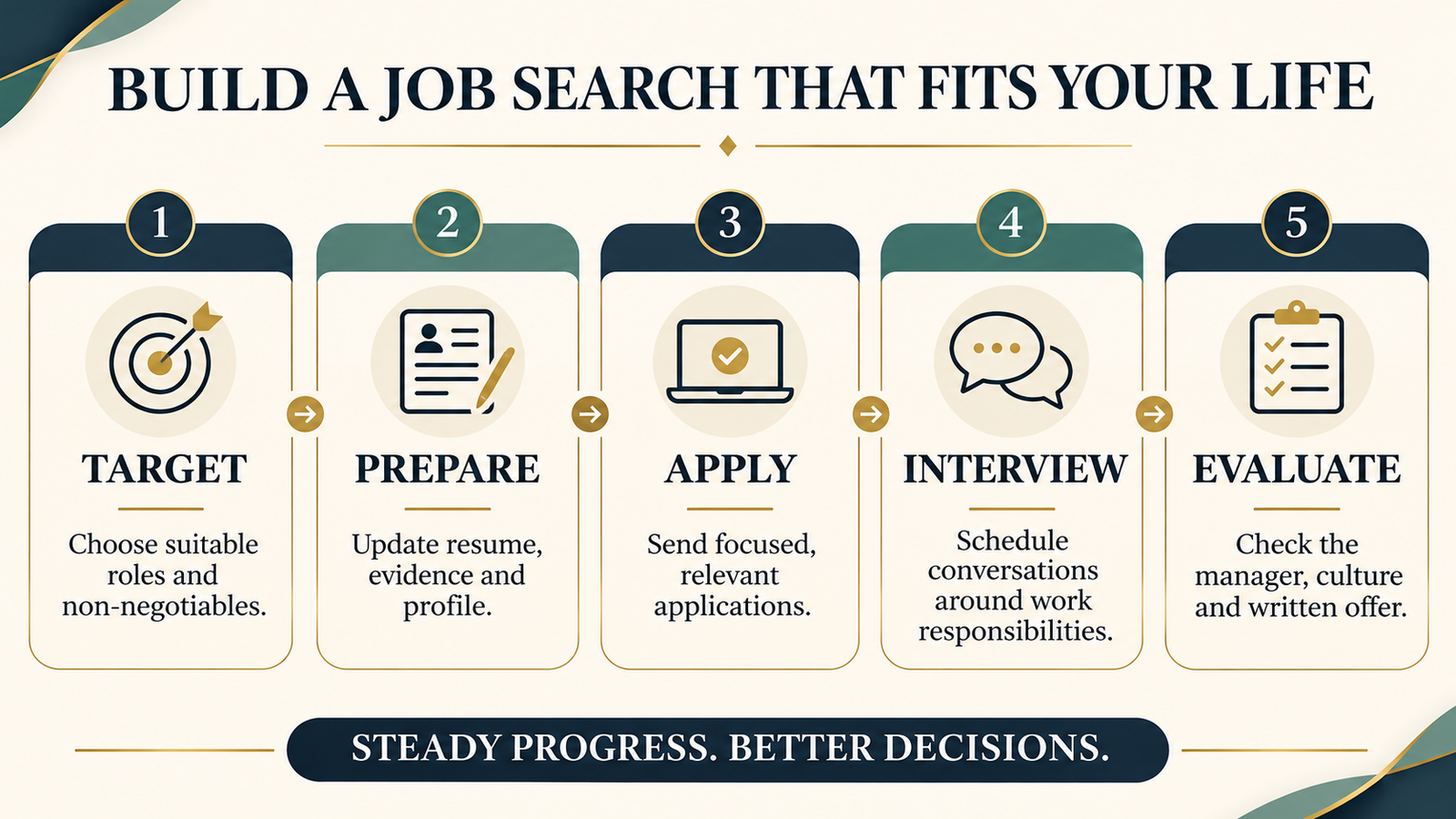
You do not need to finish one stage permanently before moving to another. Applications, interviews, and employer research may overlap. But every task should contribute to a clear objective.
Step 1: Decide What You Are Searching For Before Opening Job Boards
After an unhealthy workplace experience, it is understandable to begin searching for anything that looks different.
But a broad search can consume time and produce opportunities that do not fit your experience or needs.
Start by defining three categories.
1. Your Target Roles
Select a manageable group of positions that use your actual skills. If you have a background in project management, for example, you may be targeting project coordinator, project manager, or operations roles rather than applying across unrelated industries without a strategy.
2. Your Working Requirements
Identify conditions that materially affect whether a job is workable for you.
These could include:
- compensation appropriate to your circumstances;
- location and commute;
- working hours or shift requirements;
- remote, hybrid, or on-site arrangements;
- level of responsibility;
- training and development;
- managerial support;
- travel obligations.
3. Your Career Direction
Think beyond leaving the current manager. Ask what you want the next position to make possible.
Perhaps you want more ownership, more technical work, better opportunities to learn, less travel, clearer performance expectations, or a position more closely aligned with your long-term goals.
The stronger your target, the less time you spend on vacancies that would never be a reasonable choice.
A Simple Target-Role Statement
“I am looking for a role in [field] where I can use [two or three established strengths], with responsibilities focused on [type of work] and working arrangements compatible with [important requirement].”
Use that statement as a filter when reviewing job descriptions.
Step 2: Rebuild Your Resume Around What You Actually Accomplished
A difficult workplace can distort how you remember your recent experience.
You may immediately recall criticism, disagreements, or a manager dismissing your contribution. But prospective employers need evidence of your actual abilities.
Start with a factual inventory of your work.
- What projects did you contribute to?
- What responsibilities did you manage?
- Which tools or processes did you use?
- What problems did you solve?
- What work did you complete consistently?
- Did you improve a process or help a team deliver something?
- What outcomes can you describe accurately?
Then convert those facts into concise resume statements.
Example: Weak Resume Description
“Responsible for reports and team communication.”
More Useful Description
“Coordinated weekly reporting across multiple stakeholders, maintained project updates, and tracked approvals to support timely delivery.”
Use numbers where you genuinely know and can support them. Do not invent performance improvements or claim sole ownership of work completed by a team.
Be Careful With Work Samples
Do not copy confidential reports, customer information, restricted source code, internal databases, or proprietary documents into a private portfolio merely because they demonstrate your skills.
Where permission is required, obtain it. Otherwise, consider creating an original demonstration using fictional data or publicly available materials.
Protecting your professional history is different from taking your employer’s confidential property.
Keep Your Job Search Separate From Current Work
A useful boundary is to keep your personal career planning separate from the systems and responsibilities of your current employer.
As a general practice, use appropriate personal devices, personal accounts, and personal time for job searching rather than assuming company systems are private or available for that purpose.
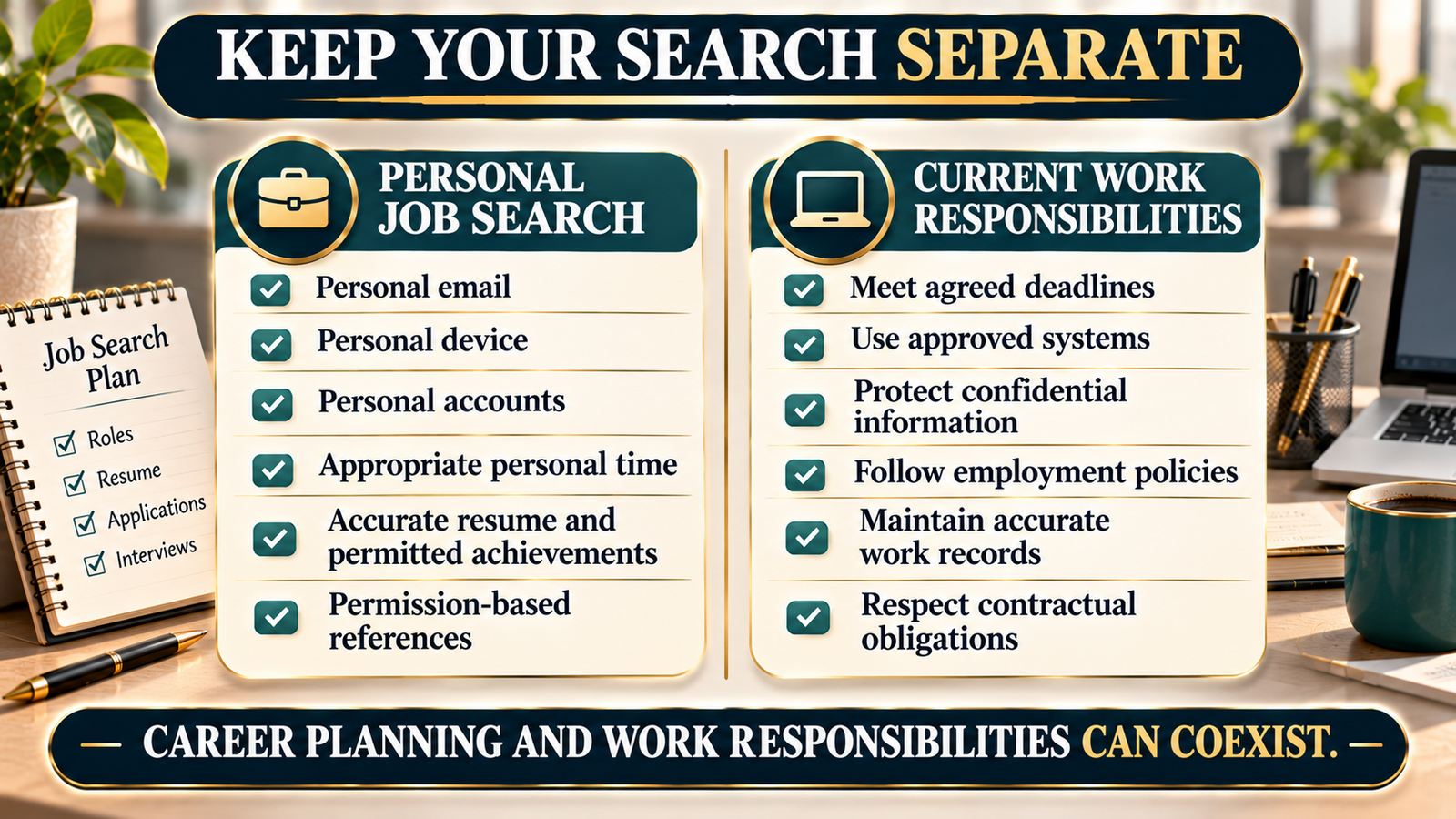
Why Company Systems Matter
Depending on local laws and employer policies, organizations may monitor some activity on company devices, accounts, and networks. In the UK, GOV.UK explains workplace monitoring rules, including requirements around informing workers about monitoring. Other jurisdictions may have different rules.
Using your own resources is an appropriate way to separate personal matters from employer responsibilities. It should not be confused with attempting to defeat legitimate security controls, access restricted information, or conceal misconduct.
Respect Your Existing Responsibilities
Continue meeting reasonable work expectations and clarify competing priorities where necessary.
For example:
“Both reports are currently assigned for Friday. Given the available time, which should take priority if both cannot be completed to the required standard?”
That keeps a professional record of your work while you independently consider your next career move.
If your workplace has ongoing issues involving changing instructions or unfair criticism, the Workplace Incident Log explains how to document important events factually.
How to Update LinkedIn When You Are Still Employed
LinkedIn can help recruiters understand your experience, but professional profiles and job-search settings have different visibility rules.
Before changing your settings, understand the distinction between:
- the information visible on your public profile;
- notifications about profile changes;
- job-search interests shared with recruiters;
- applications submitted through the platform.
LinkedIn’s official Open to Work guidance explains that the “Recruiters only” setting takes steps to limit visibility to recruiters at your current company, but cannot guarantee complete privacy.
LinkedIn also has settings controlling whether profile updates generate network notifications. Turning those notifications off does not make the updated information invisible to someone who views your profile.
Review the official profile-update visibility guidance before assuming how a change will appear.
Make the Profile Useful, Not Dramatic
Your profile should communicate your qualifications, experience, skills, and professional interests.
A profile summary such as:
“Project professional with experience coordinating cross-functional delivery, reporting, stakeholder communication, and operational improvements.”
is more useful than a public announcement about how difficult your current manager has become.
Use truthful descriptions of current employment and responsibilities.
Step 3: Apply Selectively Instead of Applying Everywhere
It is tempting to believe that sending more applications will automatically lead to a faster exit.
But application quality matters, particularly when you have limited time and energy.
A focused application demonstrates why your experience matches the specific opening.
Review a Vacancy Before Applying
Look at:
- the main responsibilities;
- essential qualifications;
- experience requirements;
- location and working arrangements;
- compensation information when available;
- the reporting structure;
- whether the role supports your career direction.
Do not automatically reject an otherwise reasonable position because you lack every preferred qualification. Distinguish essential requirements from employer preferences and assess whether you could realistically perform the work.
Tailor the Resume Without Distorting the Facts
Use the terminology of the role where it accurately describes your experience.
For example, if a job requires stakeholder coordination and you genuinely coordinated different teams, make that experience easy to identify.
Do not insert technical skills, credentials, or responsibilities you do not possess simply to match an automated screening system.
Use a Short Application Checklist
- Does this position fit my target?
- Does my resume make the relevant experience visible?
- Have I answered the application questions accurately?
- Have I checked the employer and application source?
- Do I understand the expected location and working arrangement?
- Have I recorded the application so I can follow up appropriately?
Use a Job Application Tracker
When you are applying after demanding workdays, it becomes easy to forget which version of your resume you submitted, which recruiter contacted you, or when an interview was scheduled.
A simple tracker reduces this administrative burden.
| Field | What to Record | Why It Helps |
|---|---|---|
| Employer and role | Company name and position | Identify the exact opportunity. |
| Date applied | Submission date | Keep an accurate application history. |
| Application source | Official employer site, referral, or job platform | Revisit the original information. |
| Stage | Applied, screening, interview, offer, declined, or closed | See what needs attention. |
| Next action | Follow-up, interview preparation, or document review | Make the next step specific. |
| Important questions | Role scope, workload, manager, compensation | Investigate unresolved details. |
A tracker does not need to become another complicated project. A spreadsheet, private document, or suitable application organizer may be enough.
Keep information accurate and avoid storing unnecessary sensitive information about recruiters or employees.
Step 4: Use Your Professional Network Thoughtfully
Not every opportunity comes from a public vacancy. Former colleagues, professional contacts, alumni, mentors, and people working in your field may know about relevant openings or offer perspective on an employer.
Networking does not need to mean publicly criticizing your current workplace or asking everyone you know for a job.
A Simple Networking Message
“Hi [Name], I hope you’re doing well. I’m exploring opportunities in [field or role type] and remembered your experience in that area. If you know of relevant teams or openings, I would appreciate any suggestions. I’m happy to share a brief summary of my background.”
Keep the request modest and professional.
When Asking for an Introduction
“I saw the [role] position at [company] and noticed you have experience with the organization. Would you be comfortable sharing your perspective on the team or the recruitment process?”
Allow the person to decide whether they can help. Do not pressure someone into making a referral or speaking about internal information they are not authorized to share.
Professional networking is valuable partly because it gives you information about real working conditions before you accept an offer.
How to Schedule Job Interviews While You Are Working
Interview scheduling is one of the most practical challenges of searching while employed.
Recruiters may propose appointments during ordinary working hours, while your current role may involve meetings, deadlines, or unpredictable requests.
You can explain your availability professionally without inventing a story.
Ask for a Suitable Interview Time
“Thank you for the invitation. I’m currently employed and want to respect my existing work commitments. Would an early morning, late afternoon, or another mutually convenient interview time be possible?”
Ask About a Virtual Interview
“Would the initial conversation be suitable for a video call? That would help me coordinate the appointment around my existing responsibilities.”
Use Appropriate Leave Where Needed
Depending on your role and workplace arrangements, annual leave, personal leave, flexible working, or approved time away may be options.
Do not assume you have a legal right to paid time off for interviews in every jurisdiction. For example, UK Citizens Advice guidance says employees are not usually entitled to time off for ordinary job interviews, although redundancy situations can be different.
Use the rules and approved arrangements that apply to your situation rather than fabricating an emergency or medical reason for an interview.
For Video Interviews
Prepare a suitable personal location with a reliable connection, reasonable lighting, a functioning microphone, and minimal interruptions. Do not assume a shared office meeting room or employer-owned device is available for a personal interview.
Allow for the possibility that an interview may run longer than expected. Ask how long the conversation should take and whether additional stages are expected.
How to Explain Your Current Toxic Workplace to Recruiters
A prospective employer may ask:
“Why are you looking for another role?”
You do not need to describe every incident involving your manager. But you should be accurate about the employment situation.
A useful answer explains the main professional reason for moving and then connects your goals to the vacancy.
Example: You Need Clearer Responsibilities
“My current role has developed in a direction with less consistent ownership and priorities than I expected. I’m looking for a position where I can contribute through clearer project responsibilities, and this role seems closely aligned with that experience.”
Example: The Management Relationship Became Difficult
“The management approach and working environment have become a less sustainable fit over time. I’m looking for a role where I can use my experience in [relevant area] with clear expectations and constructive working relationships.”
Example: The Role No Longer Supports Your Growth
“I’ve gained useful experience, but opportunities to develop further in the position have become limited. I’m interested in roles with greater responsibility in [specific area].”
Use only language that is true for your situation. Do not invent a restructuring, promotion opportunity, or other reason for leaving.
If a recruiter directly asks about a dismissal, disciplinary outcome, or other material employment fact, answer accurately rather than using general career language to conceal the truth.
How to Handle References While Still Employed
Some employers request references early. Others wait until a later recruitment stage or a conditional offer.
Ask what the process involves rather than assuming the recruiter will never contact your current workplace.
Consider professional referees who have direct knowledge of your work, such as former supervisors, project leads, or other appropriate colleagues.
Before listing someone, ask whether they are willing to provide a reference and how their professional relationship to you should be described.
If a Recruiter Asks to Contact Your Current Manager
“My current employer has not yet been informed of my job search. Could you explain when current-employer references are normally requested? I can provide other professional referees with direct knowledge of my work at this stage.”
This is a reasonable request for clarity, not a guarantee that every employer can accommodate it.
If a role has mandatory verification or screening requirements, understand those requirements and answer honestly.
For further guidance, read How to Protect Your References After Leaving a Difficult Manager. That article covers alternative referees, employer verification, inaccurate references, and maintaining a credible professional record.
A Flexible Weekly Job Search Schedule
One reason employed candidates become overwhelmed is that job searching has no natural stopping point.
There is always another vacancy, another resume revision, another employer to investigate, or another article about interview techniques.
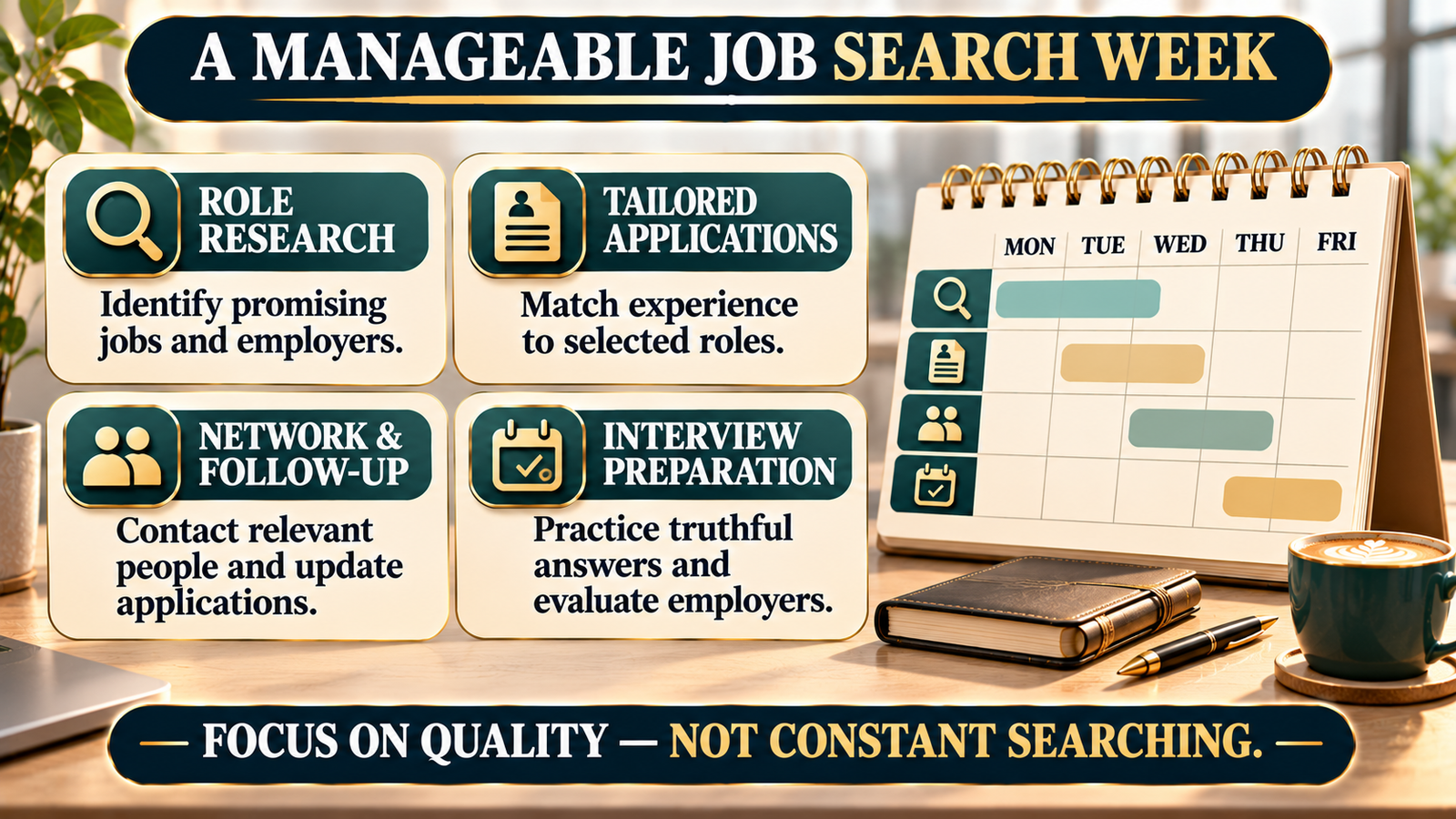
Define a manageable rhythm instead.
The following is an illustrative schedule, not a required number of hours or applications.
| Session | Focus | Useful Output |
|---|---|---|
| First available session | Research a small number of suitable roles. | A shortlist of openings worth reviewing further. |
| Second session | Tailor and submit relevant applications. | Completed applications with accurate information. |
| Third session | Check recruiter messages, networking, and follow-ups. | Updated application statuses and next actions. |
| Final review | Prepare for interviews and assess progress. | A short plan for the following week. |
When You Have Only a Short Amount of Time
Choose one meaningful task.
For example:
- review one promising opening;
- improve one relevant resume section;
- send one thoughtful networking message;
- prepare one interview example;
- research one potential employer.
Completing a small task is useful even if you cannot complete an entire application that day.
When You Have More Time
Use the additional time for deeper employer research, more tailored applications, or interview preparation rather than automatically expanding the number of vacancies.
Protecting time for rest, personal responsibilities, and life outside work can also help you make more considered career decisions.
What to Do When Your Current Manager Adds More Pressure
Job searching does not eliminate the problems of the current workplace.
Your manager may continue changing deadlines, criticizing work, assigning additional responsibilities, or handling communication poorly.
Try to manage those issues through normal professional processes rather than revealing or arguing about your job-search plans as a reaction to every difficult day.
Clarify Competing Priorities
“I can complete the client update or the revised presentation by Thursday. Which should take priority?”
Confirm a Changed Instruction
“Confirming the change from today’s meeting: the revised deadline is Monday, and the report should include the additional figures.”
Keep Relevant Records Appropriately
Document significant workplace concerns factually, but do not turn your job search into a reason to collect confidential information or access documents outside your authority.
If the ongoing conduct is serious, the existing Workplace Incident Log can help distinguish the facts from assumptions.
A future job search and an appropriate workplace complaint are not automatically mutually exclusive. They may require different records, professionals, and decisions.
Before You Accept an Offer, Investigate the Next Workplace
When your current job feels unbearable, an offer from another company can seem like a solution before you have examined it.
Try to evaluate the new opportunity on its own merits.
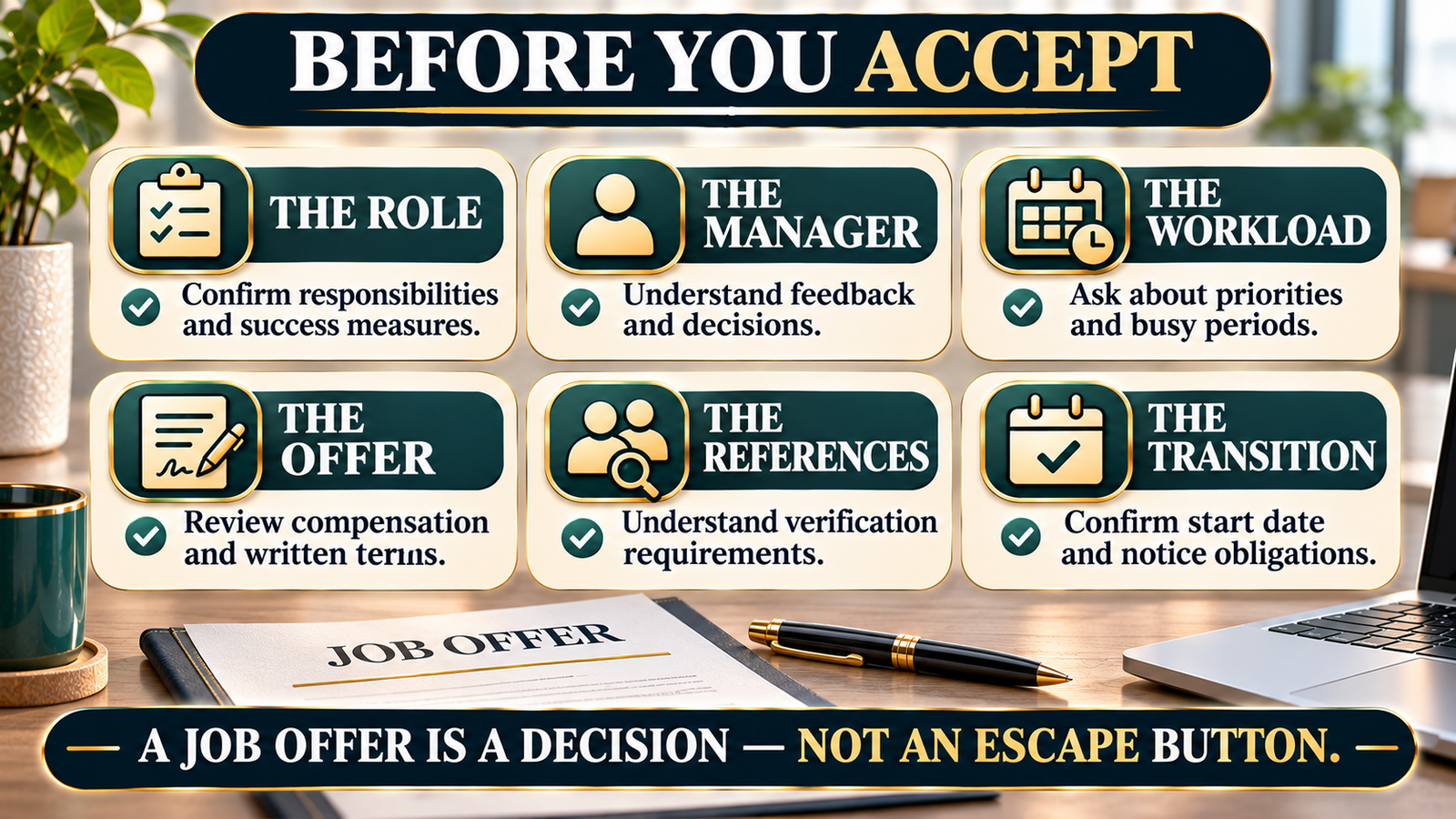
1. Clarify the Responsibilities
Make sure you understand the work, expected results, reporting structure, and scope of the role.
2. Learn About the Manager
Ask how performance feedback is given, how priorities are set, and how disagreements are resolved.
3. Investigate Workload Expectations
Find out what a genuinely busy week looks like and whether overtime, on-call duties, travel, or irregular schedules are part of the position.
4. Review the Written Offer
Check compensation, working arrangement, title, start date, employment classification, essential conditions, and any contractual terms important to your circumstances.
5. Understand Reference and Background Checks
Clarify which checks are required, when they occur, and whether current-employer contact is part of the process.
6. Compare the Offer With Your Real Priorities
Ask whether the position is genuinely compatible with your goals, finances, and working requirements—not merely different from the job you currently dislike.
For a detailed screening guide, see How to Recognize Toxic Workplace Red Flags Before Accepting Your Next Job.
Watch for Fraudulent Recruitment Offers
Pressure to escape a difficult workplace can make an unexpected job offer especially attractive.
Be careful when a supposed recruiter contacts you with a vague role, unusually easy earnings, or a request to pay money before receiving legitimate employment.
The U.S. Federal Trade Commission warns about fake job offers, impersonated recruiters, and schemes that ask applicants to send money or participate in suspicious paid tasks. See the FTC’s 2026 job-offer scam warning.
Verify the employer using legitimate public contact information and the company’s official recruitment process. Be cautious about sharing sensitive identity or financial information before establishing that the opportunity and recipient are genuine.
A real desire to leave your current job should not override ordinary checks on whether a new offer is legitimate.
What If Your Job Search Is Not Producing Interviews?
An unsuccessful search does not automatically mean you lack ability.
But it may indicate that some part of your approach needs review.
Look at the stages separately.
If You Are Finding Very Few Suitable Openings
Your target may be too narrow for the current market, or your search terms and location requirements may need adjustment. Review related roles without abandoning essential working conditions.
If You Are Applying but Not Getting Responses
Check whether the resume makes your relevant qualifications easy to identify. Compare the actual requirements of the jobs with your experience. Consider asking a trusted professional to review your materials.
If You Get Interviews but No Offers
Review your examples, technical or professional preparation, clarity of communication, and understanding of the role. When available, use specific recruiter feedback rather than assuming every rejection reflects personal bias.
If You Receive Offers That Do Not Fit
Your applications may be attracting roles with unsuitable compensation, responsibilities, schedules, or career direction. Improve targeting and evaluate recruiter conversations earlier.
The purpose is to identify which stage needs improvement rather than constantly increasing effort without learning from results.
What If You Cannot Job Search Consistently Because Work Is Exhausting?
Some employees have enough capacity for several applications a week. Others are struggling to complete the present workday and manage ordinary responsibilities afterward.
A fixed productivity target may become another source of pressure.
Consider three levels of effort.
Minimum Progress
One meaningful action, such as identifying a suitable vacancy or updating a resume section.
Regular Progress
A small number of focused sessions for applications, networking, and interview preparation.
Higher-Capacity Periods
More detailed research, multiple applications, or preparation for scheduled interviews when time and energy reasonably allow.
There is no evidence-based universal number of applications everyone must complete each week.
If workplace stress is significantly affecting sleep, concentration, daily functioning, or wellbeing, consider appropriate professional support in addition to career planning. A job-search checklist cannot replace healthcare or mental-health care where that support is needed.
What If Your Current Boss Asks Whether You Are Looking for Another Job?
There is no single appropriate response for every employment situation. Your relationship, contract, workplace process, and any disclosure obligations matter.
A career discussion about your long-term goals is different from a formal question about a conflict of interest, outside work, or another contractual issue.
You should not lie about material facts or conceal information you are legally or contractually required to disclose.
Where no special obligation applies and you are simply discussing future interests, you can respond in terms of your current responsibilities and professional development.
For example:
“I’m continuing to focus on my current responsibilities and also thinking about my longer-term career development.”
Use that response only if it is true. If a direct question requires a direct factual answer, address the actual question rather than using a statement designed to mislead.
What If You Receive an Offer While Another HR Process Is Still Active?
An ongoing grievance, discrimination concern, retaliation allegation, disciplinary matter, or other formal process may create additional considerations.
Do not assume that accepting a new job automatically resolves the previous issue or that resigning has no effect on available rights or remedies.
Depending on the facts and jurisdiction, an employee may need to consider legal deadlines, confidentiality obligations, a settlement proposal, or the effect of resignation on an active process.
When serious employment rights are involved, obtain appropriately qualified local advice before deciding how the resignation should be communicated or timed.
This does not mean everyone needs a lawyer before accepting another job. It means significant legal questions should not be decided through a generic career checklist.
When a New Job Offer Arrives: Do Not Rush the Final Transition
Before resigning, confirm what you actually have from the new employer.
Review:
- the written offer and compensation;
- proposed start date;
- any outstanding screening or other conditions;
- location and working arrangement;
- job title and responsibilities;
- notice-period compatibility;
- important employment restrictions or contractual obligations.
A written offer may still be conditional. Understand what remains to be completed rather than assuming every possible issue has already been resolved.
Next, review the resignation process that applies to your current employment.
UK ACAS guidance recommends checking contractual requirements, providing clear notice, and identifying the intended last working day. Rules elsewhere may differ.
When you are ready to give notice, the site’s How to Resign From a Toxic Job Professionally provides practical resignation emails, difficult-manager conversation scripts, handover guidance, and a final-day checklist.
A Realistic Example: Job Searching While Still Managing a Difficult Workplace
Imagine an employee whose team has undergone repeated leadership changes. The employee continues completing assigned work but has experienced unclear priorities, criticism linked to changing requirements, and limited opportunities to progress.
Leaving immediately would create financial difficulties, so the employee decides to explore external positions while continuing legitimate responsibilities.
First: Define the Target
The employee identifies roles with clearer project ownership, appropriate compensation, and development opportunities.
Second: Prepare Accurate Materials
The employee updates the resume using genuine responsibilities and results, without copying restricted company information.
Third: Organize Applications
Instead of submitting unfocused applications every night, the employee selects relevant vacancies and tracks the ones that deserve attention.
Fourth: Arrange Interviews Responsibly
The employee asks recruiters about suitable appointment times and uses legitimate personal time or leave arrangements when necessary.
Fifth: Evaluate Each Employer
During interviews, the employee asks how priorities, feedback, and workloads are managed. An attractive salary does not automatically outweigh serious concerns about the role.
Finally: Review the Offer and Transition
When a suitable offer arrives, the employee checks the written terms, outstanding conditions, notice obligations, and practical handover requirements before making the next decision.
The important result is not that the employee escaped in a particular number of weeks. It is that each stage created more information and better options.
Frequently Asked Questions
How do I job search while working in a toxic environment?
Define suitable target roles, prepare an accurate resume, apply selectively, arrange interviews around legitimate work commitments, and evaluate new employers carefully. Keep personal career planning separate from employer systems and maintain applicable professional obligations.
Can I look for a new job while still employed?
Many employees explore opportunities while remaining employed. However, employment terms, workplace policies, conflicts of interest, and legal obligations may affect particular situations. Check the rules that apply to you.
Should I tell my current boss I am looking for a job?
There is no universal answer. Consider your relationship, contractual or professional disclosure obligations, and the purpose of the conversation. You do not necessarily have to announce every possible career interest, but you should not lie or conceal information you are required to disclose.
Can my employer see my job search?
Visibility depends on which systems and platforms you use, applicable monitoring rules, and the information you share publicly. Do not assume company accounts or devices are private. LinkedIn also states that its recruiter-only Open to Work setting cannot guarantee complete privacy.
Is LinkedIn Open to Work confidential?
LinkedIn provides different visibility options. Its recruiter-only option takes steps to reduce visibility to recruiters at your current employer, but complete privacy is not guaranteed. Review the current official settings before relying on them.
How do I schedule interviews when I work full time?
Ask the recruiter about early, late, or virtual interview options, and consider legitimate personal time, flexible scheduling, or approved leave where available. The right to time off varies by jurisdiction and circumstances.
Should I use my work laptop for job applications?
As a general practice, use appropriate personal resources for personal career planning. Workplace equipment, accounts, and networks may be governed by employer policy, confidentiality obligations, and lawful monitoring arrangements.
How many jobs should I apply to each week?
There is no universally correct number. The practical target depends on available time, role suitability, job-market conditions, and application requirements. Focus on relevant applications you can complete accurately rather than treating volume as the only measure of progress.
What do I tell a recruiter about my toxic boss?
Describe the relevant professional circumstances truthfully without unnecessary personal labels. Explain what you are seeking in your next role and why the new opportunity interests you.
Can I request that my current employer not be contacted for a reference?
You can ask a prospective employer about the reference process and request appropriate discretion. Some employers may accept alternative referees at an early stage, while others have specific verification requirements. Do not assume confidentiality can be guaranteed.
What if my job search is making my current work performance worse?
Review your job-search workload and focus on fewer, more relevant tasks. Continue meeting legitimate work obligations where reasonably possible, and seek clarification when responsibilities conflict. If the overall situation is seriously affecting functioning or wellbeing, consider appropriate professional support.
Should I accept the first offer to escape a toxic workplace?
Not automatically. Evaluate the actual responsibilities, manager, workload, compensation, employment terms, and your alternatives. An offer is useful only when it represents an acceptable next step for your circumstances.
What if I cannot find another job quickly?
Review whether the problem is the availability of suitable vacancies, your application materials, the roles being targeted, interview preparation, or employer requirements. A slower search may call for changes to strategy rather than a conclusion that your professional ability has no value.
Should I resign before starting my job search?
That depends on finances, safety, health, employment terms, legal considerations, available support, and whether remaining employed is realistic. When circumstances allow, exploring options before resigning may help preserve flexibility, but serious situations may require a different approach.
How do I know a new employer will not be toxic?
You cannot know with certainty before joining. Ask behavioral questions about management, feedback, disagreement, workloads, success measures, and turnover. Compare information from several sources and clarify important contradictions before accepting.
Final Thoughts: Your Job Search Should Build Options, Not Become Another Source of Pressure
Working in a harmful environment can make the future feel urgent.
You may want a new job immediately. You may feel that every day spent in the current workplace is a day lost. And when the application process moves slowly, that urgency can become discouraging.
But an effective job search does not have to consume every evening or produce an offer within an arbitrary deadline.
It needs a direction, a repeatable process, and enough information to help you choose well.
Begin with roles you genuinely want.
Present your experience accurately.
Apply where there is a realistic connection between your skills and the requirements.
Arrange interviews responsibly.
Prepare credible references.
Investigate management and working conditions before committing.
And protect the professional obligations and personal needs that still matter while you are employed.
Most importantly, do not make another workplace decision entirely through the pressure created by the current one.
Your next job should be a considered career move—not simply the nearest available exit.
You cannot control every hiring decision or every part of your current workplace. You can make your job-search process clearer, more manageable, and better aligned with the working life you want next.
Chapter 5: Turn Career Preparation Into a Practical Exit Strategy
Chapter 5 of Reclaim Your Power, The Smart Exit Strategy, is about protecting options when a workplace is no longer serving your professional future.
Job searching is one part of that process. Other parts may include financial preparation, evaluating whether an internal solution remains possible, understanding employment terms, protecting professional references, and planning an appropriate departure.
If you have not yet decided whether leaving is right, begin with Should I Stay or Leave My Toxic Job?.
If the decision is clearer but the transition still needs preparation, use How to Build a Quiet Exit Plan While You Are Still Employed.
For the wider journey from recognizing harmful workplace patterns to rebuilding confidence and choosing a healthier professional direction, explore Reclaim Your Power and its practical seven-chapter workplace recovery framework.
Employment and professional-support disclaimer: This article provides general educational career information, not individualized legal, financial, employment, medical, or mental-health advice. Contractual obligations, workplace monitoring, outside-work restrictions, recruitment checks, references, resignation requirements, discrimination protections, and legal deadlines vary by jurisdiction and personal circumstances. Use appropriately qualified local advice when important rights, significant employment consequences, safety, or wellbeing concerns are involved.
Ready to Reclaim Your Power?
Get the 376-page digital edition with 7 chapters, 22 practical tools, reusable forms, an optional 30-entry journal, and references.
Buy Now — $4.99
Leave a Reply