
You may already know that you want to leave your job. What you may not know is how to leave without making the next few months harder than they need to be.
Perhaps your manager keeps changing expectations. Perhaps your work is being undermined, the complaint process has not improved anything, or you have simply reached the point where the job no longer offers a workable future. Yet you still need your income. You still have deadlines, professional relationships, and a career beyond this workplace.
That is where a quiet exit plan can help. It is not a dramatic resignation, a secret campaign against your employer, or a decision to stop doing your job. It is a structured way to prepare for a possible departure while you are still employed.
A practical exit plan from a toxic job has six connected parts: understand the decision, protect your current work, review finances and employment terms, prepare your next opportunity, protect your career record, and choose the right moment and process to resign.
This guide walks through each part, with a planning checklist, a flexible four-week example, scripts for recruiters and managers, and an exit-readiness review. It also explains when a slower plan may not be appropriate because a serious legal, safety, or wellbeing concern calls for prompt support.
What Is a Quiet Exit Plan From a Toxic Job?
A quiet exit plan is a private, professional plan for preparing your next career move before formally announcing a resignation. Quiet describes the absence of unnecessary drama or premature announcements. It does not mean hiding misconduct, deceiving prospective employers, or misusing company resources.
It may involve updating your resume, reviewing your finances, researching employers, identifying appropriate references, preparing for interviews, understanding your notice period, and making sure you can explain your recent work accurately.
It is not the same as quiet quitting, a loose term often used for limiting work to agreed duties. An exit plan can be underway while you are still doing your current job well.
What a quiet exit plan can give you
- more information before making a major decision;
- less pressure to accept the first alternative that appears;
- time to evaluate salary, benefits, and obligations;
- a truthful explanation of your work history;
- a clearer process for giving notice and handing over responsibilities.
If you are still deciding whether to leave at all, a separate stay-or-leave decision framework may be more useful than moving straight into applications. This article assumes you want to prepare an option to leave, not that resignation has already become inevitable.
Before Planning Your Exit, Identify What Cannot Wait
Not every difficult workplace permits a slow, orderly timeline. If your situation involves a credible threat to safety, serious harassment or discrimination, a threatened dismissal, wage problems, retaliation concerns, or a potentially important legal deadline, seek appropriate advice promptly. An internal process and an external legal deadline may run on different schedules.
Likewise, if work-related stress is significantly affecting sleep, concentration, or day-to-day functioning, consider professional health or wellbeing support rather than relying on a career checklist alone. The NHS guidance on work-related stress explains how workplace pressure can affect thoughts, feelings, and behavior and encourages practical support.
A quiet plan is useful when gradual preparation is realistic. It is not a requirement to remain in a seriously unsafe or unmanageable environment until a checklist is complete.
The Six-Part Quiet Exit Framework
Instead of beginning with a resignation date, build your plan around six areas. They do not always happen in a fixed order.
| Planning area | Question to answer |
|---|---|
| Decision and urgency | Am I preparing an option, or is a quicker decision necessary? |
| Current work | How do I keep my responsibilities, communication, and record professional? |
| Finances and terms | What income, benefits, contractual, and notice issues must I understand? |
| Next opportunity | What kind of role am I seeking, and how will I evaluate it? |
| Career evidence | How can I explain my achievements and identify credible references? |
| Departure | What must be confirmed before I give notice and hand over my work? |
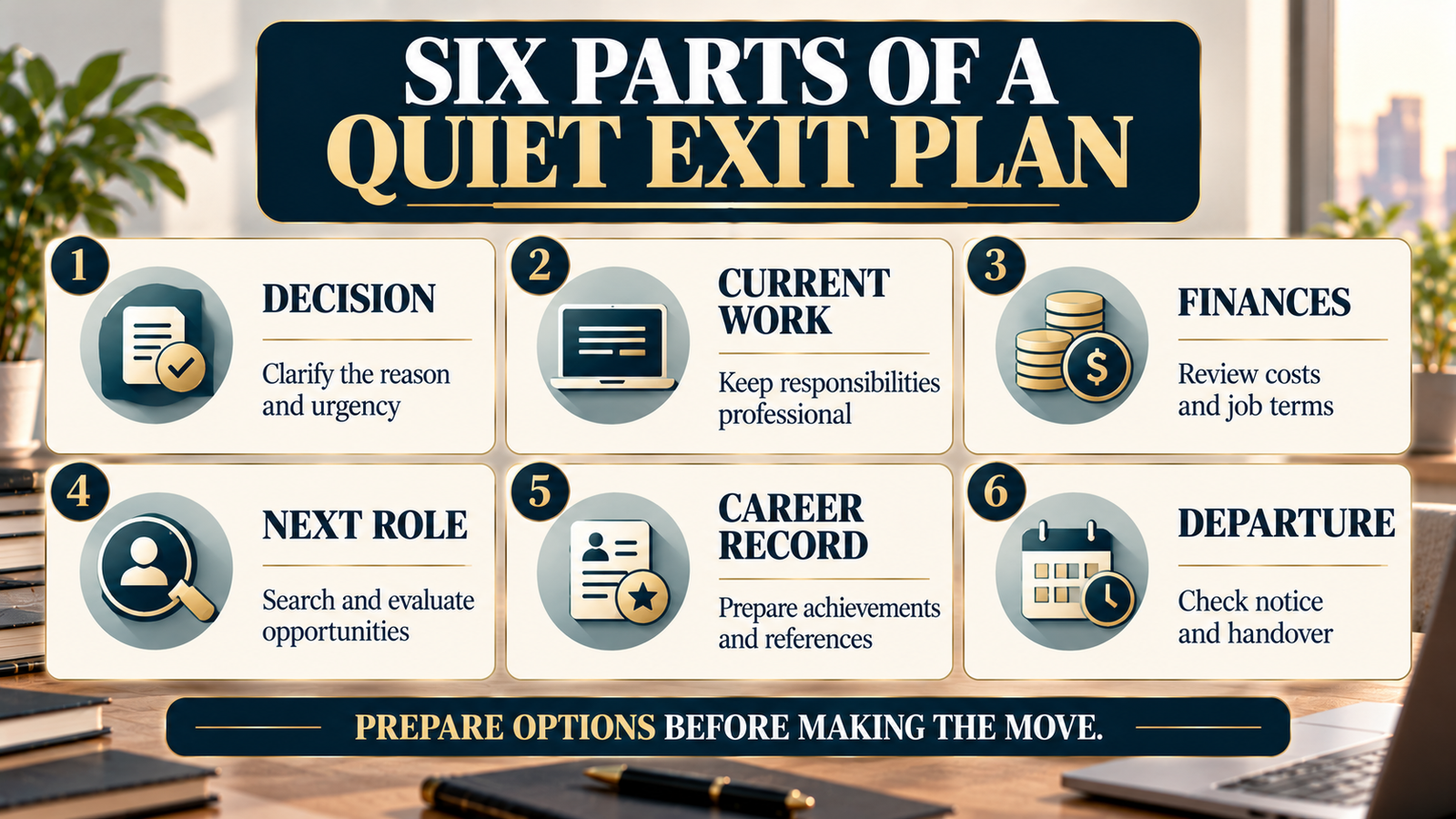
Notice what is missing: there is no universal command to resign in 30 days, no fabricated “safe savings” number, and no requirement to tell everyone why you want to leave. Your plan should reflect your actual circumstances.
Step 1: Define Why You Want to Leave Without Writing a Case Against Everyone
Before you search for a new position, describe the problem in one or two factual paragraphs. This is for your own decision-making, not necessarily a document to send to HR.
For example:
“The role still uses skills I enjoy, but the reporting relationship has become increasingly difficult. Priorities change without clear notice, I am later criticized for following earlier instructions, and attempts to clarify have not produced a stable process. I want to explore roles with clearer responsibilities and more reliable feedback.”
This description accomplishes two things. It clarifies what you want to leave, and it tells you what you must investigate before accepting a new job.
You do not need to diagnose your manager or prove a private motive. If you need to reconstruct specific events, use the site’s workplace incident log and documentation guide. Those resources cover factual records in more detail; this article focuses on planning your career transition.
Write your future criteria too
Alongside the reasons for leaving, identify what would make a new role workable: clearer ownership, a realistic workload, direct feedback, adequate training, a different reporting structure, or a more suitable schedule. A job offer is not an improvement simply because it is somewhere else.
Step 2: Continue Protecting Your Current Work While You Prepare
A future job search does not remove present work responsibilities. Keep your professional communication factual, finish assigned work where reasonably possible, and ask for clarification when expectations conflict.
If two tasks cannot both be completed on time, you might write:
“I can finish the client summary or the monthly analysis by Thursday afternoon. Which should take priority?”
If an instruction changes, confirm the new expectation without turning the email into an argument:
“Thanks for clarifying. I’ll use Friday as the revised deadline and include the updated figures.”
This is about preserving a clear work record, not pretending the situation is fine. Your existing guides on professional boundaries and follow-up emails after verbal conversations provide detailed scripts.
Why your final months of work still matter
You may need a reference. Your work may be part of a portfolio. Future employers may ask how you handled a challenging project or worked through a disagreement. Continuing to act professionally gives you a more accurate, defensible account of your contribution, regardless of how other people behave.
Step 3: Separate Personal Career Planning From Company Resources
It is reasonable to make personal career decisions without announcing every possibility to the workplace. But professional discretion has limits and should not involve wrongdoing.
As a sensible default, keep personal applications and interviews on your own time and personal systems, subject to your employment agreement and applicable law. Do not assume a work email account, company laptop, shared drive, or workplace messaging service is private. Do not use privileged access to export client lists, confidential presentations, source code, or colleagues’ personal information for a future employer.
Review any contractual rules about outside work, conflicts of interest, competing businesses, confidentiality, and intellectual property. If you are considering joining a competitor or starting a business, specialized advice may be useful before taking steps that could conflict with those rules.
The key distinction is simple: you can prepare your own career without treating your employer’s confidential property as yours to take.
Step 4: Create a Financial Transition Picture, Not a Fantasy Deadline
One of the easiest mistakes is deciding, “I will leave at the end of next month,” before understanding what happens to income and benefits. Start by reviewing your actual obligations and the information available to you.
Consider your regular essential expenses, accessible savings, people who depend on your income, health coverage or other benefits, any debt obligations, and likely job-search costs. Then review what resignation might change: notice pay, final salary, unused leave, bonuses, commissions, retirement or pension arrangements, and eligibility for support.
There is no responsible universal rule that everyone must have a certain number of months saved before leaving. Circumstances, local protections, severity of the workplace problem, and access to support vary.
The UK’s ACAS resignation guidance specifically recommends considering the effect of resignation on income and checking the employment contract for final-pay consequences. It also explains that leaving without another job can affect financial support in some circumstances. This is UK guidance, not a rule for every country.
Use three planning scenarios
| Scenario | What to check before choosing it |
|---|---|
| Leave after a confirmed new role | Written terms, start date, any conditions, and notice-period compatibility. |
| Leave before securing a role | Income gap, essential costs, benefits, legal implications, and available support. |
| Stay while continuing a search | Whether the current work situation remains manageable and what changes would make waiting inappropriate. |
The purpose is not to push everyone into the same scenario. It is to replace guesses with information.
Step 5: Review Your Contract Before You Choose a Resignation Date
Find the employment terms that actually apply to you. Depending on your employer and country, relevant questions may include:
- How much notice is required, and how must notice be given?
- How is unused leave handled?
- What happens to outstanding commissions, bonuses, or expense reimbursements?
- Do benefits end immediately or later?
- Are there lawful restrictions concerning confidential information, outside work, or competition?
- What is the process for returning equipment and closing access?
- Does any ongoing grievance, disciplinary process, redundancy discussion, or settlement proposal change the risks of resigning?
Official guidance is jurisdiction-specific. For example, ACAS explains UK notice rules, while the Australian Fair Work Ombudsman explains that Australian notice obligations can depend on an award, agreement, or contract. Do not copy one country’s notice rule into another.
If serious legal rights, possible constructive dismissal, discrimination, retaliation, or a proposed settlement are involved, seek qualified local advice before sending a resignation notice. The wording and timing may matter.
Step 6: Build a Resume Around Evidence of Your Work
After an undermining workplace experience, it is easy to define your recent job entirely through the manager who made it difficult. That is not what a prospective employer needs to know.
Review what you genuinely delivered: projects completed, processes improved, problems solved, customers supported, responsibilities handled, systems maintained, or teammates assisted. Use accurate figures only when you can substantiate them; do not invent growth percentages or claim sole credit for team results.
A useful resume bullet identifies an action and an outcome:
“Coordinated weekly project updates across three teams, clarifying ownership and reducing repeated deadline misunderstandings.”
Adjust this only if it is true of your work. Your goal is an honest and concrete career record—not a dramatic story about how difficult your former manager was.
Build a permitted achievements list
Write a personal summary of projects and outcomes that you can appropriately discuss. Avoid copying restricted reports or confidential materials into a private portfolio. If you are unsure whether a work sample can be shared, get permission or use an original demonstration with fictional data.
If colleagues repeatedly minimize your contribution, the site’s guide to protecting professional credit provides ways to keep ordinary work attribution clear without escalating unnecessary conflict.
Step 7: Prepare a Reference Plan Before the Final Week
Not every job search requires a direct reference from your current manager. Employers may have different policies about references, and some only confirm dates and job titles.
Think about who has firsthand knowledge of your work: a former supervisor, previous project lead, cross-functional partner, client where appropriate, or a colleague with enough direct experience to speak meaningfully about your contribution.
Do not put someone’s name on a reference list without checking whether they are willing and suitable. Do not ask anyone to give a false account or conceal a material fact. Be accurate about whether a person was your supervisor or a professional colleague.
If a recruiter asks to contact your current employer
“My current employer has not been informed of my job search. I can provide references from people who know my work and discuss the appropriate employment-verification process at the relevant stage.”
This is a request for professional discretion, not a guarantee of confidentiality. Ask the recruiter how reference checks will work and what consent is required.
Step 8: Research the Next Employer More Carefully Than the Last One
A job offer is not automatically a safer workplace. When you are eager to leave, normal-looking benefits of an offer can make important questions feel inconvenient.
Before accepting, ask how success is measured, who sets priorities, how feedback is delivered, why the position is available, and what actual workload looks like. Compare answers across the recruiter, hiring manager, and any team members you meet.
You are looking for consistency and capacity to handle ordinary problems, not a company with flawless reviews or a manager who never makes mistakes. If the role changes substantially between interviews and offer stage, clarify the terms before committing.
This is one reason a quiet exit plan should include destination research, not simply a list of job applications.
A Flexible Four-Week Quiet Exit Planning Example
The following is an example of how to organize tasks. It is not a medically, legally, or financially recommended waiting period. A reader with more urgent circumstances may need a different sequence, while another person may prepare for much longer.
| Stage | Planning focus | Useful output |
|---|---|---|
| Week 1 | Clarify priorities, identify urgent risks, review contract and finances. | A short situation summary and list of questions requiring advice. |
| Week 2 | Update resume, prepare permitted achievements, identify potential references. | A truthful career profile and initial reference plan. |
| Week 3 | Explore roles, research employers, prepare interview explanations. | A shortlist of roles and questions for prospective employers. |
| Week 4 | Review progress, revisit urgency, clarify offer and notice requirements. | An updated decision: continue preparing, seek support, or plan notice when appropriate. |
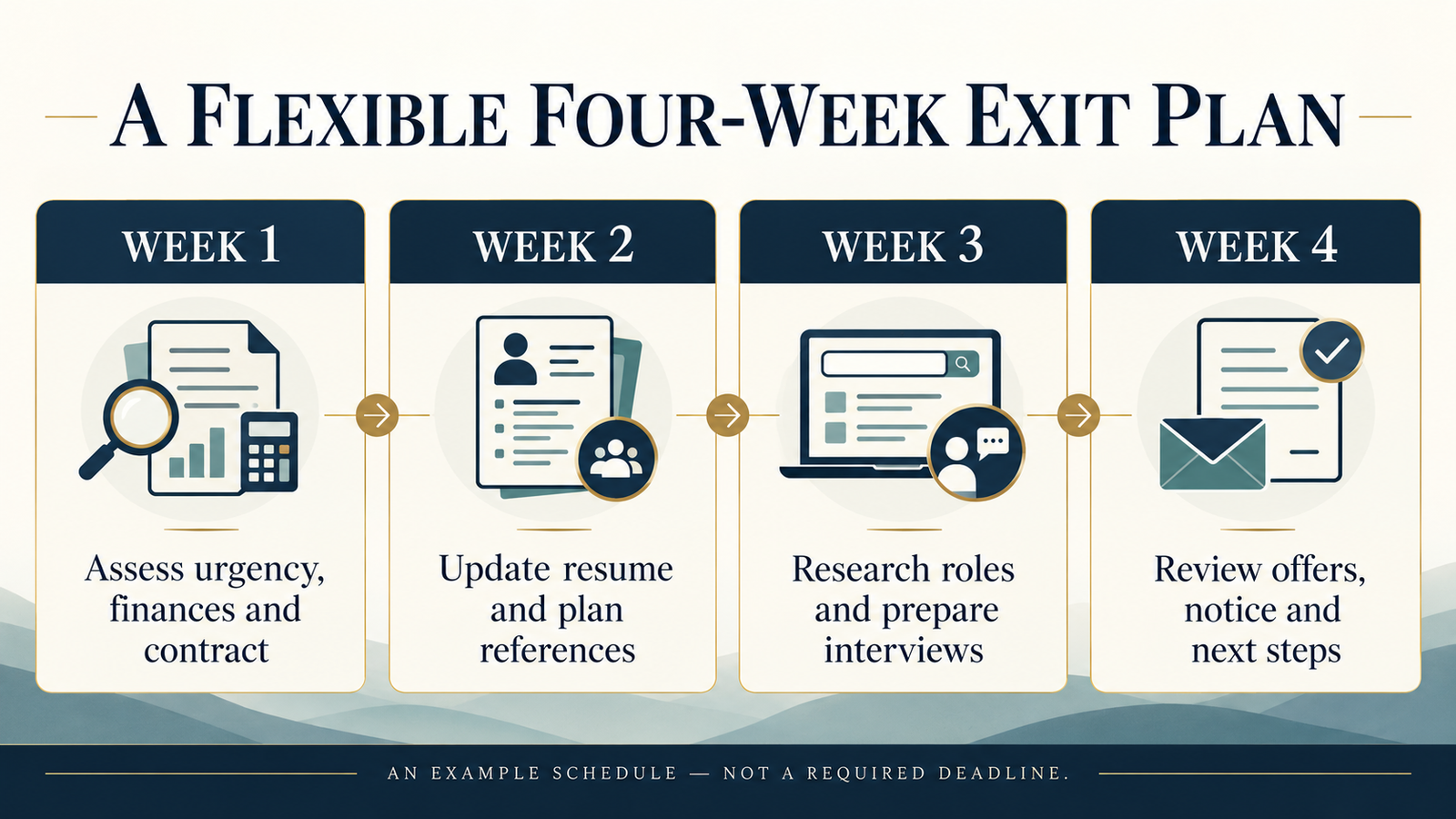
The value of this schedule is not its speed. It prevents an overwhelming task from remaining one enormous, undefined problem.
Step 9: Prepare a Truthful Interview Explanation for Why You Are Leaving
Prospective employers may ask, “Why are you looking to leave your current role?” You do not have to turn that question into a detailed complaint about your manager. You also do not need to invent a happier explanation.
Example: You need clearer responsibilities
“I’ve learned a great deal in my current position. I’m now looking for a role with clearer ownership and a more consistent structure for prioritizing work.”
Example: Growth opportunities have become limited
“The scope of my role has changed, and there is less opportunity to develop in the direction I want to pursue. I’m exploring positions that fit those goals.”
Example: The experience involved a serious workplace problem
“There were workplace circumstances that made the role less sustainable for me. I can discuss my responsibilities and achievements accurately, and I’m focused on finding a setting where expectations and communication are clear.”
Use only language that is truthful for the specific situation. Do not make knowingly false statements in hiring or background-check processes. If legal proceedings or contractual confidentiality provisions affect what can be discussed, get relevant professional advice.

Step 10: Keep the Job Search Sustainable
Working a full week while preparing to change jobs can become exhausting, especially if the current job is already stressful. A plan that depends on spending every free hour applying is difficult to sustain.
Choose manageable preparation tasks based on your circumstances. One evening might be for tailoring a resume; another for researching a promising employer; a weekend session might focus on interview preparation. Leave room for rest and normal life.
The NHS recommends identifying controllable stressors, setting workable boundaries, and seeking support when work pressure is affecting wellbeing. A career transition should not require ignoring those same needs.
Measure progress through useful actions, not by how many applications you can send in a single night.
Step 11: Plan What Must Be True Before You Give Notice
People sometimes resign because they have received an encouraging interview message. But interest from an employer is not the same as a finalized arrangement.
Before giving notice, review the written details of any next opportunity:
- job title and reporting line;
- salary and other compensation terms;
- work location, schedule, and flexibility;
- proposed start date;
- benefits and any eligibility conditions;
- reference checks, background checks, or other outstanding offer conditions;
- whether the start date allows you to meet your current notice obligations.
Some people may reasonably decide to leave without a new job. Others cannot. The point is to choose the decision with an accurate understanding of the risks, rather than relying on a verbal assumption.
What to Do If Your Current Manager Asks Whether You Are Leaving
An employee may be asked about career plans before they have made a final decision. Handle the question without fabricating facts or disclosing more than you are ready or required to share.
If you are still undecided:
“I’m focused on meeting my current responsibilities. I don’t have a formal change to announce.”
If your plans are firm and contractual or workplace rules require disclosure, follow those obligations. Avoid promising long-term availability that you know you cannot provide. The right response depends on your actual situation and any applicable employment terms.
What If Your Workload Increases While You Prepare to Leave?
Do not assume every new task is retaliation or proof that your manager knows about your search. Ask for practical priorities and note any material change in your responsibilities.
“The new assignment overlaps with the existing client deadline. Can we agree which deliverable should come first and who will handle the remaining work?”
If duties, performance ratings, or access change significantly after a formal complaint, a separate workplace or legal issue may exist. Keep a factual record and seek appropriate advice rather than folding every event into an exit narrative.
For maintaining a fair chronology, use How to Document Workplace Abuse Calmly and Clearly. For reputation concerns, read Workplace Smear Campaigns.
What If You Are Part of an Active HR Complaint?
Your exit planning and the HR process are separate decisions. Continuing a job search does not necessarily mean you have abandoned a complaint, and participating in an HR process does not require you to stay employed forever. The exact consequences depend on workplace procedure and local law.
Before withdrawing a complaint, signing a settlement, or resigning because you believe your employer has seriously breached your rights, consider qualified advice. If you need an explanation of the internal process, the site’s guide to what happens after reporting a toxic boss to HR covers that path.
A quiet exit plan should not create pressure to give up formal rights merely to avoid an uncomfortable conversation.
What If You Cannot Find Another Job Quickly?
A quiet plan should be flexible enough to survive an unsuccessful application, delayed interview, or temporary hiring slowdown. A slow search does not mean the plan has failed.
Revisit three areas: the kind of roles you are targeting, how convincingly your experience is presented, and whether the current workplace remains manageable. If the plan is affecting your finances or health, review your options with an appropriate professional rather than continuing indefinitely on autopilot.
Do not invent a fixed exit deadline merely to feel decisive. At the same time, avoid turning “I will leave someday” into a permanent substitute for making reasonable progress.
What If the Work Situation Improves While You Are Planning?
You are allowed to update your decision when the facts change. Perhaps you receive a new manager, responsibilities become clearer, a complaint leads to a credible improvement, or an internal role emerges that genuinely meets your needs.
Review whether the change is sustained, specific, and relevant to the original problem. You might decide to remain, continue evaluating, or still take an external opportunity. An exit plan creates options; it is not a promise you must fulfill no matter what happens.
Quiet Exit Planning: What to Keep and What to Avoid
| Useful preparation | Riskier shortcut |
|---|---|
| Write an accurate personal summary of achievements. | Taking restricted client files or internal reports as personal portfolio material. |
| Clarify priorities and complete legitimate work. | Deliberately withholding work or disrupting projects before leaving. |
| Ask suitable people whether they are willing to act as references. | Pressuring colleagues to give a misleading account. |
| Review written job terms and outstanding checks. | Resigning because a recruiter sounded positive. |
| Check local notice rules and employment agreements. | Assuming an online example from another country applies to you. |
| Research the next manager and role. | Accepting an offer purely to escape the current environment. |
Professional discretion is not the same as dishonesty. The aim is to protect your future while remaining accurate, respectful, and lawful.
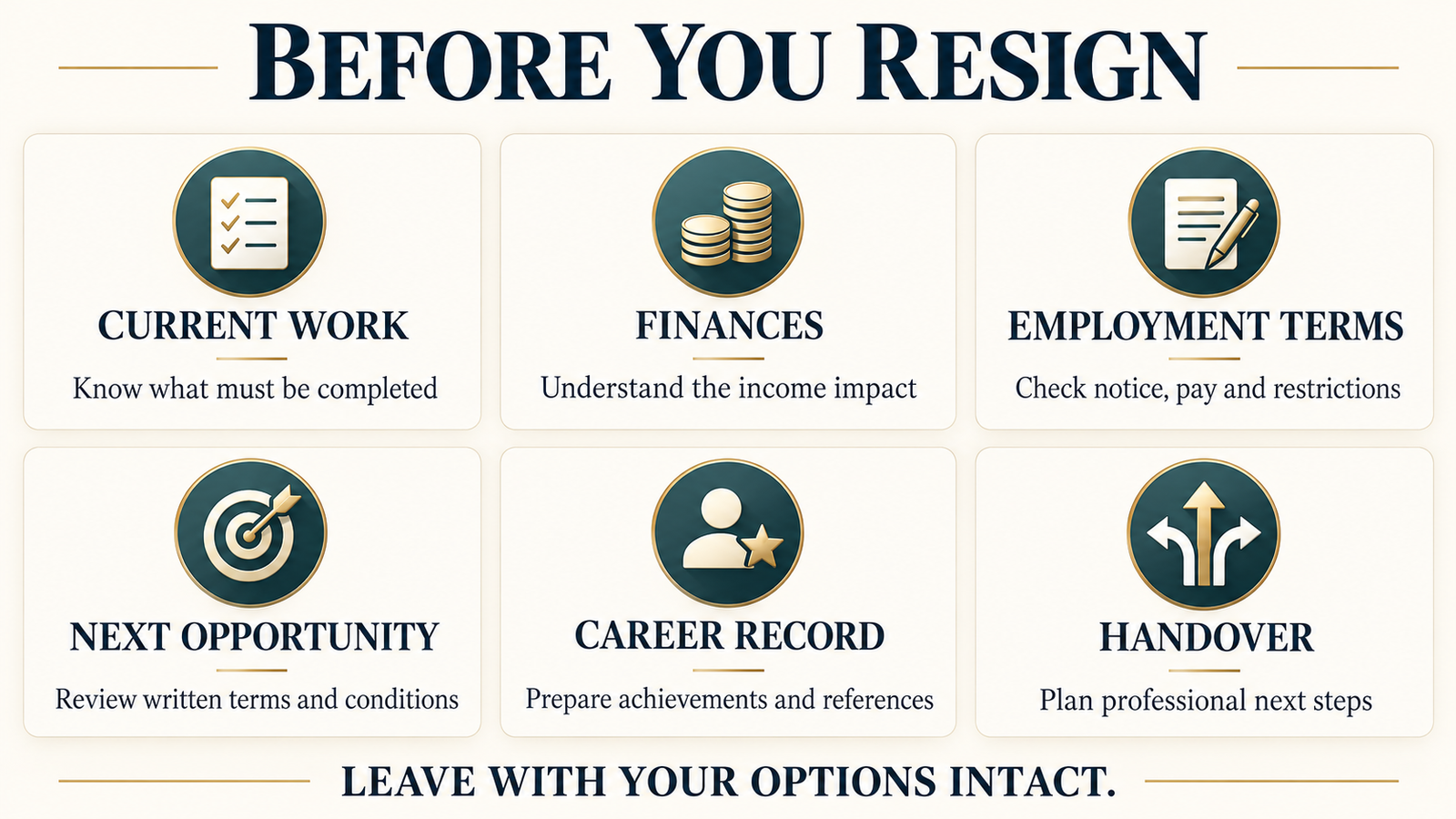
Before You Resign: The Exit-Readiness Checklist
A planning checklist should organize decisions rather than pretend there is a universal safe formula. Use the following questions before you select a final date.
Work and wellbeing
- Have I identified the main reason I want to leave?
- Is there a serious concern requiring prompt help instead of a gradual plan?
- Can I reasonably continue meeting current obligations until departure?
Money and employment terms
- Do I understand what happens to income and essential expenses?
- Have I checked my notice and resignation procedure?
- Do I know what may happen to final pay, leave, bonuses, and benefits?
- Do I need legal or financial advice before deciding?
Next role and career record
- Is my resume accurate and current?
- Can I explain my achievements without disclosing restricted information?
- Do I have an appropriate reference or verification plan?
- Have I researched the next employer’s expectations?
- If I have an offer, have I reviewed it in writing and understood all conditions?
Departure
- Do I know how and to whom to give notice?
- Can I prepare an orderly handover?
- Have I planned to return equipment and follow the applicable policies?
- Do I have a truthful, proportionate explanation for my next career step?
How to Give Notice When the Plan Becomes a Real Decision
Once you decide to resign, use the procedure required by your employment agreement and local rules. A normal resignation can often be concise: confirm that you are resigning, your notice, and the intended last working day.
For example, where a standard resignation is appropriate:
“Please accept this message as formal notice of my resignation from my role. Based on my notice period, my proposed final working day is [date]. Please confirm the date and any handover steps I should complete.”
Do not treat this sample as legal advice or use it automatically in a dispute where the specific reasons for resigning may be legally significant. The ACAS guide on how to resign recommends checking the contract, putting the resignation in writing where helpful, and understanding notice obligations. Its guidance also warns that resignation in response to a serious contractual breach can raise more complex questions.
Plan a professional handover
Identify active assignments, key dates, current status, next responsible contacts, and routine documents that belong in company systems. Keep the handover clear and ordinary. Do not use the last days to settle scores, delete work, or create ambiguity about responsibilities.
A Realistic Example: Preparing to Leave Without Making the Situation Worse
Imagine an employee, Samira, who has spent a year in a team where performance expectations change frequently and private clarifications rarely settle disputes. She wants to leave but depends on the salary and does not have another offer.
Instead of sending a resignation email after a difficult meeting, she reviews the contract, records her essential financial commitments, and updates her resume using accurate achievements. She continues completing assigned work and asks for priorities in writing when they conflict.
She identifies a former team lead who knows her work, asks that person whether they would be comfortable providing a reference, and begins researching suitable vacancies. She asks prospective managers how priorities are set and how performance is evaluated. She does not copy confidential material or use company accounts for personal applications.
When a promising offer appears, she reads the written terms, asks about outstanding conditions, and checks whether the proposed start date can accommodate her current notice obligations. She then makes an informed decision about resignation.
The example does not promise that every step will go smoothly. It shows how preparation turns an emotionally difficult decision into a series of smaller, reviewable actions.
Frequently Asked Questions
What is a quiet exit plan from a toxic job?
It is a professional plan for preparing a possible departure before submitting notice. It can include finances, employment terms, resume updates, references, job research, interview preparation, and an orderly handover. It is not a plan to sabotage work or take confidential information.
Can I look for another job while still employed?
Often, yes, but employment agreements, conflicts of interest, outside-work rules, and local law can matter. Keep applications and interviews appropriately separate from employer resources and meet your existing professional obligations.
Do I have to tell my boss that I am thinking about leaving?
Not necessarily every tentative thought or application. However, specific disclosure duties may arise under your contract or role. Avoid misleading promises and follow applicable obligations once plans become formal.
How do I leave a toxic job without another job lined up?
Review the potential income gap, essential expenses, benefits, contract obligations, job-market conditions, and the seriousness of the workplace situation. If rights or significant financial consequences are involved, seek local professional advice. There is no single safe savings target for everyone.
Should I resign immediately after a bad day?
One bad day is not necessarily enough information for an irreversible decision. If you are not facing an urgent concern, review the situation and employment terms. Serious safety or legal concerns, however, can require prompt support rather than delay.
How can I protect my professional reputation while planning to leave?
Continue performing legitimate work, clarify important expectations, maintain appropriate professional relationships, prepare accurate achievement summaries, and identify references who genuinely know your work.
Can I use work projects in my portfolio?
Only when you have the right to share them. Company intellectual property, client data, unpublished work, and confidential records may be restricted. Consider obtaining permission or making an original example with fictional information.
What if a new employer wants to contact my current manager?
Ask how employment verification works, what consent is required, and whether other relevant references can be used initially. You can truthfully explain that your current employer has not yet been informed of your search, without assuming the recruiter can guarantee secrecy.
How do I explain leaving a toxic job in interviews?
Explain the real circumstances proportionately and focus on the work environment you are looking for next. Do not invent a better story, make unverified accusations, or turn the interview into an argument about your former manager.
How long should a quiet exit plan take?
There is no universal timeline. Some people move quickly when a new opportunity appears; others need more time for financial, contractual, or career reasons. Urgent legal, safety, or wellbeing concerns can change the appropriate pace.
Should I tell coworkers I am looking for jobs?
Consider the value and consequences of disclosure, your workplace responsibilities, and whether the person needs the information. You do not have to turn an early-stage personal career decision into a team announcement. Do not ask coworkers to misrepresent facts or act improperly.
Can I still report workplace bullying while planning to leave?
Potentially, yes. Reporting and job planning address different needs. Workplace policies and legal rights vary, so seek appropriate advice if the situation involves discrimination, retaliation, serious disciplinary action, or a possible legal claim.
What if the workplace improves before I resign?
You can reassess. A plan creates an option rather than a binding commitment. Look for specific, sustained changes relevant to the problem and decide whether remaining still supports your career goals.
Is a quiet exit plan the same as quiet quitting?
No. A quiet exit plan is preparation for a potential transition while continuing legitimate work. The term quiet quitting is often used for limiting work to agreed responsibilities and is a different concept.
What should I do once I have a job offer?
Review the written terms, start date, benefits, conditions, reference or background checks, and your current notice obligations. Then assess the remaining risks before selecting a resignation date.
Conclusion: You Can Prepare an Exit Without Turning Every Workday Into an Exit
When a workplace has become difficult, it is understandable to want the situation to end immediately. But a career transition may become more manageable when it is broken into decisions you can actually make.
Understand what needs to change. Keep your present work record professional. Learn what resignation would mean financially and contractually. Prepare an honest career story and appropriate references. Investigate the next employer instead of assuming a new offer will solve every problem. Check the details before you give notice.
Most importantly, let your plan change when the facts change. Preparation is not a promise to stay indefinitely, and it is not a requirement to resign on an arbitrary date.
The purpose of a quiet exit plan is not to disappear from your current job. It is to move toward the next one with more clarity and fewer avoidable risks.
If you are still managing an active workplace pattern, the incident log, evidence-preservation guide, and boundaries guide offer related support without turning this article into another complaint or documentation tutorial.
Build Your Exit Strategy Around Your Actual Life
Chapter 5 of Reclaim Your Power, The Smart Exit Strategy, addresses staying, reporting, transferring, and leaving with attention to evidence, finances, references, and career continuity. Its wider framework also connects workplace protection with recovery and future career choices.
If you need more than a list of things to do before resigning, explore Reclaim Your Power and its practical workplace recovery tools.
Employment and wellbeing disclaimer: This article provides general educational information, not legal, financial, medical, or individualized employment advice. “Toxic workplace” is a descriptive phrase, not a universal legal category. Resignation requirements, pay, benefits, confidentiality obligations, legal rights, and filing deadlines differ by jurisdiction and circumstances. Seek qualified local advice when dismissal, discrimination, retaliation, serious harassment, contractual disputes, settlement agreements, significant health effects, or immediate safety concerns are involved.
Ready to Reclaim Your Power?
Get the 376-page digital edition with 7 chapters, 22 practical tools, reusable forms, an optional 30-entry journal, and references.
Buy Now — $4.99
Leave a Reply