
Maybe the job has ended, but your mind still reacts as though the next difficult meeting is about to begin.
You hear an email notification and brace for criticism. You have a perfectly ordinary conversation with a new colleague, then spend an hour wondering whether you said something wrong. Even on a quiet day, you may feel tired, distracted, or strangely guilty for not doing more.
Or perhaps you have not left yet. You are searching for another job, keeping up with responsibilities, and wondering how much of yourself you will have left when the transition finally happens.
If any of this sounds familiar, there is an important distinction worth making: getting away from a harmful work situation and feeling settled afterward are not always the same event. Relief can arrive alongside exhaustion. A better workplace can still feel unfamiliar. And recovery does not have to look like becoming the person you were before.
This guide explains how to recover after a toxic workplace through practical, adaptable steps: creating room to rest, making sense of what happened without staying trapped in it, reconnecting with your own judgment, and choosing healthier working conditions in the future. It is not a diagnosis or a promise that everyone will recover on the same schedule.
Quick Answer: What Helps You Recover After a Toxic Workplace?
Start by reducing avoidable sources of workplace stress where you can. Re-establish small routines that support sleep, rest, connection, and daily functioning. Separate factual events from sweeping conclusions about your worth. Talk with trusted people or seek professional support if stress is interfering with your life. As your capacity returns, rebuild confidence through manageable actions and make a practical plan for future boundaries and employment.
You do not have to complete every step in order. If you need income or must stay employed, the plan can be adapted to your circumstances rather than requiring a long career break.
What Does Recovering From a Toxic Workplace Actually Mean?
“Toxic workplace” is a common description, not a medical diagnosis or one precise legal category. People may use it for repeated humiliation, bullying, changing expectations, intimidation, sustained unfair treatment, or a culture where employees are afraid to ask ordinary questions. Other people are describing chronic overwork, an unsafe workload, or unsupported management problems. These experiences can overlap, but they are not identical.
The US National Institute for Occupational Safety and Health (NIOSH) describes job stress in terms of a mismatch between job demands and a worker’s capabilities, resources, or needs, and emphasizes the importance of work design and organizational conditions. Recovery therefore cannot be reduced to telling an employee to think more positively.
Recovery may mean:
- Being able to finish an ordinary day without repeatedly replaying every conversation.
- Getting back some of the attention you want to give to friends, family, hobbies, or everyday life.
- Recognizing your professional skills without viewing everything through a former manager’s opinion.
- Being able to ask a question or receive feedback without immediately expecting humiliation.
- Making new work decisions with clearer information and healthier boundaries.
- Knowing when to seek support rather than managing everything alone.
These are examples, not milestones everyone must reach. Some people experience relatively little lasting impact; others need more time or more support. Both the circumstances of the workplace and the person’s broader situation matter.
Stress, Burnout, and Harmful Workplace Experiences: Know the Difference
It helps to use accurate language. Stress can affect sleep, concentration, mood, energy, and behavior. The NHS guidance on work-related stress describes changes such as feeling withdrawn, losing confidence, overworking, or struggling to switch off.
Burnout is related but more specific. The World Health Organization (WHO) classifies burnout as an occupational phenomenon—not a medical condition—associated with chronic work stress that has not been successfully managed. Its description includes exhaustion, greater mental distance or cynicism toward work, and reduced professional efficacy.
Not everyone who leaves an unhealthy workplace has burnout. And a difficult workplace experience does not, by itself, establish a particular mental-health diagnosis.
What matters first is the impact you are actually experiencing, rather than choosing the most dramatic label for it. Persistent symptoms that affect daily functioning deserve appropriate professional assessment.
A Four-Part Roadmap for Recovery
Think of recovery as four areas you can revisit, rather than a ladder you must climb in order. One week you may focus on rest; another week you may need to sort out a career decision or reconnect with people you have had little time for.
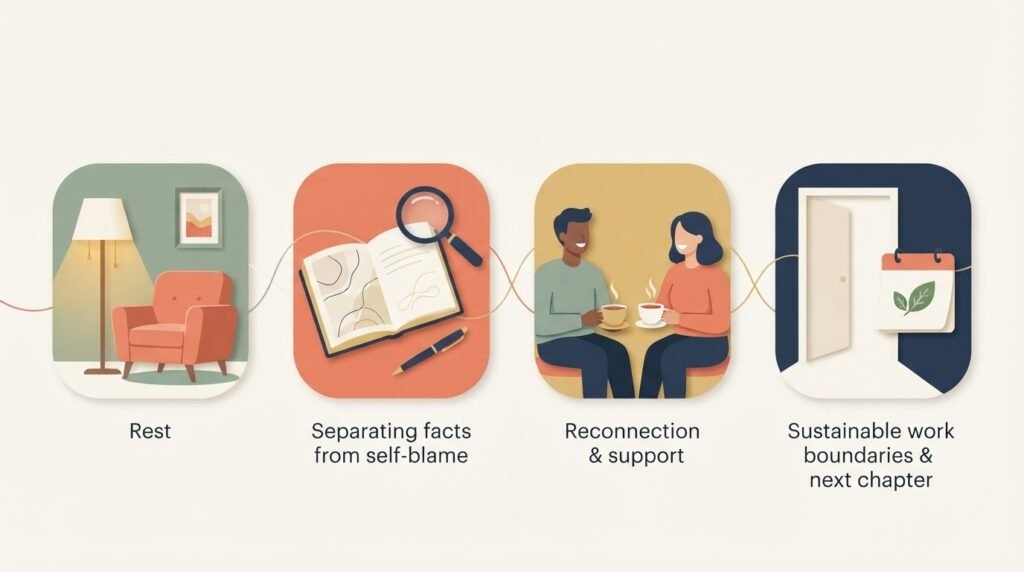
| Area | Purpose | One manageable action |
|---|---|---|
| 1. Create space | Reduce continuing pressure and support basic functioning. | Choose one realistic daily stopping point for work-related tasks. |
| 2. Make sense | Understand events without letting them define your identity. | Write down one factual incident and what you know about it. |
| 3. Reconnect | Bring supportive people and neglected interests back into view. | Arrange one low-pressure conversation or enjoyable activity. |
| 4. Rebuild | Make future choices using clearer standards and boundaries. | List three working conditions you want to assess in your next role. |
The stages below explain what each area can look like in real life, including if you are still employed.
1. Create Space Before Trying to Fix Everything
After a difficult working period, it can be tempting to turn recovery into another performance target: read five books, apply for twenty jobs, exercise every day, complete a workbook, and emerge as a different person by next month.
That kind of plan can quickly become another exhausting list.
Start with what is sustainable. If you have left the job, there may be practical arrangements to finish: final pay, references, health coverage, a job search, or a new routine. If you are still there, you may be managing financial constraints or waiting for a suitable offer. Your first objective is not to do everything. It is to reduce unnecessary strain where possible.
Restore a few ordinary routines
Notice what makes the day feel more workable. It could be a fairly consistent sleep and wake schedule, meals you have time to enjoy, a short walk, stepping away from screens, or taking a real break between job applications. These are supportive habits, not treatments or strict performance rules.
The NHS stress guidance recommends small achievable targets, time-management techniques, social support, and relaxation practices rather than attempting to solve everything at once.
Create a transition between work and home
If you are currently employed, a modest end-of-day ritual can help mark the boundary: finish an appropriate handoff, close work accounts, take a short break, and turn to an activity unrelated to the job. If you have left, consider limiting unnecessary visits to old work chats or social pages that keep pulling you into the same conflict.
Some people need time away from work; others cannot afford it or prefer to move into another role. There is no universally required career break.
What if you still feel unsettled after leaving?
Do not assume every reaction has a single cause. Lack of sleep, the demands of unemployment, financial pressure, health concerns, and the experience of the workplace may interact. Notice what is happening without diagnosing yourself through an online checklist. If symptoms persist or interfere with daily life, a healthcare professional can help assess them.
2. Make Sense of What Happened Without Living in the Replay
One of the hardest parts of leaving a troubling workplace can be the unfinished questions. Why did an ordinary meeting become so personal? Did I misunderstand the feedback? Should I have challenged the decision? What will they say about me now?
Those questions may feel important because the experience mattered. But a replay that never produces a useful conclusion can take time and energy away from the present.
Separate facts, interpretations, and decisions
Try a short written exercise, using a situation you feel comfortable reflecting on:
| Question | Illustrative answer |
|---|---|
| What happened? | “My project update was interrupted twice during Monday’s meeting.” |
| What did I conclude? | “I decided the interruption meant my work was worthless.” |
| What else is possible? | “The interruption was discourteous. It does not, by itself, measure the quality of everything I contributed.” |
| What matters now? | “I can list the projects I completed and seek feedback from people who know my work.” |
This does not mean denying unfairness or treating a legitimate concern as a distorted thought. It means distinguishing the observed event from a sweeping conclusion about your character.
The NHS thought-record exercise offers a more detailed way to examine situations, emotions, evidence, and alternative perspectives. Use it only if it feels helpful; you can discuss difficult material with a qualified professional instead.
Give reflection a stopping point
When you have thought about a specific incident for some time, ask: “Is there a decision I can make, a factual record I need, or a question for someone qualified to answer?” If the answer is no, it may help to shift attention to a present-day task rather than pursuing another round of speculation.
The NHS guidance on managing worries describes setting aside a bounded period for concerns and distinguishing actionable problems from those you cannot solve immediately.
If you are considering an employment complaint, keeping accurate records may still matter. Do not delete relevant materials or move confidential company information to personal accounts contrary to policy or law. For documentation questions, see our workplace incident log guide and seek appropriate employment advice for your location.
3. Reconnect With a Life That Is Larger Than the Job
An exhausting workplace can take more than working hours. You may stop replying to friends because every conversation feels like effort. You may give up a hobby because your evenings are spent preparing for tomorrow’s criticism. Or you may realize that most of your conversations have become about the same manager.
Recovery can include widening the picture again.
Start with low-pressure contact
You do not need to organize a big social event or explain your entire employment history. A message such as “I have had a demanding few months. Would you be free for coffee or a short call sometime?” can be enough.
Choose people who listen without insisting that you should have resigned sooner, forgiven everyone, or immediately moved on. You can set limits on how much you discuss. Social support is helpful when it feels supportive, not like another obligation.
Return to something that does not need to be productive
It may be music, gardening, cooking, reading, an interest you had before the job, or learning something for pleasure rather than career advancement. Activities that are enjoyable and meaningful can help you reconnect with parts of life that were crowded out by work.
SAMHSA’s general coping guidance includes maintaining connections, spending time on interests, and keeping manageable routines. These are options to consider, not proof that a person will improve in a set number of days.
Allow mixed feelings
Some people feel relieved after leaving, then unexpectedly sad about the team, routine, opportunities, or professional identity they lost. Others miss colleagues but not the workplace culture. It is possible to appreciate parts of a job and still decide that leaving was right for you.
There is no requirement to reduce a complicated experience to “it was all bad” or “it taught me a lesson.”
4. Rebuild Trust in Your Professional Judgment
After repeated criticism or undermining, a person may begin to treat their own decisions as suspect. That can show up in surprisingly ordinary moments: spending too long rewriting a simple email, asking for reassurance about every task, or assuming that a new manager’s neutral tone means trouble.
The aim is not to become incapable of doubt. Good judgment includes uncertainty, checking facts, and changing your mind when evidence calls for it. The aim is to regain a proportionate sense of your abilities.
Use an evidence bank instead of a motivational slogan
Write down five things you can truthfully say about your work. Examples might include: “I coordinated weekly client updates,” “I trained a new teammate on a process,” or “I delivered a project despite changed priorities.” Avoid inventing numbers or claiming team achievements as your own.
For each item, note what you personally did and what it shows about your skills. A short list can help when you are writing a résumé or preparing for interviews.
Our guide to writing your career story after a toxic workplace goes deeper into this exercise and offers résumé, LinkedIn, and interview examples.
Make a small decision and review it fairly
Choose a manageable decision—how to structure a job-search week, which professional skill to practise, or what a reasonable working hour looks like. Make the decision using the information available, then review the result without labeling the entire choice a personal failure.
Learning to make decisions again may be more useful than searching for the one choice that can never be criticized.
Set Boundaries That Work in Real Life, Not Just on Social Media
Advice about boundaries can sound effortless when written as a slogan: “Never answer a message after 5 p.m.” Real employment arrangements are often more complicated. People work shifts, support customers in different time zones, have contractual on-call duties, or are trying to protect their income.
A useful boundary is specific, proportionate, and consistent with your obligations. For example:
- “I can review this request tomorrow morning; please tell me if there is an agreed urgent escalation procedure.”
- “Could you confirm the priority and deadline so I can plan the work accurately?”
- “I am available for a meeting during these hours. Which option works for the team?”
- “I need the feedback to identify what to change in the deliverable.”
These statements may not work safely in every workplace. A manager who routinely responds to reasonable questions with threats may need a different approach, including appropriate documentation, independent advice, or an exit plan.
Our guide on setting professional boundaries with a manipulative boss discusses the risks and limitations of different responses.
If You Are Still in the Toxic Workplace, Adapt the Roadmap
You do not need to wait until a resignation date to begin protecting your wellbeing. But the steps available while employed may be more constrained.
Start by identifying what you can realistically influence now: a clearer priority list, a safer method of documenting work, using available leave, accessing support, or researching roles privately and responsibly. Keep your job search consistent with contractual requirements and workplace policies.
If you are deciding whether to stay or leave, separate immediate safety or health concerns from career preferences and financial planning. Our stay-or-leave decision framework covers those questions without assuming resignation is always practical.
For an active search, see how to job search while working in a toxic environment. The purpose of this recovery guide is not to tell you to quit on a particular date.
How to Avoid Repeating the Same Workplace Problems in Your Next Job
After an unhappy experience, “anything different” can feel like the right choice. But a company can have a different brand, office layout, or salary and still have similar management problems.
Before accepting a new role, look for evidence about how work actually happens:
- Expectations: What does successful performance look like after 30, 60, or 90 days?
- Workload: How are competing priorities resolved and who makes the final decision?
- Feedback: How do managers deliver corrections and discuss errors?
- Voice: Can team members respectfully raise a concern or question an assumption?
- Working arrangements: What are the real hours, flexibility rules, and escalation expectations?
- Support: How are new employees trained, and who helps when responsibilities are unclear?
Pay attention to examples rather than polished descriptions. “We are all like a family” is less informative than an interviewer describing how a disagreement was handled last month.
We have explored this in more depth in what psychological safety looks like at work and red flags to look for before accepting a job.
One imperfect interview answer is not proof that an employer is unhealthy. Think in terms of multiple signals and the practical fit of the role.
A Gentle Two-Week Starting Plan (Not a Recovery Deadline)
This is an optional way to begin. It is not a medical protocol, a daily challenge, or a promise that you should feel recovered after two weeks. Skip or change anything that does not suit your health, responsibilities, or situation.
| When it suits you | Small action | Why it may help |
|---|---|---|
| Early days | Notice one source of avoidable work-related pressure and decide whether you can reduce it. | Creates a little room to think. |
| Early days | Choose a simple routine you can maintain without turning it into a strict target. | Offers predictability. |
| When ready | Share part of your experience with a trusted person, or choose another supportive activity. | Reduces isolation without requiring full disclosure. |
| When ready | Write a brief facts-versus-interpretations note about one event. | Helps separate an event from a judgment about yourself. |
| During the next week | List three genuine professional accomplishments or strengths. | Reconnects your career story with evidence. |
| During the next week | Write three questions to ask your next manager or interviewer. | Turns experience into future decision criteria. |
| Any time | Review what helped, what felt difficult, and whether additional support would be useful. | Encourages a flexible rather than perfectionist plan. |
There is no penalty for doing less. If you have urgent financial, caregiving, or health responsibilities, those may rightly come first.
A Short Worksheet: What Do I Need Now?
Use these prompts in a journal or note. You can answer one at a time or not at all.
- What is hardest at the moment? Name the concrete problem—sleep, uncertainty, references, finances, concentration, relationships, or something else.
- What is actually within my influence? Separate today’s actions from decisions another person must make.
- What do I know happened? Describe one situation in neutral, observable language.
- What have I concluded about myself? Check whether the conclusion is supported by the full evidence.
- Who or what helps me feel supported? Name a person, activity, professional service, or ordinary routine.
- What am I looking for in my next work environment? Think beyond salary or title alone.
- What is one modest next step? Choose something achievable, not an entire life overhaul.
The purpose is to turn a large, vague problem into smaller questions. You can return to the worksheet later and change your answers.
What Recovery Is Not
It is not forgetting everything that happened
You can remember an unfair experience and still make room for other parts of your life. You do not have to pretend it was acceptable.
It is not forgiving a manager on a deadline
People differ in how they understand forgiveness and closure. Neither is a mandatory step for regaining stability or making professional choices.
It is not becoming permanently cheerful or fearless
Ordinary work contains uncertainty, mistakes, and difficult feedback. Feeling some anxiety before an interview or performance review does not mean your efforts have failed.
It is not treating every new employer as unsafe
Careful assessment is different from assuming the next workplace will repeat every part of the previous experience. Use evidence, questions, and practical boundaries.
It is not solving structural workplace problems alone
Job design, fair workloads, policies, and management behavior remain organizational responsibilities. CDC guidance on supporting worker mental health emphasizes changing workplace policies and practices, not solely asking employees to cope better.
How Can You Tell If Things Are Improving?
Progress may be subtle. Perhaps an email no longer consumes your afternoon. You can describe a professional accomplishment without immediately dismissing it. You enjoy a weekend activity without thinking about work the entire time. Or you feel able to ask for clarification in a new team.
There may also be difficult days. They do not automatically erase the changes you have made. The NHS advice on staying on top of things encourages reviewing personal warning signs, noticing what helps, and treating setbacks as something to learn from rather than proof of failure.
Instead of asking “Am I fully recovered yet?”, try “What has become a little easier, and what still needs attention?”
When Is It Time to Seek Professional Help?
Self-help articles are limited. If stress, worry, low mood, difficulties sleeping, or changes in daily functioning are persisting, worsening, or making it hard to manage ordinary life, speak with an appropriate healthcare professional. They can consider possible causes and suggest support suited to your situation.
It can also be helpful to speak with a qualified counselor or therapist if you are repeatedly overwhelmed by work-related memories or struggling with your relationships or next employment steps. You do not need to decide that you have a particular diagnosis before seeking advice.
If you have new or concerning physical symptoms, have them assessed rather than assuming they are “just stress.” For urgent health or safety concerns, use appropriate local services.
The NHS work-related stress page describes circumstances in which further help may be appropriate. An employer assistance program, union representative, or employment adviser may address different aspects of your situation; none replaces healthcare or specialized legal guidance where it is needed.
Frequently Asked Questions
How long does it take to recover after a toxic workplace?
There is no reliable universal timetable. Experiences differ in severity, duration, personal circumstances, ongoing financial or legal pressures, and access to support. A brief article cannot predict your recovery time. If symptoms are persistent or disruptive, professional assessment can help.
Why do I still feel tense after leaving a toxic job?
Changes in routine, uncertainty about what comes next, financial strain, and the effects of prolonged stress can all contribute. Do not assume one cause or a diagnosis. If the feeling is persistent, worsening, or affecting daily life, seek appropriate advice.
Can I recover while I am still working in the same environment?
You may be able to take useful steps, such as clarifying priorities, using appropriate support, making time for rest, or planning a transition. But coping methods cannot make an unsafe organizational problem disappear. Your options depend on the circumstances, and sometimes a change in working conditions or role is needed.
Should I take a break before starting a new job?
A break can be useful for some people but is not always feasible or necessary. Consider your financial position, health, responsibilities, and available opportunities. If health concerns are affecting your ability to work, seek advice relevant to your situation.
How do I rebuild confidence after a manager repeatedly criticized me?
Begin with factual evidence of work you completed, specific feedback from appropriate sources, and small decisions you can evaluate fairly. Avoid treating one person’s opinion as a complete measurement of your abilities.
Do I have to tell my new employer what happened?
Not every private workplace conflict belongs in an interview. Give truthful answers to relevant questions and comply with formal disclosure requirements that apply to your role. Focus on the skills you can substantiate and your direction. For examples, see how to explain leaving a toxic workplace in an interview.
Is burnout the same as a mental-health diagnosis?
No. The WHO describes burnout as an occupational phenomenon, not a medical condition. Symptoms that seem related to work can also have other causes, so professional assessment may matter.
What if I feel better, then have another difficult week?
Progress does not necessarily happen in a straight line. Reflect on what changed, what support helped before, and whether new or persistent symptoms need professional attention. A difficult week does not prove every earlier step was pointless.
Recovery Is About Making Your Life More Workable Again
You do not need an inspiring closing speech about how a difficult job made you stronger. Sometimes it cost you time, confidence, energy, or opportunities. The more useful question is what you need now.
Maybe it is a week with fewer demands. Maybe it is an accurate list of the work you did. Maybe it is speaking to someone who can help. Or maybe it is entering your next workplace with clearer questions and a better sense of what you are willing to accept.
Whatever your situation, recovery is less about becoming permanently unaffected by work and more about having room to think, make decisions, connect with other parts of life, and seek support when you need it.
Start with one action you can sustain. That is a practical place to begin.
Sources and Further Reading
- NHS Every Mind Matters — Work-related stress. Signs, everyday coping approaches, and help-seeking guidance.
- World Health Organization — Burn-out as an occupational phenomenon. Clarifies what burnout means and how it is classified.
- CDC/NIOSH — Stress and Work. Explains job demands, resources, and workplace conditions in job stress.
- American Psychological Association — Coping with Stress at Work. Discusses recovery opportunities, work detachment, and coping approaches.
- NHS — Thought Record. A structured exercise for examining difficult thoughts and interpretations.
- NHS — Tackling Your Worries. Practical problem-solving and a bounded time for worrying.
- CDC — Providing Support for Worker Mental Health. Emphasizes organizational responsibilities as well as coping approaches.
Ready to Reclaim Your Power?
Get the 376-page digital edition with 7 chapters, 22 practical tools, reusable forms, an optional 30-entry journal, and references.
Buy Now — $4.99