
It sounds like a straightforward interview question. But when your previous workplace involved bullying, unpredictable management, repeated criticism, exclusion, or an unhealthy working environment, finding a professional answer can feel surprisingly difficult.
You may want to tell the interviewer exactly what happened. You may also worry that mentioning a difficult boss will make you look negative, unreliable, or unable to handle ordinary workplace conflict.
Some candidates respond by saying too much. Others invent a completely different reason for leaving because they believe the truth will damage their chances.
Neither approach is necessary.
You can be honest about leaving a toxic workplace without turning your job interview into a complaint against your former employer.
What matters is separating three things: what happened, what you are choosing to share, and why the new opportunity makes professional sense.
For example, you might explain that unclear priorities and inconsistent management made the previous environment unsuitable for your working style. You can then describe why clear expectations, meaningful responsibility, or structured collaboration matter to you in your next position.
That explanation may be both accurate and more useful to a hiring manager than saying your former boss was toxic.
This guide explains how to discuss leaving a toxic job in an interview, with sample answers for difficult managers, bullying, resignations, short tenures, employment gaps, dismissals, and reference concerns. It also helps you use the interview to assess whether your next workplace is likely to be a better fit.
Why Do Interviewers Ask Why You Left Your Last Job?
Employers usually ask about previous departures because they want to understand your career history and what you are looking for.
They may be trying to determine whether:
- you left voluntarily or involuntarily;
- your previous responsibilities were a good match for your skills;
- you are seeking professional growth;
- you have a clear reason for applying;
- the opportunities and expectations of the new position match your needs;
- there is anything in your employment history requiring clarification.
According to the UK National Careers Service interview guidance, candidates who voluntarily leave a job should explain what attracts them to their next opportunity. Candidates who were dismissed or made redundant should address those circumstances accurately and explain relevant learning or progress.
The question is therefore an opportunity to explain your professional direction, not a requirement to recount every painful experience from your previous workplace.
What the interviewer generally needs to understand
A useful response helps the interviewer answer three practical questions:
- Why are you no longer in the previous role?
- What are you seeking in the next position?
- Why does this specific opportunity make sense for you?
You do not need to provide a detailed personal history unless a particular question genuinely requires additional explanation.
The Three-Part Answer Formula
One practical way to explain leaving a toxic workplace is to build your response around three components.
Part 1: Give a Brief, Accurate Explanation
Describe the main professional reason for moving on.
Depending on the facts, that might involve:
- inconsistent expectations;
- a significant change in leadership or role structure;
- limited professional development;
- an unsuitable management approach;
- a breakdown in the working relationship;
- working conditions that were no longer sustainable.
You do not have to use the word “toxic.” However, you should not substitute a false reason simply because it sounds more attractive.
Part 2: Explain What You Want Next
Turn the discussion toward your professional priorities.
For example:
“I’m looking for a position with clearly defined responsibilities, constructive feedback, and opportunities to contribute more consistently.”
This tells the interviewer what matters to you without requiring a judgment about someone else’s personality.
Part 3: Connect Your Answer to the New Job
Complete the explanation by identifying something specific about the position you are interviewing for.
“What attracted me to this opportunity is the clearly defined project ownership and the emphasis on cross-functional collaboration.”
Do not claim the employer has a healthy culture if you have not established that. Refer to something you learned from the job description, recruiter, interview, or company information.
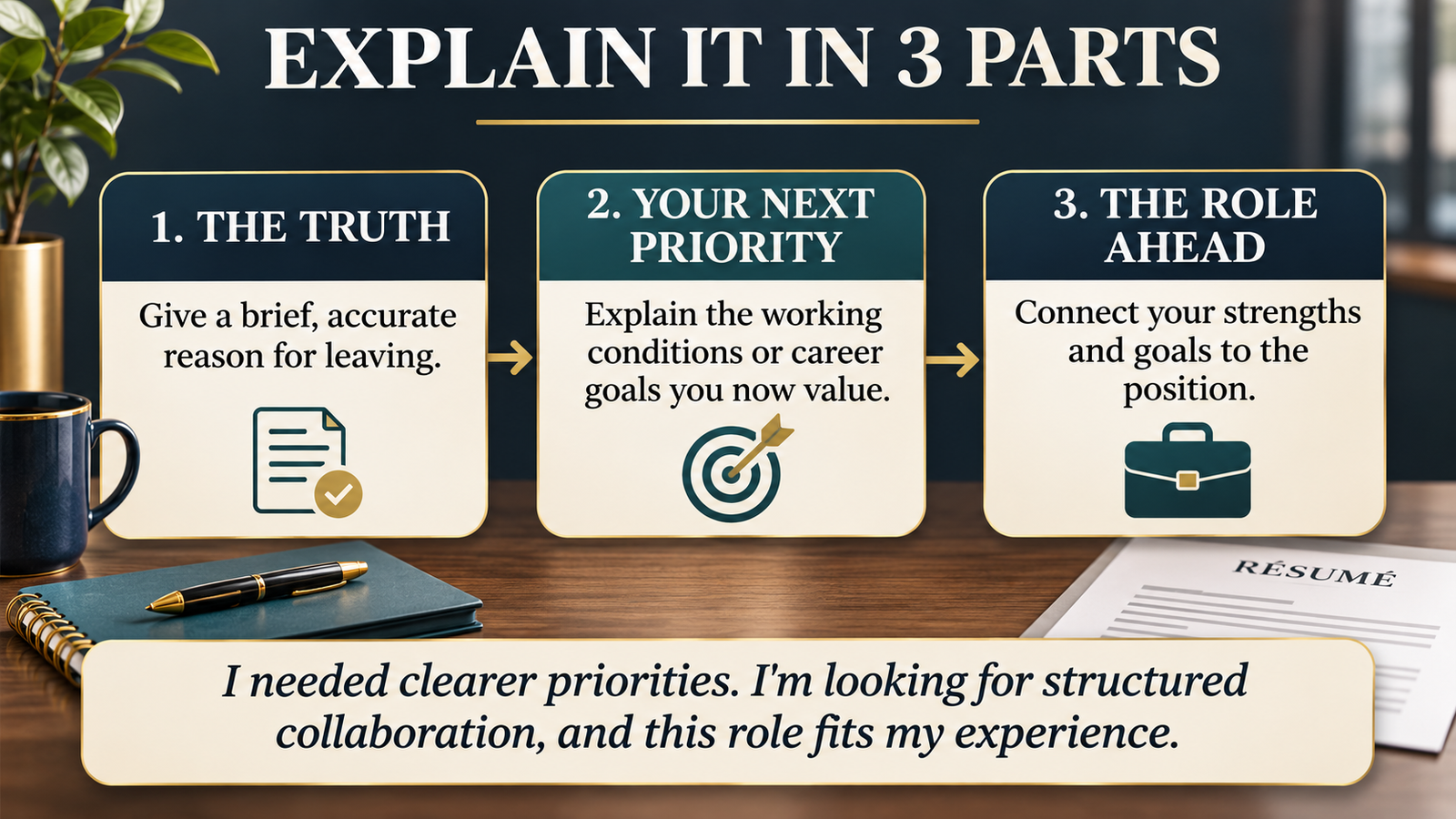
Putting the Three Parts Together
“Over time, the responsibilities and management expectations in my previous role became less consistent, and I decided it was no longer the right long-term fit. I’m looking for a position with clearer priorities and stronger collaboration. This opportunity interests me because the role has defined ownership of projects and closely matches the work I’ve enjoyed doing.”
Adapt the wording to your actual experience. The structure is useful because it explains the departure without allowing the previous workplace to become the entire conversation.
How Long Should Your Answer Be?
There is no universal interview rule requiring a particular number of seconds.
As a practical starting point, prepare an answer that can be delivered comfortably in about 20 to 40 seconds. Then prepare one slightly longer version for follow-up questions.
The short answer should contain:
- the genuine reason in broad professional terms;
- the career direction you are pursuing;
- a connection to the new opportunity.
You do not have to fill every moment of silence after answering.
If the interviewer wants more detail, they can ask for it. The longer version should clarify facts rather than introduce a new story that contradicts the first.
How to Describe a Toxic Workplace Without Attacking People
The word “toxic” can describe a genuine experience, but it is broad. An interviewer may not know whether you mean bullying, inconsistent leadership, excessive workloads, ordinary disagreement, or something else.
A more useful answer identifies the work condition involved.
| What You Might Feel Tempted to Say | More Specific Professional Language |
|---|---|
| “My manager was toxic.” | “The management approach was not a sustainable fit for how I worked best.” |
| “Everything was chaotic.” | “Responsibilities and priorities changed frequently without enough clarification.” |
| “My boss blamed me for everything.” | “I was looking for clearer accountability and a more consistent feedback process.” |
| “Nobody supported me.” | “I wanted a role with more defined collaboration and clearer access to the information needed for the work.” |
| “I couldn’t stand the company anymore.” | “After considering the working conditions and my goals, I decided to pursue a different environment.” |
| “I had no future there.” | “The scope for further development in that role had become limited.” |
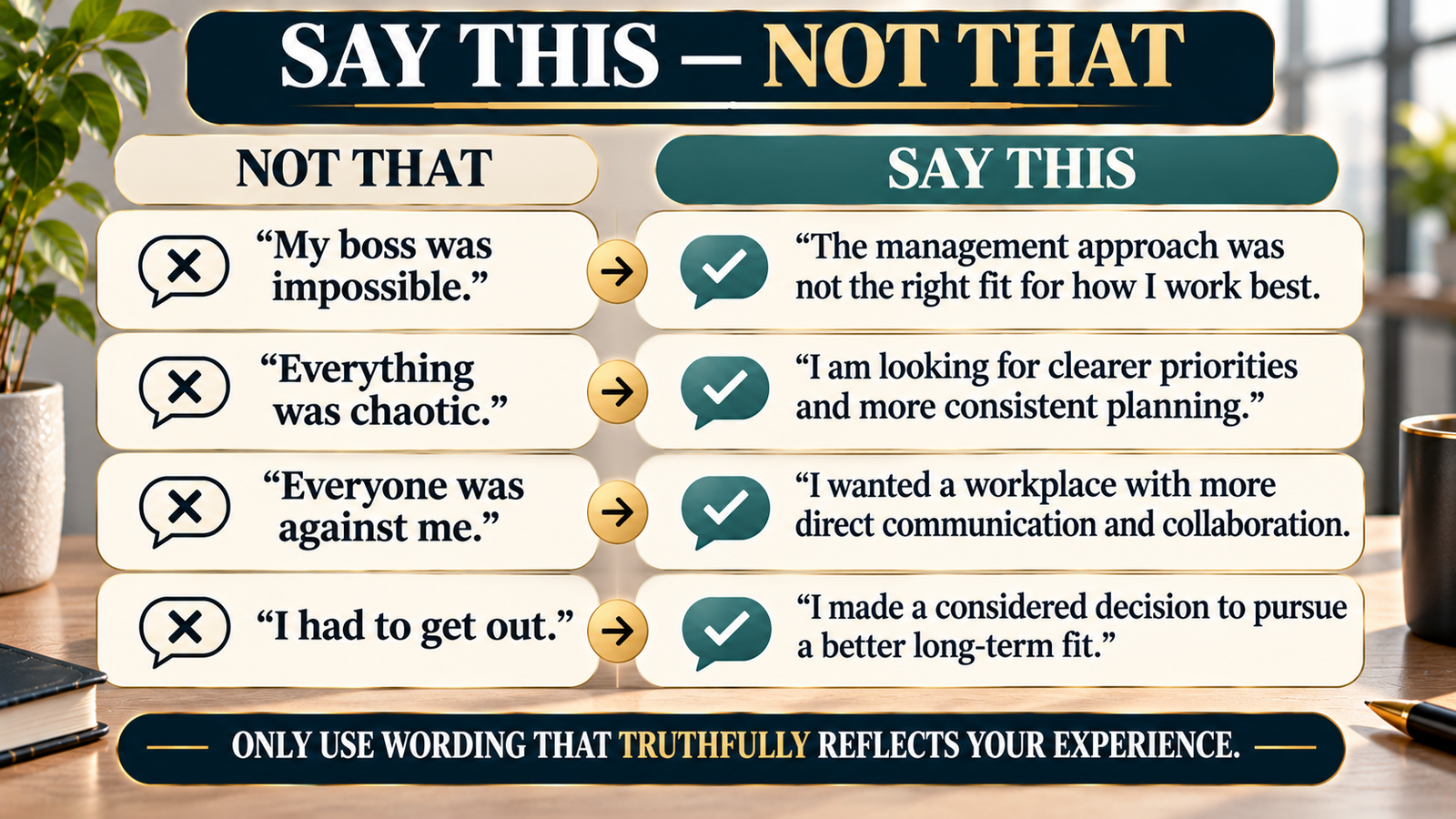
Important: These are alternative ways to communicate different real situations, not interchangeable excuses. Use only a statement that accurately describes your experience.
If the central reason was a serious incident of harassment or retaliation, you are not required to pretend that it was merely a preference for career development. You can acknowledge that the working environment was unsuitable or that serious workplace concerns contributed to your decision, while still limiting unnecessary personal details.
12 Professional Answers for Different Toxic Workplace Situations
Your best explanation depends on what actually happened. The following examples are templates to adapt, not statements to repeat regardless of the facts.
1. You Left Because of a Difficult Manager
“I learned a great deal from the role, but over time I recognized that the management approach was not the best long-term fit for me. I’m looking for a position where expectations and feedback are communicated more consistently, and this opportunity seems closely aligned with those priorities.”
This works when management fit genuinely contributed to your decision.
2. You Experienced Repeated Bullying or Undermining
“The working environment became difficult in ways that affected my ability to contribute effectively. I considered the available options and ultimately decided to move on. My priority now is finding a position where I can apply my skills in a professional and constructive environment.”
You can be more specific if appropriate, but you do not need to describe every incident to a hiring manager.
3. The Workload Became Unsustainable
“The role evolved into a pattern of competing priorities that could not consistently be managed within the available resources. I’m comfortable with demanding work, but I perform best when priorities are clear and capacity decisions are made openly.”
Notice that this does not suggest you are unwilling to work hard. It distinguishes challenging work from unclear or unmanaged expectations.
4. Your Boss Changed Expectations Repeatedly
“One of the challenges in my previous position was that responsibilities and success measures changed frequently. I realized that a role with clearer ownership and defined goals would allow me to contribute more effectively.”
5. You Left After Leadership Changes
“Following a leadership change, the direction and structure of my role shifted significantly. I considered how those changes aligned with my professional goals and decided to pursue opportunities more closely connected to my strengths.”
This is particularly useful when a genuine restructuring occurred. It should not be used to invent a leadership change that never happened.
6. You Left Because Your Contributions Were Not Recognized
“I was looking for a role with clearer ownership of projects and more transparent performance expectations. I enjoy taking responsibility for measurable work, and that is an important part of what attracted me to this position.”
Be prepared to discuss actual achievements. Concrete work examples are more persuasive than broad claims that your former workplace never appreciated you.
7. You Left After an HR Complaint
“There were workplace concerns that I addressed through the appropriate internal process. After reviewing the situation and the available options, I decided it was best to pursue a different professional environment. I’m focused on finding a role where I can contribute through my experience in [relevant skill or area].”
Do not disclose confidential investigative material or claim an investigation reached a conclusion it did not reach.
If you need to understand the reporting process separately, see what happens after reporting a difficult manager to HR.
8. You Left Without Another Job
“I made a considered decision to leave because the working conditions were no longer a suitable long-term fit. Since then, I’ve been focusing on finding an opportunity that matches my skills and expectations more closely. I’ve also used the time to [truthful example of learning, applications, projects, or other relevant activity].”
You do not have to invent training or achievements to fill the gap. If you spent part of that time handling personal responsibilities or recovering from a difficult experience, you can explain the break in an appropriately general way.
9. You Left After Only a Few Months
“After joining, it became clear that the day-to-day role and working arrangements were materially different from what I understood during recruitment. I evaluated whether that could be resolved and ultimately decided to look for a role with a better long-term fit.”
Use this only if the actual job differed significantly from what was discussed.
10. You Were Pressured to Resign
“The working relationship had become difficult, and my employment ended following discussions about the situation. I’m happy to clarify the formal circumstances accurately. My focus now is finding a position where I can apply my skills and build a productive working relationship.”
Do not describe a dismissal as a voluntary resignation if that is not what happened. Where the status is disputed or there is a settlement agreement, seek appropriate advice about legal obligations and accurate disclosure.
11. You Were Dismissed
“My employment ended following a disagreement about performance expectations. I understand that the employer had concerns about [accurate, relevant issue]. I took time to review that experience, and I have since worked on [genuine action or improvement]. I’m now looking for a role where the expectations and my experience align more closely.”
This example applies only if it accurately describes the dismissal. Other dismissals may involve redundancy, misconduct, restructuring, or disputed facts. Answer the direct question rather than hiding it behind a vague reference to cultural fit.
12. You Are Still Employed but Looking to Leave
“My current role has given me useful experience, but the environment and direction have changed over time. I’m exploring opportunities where I can contribute more effectively through [specific skills], and the responsibilities of this position are a strong match.”
Avoid announcing to the new employer that you have already resigned if you have not. Likewise, do not misrepresent your availability or notice period.
How to Handle Difficult Follow-Up Questions
A polished initial answer is useful, but interviewers may ask for more detail. Prepare for that possibility without assuming every follow-up is an attempt to trap you.
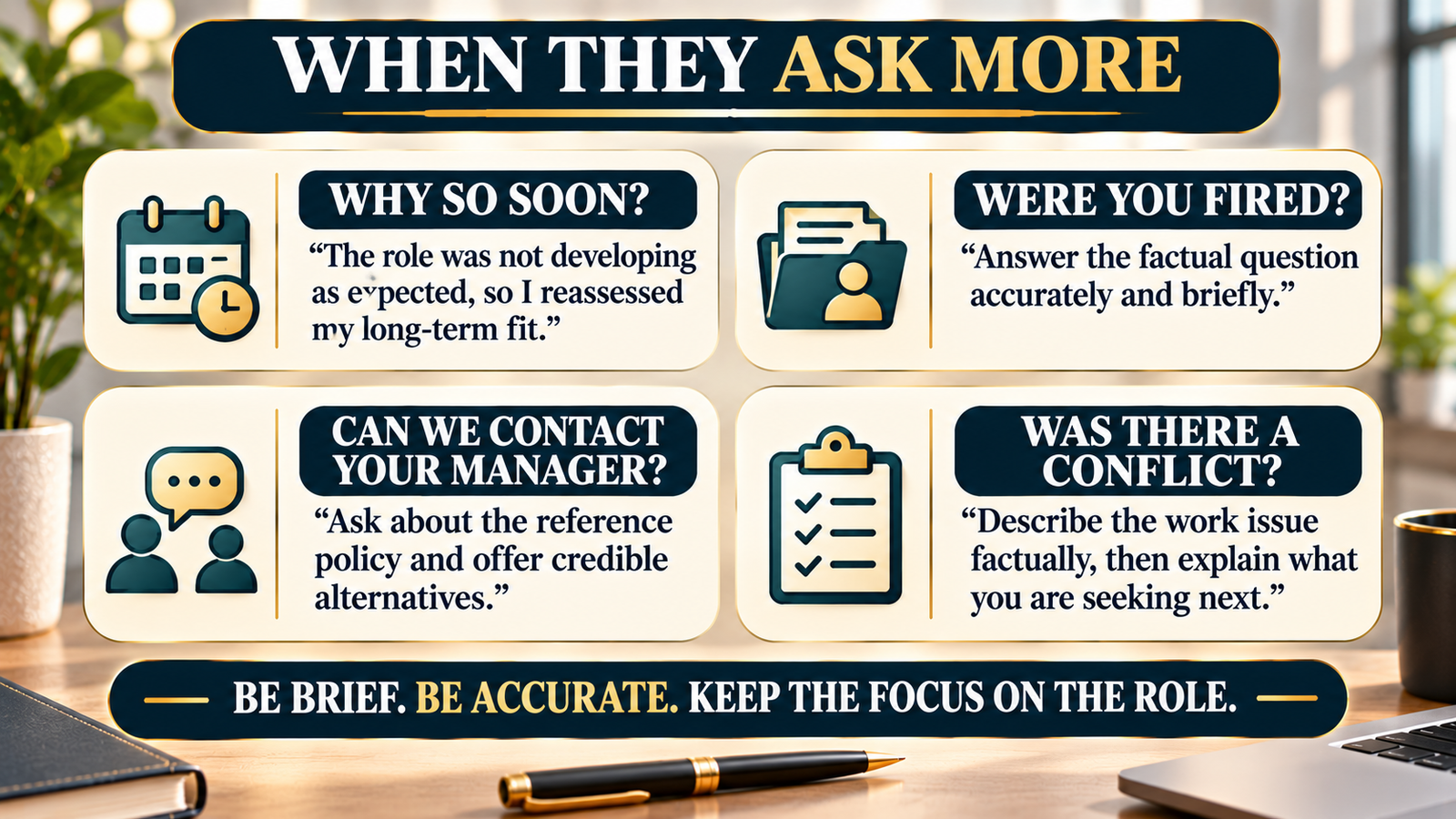
“What Exactly Was Wrong With Your Previous Manager?”
A possible response:
“Our approaches to communication and priorities were different, and that became difficult to sustain over time. I would prefer to focus on the work expectations that help me perform well, rather than making a personal judgment about my former manager.”
This keeps the discussion specific enough to be meaningful while avoiding speculation about the manager’s character.
“Did You Try to Resolve the Problem?”
If you genuinely tried to resolve it:
“Yes. I asked for clearer expectations and worked through the appropriate channels to address the issues. After considering the outcome, I decided that pursuing another opportunity was the right decision.”
If you did not attempt formal resolution, do not claim otherwise. You could say:
“I considered the available options and concluded that moving toward another opportunity was the most appropriate step for my circumstances.”
“Do You Have Problems Working With Authority?”
This question can feel loaded, but the useful response is to explain how you handle legitimate direction and disagreement.
“I’m comfortable working with clear expectations and being accountable for results. When I disagree with a decision, I try to clarify the priorities, share relevant information, and follow the agreed direction.”
Give a real example if asked.
“Why Did You Stay for So Long?”
“I wanted to give the role a reasonable opportunity to work and fulfill my responsibilities. Over time, it became clear that the conditions were not likely to improve enough for a sustainable long-term fit, so I made a considered decision to move on.”
This response is appropriate only when it matches your actual thinking and actions.
“Why Did You Leave So Quickly?”
“I recognized fairly early that there was a significant mismatch between the role I expected and the actual working conditions. I evaluated the situation and decided it was more responsible to make a change rather than continue in a position I did not see as a sustainable fit.”
“Can We Contact Your Previous Manager?”
Do not panic or imply that the manager is guaranteed to give a damaging reference.
Ask about the process:
“Could you clarify whether you’re looking for formal employment verification or a professional reference? I can provide appropriate verification information and referees who have direct knowledge of my work.”
If a specific former manager is required, be truthful about whether you can provide that contact and why you would prefer an alternative.
“Were You Fired?”
Answer the status accurately.
If the answer is yes, do not say no. If your employment status is genuinely disputed, explain that there is a dispute without presenting your interpretation as a settled legal outcome.
Then provide relevant context, reflect on any legitimate feedback, and bring the conversation back to your experience and suitability for the new role.
Should You Actually Use the Word “Toxic” in an Interview?
Usually, a specific description communicates more than a broad label.
“Toxic” does not tell the interviewer what happened. It may refer to poor communication, bullying, excessive workloads, favoritism, harassment, leadership problems, or an unresolved working relationship.
Instead of saying:
“It was a toxic workplace.”
you might explain:
“The role became difficult because priorities and responsibilities changed frequently without clear decisions about ownership.”
Or, if appropriate:
“I experienced repeated workplace conduct concerns and ultimately concluded that leaving was the most constructive option available to me.”
There is no absolute rule against the word. But the interviewer will generally learn more from a clear account of the relevant working conditions.
What If the Workplace Really Was Abusive?
Professional language should not require minimizing serious conduct.
Someone may have experienced harassment, threats, repeated humiliation, or other significant workplace problems. Those experiences do not have to be reframed as harmless personality differences.
At the same time, a recruitment interview is not necessarily the appropriate setting to present an entire workplace investigation or legal claim.
You can acknowledge the seriousness in measured language:
“There were serious workplace conduct concerns that contributed to my decision to leave. I addressed the situation through the channels available to me, and I would prefer to keep confidential details separate from this interview. I’m happy to discuss my responsibilities, achievements, and the kind of working environment where I can contribute effectively.”
Do not claim that a process established misconduct if the outcome was different or remains unresolved.
Where legal proceedings, confidentiality obligations, settlement terms, or protected reporting are involved, seek appropriately qualified advice about what you can disclose.
What If Your Previous Manager Damaged Your Reputation?
A difficult manager may have influenced how other people view your work. That concern can become especially stressful when a recruiter asks about references.
Begin by separating assumptions from established facts.
Ask yourself:
- Has an employer actually told me there was a negative reference?
- Do I know what was said?
- Is the information inaccurate or merely unfavorable?
- What records can verify my actual responsibilities and achievements?
- Who else has direct knowledge of my work?
Do not open a new interview by warning that your previous manager may lie about you unless there is a specific reason the issue must be addressed.
Focus first on credible professional evidence:
- accurate job titles and employment dates;
- relevant projects and responsibilities;
- measurable achievements you can support;
- appropriate supervisors or colleagues willing to provide references;
- ordinary employment verification where available.
In the UK, ACAS explains that employment references must be fair and accurate, but may include relevant negative information. In the United States, the EEOC explains that false negative references given because of protected EEO activity can raise retaliation concerns. These protections and requirements differ by jurisdiction.
If a damaging reference becomes a real problem, address the specific information with appropriate professional or legal support rather than speculating about what the former manager may have said.
For the related problem of workplace reputation damage before departure, see our guide to workplace smear campaigns and calm reputation protection.
How to Explain an Employment Gap After Leaving a Toxic Job
Leaving without another offer may create a gap between positions. That gap is not automatically evidence of poor professional ability.
An interviewer may simply want to understand the timeline.
Give an accurate explanation and describe relevant activities if you completed them.
If You Focused on Your Job Search
“After leaving my previous position, I focused on finding a role that better matched my skills and working priorities. I’ve been researching employers, applying for suitable opportunities, and preparing for interviews.”
If You Completed Relevant Learning
“During the transition, I completed [actual course or project] to strengthen my skills in [area]. I’m now looking for opportunities where I can apply that learning alongside my previous experience.”
If You Needed a Personal Break
“After leaving, I took a planned break to address personal priorities before returning to my job search. I’m now ready to focus on my next professional position.”
You generally do not need to share a detailed personal or medical history just to account for time between jobs. Specific disclosure obligations can depend on the role and local rules.
The National Careers Service also recommends explaining employment gaps through a truthful account of what you have done during the period, including learning, networking, or other relevant activities where applicable.
How to Explain a Short Stay on Your Resume
Short tenure can attract questions, particularly when several recent positions lasted only a few months.
Do not invent dates to make a short role appear longer.
If asked, explain:
- what the role was expected to involve;
- what materially changed or proved unsuitable;
- how you assessed the situation;
- why your current opportunity is a stronger match.
For example:
“I joined expecting a role focused on client delivery, but the responsibilities changed substantially toward a different function. After discussing the scope and considering the long-term fit, I decided to move toward positions more closely aligned with my background in client delivery.”
That is a credible explanation when the responsibilities really changed in that way.
Your resume can normally focus on positions, responsibilities, results, and dates. An application form that specifically asks for complete employment history or the reason for leaving should be answered according to its requirements.
How to Avoid Sounding Defensive During the Interview
When a previous workplace left you feeling repeatedly criticized or misunderstood, even an ordinary interview question can feel like another accusation.
A useful preparation method is to separate what you want the interviewer to understand from everything you wish your former employer had understood.
Before the interview, write two short statements.
Statement A: What Happened
“The role involved repeatedly changing priorities and insufficient clarity about responsibilities, which eventually made it unsuitable for me.”
Statement B: What I Want the Interviewer to Know
“I manage complex work effectively when expectations are clear, and I have direct examples of the results I delivered.”
These statements serve different purposes.
The first explains the departure.
The second communicates your professional value.
Use the interview to connect them without repeatedly defending your character.
Prepare Evidence of Your Professional Strengths
Do not let the reason for leaving become the only story you have prepared.
Most of the interview should still be about your ability to do the new job.
Prepare three to five examples of relevant work, such as:
- a difficult project you completed;
- a measurable improvement you contributed to;
- a customer or stakeholder problem you resolved;
- a technical or operational skill you developed;
- a time you handled constructive feedback well;
- a disagreement you resolved professionally.
For each example, prepare the situation, your actual responsibility, the action you took, and the result.
Only use numbers and achievements you can support.
Example
“One project I’m particularly proud of involved reorganizing our reporting process. I clarified ownership with the relevant teams, documented the approval steps, and helped reduce recurring confusion about who was responsible for each stage.”
This is more meaningful than repeatedly reassuring the interviewer that your previous boss’s judgment was unfair.
Turn the Interview Into a Two-Way Evaluation
If you have already experienced a harmful workplace, getting another job is only part of the goal.
You also want to evaluate whether the new role has workable conditions.
CIPD describes interviews as a two-way process: employers evaluate candidates, while candidates use the conversation to understand the role and decide whether they would want to work there.
See CIPD guidance on selection interviews.

Ask How Feedback Is Delivered
“How does the manager normally give feedback to someone in this role?”
Listen for actual routines: one-to-one meetings, performance reviews, project discussions, or clear written expectations.
Ask How Disagreement Is Resolved
“Can you give me an example of a disagreement on the team and how the decision was made?”
You are not looking for an absence of conflict. You are looking for reasonable ways of handling it.
Ask About Competing Priorities
“When two important deadlines compete and the team does not have capacity for both, how do you determine what takes priority?”
Ask About Workload
“What does a particularly demanding week look like in this position, and how often does that occur?”
Ask What Success Looks Like
“What would make you say after six months that someone in this role is performing well?”
Compare the answers with the written job description and what other interviewers have told you.
A single vague answer does not prove the workplace is unhealthy. But repeated contradictions or hostility toward reasonable questions can justify further investigation before accepting an offer.
How to Practice Your Interview Answer
Preparation matters most when the question is personally difficult.
You do not need to memorize a polished speech word for word. Instead, prepare a stable account of the facts and practise expressing it naturally.
A Simple Five-Step Rehearsal
- Write the factual reason. State why you actually left or are considering leaving.
- Remove unnecessary detail. Keep relevant context without lengthy character judgments, gossip, or unrelated incidents.
- Identify your next priority. Name one or two working conditions or career goals that genuinely matter.
- Connect the answer to the vacancy. Identify specific responsibilities that attract you.
- Practise one follow-up. Prepare a longer answer if the interviewer asks for clarification.
Record yourself giving the answer or practise with a trusted person. Listen for accuracy, clarity, and whether the response moves naturally toward your relevant abilities.
A good answer should sound like a real professional describing a career decision, not someone reading a public-relations statement.
Common Mistakes When Explaining a Toxic Workplace
| Mistake | Why It Creates Problems | Better Approach |
|---|---|---|
| Inventing a reason for leaving | It can conflict with employment records or later answers. | Give a true, appropriately concise explanation. |
| Diagnosing the former manager | It shifts attention away from observable work conditions. | Describe conduct, structure, or management practices. |
| Recounting every incident | The main interview question may get buried in unrelated details. | Answer the question and expand only when useful. |
| Claiming all feedback was unfair | It leaves the interviewer unable to assess accountability. | Separate legitimate feedback from concerns about how it was delivered or applied. |
| Hiding a dismissal when asked directly | It misrepresents a material employment fact. | Explain the employment outcome accurately and discuss relevant learning. |
| Assuming the new employer is healthy | A polished interview does not guarantee good conditions. | Ask specific questions and compare information. |
| Making promises about references | The actual policy or referee may not match the claim. | Confirm which references and verification documents are available. |
Professional communication is not about making the story artificially positive. It is about communicating the facts that matter without unnecessary speculation or hostility.
Chapter 5: Protect the Career Story You Take With You
Chapter 5 of Reclaim Your Power, The Smart Exit Strategy, focuses on leaving with attention to evidence, finances, references, and career continuity.
Those considerations do not end when you submit a resignation letter.
Your next interview is another stage of protecting your career story.
That means being able to explain:
- what your responsibilities were;
- what you accomplished;
- why the role ended or became unsuitable;
- what you learned about the work conditions you need;
- what you are prepared to contribute next.
You cannot control how every former coworker or manager remembers you.
You can build a truthful account of your own work supported by appropriate examples and records.
Chapter 7: Use the Experience to Choose Your Next Workplace More Carefully
Chapter 7, Building a Safer Working Life, takes the process further.
The purpose is not to become suspicious of every hiring manager.
It is to recognize conditions that support good work and to ask better questions before joining.
You may now know that you need:
- clear priorities;
- consistent feedback;
- reasonable workload discussions;
- accurate role descriptions;
- professional boundaries;
- fair processes for resolving disagreement.
Those requirements can become useful interview questions rather than fears you carry silently into your next position.
The goal is a career decision informed by experience, not a search for a workplace where problems can never occur.
Frequently Asked Questions
How do I explain leaving a toxic job in an interview?
Give an accurate, concise explanation of the main reason for leaving, describe what you are looking for in your next role, and connect those priorities to the position. Avoid turning the answer into a long account of personal conflict.
Should I tell an interviewer my previous boss was toxic?
You can discuss genuine concerns, but describing the specific management behavior or working conditions is usually more informative than applying a broad personality label.
What is a good answer to “Why did you leave your last job?”
A good answer is truthful, relevant, and forward-looking. For example, if management expectations genuinely changed, you might say the role was no longer a sustainable fit and explain why the new position better matches your skills and professional priorities.
Can I say I left because of bad management?
Yes, when that accurately describes your decision. It is usually more useful to describe the management issue specifically, such as unclear responsibilities, inconsistent feedback, or an unsuitable working relationship.
How do I explain workplace bullying without sounding negative?
You can acknowledge serious workplace conduct concerns without detailing every incident. Briefly describe the situation, the decision you made, and what you are seeking next. You do not need to excuse the conduct or invent a different reason for leaving.
Should I mention an HR complaint in my next interview?
Not automatically. If the interviewer asks why you left, give the relevant truthful explanation. An HR complaint may be part of the context, but confidential details or disputed allegations do not necessarily need to become the focus of an ordinary recruitment conversation.
How do I explain resigning without another job?
Explain the decision accurately and describe your subsequent activities where relevant. These could include job applications, professional learning, family responsibilities, or a planned personal break. Do not invent activities to make the gap appear more productive.
Will employers reject me for leaving a toxic workplace?
No one can guarantee how an individual employer will respond. Hiring decisions depend on many factors, including qualifications, experience, references, interview performance, and the requirements of the role. A concise, credible explanation can help the interviewer understand your situation.
What if I was fired from a toxic workplace?
Answer a direct question about dismissal accurately. Explain the relevant circumstances without inventing a voluntary resignation, acknowledge legitimate feedback where applicable, and focus on your skills and what you can contribute next.
What if the interviewer asks whether I caused the conflict?
Describe the relevant facts, your own actions, and anything you could reasonably have handled differently. Do not accept unsupported blame, but avoid claiming you were incapable of making any mistakes.
Can I refuse to discuss private details about my old workplace?
You can usually keep unnecessary personal details out of an ordinary interview. However, some roles, screening processes, or application questions may require specific factual disclosures. Understand those requirements rather than giving a misleading answer.
What if my old manager gives a bad reference?
First establish what information was actually provided. You may be able to offer additional credible referees or relevant verification. If the information appears inaccurate, discriminatory, or unlawfully retaliatory, seek advice under the rules that apply where you work.
How do I explain a three-month job on my resume?
Explain the genuine reason the role ended or proved unsuitable. If the responsibilities materially differed from what was represented, you can say so accurately and explain why you are seeking a better long-term match.
Should I put “toxic workplace” as my reason for leaving on a job application?
Usually, a short factual description communicates more clearly than the label “toxic.” If the form requires a reason or complete employment history, answer accurately and follow its instructions.
What questions should I ask to avoid another toxic workplace?
Ask about feedback, performance measures, disagreements, competing priorities, workload, turnover, and role expectations. Look for specificity and consistency across the hiring process rather than assuming one answer proves the workplace will be healthy or harmful.
Final Thoughts: Your Previous Workplace Does Not Have to Define Your Next Interview
Leaving a difficult workplace can create a complicated career story.
You may be proud of the work you completed while also being disappointed by how the employment relationship ended.
You may have learned useful skills in an environment you would not choose again.
You may have received legitimate feedback alongside treatment you believe was unfair.
Those things can exist together.
You do not need to present your previous workplace as entirely positive. You also do not need to make your former manager the main character of your next job interview.
Start with an accurate explanation.
Keep it proportionate to the question.
Explain the professional conditions and goals that matter now.
Then bring the discussion back to your experience, your achievements, and the work you are capable of doing.
Most importantly, use the interview to learn about the opportunity in front of you.
Your next interview is not a trial about your previous workplace. It is a conversation about whether the next role is right for you and whether you are right for it.
That is the story worth preparing.
Turn a Difficult Departure Into a More Deliberate Career Decision
Reclaim Your Power provides a broader framework for navigating harmful workplace patterns and rebuilding after them.
Chapter 5, The Smart Exit Strategy, addresses the practical decisions involved in protecting your future when staying is no longer workable.
Chapter 7, Building a Safer Working Life, focuses on stronger professional boundaries, clearer standards, and better ways to evaluate future workplaces.
The guide also includes practical planning and reflection tools to support workplace documentation, career decision-making, recovery, and rebuilding.
If your previous workplace experience is affecting how you approach interviews or your confidence about the next opportunity, explore Reclaim Your Power and its seven-chapter workplace recovery framework.
Professional disclaimer: This article offers general career education, not individualized employment, legal, medical, or mental-health advice. Recruitment practices, employment verification, protected disclosures, settlement confidentiality, background checks, and reference requirements vary by employer, industry, and jurisdiction. The examples are illustrative and should be used only when factually accurate for your circumstances. For disputes involving legal rights, confidentiality obligations, or serious employment consequences, seek appropriately qualified local advice.
Ready to Reclaim Your Power?
Get the 376-page digital edition with 7 chapters, 22 practical tools, reusable forms, an optional 30-entry journal, and references.
Buy Now — $4.99
Leave a Reply