
People disagree about priorities. Managers give feedback employees do not like. Coworkers have different communication styles. Deadlines create pressure. Responsibilities overlap. Someone misunderstands a message, becomes defensive, or handles a conversation poorly.
None of that automatically means workplace bullying.
But sometimes a disagreement stops behaving like an ordinary communication problem.
The issue becomes personal.
The same person is repeatedly humiliated, excluded, blamed or undermined.
Questions lead to punishment instead of clarity.
Standards keep changing.
One person has the power to shape the story while the other spends more and more energy defending themselves.
Attempts to resolve the problem do not create greater understanding. They create more confusion.
This is where the question changes from:
“How do we communicate better?”
to:
“Is this still workplace conflict, or has it become a repeated harmful pattern?”
The difference is not always obvious from one meeting, one rude comment or one disagreement.
It usually becomes clearer when you examine repetition, power, accountability, response to boundaries, capacity for repair and professional impact.
This guide explains workplace conflict vs. bullying, how to tell when an ordinary disagreement may be becoming something more serious, and what practical steps to take when you are not yet certain.
What Is Workplace Conflict?
Workplace conflict is a broad term for disagreements, disputes or difficult relationships involving people at work.
Conflict can arise from:
- different priorities;
- unclear responsibilities;
- working-style differences;
- poor communication;
- competition for resources;
- performance concerns;
- personality clashes;
- pressure and workload;
- different interpretations of a decision;
- mistakes or misunderstandings.
Conflict is not inherently abusive.
In fact, respectful disagreement can be useful.
Two people can disagree strongly about a project and still:
- listen to each other;
- challenge ideas rather than attack character;
- acknowledge evidence;
- adjust when something is wrong;
- reach a workable decision;
- continue working together afterward.
CIPD guidance notes that workplace conflict can include everything from disagreements and working-style differences to more serious bullying and harassment, and that early intervention can prevent problems from becoming entrenched. See CIPD guidance on workplace conflict and bullying.
What Is Workplace Bullying?
There is no single universal legal definition of workplace bullying.
ACAS describes bullying as unwanted behavior from a person or group that is offensive, intimidating, malicious or insulting, or an abuse or misuse of power that undermines, humiliates or causes harm.
ACAS also notes that bullying can:
- be a repeated pattern or sometimes a one-off incident;
- happen face-to-face or through digital communication;
- occur in work-related situations;
- be subtle and not obvious to other people;
- occur even when the person responsible says they did not intend to bully.
Read ACAS guidance on workplace bullying.
The practical distinction is therefore not:
“Did someone upset me?”
It is:
“What pattern of behavior is occurring, how does power operate inside it, and what is the pattern doing to my ability to work?”
Workplace Conflict vs. Bullying: The Quick Comparison
| Question | Workplace Conflict | Possible Bullying Pattern |
|---|---|---|
| What is the disagreement about? | Usually a work issue, decision, priority, communication style or competing viewpoint. | The focus may repeatedly shift from the work to your competence, character, worth or right to speak. |
| Can both sides speak? | Both people can usually express disagreement, even if the conversation is uncomfortable. | One person’s voice may dominate through status, intimidation, exclusion or control of information. |
| Can mistakes be acknowledged? | People may become defensive but can eventually correct misunderstandings or admit errors. | Responsibility may repeatedly be denied, redirected or turned back onto the person raising the concern. |
| Are expectations stable? | Clarification usually makes the work standard more understandable. | The standard may keep changing, be applied selectively or be denied after the fact. |
| What happens after a boundary? | The other person may disagree but the relationship remains professional. | Reasonable boundaries may lead to exclusion, punishment, ridicule, reduced access or character attacks. |
| Can the issue be repaired? | Conversation, clarification, compromise or mediation may improve the situation. | Attempts to repair the situation may create greater confusion, hostility, retaliation or repetition. |
| What is the impact? | The conflict is stressful but you generally understand the disagreement. | The pattern may affect work, reputation, access, confidence, opportunities or professional safety. |
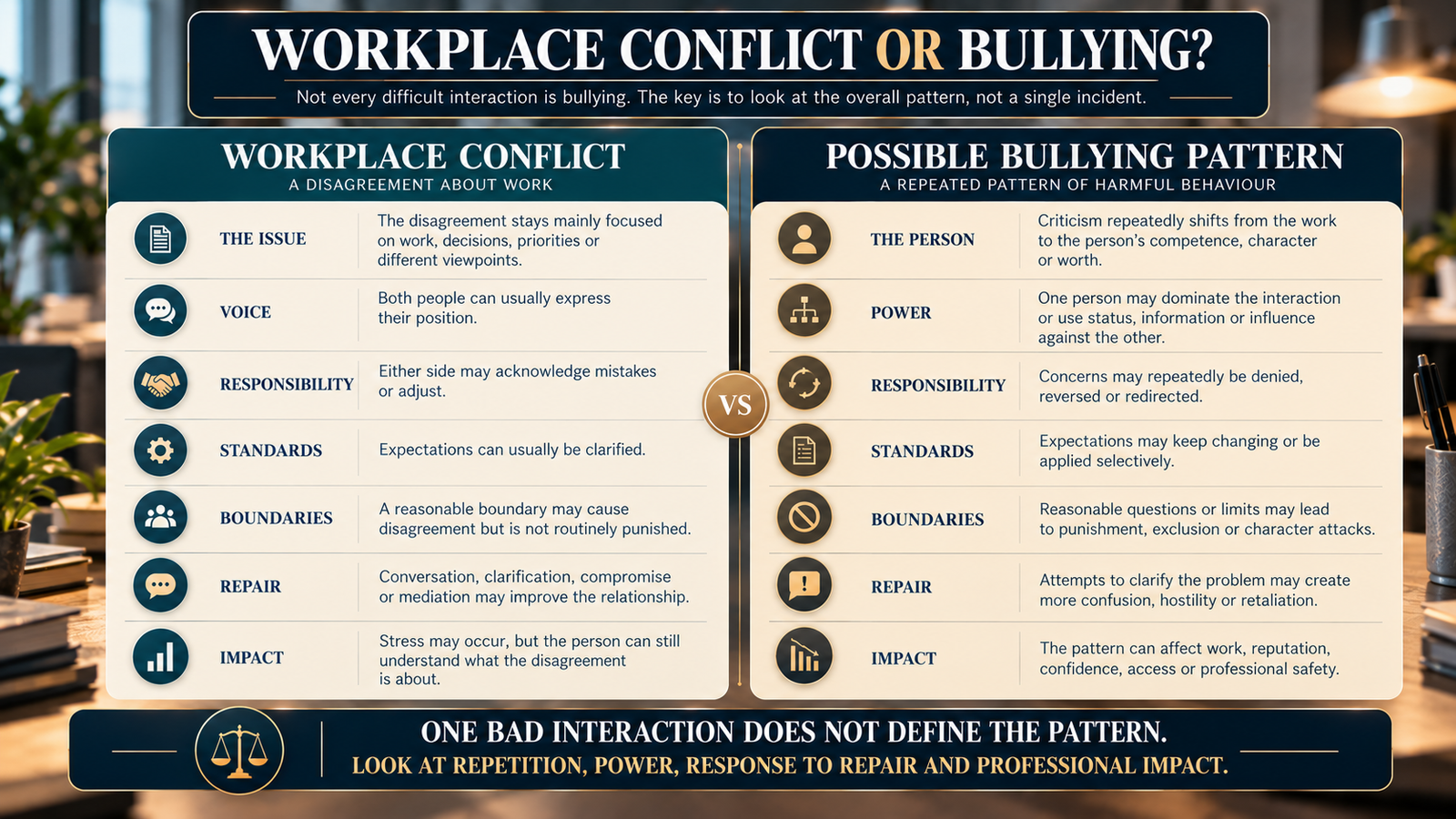
This comparison is not a diagnostic test.
One concerning behavior does not automatically transform a workplace disagreement into bullying.
Look at the pattern as a whole.
The Difference Is Usually Found in the Pattern, Not the Argument
Two coworkers can have a heated argument without either one bullying the other.
A manager can give difficult feedback without bullying an employee.
An employee can disagree with a performance review without the review being abusive.
What changes the picture is what happens repeatedly.
Ask:
- Does the behavior keep happening?
- Is the same person repeatedly targeted?
- Does the person raising the issue get punished?
- Are expectations applied consistently?
- Does one person control the information or narrative?
- Do attempts to resolve the problem make things clearer or worse?
- Is the pattern affecting the person’s work or professional position?
This is why our article on why workplace abuse can be hard to recognize while it is happening emphasizes cumulative patterns rather than waiting for one dramatic event.
1. Conflict Usually Stays Focused on the Issue
In an ordinary conflict, the disagreement usually remains recognizable.
You might disagree about:
- which deadline matters most;
- who owns a task;
- how a client should be handled;
- how much detail a report needs;
- whether someone’s performance met the standard.
The conversation may become tense.
But the underlying issue remains visible.
Example
“I expected the report on Thursday.”
You respond:
“My calendar shows Friday. Can we check the project record?”
The discussion remains about the deadline.
Compare that with:
“This is exactly your problem. You are always making excuses and everyone finds you difficult.”
The disagreement has moved from a deadline to your character.
That shift does not automatically prove bullying, but repeated personalisation is more concerning than ordinary task disagreement.
2. Healthy Conflict Allows Some Mutual Influence
Conflict does not require equal job titles.
A manager still has legitimate authority.
But in a healthier disagreement, information can influence the outcome.
You can say:
“The client changed the specification yesterday.”
and the manager can consider the evidence.
You can say:
“I misunderstood the instruction.”
and take responsibility.
The other person can also adjust.
A more harmful pattern becomes concerning when the result seems predetermined regardless of evidence.
Your role is always to be wrong.
The other person’s role is always to define reality.
3. Bullying Often Involves a Power Imbalance
Power does not only mean job title.
A person may have power because they control:
- your performance review;
- important information;
- client access;
- project assignments;
- senior leadership relationships;
- social influence within the team;
- informal workplace reputation.
A coworker with no formal authority may still have enough influence to isolate someone, control information or shape how others perceive them.
The question is not simply:
“Who has the higher title?”
Ask:
“Who has the practical ability to impose consequences, control the narrative or make the other person’s working life significantly harder?”
4. Look at How Feedback Works
Legitimate feedback may be uncomfortable.
But useful performance feedback normally identifies:
- the work problem;
- a specific example;
- the expected standard;
- what needs to change.
For example:
“The financial section contains three calculation errors. Please check the formulas and resend the report by 3 p.m.”
That is not bullying simply because the employee dislikes hearing it.
ACAS gives a similar example: a manager privately explaining genuine mistakes and how to correct them is appropriate management, not automatically bullying. See the ACAS example.
More concerning feedback may become:
“You clearly are not capable of working at this level.”
or:
“Everyone else understands this. Why are you always the problem?”
Again, one inappropriate comment matters, but repetition and impact provide the larger context.
5. Look at Whether Expectations Become Clearer
Conflict often contains misunderstanding.
That is normal.
The important question is what happens after clarification.
In healthier conflict:
- deadlines become clearer;
- responsibilities become clearer;
- the same mistake is less likely to happen again;
- people know what is expected next.
A harmful dynamic may move in the opposite direction.
You clarify the deadline.
The requirement changes again.
You ask for the standard in writing.
You are accused of being difficult.
You follow the new instruction.
You are criticised for not following the previous one.
Over time, you stop knowing what successful performance even means.
The Repair Test: What Happens When You Try to Resolve the Problem?
This is one of the most useful distinctions.
You do not need the other person to agree with everything you say.
You do not need an immediate apology.
You do not need conflict to disappear completely.
The question is whether attempts at repair create enough accountability and change for the problem to become more stable.
Healthier Repair Can Look Like:
- “I can see why that was confusing.”
- “I should have communicated that more clearly.”
- “Let’s put the deadline in the project system.”
- “I disagree with your interpretation, but I understand the concern.”
- “Let’s agree on how we will handle this next time.”
A More Concerning Response Can Look Like:
- denying records that are clearly available;
- attacking your personality instead of addressing the issue;
- punishing you for raising the concern;
- spreading a negative story about your motives;
- removing access or opportunities after reasonable questions;
- repeating the same behavior after promising change.
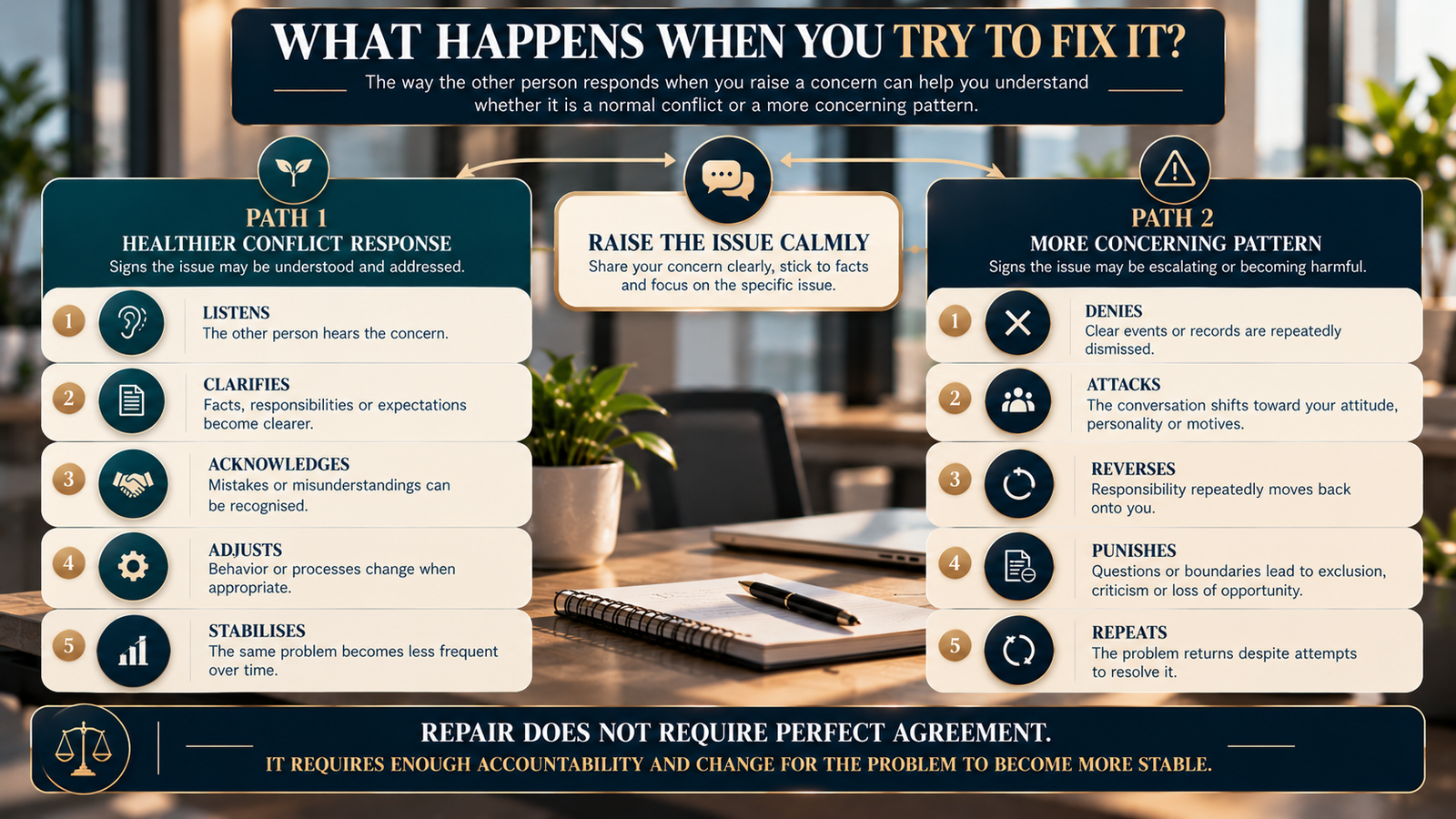
A difficult person may become defensive.
That alone does not prove bullying.
Look at whether accountability and behavioral change eventually appear.
6. What Happens When You Set a Reasonable Boundary?
Conflict can reveal how a relationship handles limits.
You might say:
“I can complete the client report or the audit response today, but I cannot complete both accurately. Which should take priority?”
A manager may dislike that constraint.
They may push back.
But a professional response eventually deals with the workload.
A more concerning pattern may turn the boundary into a character judgment:
“This shows you are not committed.”
or:
“Other employees do not create these problems.”
Then the employee may lose opportunities, access or approval because they stated a reasonable limit.
If boundaries are central to the problem, see our guide on setting boundaries with a manipulative boss professionally.
7. Look for Repeated Humiliation or Intimidation
Normal conflict can become heated.
But repeated behaviors such as these deserve closer attention:
- public humiliation;
- shouting at one person repeatedly;
- constant put-downs;
- mocking someone’s competence;
- threatening language;
- deliberately impossible workloads;
- repeatedly undermining someone’s authority;
- using fear to control questions or disagreement.
CIPD identifies behaviors such as undermining, persistent unwanted criticism, unreasonable pressure, public humiliation, verbal abuse and isolation as common forms of reported bullying or harassment. See CIPD’s manager guidance.
8. Look at Exclusion and Information Control
One missed email can be a mistake.
One meeting invitation can be forgotten.
But a repeated sequence deserves attention:
- You are excluded from information.
- You complete the work without that information.
- The work is criticised.
- You are blamed for not knowing what you were not told.
This is no longer just about someone being unfriendly.
The communication problem is affecting your ability to perform.
Our guide to silent treatment and strategic exclusion at work explains this distinction in more detail.
9. Look at Whether Responsibility Can Be Shared Fairly
Ordinary conflict often includes different perspectives on responsibility.
Sometimes both people contributed.
A healthy review can say:
“You should have followed up sooner, and I should have communicated the change more clearly.”
A concerning pattern may make responsibility travel in only one direction.
Success moves upward.
Blame moves downward.
Every problem eventually becomes your failure.
Every challenge to that account becomes further evidence that you are difficult.
If this is happening repeatedly, our guide to blame-shifting at work provides a practical framework for reconstructing responsibility.
10. Look at What Happens to Your Reputation
Conflict should not require the destruction of another person’s credibility.
A manager can say:
“We disagree about how this project should have been handled.”
without saying:
“This employee cannot be trusted.”
A coworker can challenge your decision without telling the rest of the team that you are unstable, dishonest or incompetent.
When the workplace disagreement turns into a repeated negative narrative about who you are, the issue may be expanding beyond ordinary conflict.
If reputation damage becomes part of the pattern, see our guide to workplace smear campaigns.
Can Workplace Conflict Turn Into Bullying?
Yes, conflict can escalate.
But escalation is not inevitable.
CIPD notes that subtle behaviors such as belittling people, ignoring them, excluding them from communication, taking credit for their ideas or failing to value their views can contribute to workplace disputes when left unresolved. It also emphasizes early intervention because unresolved conflict can intensify. See CIPD guidance.
A conflict may become more serious when:
- the disagreement becomes repeatedly personal;
- one side uses power to punish the other;
- humiliation becomes routine;
- information is withheld;
- boundaries produce retaliation;
- the person is isolated from support;
- the behavior continues despite attempts to resolve it;
- the person’s professional position begins deteriorating.
The useful question is therefore not:
“When did the conflict officially become bullying?”
It is:
“What has the relationship become, and what response is now proportionate?”
What If Both People Contributed to the Conflict?
This is an important question.
Workplace problems are not always simple victim-versus-perpetrator stories.
You may have:
- communicated poorly;
- become defensive;
- missed a deadline;
- raised your voice;
- made assumptions;
- handled part of the disagreement badly.
That does not automatically mean every later behavior toward you is justified.
You can take responsibility for your own conduct while still asking whether the other person’s response was proportionate.
For example:
“I accept that my email was too blunt. I do not believe that justified removing me from project communications for the following three weeks.”
Accountability does not require accepting every accusation.
Does Someone Have to Intend to Bully You?
Not necessarily.
Intent can matter in understanding a situation, but it is not the only thing that matters.
ACAS notes that someone may not realize their behavior is bullying and that harmful behavior can still be treated seriously even without conscious intent.
This is why arguments about motive can become unhelpful.
You may never know whether the person intended to undermine you.
You can still evaluate:
- what they did;
- how often it happened;
- what happened when the concern was raised;
- what professional impact followed.
When Conflict Starts Causing Professional Damage
Chapter 3 of Reclaim Your Power focuses on damage assessment because recognition alone is not enough.
The conflict may have begun as a disagreement.
What matters now is what it has become.
Assess several areas.
| Area | Questions to Ask | Useful Records |
|---|---|---|
| Work | Is the pattern causing errors, rework, missed information or difficulty completing responsibilities? | Project records, deadlines, written instructions and work history. |
| Reputation | Are vague concerns, inaccurate narratives or blame affecting how others perceive you? | Performance feedback, emails, meeting records and specific statements. |
| Access | Have you lost meetings, clients, information, authority or opportunities? | Calendars, assignments, project access and role history. |
| Confidence | Are you becoming afraid to ask reasonable questions or constantly doubting your own judgment? | Personal reflective notes and trusted outside perspective. |
| Boundaries | Do reasonable limits repeatedly trigger punishment or personal attacks? | Messages, workload records and follow-up communication. |
| Career | Are responsibilities, development, promotion or future references being affected? | Reviews, achievements, role descriptions and opportunity records. |
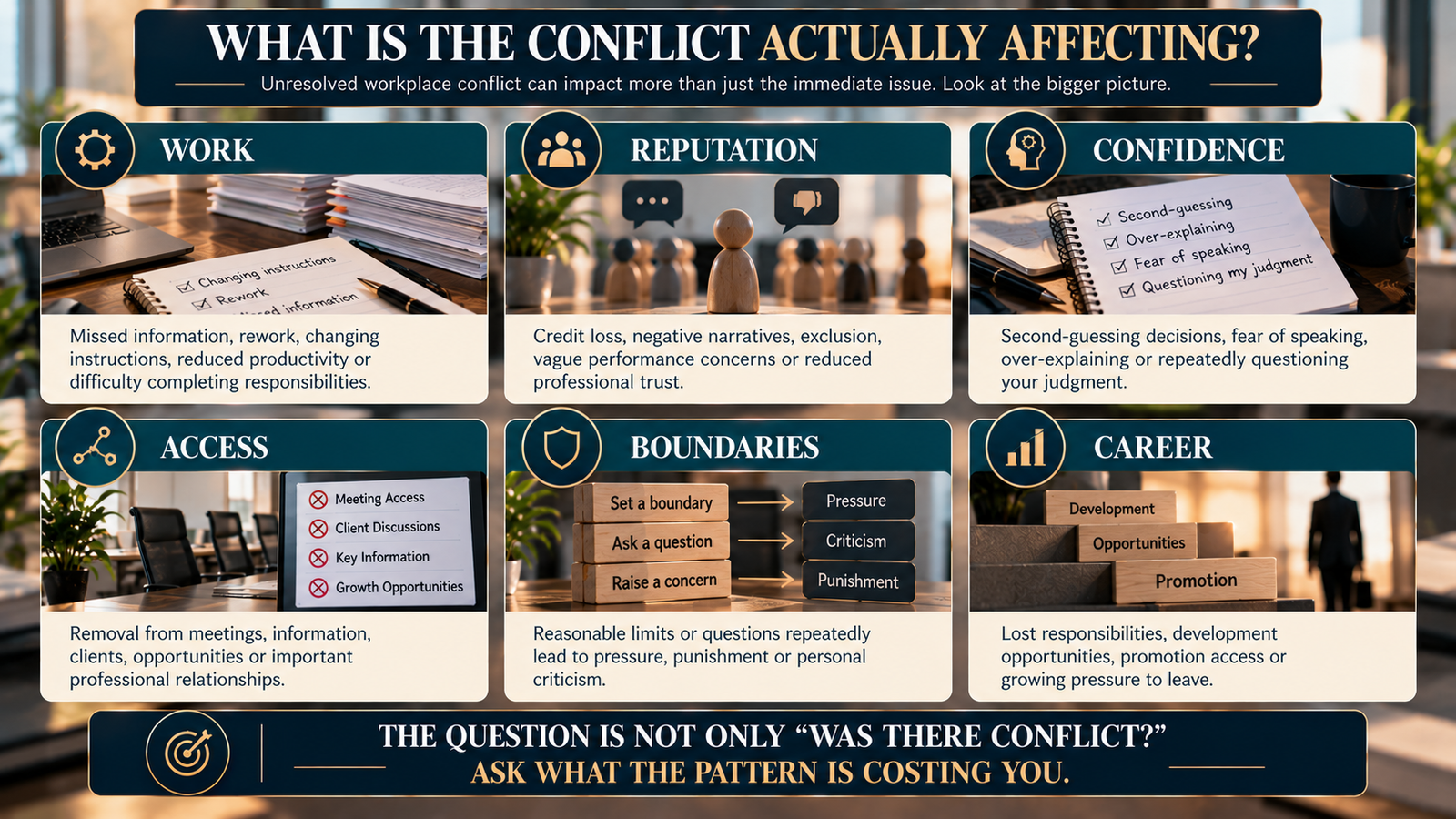
The goal is not to convince yourself that permanent damage has occurred.
It is to understand what needs protection or repair.
Five Questions That Often Clarify the Difference
- Is the problem mainly about the work, or has it become repeatedly about me as a person?
- Can both sides acknowledge facts and responsibility?
- Do attempts at clarification make the situation more stable or more confusing?
- What happens when I ask a reasonable question or set a reasonable boundary?
- Is this pattern now affecting my work, reputation, access or career?
You do not need all five answers to point in one direction.
The purpose is to make the situation more observable.
When Informal Conflict Resolution May Still Make Sense
Some workplace problems are best addressed early and informally.
That may be reasonable when:
- the issue is still primarily a disagreement;
- both people can participate without intimidation;
- the person raising the concern feels able to speak safely;
- there is a realistic possibility of changed behavior;
- the problem has not become too serious for an informal approach.
Possible approaches include:
- a direct professional conversation;
- manager-facilitated clarification;
- role clarification;
- written expectations;
- mediation where appropriate.
ACAS describes workplace mediation as a voluntary, confidential process designed to help people resolve relationship disagreements and agree how to work together in the future. See ACAS mediation guidance.
When Informal Resolution May Not Be Enough
A formal process may deserve consideration when:
- the behavior is serious;
- the same pattern continues after attempts to resolve it;
- you are afraid of retaliation;
- there are threats or significant intimidation;
- your professional record is being affected;
- discrimination or harassment may be involved;
- you are being pressured not to report legitimate concerns;
- the power imbalance makes direct resolution unrealistic.
ACAS states that employees may raise a problem formally when informal steps have not worked or the issue feels too serious for informal resolution. See ACAS guidance on raising workplace problems.
What to Do When You Are Still Not Sure
You do not need to decide today whether the perfect word is conflict, bullying, gaslighting or abuse.
You can still take proportionate protective steps.
1. Keep a Factual Timeline
Record:
- dates;
- people involved;
- what happened;
- instructions given;
- what changed;
- evidence;
- professional impact.
The workplace incident log is designed for exactly this stage.
2. Confirm Important Instructions
“Just confirming my understanding: the final draft is due Friday and should include the revised pricing section.”
3. Ask for Specific Examples
“I want to address the concern. Could you give me the specific example and expected standard?”
4. Seek Outside Perspective
A trusted person who is not inside the immediate conflict may help you separate an isolated disagreement from a pattern.
5. Review the Workplace Policy
Look for bullying, respectful conduct, grievance, harassment or conflict-resolution procedures.
6. Watch What Happens After Clarification
The response itself gives you information.
Does the situation become more workable?
Or does speaking up trigger more punishment, confusion or exclusion?
Professional Scripts for Workplace Conflict
| Situation | Grounded Response |
|---|---|
| Different understanding of a deadline | “I have Friday recorded as the deadline. Could we check the project record and confirm which date applies?” |
| Vague criticism | “I want to improve this. Could you give me the specific example and the standard you expect?” |
| Conversation becomes personal | “I am happy to discuss the work issue. I would like to keep the conversation focused on the specific behavior or result that needs to change.” |
| Workload conflict | “I can complete one of these priorities today. Which one should come first?” |
| Repeated exclusion | “I need the decisions from that meeting to complete my assigned work. Please confirm how those updates will be communicated to me going forward.” |
| Responsibility is disputed | “Can we review the timeline and clarify who owned each decision and approval?” |
What Not to Do While You Are Trying to Understand the Pattern
Try to avoid:
- diagnosing the other person;
- calling every disagreement bullying;
- assuming every mistake is intentional;
- responding with your own gossip or exclusion;
- sending a long emotional accusation while highly upset;
- coaching coworkers to support your version;
- secretly recording without checking applicable law and policy;
- removing confidential company information;
- waiting for perfect certainty before documenting basic facts;
- resigning impulsively solely because the conflict feels intense today.
The goal is not to minimize the problem.
It is to make your response proportionate to what you can actually observe.
Chapter 1: Recognize the Pattern Before You Name It
Chapter 1 of Reclaim Your Power begins with recognition.
That means learning to distinguish:
- a bad day from a repeated pattern;
- feedback from humiliation;
- authority from misuse of power;
- conflict from professional destabilization;
- an ordinary disagreement from repeated punishment for speaking.
You do not have to become an expert on another person’s psychology.
You need to become clearer about what is happening around you.
Our comparison of a narcissistic boss vs. a difficult boss uses the same principle: pattern, accountability, consistency and capacity for change matter more than one unpleasant interaction.
Chapter 2: Look for the Tactics Inside the Conflict
Some workplace conflicts remain straightforward disagreements.
Others begin accumulating tactics such as:
- blame-shifting;
- changing standards;
- selective exclusion;
- denial;
- triangulation;
- reputation attacks;
- punishment after boundaries.
That does not automatically prove a single diagnosis or motive.
It does tell you that communication alone may no longer be the whole problem.
Chapter 3: Assess What the Pattern Has Changed
Chapter 3 shifts the focus from:
“What should I call this?”
to:
“What has this pattern actually affected?”
Review:
- your work;
- professional reputation;
- confidence;
- access to information and opportunities;
- relationships;
- career direction.
This is especially useful when you are still uncertain about labels.
Damage can be assessed from observable consequences.
Frequently Asked Questions
What is the difference between workplace conflict and bullying?
Workplace conflict usually involves a disagreement, competing priorities, communication problems or different perspectives. Bullying concerns grow when behavior becomes repeatedly intimidating, humiliating, undermining, excluding or abusive of power and begins harming someone’s ability to work or professional position.
Is every workplace disagreement bullying?
No. Disagreement, criticism, performance feedback and difficult conversations are normal parts of work. The pattern, power dynamic, behavior, response to repair and professional impact are more useful indicators.
Can workplace conflict become bullying?
Yes, a conflict can escalate if the disagreement becomes repeatedly personal, humiliating, intimidating, exclusionary or punitive. However, not every unresolved conflict becomes bullying.
Can bullying happen without shouting?
Yes. Bullying may be subtle. It can involve repeated exclusion, malicious rumors, constant criticism, information withholding, unreasonable pressure, professional undermining or misuse of power.
Does bullying have to be repeated?
Repeated behavior is common in workplace bullying patterns, but some policies or guidance can also recognize sufficiently serious one-off incidents. Review the conduct, context and relevant workplace policy.
Does someone have to intend to bully me?
Not necessarily. ACAS notes that a person may not realize their behavior is bullying. Intent can provide context, but conduct and impact also matter.
Is harsh performance feedback bullying?
Not automatically. A manager can legitimately identify mistakes, set standards and require improvement. Concern increases when feedback becomes repeatedly humiliating, personal, inconsistent, selective or disconnected from clear performance standards.
How can I tell if my manager is managing performance or bullying me?
Look for specificity, consistency and proportionality. Appropriate performance management usually identifies the problem, examples, expected standard and improvement required. A bullying pattern may repeatedly attack character, change standards or punish reasonable questions.
Is exclusion from meetings bullying?
One missed invitation may be accidental. Repeated exclusion becomes more concerning when the meetings are necessary for your role and the lack of information affects your work, opportunities or professional position.
Can mediation help workplace bullying?
Mediation can help some workplace relationship disputes and communication problems when participation is voluntary and both sides can engage meaningfully. More serious conduct may require a formal process instead. The appropriate approach depends on the situation and workplace policy.
What should I document?
Record dates, conduct, people involved, witnesses, instructions, later changes, available evidence, your response and professional impact. Avoid relying only on labels or assumptions about motive.
When should I go to HR?
Consider HR or another formal workplace process when the behavior is repeated or serious, informal resolution has failed, the power imbalance makes direct resolution unrealistic, or the pattern affects your performance record, opportunities, safety or employment position.
What if I am partly responsible for the conflict?
You can acknowledge your own mistakes and still assess whether the response you received was proportionate. Taking responsibility for your conduct does not require accepting humiliation, intimidation, exclusion or inaccurate blame.
What if I still cannot tell whether it is bullying?
You do not need perfect certainty before taking basic protective steps. Document the facts, confirm important expectations, seek outside perspective, review policies and observe what happens after reasonable attempts at clarification.
Final Thoughts: Ask Whether the Conflict Can Still Be Repaired
Not every difficult workplace relationship is bullying.
People communicate badly.
Managers make mistakes.
Coworkers disagree.
Feedback can hurt.
Pressure can make good people behave poorly.
The question is what happens next.
Can the misunderstanding be clarified?
Can facts influence the conversation?
Can both people accept some responsibility?
Can reasonable boundaries survive disagreement?
Does behavior improve?
Does the relationship become more stable?
Or does every attempt to repair the situation create more confusion, humiliation, exclusion, blame or fear?
That is often where workplace conflict begins to look like something more.
You do not need to diagnose anyone.
You do not need to wait until the situation becomes unbearable.
You can start with what is observable:
- what happened;
- how often it happened;
- who had power;
- how the person responded to accountability;
- what happened after boundaries;
- what the pattern affected.
If you are still trying to classify the behavior, continue with Workplace Bullying vs. Gaslighting vs. Harassment.
If the pattern has been difficult to recognize because each event seemed explainable on its own, read Why Workplace Abuse Can Be Hard to Recognize While It Is Happening.
Move From Confusion Toward a Clearer Decision
Reclaim Your Power is built around this progression.
Chapter 1 helps you recognize patterns without rushing to a diagnosis.
Chapter 2 helps you identify manipulation tactics that may be hidden inside ordinary workplace language.
Chapter 3 helps you assess what the experience has actually changed in your work, reputation, confidence and career.
The objective is not to make every workplace problem sound abusive.
It is to help you recognise when ordinary conflict has stopped being ordinary—and decide what protection, repair or next step now makes sense.
If this is part of a larger workplace pattern, explore Reclaim Your Power and the complete seven-chapter workplace recovery path.
Educational disclaimer: This article provides general educational information and is not legal, medical, mental-health or employment advice. “Workplace bullying” does not have one universal legal definition, and workplace policies and legal protections vary by location. A difficult conflict, poor management or upsetting interaction does not automatically establish bullying or unlawful conduct. Seek appropriately qualified support when the situation involves serious threats, discrimination, harassment, retaliation, employment consequences or significant effects on your wellbeing.
Ready to Reclaim Your Power?
Get the 376-page digital edition with 7 chapters, 22 practical tools, reusable forms, an optional 30-entry journal, and references.
Buy Now — $4.99
Leave a Reply