The terms “narcissist,” “narcissistic traits” and “Narcissistic Personality Disorder” are often used as though they mean the same thing.
They do not.
A boss who constantly seeks praise may display a narcissistic trait.
A coworker who takes credit for another person’s idea may behave selfishly or manipulatively.
A leader who reacts badly to criticism may be insecure, emotionally immature, under pressure or showing a narcissistic pattern.
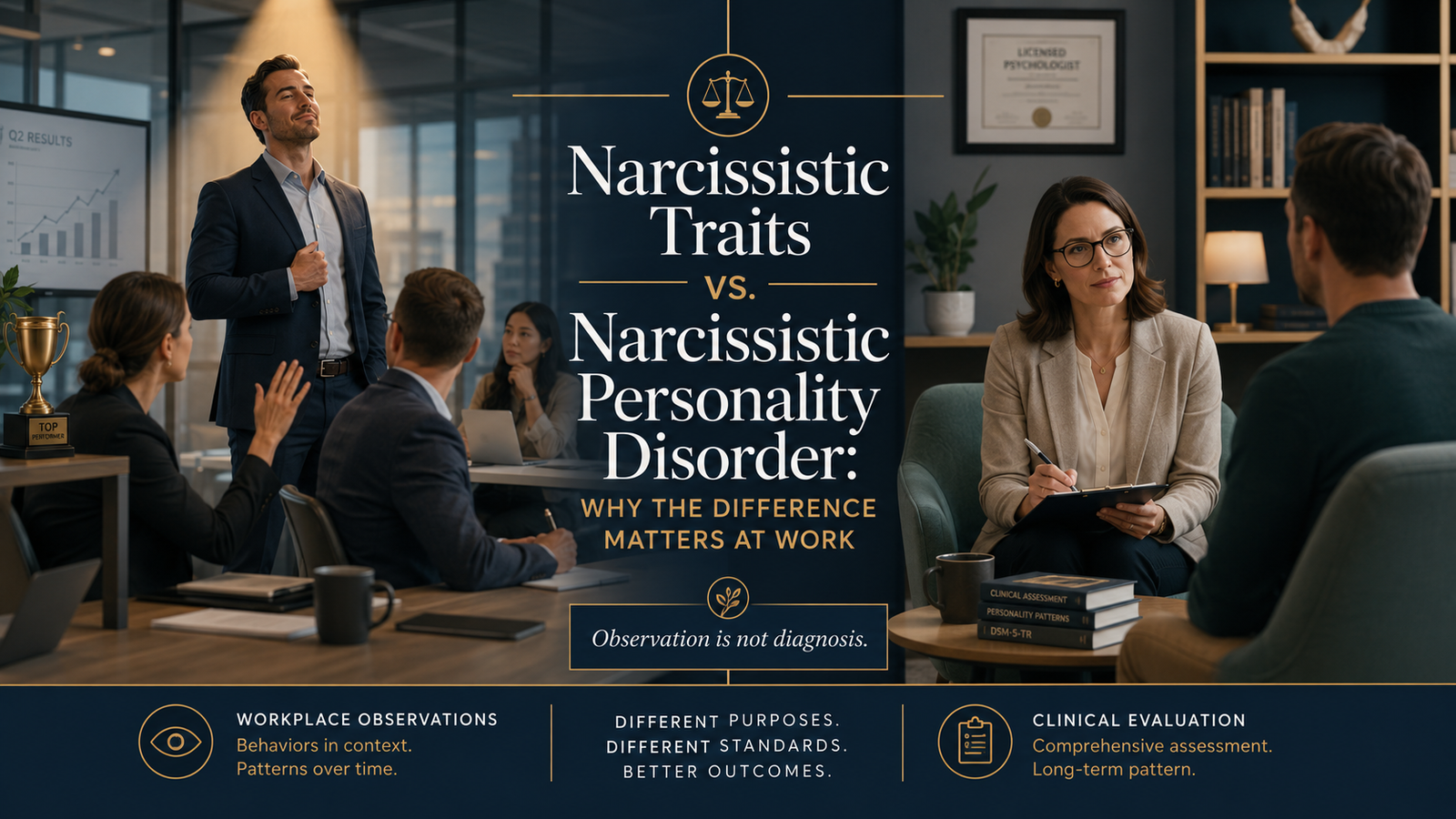
None of these observations, by themselves, establish Narcissistic Personality Disorder.
Narcissistic Personality Disorder—usually shortened to NPD—is a clinical mental-health diagnosis. It requires a broader professional assessment than coworkers, employees or online readers can perform.
This difference matters at work because inaccurate labels can distract from the conduct that actually needs attention.
You do not have to diagnose a manager before documenting changing instructions.
You do not have to diagnose a coworker before protecting the authorship of your work.
You do not have to prove NPD before deciding that repeated humiliation, manipulation, retaliation or boundary violations are unacceptable.
This article explains narcissistic traits vs NPD, why the terms should not be used interchangeably and how to discuss workplace behavior more accurately.
For a broader guide to harmful professional patterns and recovery, read our introduction to workplace narcissistic abuse.
What Is a Personality Trait?
A personality trait is a relatively consistent tendency in how someone thinks, feels or behaves.
People may be:
- confident
- cautious
- competitive
- sociable
- perfectionistic
- emotionally expressive
- reserved
- demanding
- generous
- controlling
A trait is not automatically an illness or disorder.
A person can also show different traits in different situations.
Someone may be highly competitive at work but relaxed with friends. Another person may seek recognition during an important project without needing admiration in every area of life.
The American Psychiatric Association’s explanation of personality traits and disorders emphasizes that personality exists in patterns. A disorder becomes a consideration when patterns are long-standing, rigid and inflexible and create significant distress or difficulty functioning.
One behavior does not tell you everything about a person’s personality.
A workplace gives you only a limited view.
What Are Narcissistic Traits?
Narcissistic traits are characteristics associated with an elevated focus on status, importance, admiration, entitlement or self-image.
Examples may include:
- wanting frequent praise
- exaggerating achievements
- seeking status
- expecting special treatment
- reacting defensively to criticism
- showing arrogance
- competing for attention
- struggling to recognize another person’s perspective
- becoming envious when others succeed
- placing personal image above collaboration
A person can display one or more of these tendencies without meeting the clinical criteria for NPD.
The intensity may also vary.
For example, one employee may occasionally overstate their contribution during a performance review. Another may repeatedly take credit, undermine colleagues and react aggressively whenever their professional image is questioned.
Both situations can involve narcissistic traits, but they do not provide enough information for a diagnosis.
Traits describe tendencies you may observe.
A disorder is a clinical conclusion based on a much wider assessment.
What Is Narcissistic Personality Disorder?
Narcissistic Personality Disorder is a recognized mental-health condition.
The American Psychiatric Association’s explanation of NPD describes it as a pervasive pattern involving grandiosity, need for admiration and lack of empathy.
“Pervasive” is important.
It means the pattern is not limited to one stressful meeting, one conflict or one professional relationship. Clinicians consider a person’s functioning and history across situations and over time.
Clinical descriptions of NPD may include patterns involving:
- exaggerated self-importance
- preoccupation with exceptional success or power
- beliefs about being unusually special
- strong need for admiration
- entitlement
- exploitation of others
- limited recognition of other people’s needs
- envy
- arrogant attitudes or conduct
Reading this list is not the same as conducting an assessment.
Many behaviors can have more than one possible explanation. Clinicians must consider severity, persistence, impairment, history, context and other possible conditions.
NPD is therefore not a conclusion that should be reached because a manager is arrogant, a colleague is competitive or a checklist feels familiar.
Narcissistic Traits vs NPD: The Central Difference
The shortest distinction is this:
Narcissistic traits are individual characteristics or behavioral tendencies.
NPD is a persistent and clinically significant personality pattern assessed by a qualified professional.
Several factors separate a trait from a disorder.
Persistence
A trait may appear occasionally or under particular circumstances.
A personality disorder involves a long-standing pattern.
A manager who becomes self-important after receiving a promotion may be responding to status or insecurity. That alone does not establish a lifelong or pervasive pattern.
Rigidity
People without a personality disorder may still act selfishly, arrogantly or defensively.
However, they may be able to reflect, adjust and behave differently when circumstances change.
A clinically significant personality pattern is generally more inflexible and difficult to adapt.
Breadth
Workplace observations cover only one part of someone’s life.
A clinician considers whether relevant patterns appear across relationships, situations and areas of functioning.
You may know how your boss acts during deadlines, but not how they function across their wider life.
Severity
Traits exist at different levels.
Wanting recognition is not equivalent to requiring constant admiration.
Defensiveness is not equivalent to a pervasive inability to tolerate criticism.
Confidence is not equivalent to grandiosity.
Distress or Impairment
Personality disorders involve meaningful distress or difficulty functioning.
The assessment is broader than whether other people find the person unpleasant.
Professional Evaluation
NPD is diagnosed through clinical assessment.
The Merck Manual’s professional overview of NPD explains that diagnosis is based on clinical criteria and a persistent pattern.
An employee, manager, coach, friend or social-media creator cannot establish that diagnosis from secondhand stories or workplace incidents.
Quick Comparison: Narcissistic Traits vs. NPD
Narcissistic traits may:
- occur occasionally
- become stronger under stress or competition
- appear mainly in certain environments
- exist without major impairment
- change in response to feedback or consequences
- be observed without establishing a disorder
- have several possible explanations
NPD involves:
- a persistent pattern
- significant rigidity
- a broader pattern across contexts
- clinically relevant impairment or distress
- professional psychological or psychiatric evaluation
- consideration of history, severity and alternative explanations
- established diagnostic criteria
This comparison is educational.
It is not a test that allows one person to diagnose another.
Why Workplace Observation Is Not Enough for Diagnosis
Workplaces reveal important behavior, but they provide incomplete information.
You may observe that someone:
- takes credit
- exaggerates achievements
- seeks admiration
- dismisses feedback
- expects exceptions
- humiliates employees
- reacts badly when challenged
- appears jealous of another person’s success
These behaviors may resemble traits associated with narcissism.
But the same behavior can emerge from different causes.
Credit-taking might reflect ambition, fear, poor workplace incentives or deliberate exploitation.
Defensiveness might reflect insecurity, stress, shame, lack of management skill or a broader personality pattern.
Limited empathy during a crisis might reflect exhaustion, pressure or a stable disregard for others.
This does not mean you must ignore what happened.
It means you should be precise about what you know.
You know what the person did.
You know how often it occurred.
You may know who witnessed it.
You know how it affected the work.
You usually do not know enough to establish a mental-health diagnosis.
Why the Difference Matters at Work
Using accurate language is not merely a matter of politeness.
It changes how effectively you can understand and respond to a workplace problem.
1. It Keeps Attention on Verifiable Conduct
Compare these statements:
“My manager is a narcissist.”
“My manager changed the deadline after the work was submitted and then said the original instruction had never been given.”
The first statement is a conclusion about personality and diagnosis.
The second describes conduct that can be reviewed.
Specific behavior is more useful for:
- documentation
- manager discussions
- HR reports
- mediation
- employment advice
- personal decision-making
2. It Prevents Overdiagnosis
Many people occasionally show entitlement, arrogance, defensiveness or self-focus.
If every instance is treated as proof of NPD, the term loses accuracy.
Overdiagnosis may also prevent you from considering other explanations or solutions.
A poorly trained manager may benefit from clearer systems.
A competitive coworker may respond to defined responsibilities.
A manipulative leader may continue harmful conduct regardless of whether any diagnosis applies.
The response should fit the behavior and risk—not an assumed condition.
3. It Reduces Mental-Health Stigma
A psychiatric diagnosis should not be used as an insult.
People with mental-health conditions are individuals. They do not all behave identically, and a diagnosis should not automatically be treated as proof of abusive behavior.
Likewise, many people who behave abusively or unethically may have no known personality disorder.
Equating NPD with every harmful boss creates two problems:
- it stigmatizes people with a diagnosis
- it incorrectly medicalizes behavior that should be addressed through accountability
4. It Makes Workplace Reports More Credible
Most managers and HR professionals cannot evaluate an employee’s informal psychiatric conclusion about another person.
They can evaluate:
- emails
- project records
- missed agreements
- exclusion from meetings
- discriminatory statements
- retaliation
- responsibility disputes
- policy violations
- witness accounts
A behavior-focused report is generally clearer than a diagnosis-focused accusation.
Instead of saying:
“My coworker has NPD and is gaslighting me.”
You might say:
“On April 4, we agreed in writing that I would prepare the analysis. During the April 8 meeting, my coworker presented the analysis as their own and said they had completed it. The project history records my authorship.”
5. It Protects Your Decision-Making
Trying to determine whether another person has NPD can become consuming.
You may spend hours analyzing every message, facial expression or conversation.
Meanwhile, the practical questions remain unanswered:
- What conduct is occurring?
- What evidence exists?
- What boundaries are possible?
- Is the organization responding?
- Is the situation affecting my health?
- What options do I have?
You do not need certainty about another person’s psychology before making decisions about your own wellbeing.
6. It Prevents the Diagnosis From Becoming an Excuse
A diagnosis may help explain aspects of a person’s functioning, but it does not remove workplace responsibility.
Employees and leaders are still accountable for:
- following policies
- communicating professionally
- respecting legal rights
- managing performance fairly
- avoiding harassment or retaliation
- protecting confidential information
- accurately representing other people’s work
At the same time, you do not need a diagnosis before holding someone accountable.
Behavior can violate policy or cause harm regardless of its psychological source.
Harmful Behavior Does Not Require NPD
One of the most important points in this article is that the absence of a diagnosis does not make harmful conduct acceptable.
A boss does not need NPD to:
- humiliate employees
- move the goalposts
- punish boundaries
- take credit
- redirect blame
- create favorites and targets
- misuse confidential information
- retaliate against disagreement
A coworker does not need NPD to:
- spread rumors
- undermine shared work
- exclude someone from information
- claim another person’s ideas
- manipulate relationships
- distort an agreement
Whether the person has narcissistic traits, NPD, another explanation or no diagnosis at all, you can still evaluate the professional impact.
The question is not only:
“What condition might explain this?”
More useful questions include:
“What happened?”
“Is it repeating?”
“Can it be resolved?”
“Is my work or wellbeing being affected?”
“What protection is appropriate?”
Does Having NPD Mean Someone Is Abusive?
No diagnosis automatically tells you everything about a person’s conduct.
NPD is not synonymous with abuse.
People with the same diagnosis can have different levels of self-awareness, functioning, treatment engagement and behavior.
Similarly, abusive behavior is not limited to people with NPD.
A person may manipulate, intimidate or exploit others without meeting the criteria for any personality disorder.
The responsible approach is to keep two questions separate:
- Does this person have a clinical diagnosis?
- Is this workplace behavior harmful or unacceptable?
The first requires qualified clinical assessment and is usually private.
The second can be evaluated through observable conduct, organizational policies, professional standards and impact.
Can Someone Have Narcissistic Traits Without NPD?
Yes.
The American Psychiatric Association specifically distinguishes narcissistic traits from Narcissistic Personality Disorder.
A person may:
- enjoy recognition
- become defensive about criticism
- exaggerate an achievement
- act entitled in certain circumstances
- seek status
- show limited empathy during conflict
without having NPD.
What matters clinically is not simply whether a familiar trait appears.
Professionals consider whether the broader pattern is persistent, inflexible, pervasive and associated with significant impairment or distress.
This is one reason online “diagnosis by checklist” is unreliable.
A checklist may help someone recognize topics to discuss with a qualified professional. It cannot replace a full evaluation.
What You Can Observe at Work
Although you cannot diagnose someone, you can observe workplace patterns.
You can assess whether a person repeatedly:
- takes credit and redirects blame
- changes expectations without acknowledging the change
- responds to disagreement with retaliation
- demands personal loyalty
- treats people differently according to status
- ignores reasonable boundaries
- controls information
- excludes particular employees
- uses humiliation as management
- misrepresents conversations
- becomes hostile when others receive recognition
- refuses accountability
- creates confusion that consistently benefits them
These observations may help you recognize a concerning pattern.
They should still be described as behavior rather than proof of NPD.
For examples involving leadership, review the signs of narcissistic leadership at work.
For peer relationships, see our guide to narcissistic coworker signs.
Better Language for Workplace Conversations
Responsible language does not require minimizing your experience.
It requires describing it more accurately.
Instead of “My boss is a narcissist”
Say:
“My boss repeatedly takes credit for team achievements and redirects responsibility when projects fail.”
Instead of “My coworker has NPD”
Say:
“My coworker has repeatedly changed their account of our agreements and presented my work as their own.”
Instead of “They are gaslighting everyone”
Say:
“They denied giving the instruction even after the written message was presented.”
Instead of “They have no empathy”
Say:
“They continued requiring non-urgent after-hours work after the team raised concerns about workload and approved boundaries.”
Instead of “They need to control everything”
Say:
“They require approval for routine decisions but later criticize employees for lacking initiative.”
Instead of “They are jealous of me”
Say:
“The treatment changed after senior leadership recognized my contribution, and I was subsequently removed from related meetings without an explanation.”
This language is not weaker.
It is more specific.
Narcissistic Boss, Difficult Boss or Something Else?
A difficult boss and a boss displaying narcissistic traits can sometimes behave similarly.
Both may:
- communicate poorly
- become defensive
- dislike criticism
- create excessive pressure
- make inconsistent decisions
- struggle with empathy
The distinction becomes clearer through patterns and accountability.
Can the boss acknowledge a mistake?
Do expectations become clearer after discussion?
Does the same conduct continue despite evidence and consequences?
Are boundaries respected?
Is employee success supported or treated as a threat?
You may never know the manager’s diagnosis.
You can still determine whether the relationship is becoming safer, clearer and more workable.
Our detailed comparison of a narcissistic boss versus a difficult boss explores these differences without attempting a clinical diagnosis.
How to Respond Without Diagnosing Anyone
A behavior-focused approach gives you practical options.
Document Specific Events
Record:
- date and time
- people present
- instructions given
- action taken
- what changed later
- relevant messages
- impact on the work
Avoid using diagnostic labels in formal records.
Write what someone said or did.
Confirm Important Instructions
After a conversation, send a neutral summary:
“Confirming my understanding from today’s meeting: I will prepare the revised report by Thursday and send it to you for approval before client delivery.”
This supports clarity whether the original problem involved manipulation, poor memory or disorganization.
Refer to Policies and Responsibilities
Workplace standards are more actionable than personality debates.
Focus on:
- role boundaries
- deadlines
- authorship
- communication procedures
- respectful-conduct policies
- grievance procedures
- anti-retaliation rules
- performance expectations
Ask for a Practical Resolution
When raising a concern, identify what needs to change.
For example:
“I would like project responsibilities to be confirmed in the shared system.”
“I am requesting that the authorship of the analysis be corrected.”
“I would like future performance feedback provided in writing.”
“I am asking to be included in meetings directly related to my assigned responsibilities.”
Seek Appropriate Support
Depending on the seriousness of the situation, support may come from:
- a trusted manager
- HR
- a union representative
- an employee-assistance service
- a therapist
- a career adviser
- a qualified employment professional
- an appropriate legal adviser
The goal is not to find someone who will confirm your diagnosis of the other person.
The goal is to understand your situation, rights, risks and options.
Why This Distinction Matters to Reclaim Your Power
Reclaim Your Power discusses workplace patterns commonly associated with narcissistic or manipulative dynamics.
It is not a diagnostic manual.
The book does not claim that:
- every difficult boss has NPD
- every selfish coworker is a narcissist
- a reader can diagnose someone through a checklist
- all people with NPD behave identically
- a diagnosis is necessary before workplace harm can be recognized
Instead, the book focuses on what a reader can reasonably evaluate:
- observable behavior
- repeated patterns
- emotional and professional impact
- boundaries
- documentation
- decision-making
- self-trust
- recovery
This distinction supports the complete seven-chapter path.
Recognition is not about becoming certain of someone else’s diagnosis.
It is about becoming clearer about your own experience.
Professional protection is not about proving a personality disorder.
It is about reducing preventable risk.
Recovery is not about understanding every motive of the person who harmed you.
It is about rebuilding the parts of your life that the experience affected.
Explore the complete seven-chapter recovery path when you are ready to move from confusing labels toward clarity, protection and recovery.
Frequently Asked Questions
What is the difference between narcissistic traits and NPD?
Narcissistic traits are individual tendencies such as entitlement, admiration-seeking, arrogance or sensitivity to criticism.
Narcissistic Personality Disorder is a clinical diagnosis involving a persistent, pervasive and impairing pattern that must be evaluated by a qualified mental-health professional.
Can everyone show narcissistic traits sometimes?
Many people may occasionally behave self-importantly, defensively, competitively or without enough empathy.
An occasional trait or reaction does not establish NPD. Clinicians assess the broader pattern, duration, severity, rigidity and effect on functioning.
Can I tell whether my boss has NPD?
You may recognize behavior that resembles narcissistic traits, but workplace observation is not sufficient for a clinical diagnosis.
You can evaluate what your boss repeatedly does, document its effect and decide what professional response is appropriate.
Can an online checklist diagnose NPD?
No.
A checklist can provide general education or identify topics someone may wish to discuss with a mental-health professional. It cannot assess the full history, context, severity, differential diagnosis and functioning required for a clinical conclusion.
Does narcissistic behavior always mean NPD?
No.
Similar behavior can arise from personality traits, insecurity, workplace pressure, learned habits, poor leadership, other mental-health concerns or deliberate misconduct without a diagnosable disorder.
Does someone need NPD to commit workplace abuse?
No.
People can bully, manipulate, humiliate, exploit or retaliate without having NPD.
The conduct should be evaluated through evidence, professional standards, workplace policy and applicable law rather than an assumed diagnosis.
Is every person with NPD abusive?
No.
A diagnosis does not mean every person behaves identically, and it should not automatically be treated as proof of abuse.
Evaluate actual behavior rather than using a diagnosis as a stereotype.
Who can diagnose Narcissistic Personality Disorder?
NPD is diagnosed by qualified mental-health professionals through clinical evaluation.
The evaluator considers patterns over time, severity, functioning, history and whether another explanation better accounts for the symptoms.
How should I describe narcissistic behavior to HR?
Describe specific, work-related conduct.
Include dates, relevant statements, records, witnesses, the effect on the work and the solution you are requesting.
Avoid presenting an informal psychiatric diagnosis as the main complaint.
What should I do if I do not know whether the person has NPD?
You do not need to determine it.
Focus on whether the behavior is repeated, harmful, documented and responsive to accountability.
Make decisions based on the workplace reality you can observe.
Final Thoughts
The difference between narcissistic traits and Narcissistic Personality Disorder matters.
Traits are tendencies.
NPD is a clinical diagnosis.
A difficult interaction is not a diagnosis.
A workplace checklist is not a psychological evaluation.
An employee’s interpretation is not a substitute for professional assessment.
At the same time, responsible language should never become a reason to dismiss harm.
You do not need proof of NPD before documenting manipulation.
You do not need a diagnosis before setting a boundary.
You do not need to know someone’s psychological history before deciding that repeated humiliation or retaliation is unacceptable.
You can hold two truths at the same time:
It is inappropriate to diagnose another person without the qualifications and information required.
It is appropriate to recognize and respond to harmful workplace behavior.
That is the approach taken throughout Reclaim Your Power.
The goal is not to teach you to label people.
It is to help you recognize patterns, protect your professional position, rebuild self-trust and make clearer decisions about your future.
Continue with our guide to workplace narcissistic abuse, compare a narcissistic boss with a difficult boss, or explore the complete seven-chapter recovery path.
Educational disclaimer: This article and Reclaim Your Power provide general educational information about workplace behavior and recovery. They do not diagnose any person, provide mental-health treatment or replace medical, psychological, legal or employment advice. A qualified mental-health professional should assess questions about diagnosis.
Ready to Reclaim Your Power?
Get the complete 7-chapter guide, workbook exercises, and 30-day recovery journal.
Buy Now — $4.99
Leave a Reply